Help us get this right
Does this portrait look right for Manggarai?
Nobody has judged this one yet. You would be the first.
Manggarai Erotic
Manggarai (Indonesia)
Christianity
About Manggarai People
The Manggarai live in the western third of Flores, a long volcanic island in eastern Indonesia where the highlands rise sharply from the Savu and Flores Seas. Their country is cool, rainy, and corrugated — terraced rice valleys, coffee gardens, stands of bamboo, and the conical thatched houses that still mark older villages. Counted at well over half a million, they are the dominant people of the regencies that bear their name, with Ruteng as the upland capital and a string of smaller towns running down toward the coast.
Their language, Manggarai, belongs to the Austronesian family and sits inside the Sumba–Flores subgroup, surrounded by close relatives like Rembong, Ngadha, and Manggarai-Rai dialect chains that shade into one another from valley to valley. Linguists generally treat what locals call one tongue as a cluster of regional varieties, with the western, central, and eastern dialects differing enough that speakers from opposite ends of the homeland sometimes meet halfway in Indonesian. The neighbouring Bimanese on Sumbawa, by contrast, speak something noticeably different, and the boundary at the Sape Strait is a real linguistic seam.
Manggarai religious life is overwhelmingly Catholic, a legacy of Portuguese contact in the sixteenth century and, more decisively, the long Dutch missionary presence on Flores. Mass attendance is high, parish life is dense, and church calendars structure much of the year. But Catholicism here has not displaced the older religion so much as braided into it. Ancestors still receive offerings, ritual specialists still read entrails, and clan houses — the mbaru gendang — keep their drums and their authority over land. Compang stone platforms in village centres remain the proper place for communal prayer when something serious is at stake: a harvest, an illness, a dispute over a boundary.
The custom outsiders most often hear about is caci, a one-on-one whip duel performed at weddings, harvest feasts, and welcomes for important guests. Two men take turns striking and parrying with a rawhide whip and a buffalo-hide shield, dressed in headcloths and bells, while spectators sing and drum. Cuts to the face are common and worn without complaint; the point is not to injure but to display composure. Equally distinctive are the lingko, the spiderweb-shaped rice fields radiating from a central stake, where land is allotted to families in pie-slice wedges by clan elders. Both customs are practical institutions as much as cultural set pieces — ways of settling who owns what, who owes whom, and who has stood up well in front of the village.
Related ethnic groups
Groups that share Manggarai's homeland, region, language, or religious tradition. These are likely candidates for comparative phenotype reference.
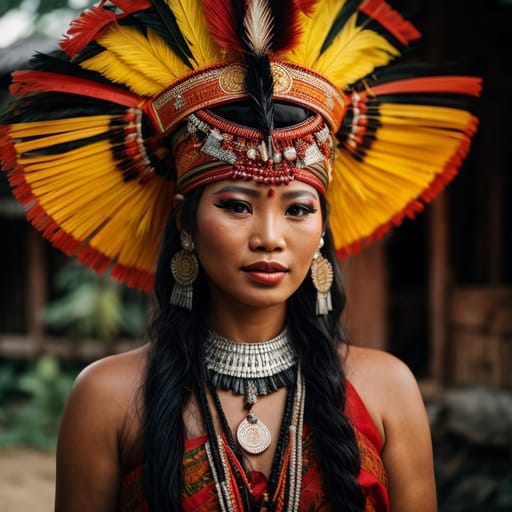
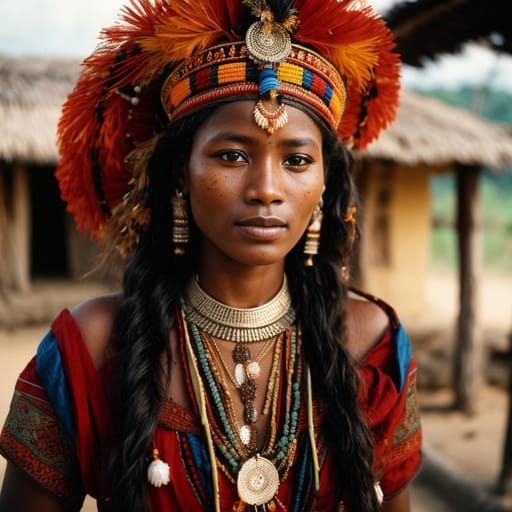
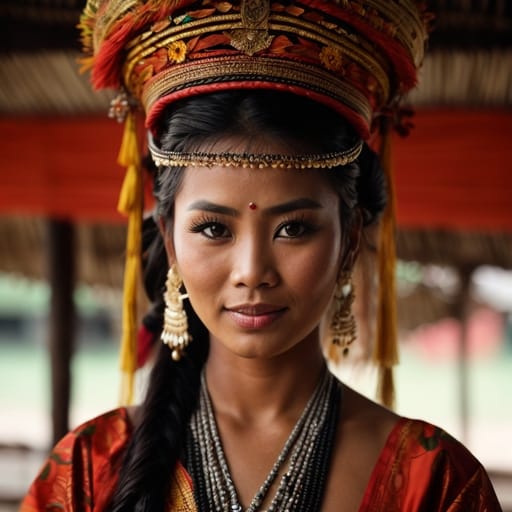
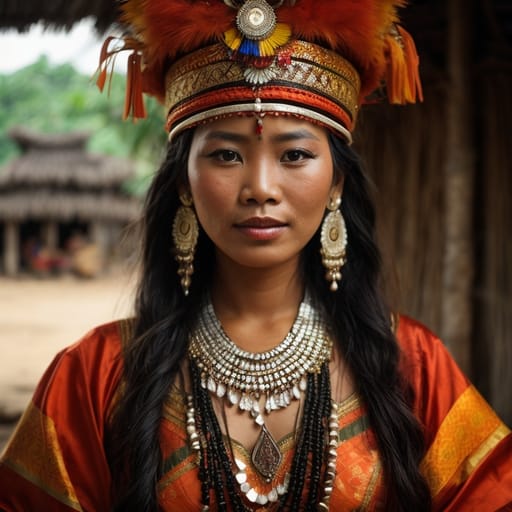
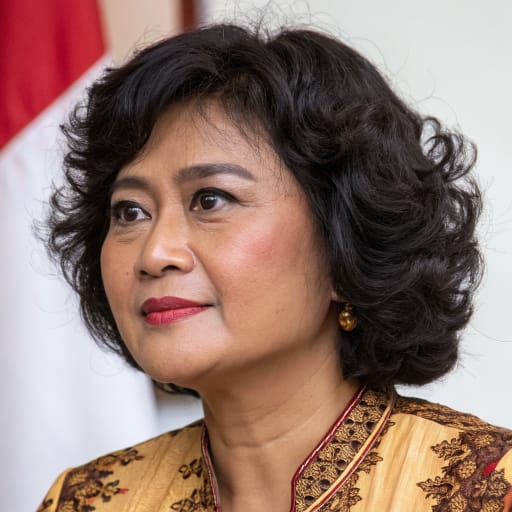
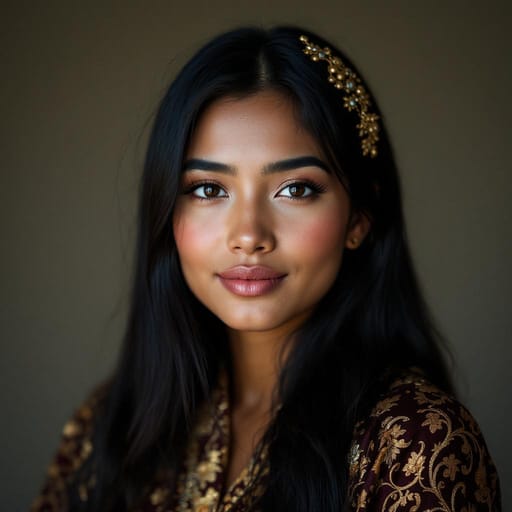
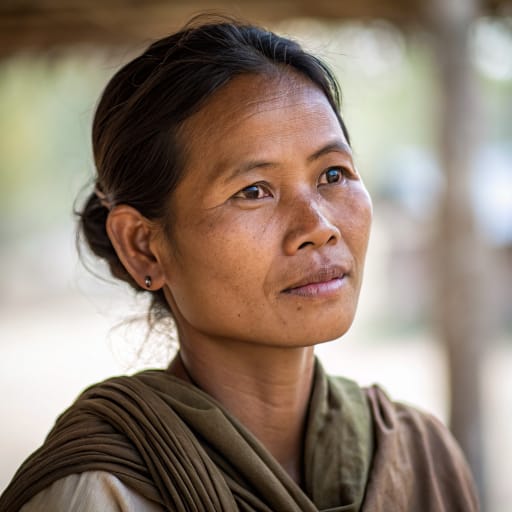
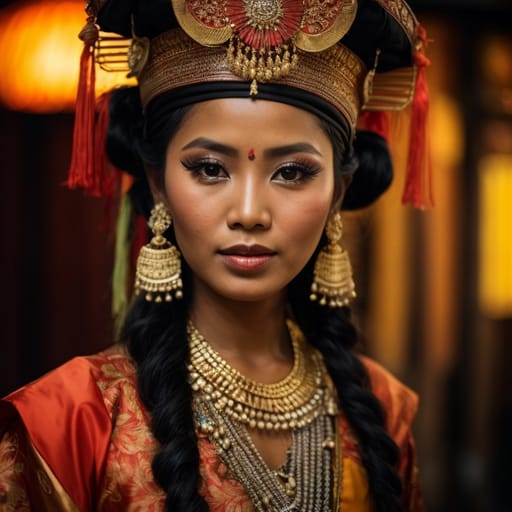
Typical Manggarai Phenotypes
Reference for AI generation: hair, eyes, skin, facial structure, build
The Manggarai of western Flores sit at one of Indonesia's clearest phenotype transitions — Austronesian features carried east from Sundaland meeting older Melanesian-influenced substrates that strengthen as you move toward Lembata and Timor. The result is a population that reads as visibly distinct from Javanese or Balinese: darker on average, with stronger brow and jaw architecture and a higher incidence of wavy-to-curly hair than further west.
Hair is almost universally black or very dark brown, but texture varies more than in most Indonesian groups — straight in maybe a third of the population, loose-wave to ringlet-curl across most of the rest, and tight 3C–4A coils at meaningful frequency, particularly in inland and southern villages where the Melanesian contribution is strongest. Greying tends to come late.
Eyes are dark brown to near-black. The epicanthic fold is present but lighter and less complete than in mainland Southeast Asian populations — many Manggarai faces have a partial fold or none at all, with a rounder, more open eye shape than a Javanese or Sundanese baseline. Lashes are typically thick.
Skin spans Fitzpatrick IV through deep VI, centered on a warm coppery to chocolate brown with red-bronze undertones rather than the olive-yellow common further west. Sun-darkening on agricultural laborers in the karst highlands is pronounced, so working populations often appear notably darker than children and indoor workers from the same family line.
Facial structure tends toward broader nasal bridges with wider alar bases, fuller lips than the Indonesian average — both upper and lower — and squared jaws with prominent chins. Cheekbones are present but less laterally projected than in Filipino or southern Chinese phenotypes.
Build is short and compact: men commonly 158–165 cm, women 148–155 cm, with the documented short-stature outlier being the Rampasasa orang pendek village near Liang Bua, whose adults frequently fall below 145 cm. Bodies are wiry and muscular rather than slight, shoulders proportionally broad, with low body fat sustained by mountain agricultural work.
Manggarai Body & Anatomy Reference
Anatomy by feature, Southeast Asian Austronesian / Austroasiatic phenotype
Manggarai Boobs & Breasts
Bust reference for Manggarai women: small-to-medium cup, modest projection, which is typical of Southeast Asian Austronesian / Austroasiatic ancestry. Areolas measure about 26-38mm across, with medium-brown to dark-brown pigmentation. Body type (ectomorph, petite frame) shapes the bust as well, so Manggarai tits are usually firm, modest projection. In AI imagery, keep the forward-set shape rather than drifting toward the fuller South Asian or Polynesian bust.
Manggarai Ass & Hips
The Manggarai ass is typically small-to-medium, modest projection, narrower hip profile, which sets it apart from the fuller glutes of the Pacific Islander phenotype. Underneath, the pelvis shows narrow-to-medium iliac crests, part of the Southeast Asian Austronesian / Austroasiatic skeletal pattern. For Manggarai butt pics and AI renders, match that silhouette and the overall build (ectomorph, petite frame).
Manggarai Vagina & Pussy
Manggarai pussy and vulvar anatomy presents medium-brown to dark-brown labial pigmentation, consistent with the Southeast Asian Austronesian / Austroasiatic phenotype's pigmentation pattern. Manggarai pubic hair is typically straight-to-wavy fine-to-medium texture, in the inverted-triangle pattern. For anatomically accurate Manggarai pussy renders the labial coloration should match the surrounding tan to medium-brown skin tone with a continuous gradient, and the hair should keep its straight-to-wavy fine-to-medium texture.
Manggarai Dicks & Penis
Manggarai dicks follow the Southeast Asian Austronesian / Austroasiatic reference data: regional mean ~11cm erect; moderate girth; medium-brown shaft pigmentation. Shaft color should track the tan to medium-brown skin tone with a smooth change toward the glans, and Manggarai pubic hair keeps its straight-to-wavy fine-to-medium texture.
Manggarai Body, Curves & Build
Manggarai body type and overall build presents as ectomorph, petite frame, with mean adult female BMI 20-23: the characteristic Southeast Asian Austronesian / Austroasiatic habitus. Manggarai curves and proportions should keep the regional skeletal frame (height, shoulder-to-hip ratio, limb proportions) rather than a generic mesomorph default.
Manggarai Skin Tone & Hair Texture
Manggarai skin sits in the tan to medium-brown (Fitzpatrick III-V) band. Hair is typically straight-to-wavy 1A-2A, dark-brown to black, in keeping with the Southeast Asian Austronesian / Austroasiatic phenotype. In nude renders the skin should stay one even tone from face to body, and body, pubic and head hair should match.
Data depth
0/100Coverage of image-grounded phenotype observations · drives AI generation diversity
- Sample size
- 0/40· 0 images
- Image quality
- 0/30· 0% high
- Confidence
- 0/20
- Source diversity
- 0/10
- ·No image observations yet
Explore phenotype categories
Structured taxonomy with peer-reviewed scales · 22 anatomical categories
Erotic Poses & Sex Positions
From the pose catalog: 219 named positions with reference skeletons
Frequently asked questions about Manggarai people
Where is the Manggarai homeland?
The Manggarai homeland is Manggarai (Indonesia) in Southeast Asia.
What language do Manggarai people speak?
Manggarai people primarily speak Austronesian / Sumba-Flores / Manggarai.
What religion do Manggarai people practice?
The predominant religion among Manggarai people is Christianity.






Make your own Manggarai images
Five a day, free, no credits to buy. The studio starts from this group's phenotype data, so you can set body type, pose and style and keep the traits accurate.
Start with Manggarai