Help us get this right
Does this portrait look right for Abui?
Nobody has judged this one yet. You would be the first.
Abui Erotic
Central highlands of Alor Island, Alor Regency, East Nusa Tenggara, Indonesia, inland from the town of Kalabahi.
Abui (Papuan, Timor-Alor-Pantar family, Alor-Pantar branch); Alor Malay and Indonesian widely spoken as second languages.
Predominantly Protestant Christian (Evangelical Christian Church in Timor), with a Muslim minority and continuing ancestral ritual practice.
One of the Papuan-speaking peoples of the Alor-Pantar archipelago; divided into patrilineal clans and several regional dialect groups.
About Abui People
The Abui are the mountain people of Alor, and they say so themselves: the name comes from their own word for mountain, and they call their language the mountain tongue. Alor is a rugged island at the eastern end of Indonesia's Lesser Sunda chain, closer to Timor than to Bali, and the Abui hold its central highlands, the ridges and dry valleys inland from the regency capital of Kalabahi. They are the largest of the island's many ethnic groups, with a population usually put in the tens of thousands, and their villages traditionally sat on high ground, which made sense in an era when neighboring clans raided one another and took heads.
What sets them apart from most of Indonesia is speech. Abui is a Papuan language, part of the small Timor-Alor-Pantar family, with no relation to the Austronesian languages spoken along the Alor coast and across the rest of the archipelago. Nobody is certain how these languages ended up a thousand kilometers west of New Guinea. Most Abui today also speak Alor Malay, and in some villages children are growing up with Malay first, so the language is well documented but not entirely secure.
Missionaries arrived under Dutch rule in the early twentieth century, and the great majority of Abui are now Protestant, most of them in the Evangelical Christian Church in Timor, the main Protestant body of the region. Older practice runs alongside it. The center of a traditional village is the mesbah, a raised stone platform that serves as an altar and a dance floor. On it the community performs the lego-lego, a circle dance in which dozens of people link arms and move in a slow ring, often through the night, to the sound of chanting and gongs. The other great object of Abui life is the moko, a bronze hourglass drum descended from ancient Dong Son designs. Mokos were cast elsewhere and traded in over centuries. On Alor they became heirloom wealth, graded and named, and they remain the core of bride price alongside pigs and cloth.
Descent runs through the father, and clans hold land and ritual roles. The Abui also carry an unusual place in the history of anthropology: the American ethnographer Cora Du Bois lived in the village of Atimelang in 1938 and 1939, and her book The People of Alor became a foundational study of the culture and personality school. Today the village of Takpala, with its tall pyramid-roofed houses, is where visitors meet Abui culture, but most Abui live by farming maize, cassava and candlenut on steep swidden plots much as their grandparents did.
Related ethnic groups
Groups that share Abui's homeland, region, language, or religious tradition. These are likely candidates for comparative phenotype reference.
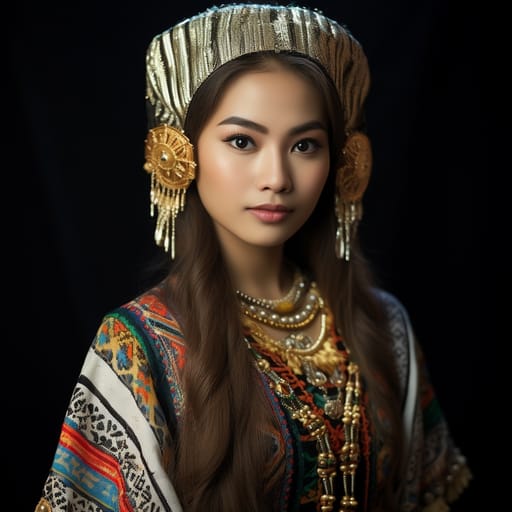
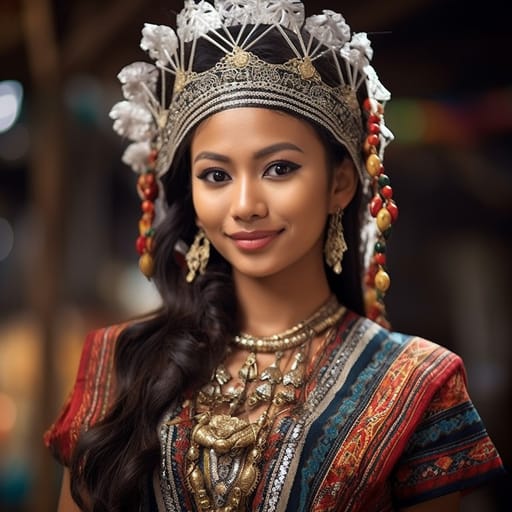
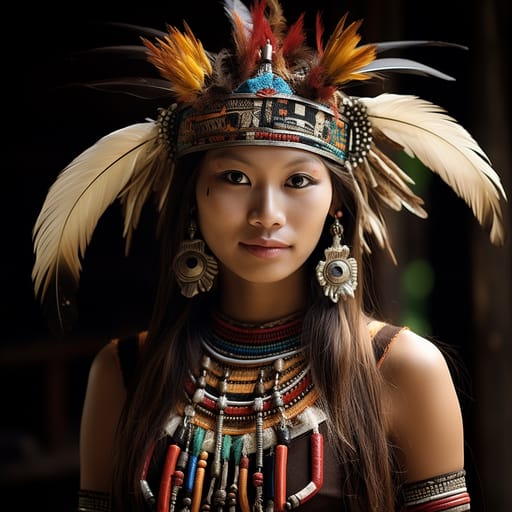
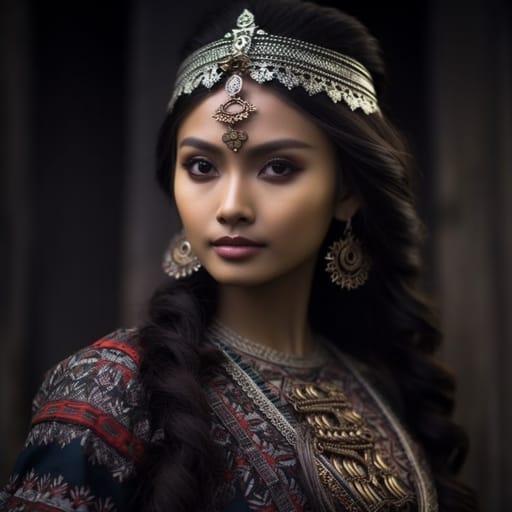
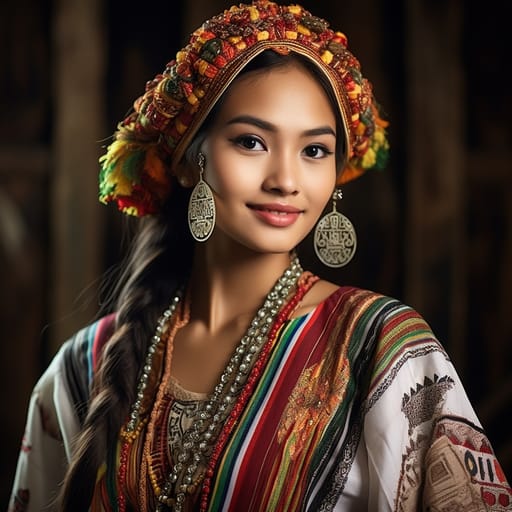
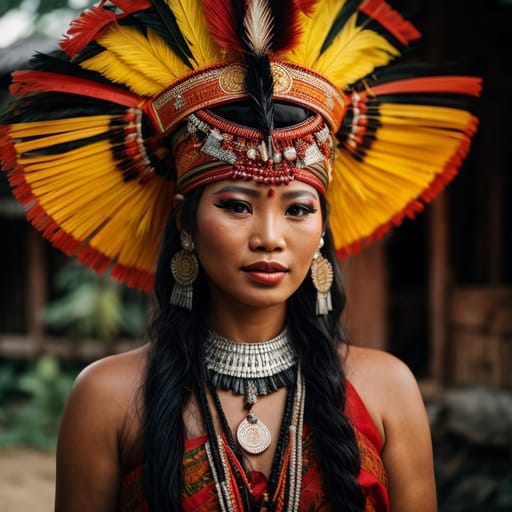
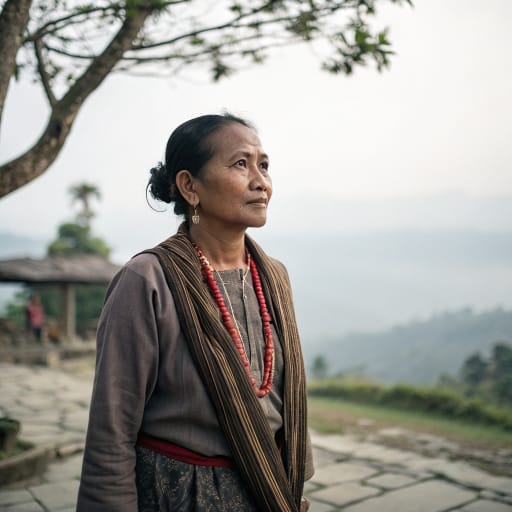
Typical Abui Phenotypes
Reference for AI generation: hair, eyes, skin, facial structure, build
Abui Body & Anatomy Reference
Anatomy by feature, Southeast Asian Austronesian / Austroasiatic phenotype
Abui Boobs & Breasts
Bust reference for Abui women: small-to-medium cup, modest projection, which is typical of Southeast Asian Austronesian / Austroasiatic ancestry. Areolas measure about 26-38mm across, with medium-brown to dark-brown pigmentation. Body type (ectomorph, petite frame) shapes the bust as well, so Abui tits are usually firm, modest projection. In AI imagery, keep the forward-set shape rather than drifting toward the fuller South Asian or Polynesian bust.
Abui Ass & Hips
The Abui ass is typically small-to-medium, modest projection, narrower hip profile, which sets it apart from the fuller glutes of the Pacific Islander phenotype. Underneath, the pelvis shows narrow-to-medium iliac crests, part of the Southeast Asian Austronesian / Austroasiatic skeletal pattern. For Abui butt pics and AI renders, match that silhouette and the overall build (ectomorph, petite frame).
Abui Vagina & Pussy
Abui pussy and vulvar anatomy presents medium-brown to dark-brown labial pigmentation, consistent with the Southeast Asian Austronesian / Austroasiatic phenotype's pigmentation pattern. Abui pubic hair is typically straight-to-wavy fine-to-medium texture, in the inverted-triangle pattern. For anatomically accurate Abui pussy renders the labial coloration should match the surrounding tan to medium-brown skin tone with a continuous gradient, and the hair should keep its straight-to-wavy fine-to-medium texture.
Abui Dicks & Penis
Abui dicks follow the Southeast Asian Austronesian / Austroasiatic reference data: regional mean ~11cm erect; moderate girth; medium-brown shaft pigmentation. Shaft color should track the tan to medium-brown skin tone with a smooth change toward the glans, and Abui pubic hair keeps its straight-to-wavy fine-to-medium texture.
Abui Body, Curves & Build
Abui body type and overall build presents as ectomorph, petite frame, with mean adult female BMI 20-23: the characteristic Southeast Asian Austronesian / Austroasiatic habitus. Abui curves and proportions should keep the regional skeletal frame (height, shoulder-to-hip ratio, limb proportions) rather than a generic mesomorph default.
Abui Skin Tone & Hair Texture
Abui skin sits in the tan to medium-brown (Fitzpatrick III-V) band. Hair is typically straight-to-wavy 1A-2A, dark-brown to black, in keeping with the Southeast Asian Austronesian / Austroasiatic phenotype. In nude renders the skin should stay one even tone from face to body, and body, pubic and head hair should match.
Explore phenotype categories
Structured taxonomy with peer-reviewed scales · 22 anatomical categories
Erotic Poses & Sex Positions
From the pose catalog: 219 named positions with reference skeletons
Frequently asked questions about Abui people
Where is the Abui homeland?
The Abui homeland is Central highlands of Alor Island, Alor Regency, East Nusa Tenggara, Indonesia, inland from the town of Kalabahi. in Southeast Asia.
What language do Abui people speak?
Abui people primarily speak Abui (Papuan, Timor-Alor-Pantar family, Alor-Pantar branch); Alor Malay and Indonesian widely spoken as second languages..
What religion do Abui people practice?
The predominant religion among Abui people is Predominantly Protestant Christian (Evangelical Christian Church in Timor), with a Muslim minority and continuing ancestral ritual practice..






Make your own Abui images
Five a day, free, no credits to buy. The studio starts from this group's phenotype data, so you can set body type, pose and style and keep the traits accurate.
Start with Abui