Help us get this right
Does this portrait look right for Iranun?
One tap. It takes a second and it is recorded.
5 say it looks right, 0 say it looks off.
Iranun Erotic
Mindanao (Philippines)
Islam / Sunni Islam
About Iranun People
The Iranun are a Moro people of coastal Mindanao and the Sulu archipelago, concentrated around Illana Bay — the body of water that takes its name from them. Older sources sometimes fold them into the Maranao or Maguindanao, and the three groups share a deep linguistic and political history, but the Iranun hold themselves apart. Their language, also called Iranun, is closely related to Maranao and Maguindanao within the Danao branch of the Philippine languages, close enough that speakers can often follow one another with effort but distinct enough that Iranun speakers correct anyone who calls it a dialect of either neighbor.
Sunni Islam, of the Shafi'i school, arrived in the region in the 14th and 15th centuries through trade and missionary contact with Muslim Southeast Asia, and it shapes the rhythm of Iranun life in the way Islam tends to in long-Islamized communities — woven into naming, marriage, inheritance, and the lunar calendar rather than worn as an overlay. The Iranun were central to the Maguindanao Sultanate's maritime power from the 17th through 19th centuries, and their reputation as seafarers had a sharper edge: Iranun fleets ranged across the Sulu Sea, the Strait of Malacca, and as far as the Indonesian archipelago, and the English word "Lanun" — Malay for pirate — is a direct borrowing of the ethnonym. That history is uncomfortable in some retellings and a point of pride in others; what it indicates is a people whose orientation was outward and nautical, not inland and agricultural, in a way that distinguished them from many of their highland neighbors.
Today the Iranun are spread across Maguindanao and Lanao del Norte provinces in the Philippines, with a substantial diaspora population in Sabah, Malaysia, where they are recognized as a Bumiputera group and where the language has held on across generations. They retain a strong tradition of kulintang ensemble music — gong-and-drum compositions shared in family form with the Maguindanao and Maranao but with their own repertoire — and a distinct embroidery and weaving tradition tied to women's ceremonial dress. Population estimates are imprecise, hovering somewhere between 250,000 and 350,000 across both countries, partly because Philippine and Malaysian census categories have historically lumped them with larger Moro groups. The Iranun themselves have been pushing, in recent decades, for separate recognition.
Related ethnic groups
Groups that share Iranun's homeland, region, language, or religious tradition. These are likely candidates for comparative phenotype reference.
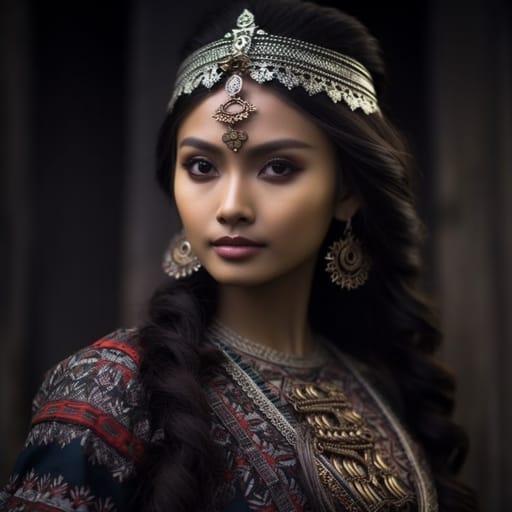
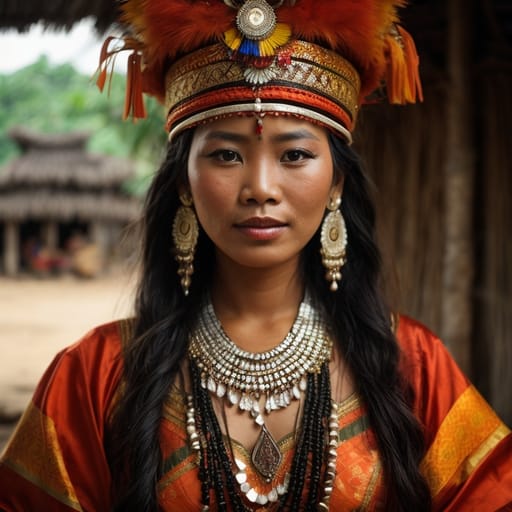
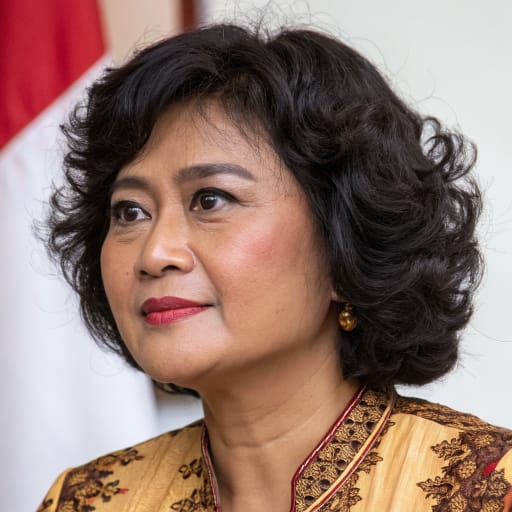
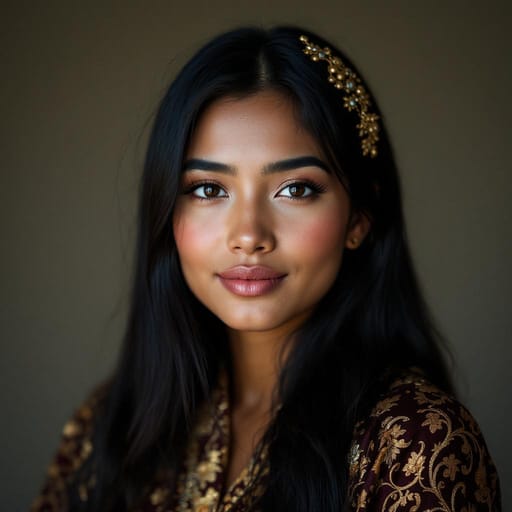
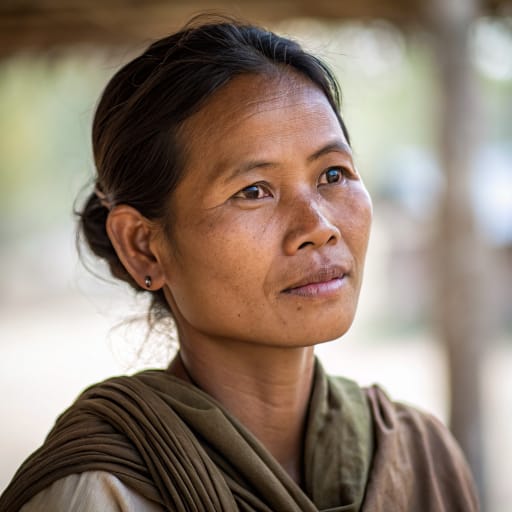
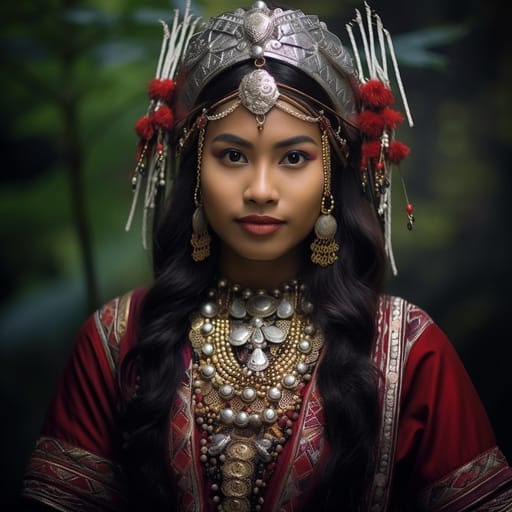
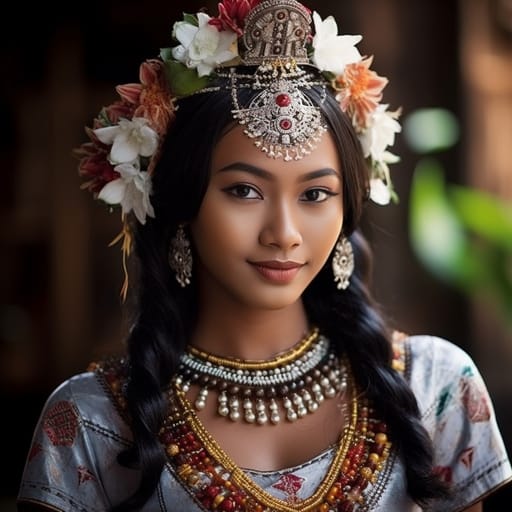
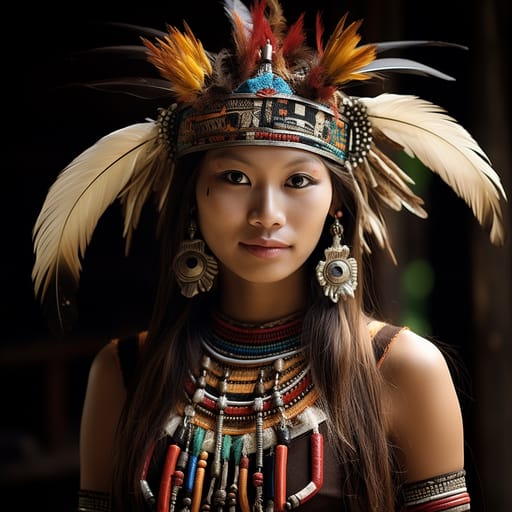
Typical Iranun Phenotypes
Reference for AI generation: hair, eyes, skin, facial structure, build
The Iranun are a Moro people of coastal Mindanao and Sabah, and their phenotype reads as classically Southern Philippine Austronesian with a maritime Southeast Asian baseline — closer in build and feature to coastal Malay, Maguindanao, and Sama-Bajau populations than to the lighter-skinned Tagalog or Visayan stereotype that dominates Filipino media.
Hair is uniformly dark — black to very dark brown, often with a soft cool undertone rather than the warm reddish cast seen in some island populations. Texture runs straight to gently wavy; tighter waves and looser curls appear in a minority, particularly along the Sulu-facing coasts where Sama and Bajau admixture is older. Premature greying is uncommon; balding patterns in men tend toward thinning at the crown rather than a receding hairline.
Eyes are dark brown, occasionally near-black. The epicanthic fold is present but typically partial rather than full — a soft inner-corner cover rather than the sharply hooded lid common further north in East Asia. Palpebral fissures are moderate, often slightly almond-shaped, with thick lashes and well-defined brows.
Skin sits in the Fitzpatrick IV–V range, with golden-bronze to deeper warm-brown undertones; coastal fishing communities and inland farming families lean noticeably darker than the urban Cotabato and Sabah-resident segment. Sunburn is rare; tanning is even and warm rather than ruddy.
Facial structure is broader and flatter than mainland Southeast Asian norms: a low-to-medium nasal bridge with a moderately wide alar base, full but well-defined lips, and rounded malar prominence. Jaws are squarer in men and softer-angled in women, with a fairly short chin. The face overall reads compact and horizontally proportioned rather than long.
Build is short to medium — men typically 160–168 cm, women 150–158 cm — with broad shoulders relative to height in seafaring lineages and a tendency toward lean-muscular rather than slight or tall-slender. Limb proportions are even; torsos run slightly longer than legs, consistent with the wider Austronesian pattern.
Iranun Body & Anatomy Reference
Anatomy by feature, Southeast Asian Austronesian / Austroasiatic phenotype
Iranun Boobs & Breasts
The typical Iranun bust is small-to-medium cup, modest projection, in line with the wider Southeast Asian Austronesian / Austroasiatic pattern. Areolas usually fall in the 26-38mm range, with medium-brown to dark-brown areolar pigmentation against the tan-to-medium-brown skin tone. Compared with the fuller South Asian or Polynesian bust, Iranun breasts sit forward and are generally firm, modest projection. A faithful AI render of Iranun tits keeps that shape and areola size.
Iranun Ass & Hips
Butt shape among Iranun women: small-to-medium, modest projection, narrower hip profile, over narrow-to-medium iliac crests. This follows Southeast Asian Austronesian / Austroasiatic ancestry and looks quite unlike the fuller glutes of the Pacific Islander phenotype. An accurate Iranun ass in adult AI imagery keeps both the silhouette and the overall build (ectomorph, petite frame) instead of a generic average.
Iranun Vagina & Pussy
Vulvar anatomy among Iranun women: medium-brown to dark-brown labial pigmentation. Pubic hair tends to be straight-to-wavy fine-to-medium texture, in the usual inverted-triangle pattern. Both follow Southeast Asian Austronesian / Austroasiatic pigmentation, which is why Iranun pussy renders should not fall back on a pale, sparse Western template.
Iranun Dicks & Penis
The Iranun cock profile, from Southeast Asian Austronesian / Austroasiatic anthropometric data: regional mean ~11cm erect; moderate girth; medium-brown shaft pigmentation. Pubic hair has a straight-to-wavy fine-to-medium texture and forms the usual inverted-V pattern. Whether Iranun men are circumcised follows religious and cultural practice rather than phenotype.
Iranun Body, Curves & Build
Build and curves among Iranun women follow the Southeast Asian Austronesian / Austroasiatic pattern: ectomorph, petite frame, mean adult female BMI 20-23. Proportions matter as much as skin tone, so Iranun figures should keep their regional height and limb ratios.
Iranun Skin Tone & Hair Texture
The Iranun skin range is tan to medium-brown (Fitzpatrick III-V), and hair tends to be straight-to-wavy 1A-2A, dark-brown to black. That combination marks the Southeast Asian Austronesian / Austroasiatic phenotype, and skin tone is the trait AI generators most often get wrong for Iranun women.
Data depth
83/100Coverage of image-grounded phenotype observations · drives AI generation diversity
- Sample size
- 39/40· 48 images
- Image quality
- 29/30· 58% high
- Confidence
- 15/20· mean 0.79
- Source diversity
- 0/10· wikipedia
- ·Wikipedia-only source, not population-representative
Observed Distribution: Image Sample
Empirical observations from analyzed photographs · supplementary signal, not population truth
Sample: 48 images analyzed (48 wikipedia). Quality: 28 high, 14 medium, 6 low, 0 very_low. Avg analyzer confidence: 0.79.
Skin tone (Fitzpatrick): III (17%), IV (73%), V (10%)
Hair color: black (58%), gray/white (27%), red/auburn (2%), dark brown (2%), blonde (2%), unclear (8%)
Hair texture: straight (58%), wavy (19%), covered (23%)
Eye color: dark brown (96%), blue (2%), unclear (2%)
Epicanthic fold: 88% present, 8% absent, 2% partial, 2% unclear
Caveats: Sample is 100% Wikipedia notable people, which skews toward male, public-life, and modern figures, not population-representative.
Last aggregated: May 7, 2026
Explore phenotype categories
Structured taxonomy with peer-reviewed scales · 22 anatomical categories
- SkinFitzpatrick I to VI, undertone, pigmentation
- EyesColor, shape, eyelid, epicanthic fold
- Head hairColor, Andre Walker texture, hairline
- Body shapeHeath-Carter somatotype, WHR, frame
- NoseBridge, tip, nostril, alar width
- Lips & mouthVolume, Cupid’s bow, philtrum
Measured in Iranun portraits
Notable Iranun People
100 reference figures, sourced from Wikipedia
- Anwar Fazal, consumer, environmental activist, health advocate
- Amir Ahnaf, Malaysian actor
- Aaron Aziz, Singaporean actor
- Aedy Ashraf, Malaysian actor
- Alif Satar, Malaysian singer, TV host and actor, 1/2 Malay
- Aznil Nawawi, Malaysian TV host, singer and actor
- Cico Harahap, Malaysian actor, 1/2 Batak, 1/2 Malay
- Dini Schatzmann, Malaysian actor, 1/2 Malay 1/2 Switzerland Germans
- Iqram Dinzly, Malaysian actor
- Izzue Islam, Malaysian actor
- Pierre Andre, Malaysian actor
- Shaheizy Sam, Malaysian actor
- Syafiq Kyle, Malaysian actor
- Stephen Rahman-Hughes, Welsh actor, 1/2 Malay
- Zizan Razak, Malaysian actor and singer
- Asiah Aman, Singaporean actress and model, Singapore Hall of Fame 2022
- Artika Sari Devi, Indonesian actress and model
- Ayda Jebat, Malaysian singer and actress
- Fasha Sandha, Malaysian actress
- Heliza Helmi, Malaysian singer and activist
- Hazwani Helmi, Malaysian singer and activist
- Janna Nick, Malaysian actress, singer and producer, the most successful female singer in …
- Liyana Fizi, Malaysian actress, singer and famous songwriter
- Mathira, Pakistani and Zimbabwean actress, 1/2 Malay
- Mishqah Parthiepal, South African actress, 1/4 Malay
- Maisie Conceição, Singaporean actress and singer, 1/4 Malay
- Revalina S. Temat, Indonesian actress
- Uji Rashid, Bruneian-Malay actress and singer
- Zizi Kirana, famous Malaysian actress and singer from Sabah region
- Mazlan Othman, Malaysian astrophysicist who pioneered Malaysia's participation in Space expl…
- Sheikh Muszaphar Shukor, first Malaysian astronaut
- Nasimuddin Amin, founder, chairman and chief executive officer of the Naza Group of Malaysia.
- Syed Mokhtar Al-Bukhary, founder of the Albukhary Foundation
- Norman Musa, chef and restaurateur
- Rozman Jusoh, Malaysian convicted drug trafficker
- Ahmad Muin Yaacob, Malaysian convicted murderer
- Ahmad Najib Aris, Malaysian convicted murderer
- Mona Fandey, Malaysian convicted murderer
- Muid Latif, graphic designer, multimedia designer
- Nor Aini Shariff, fashion designer
- Ashley Isham, fashion designer
- P. Ramlee, Malaysian singer, actor and film director
- Jamil Sulong, Malaysian actor, film director and comic book artist
- M. Nasir, Singaporean poet, singer-songwriter, composer, producer, actor and film director
- Yasmin Ahmad, Malaysian film director, film writer, scriptwriter
- Aziz M. Osman, Malaysian film director
- Yusof Haslam, Malaysian actor and film director
- Syamsul Yusof, Malaysian actor and film director
- Syafiq Yusof, Malaysian actor and film director
- Nam Ron, Malaysian film director and producer
- Zainal Rashid Ahmad, Kedah famous author
- Tunku Abdul Rahman, 1st Prime Minister of Malaysia
- Abdul Razak Hussein, 2nd Prime Minister of Malaysia
- Mahathir Mohamad, 4th and 7th Prime Minister of Malaysia
- Abdullah Ahmad Badawi, 5th Prime Minister of Malaysia
- Najib Razak, 6th Prime Minister of Malaysia
- Muhyiddin Yassin, 8th Prime Minister of Malaysia
- Ismail Sabri Yaakob, 9th Prime Minister of Malaysia
- Anwar Ibrahim, 10th Prime Minister of Malaysia
- Ibrahim Mohammad Jaafar, 1st Brunei Chief Minister
- Marsal Maun, 2nd Brunei Chief Minister
- Pengiran Muhammad Yusuf, 3rd Brunei Chief Minister
- Pengiran Abdul Momin, 4th Brunei Chief Minister
- Abdul Aziz Umar, 5th Brunei Chief Minister
- Hassanal Bolkiah, 1st Brunei sovereign Prime Minister
- Hamzah Haz, 9th Vice President of Indonesia
- Raja Ali Haji, Johor Sultanate historian, poet and malay culture scholar, Malay royal family…
- Amir Hamzah, Indonesian national hero and poet
- A. Samad Said, father of Malaysian National Literature
- Salmi Manja, Singaporean female poet, wife of Samad Said
- Keris Mas, Asas 50's literature movement founder
- Faisal Tehrani, Malaysian writer of shia religion, Iranian maternal ancestry, Tehrani is his …
- Ishak Haji Muhammad, also known as Pak Sako, famous for his advocation of Maphilindo movement
- Shahnon Ahmad, famous writer from Kedah
- Tenas Effendy, Indonesian historian, renowned figure from Pelalawan Kingdom
- Taufik Ikram Jamil, Indonesian historian from Bengkalis, Riau
- Jamil Al-Sufri, Brunei historian, part of royal family
- Andrea Hirata, Indonesian novelist from Bangka Belitung
- Tere Liye, Indonesian best seller novelist from Lahat, Sumatra Selatan
- Hill Zaini, Bruneian singer and actor
- Evie Tamala, Indonesian dangdut singer and actress
- Shila Amzah, international Malaysian singer-songwriter
- Taliep Petersen, South African guitarist
- Yuna, Malaysian singer
- Aliff Aziz, Singaporean singer
- Meria Aires, known as Maria, a Bruneian singer
- Jamal Abdillah, Malaysian singer
- Sudirman Arshad, Malaysian singer
- Taufik Batisah, Singaporean singer
- Zul F, Bruneian actor and singer
- Elyana, Malaysian singer and actress
- Erwin Gutawa, Indonesian composer
- Eqah, Bruneian singer
- Erra Fazira, Malaysian actress and singer
- Sean Ghazi, Malaysian singer and actor
- Gita Gutawa, Indonesian singer 1/2 Malay
- Fauziah Latiff, Malaysian singer
- Sheila Majid, Malaysian singer
- Amy Mastura, Malaysian actress and singer
- Noorhaqmal Mohamed Noor, known as Aqmal. N, a Singaporean singer and songwriter
Erotic Poses & Sex Positions
From the pose catalog: 219 named positions with reference skeletons
Frequently asked questions about Iranun people
Where is the Iranun homeland?
The Iranun homeland is Mindanao (Philippines) in Southeast Asia.
What language do Iranun people speak?
Iranun people primarily speak Austronesian / Philippine / Iranun.
What religion do Iranun people practice?
The predominant religion among Iranun people is Islam / Sunni Islam.






Make your own Iranun images
Five a day, free, no credits to buy. The studio starts from this group's phenotype data, so you can set body type, pose and style and keep the traits accurate.
Start with Iranun