No portrait yet
Xianbei Erotic
Greater Khingan range and eastern Inner Mongolia, later the Mongolian Plateau and northern China (present-day China and Mongolia)
Xianbei (Para-Mongolic; unwritten, known only from Chinese glosses, closest to Khitan), with Tungusic and Turkic speakers inside the confederation; later Chinese
Shamanism and sky worship; the Tuoba Northern Wei became major patrons of Buddhism after a Daoist-backed persecution in the 440s
Branch of the Donghu alongside the Wuhuan; clans included the Tuoba, Murong, Yuwen, Duan, Tufa, Qifu and Tuyuhun; ancestral to the Khitan and Kumo Xi
About Xianbei People
The Xianbei were a nomadic people who emerged around the Greater Khingan range in the last centuries BC, took the Mongolian Plateau from the Xiongnu, ruled northern China for a century and a half, and then disappeared as a people by dissolving into the population they governed. No one is Xianbei today. Their descendants include a good share of northern China, the Khitan who built the Liao dynasty, and the Sui and Tang imperial houses, which had Xianbei wives and mothers. They began as one half of the Donghu, who split into Wuhuan and Xianbei after the Xiongnu crushed them around 200 BC. What held the name together was never one language or bloodline. It was a confederation of clans, mostly speakers of a Para-Mongolic tongue with Tungusic and Turkic riders folded in, that briefly unified under the chieftain Tanshihuai in the mid second century AD and raided the Han frontier from Liaodong to the Gansu corridor. After his death it broke back into its parts, and those parts are the names the histories remember: Murong, Tuoba, Yuwen, Duan, Tufa, Qifu, Tuyuhun. The Tuyuhun walked all the way to the Qinghai lake country and ran a kingdom there for three and a half centuries.
The Tuoba did the most. Their Northern Wei state (386 to 534) was the first steppe dynasty to hold northern China for generations, and it left the Yungang caves at Datong and the Longmen caves at Luoyang, colossal Buddhist commissions by a court that had, not twenty years earlier, tried to stamp Buddhism out in favor of Daoism. In 494 Emperor Xiaowen moved the capital to Luoyang, banned Xianbei speech and dress at court, and made the clans take Chinese surnames, so Tuoba became Yuan. The northern garrisons, still Xianbei-speaking herders, revolted within thirty years and tore the state in two. Much else is only faintly visible through Chinese ink. The language survives as scattered glossed words, with Khitan as its closest known relative. The title khan appears among the Xianbei before the Turks made it famous: in 1980 archaeologists found the Tuoba ancestral cave at Gaxian in the Greater Khingan, with a 443 AD inscription that addresses the ancestors as khagan and khatun, as the Book of Wei had said. The Northern Wei court put the mother of the designated heir to death as standing policy, to keep her clan from power. And Xianbei women ran households, argued lawsuits, and rode, which struck southern Chinese observers as unseemly and shows through in the Ballad of Mulan, a Northern Wei poem whose ruler is called both Son of Heaven and Khan.
Related ethnic groups
Groups that share Xianbei's homeland, region, language, or religious tradition. These are likely candidates for comparative phenotype reference.
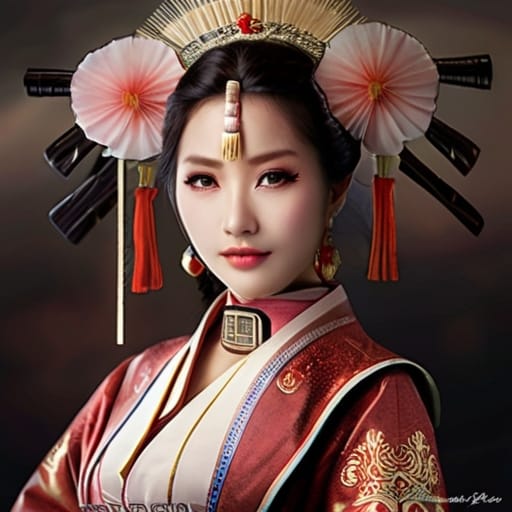
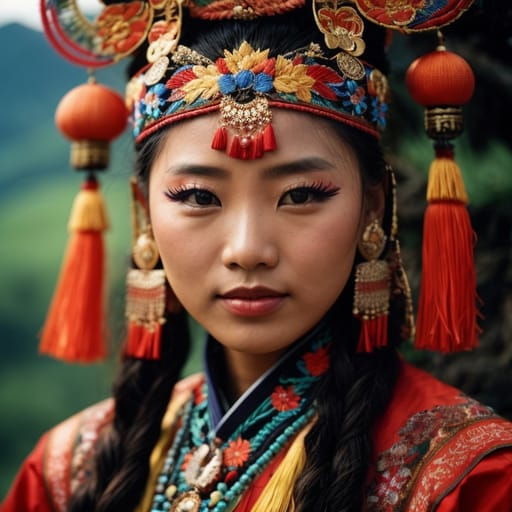
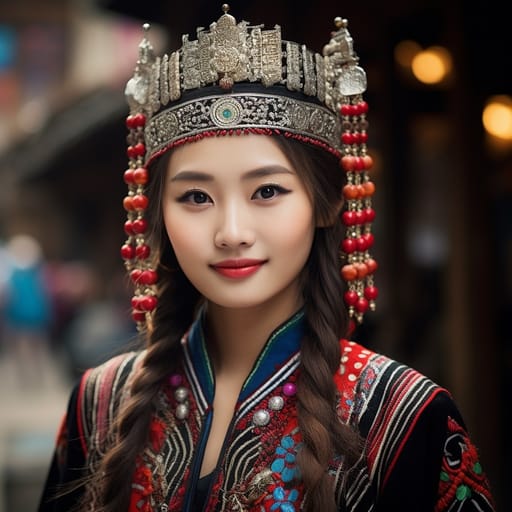
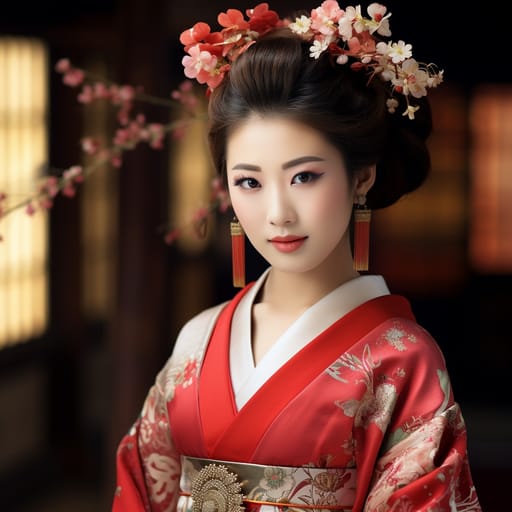
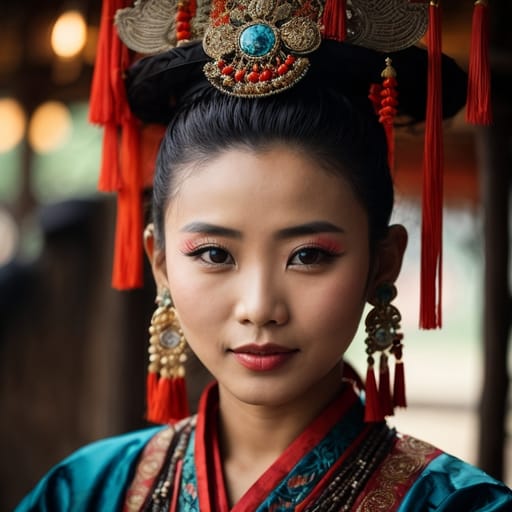
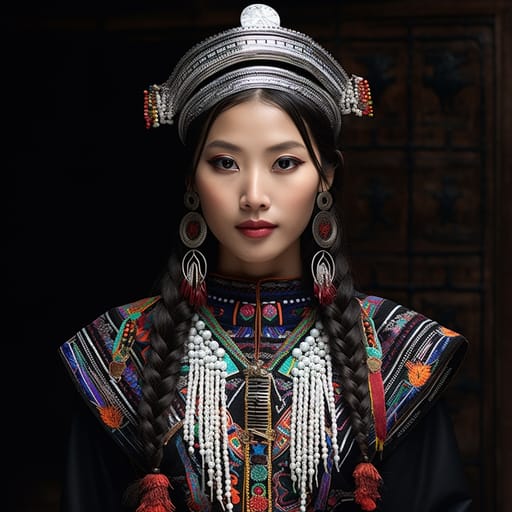
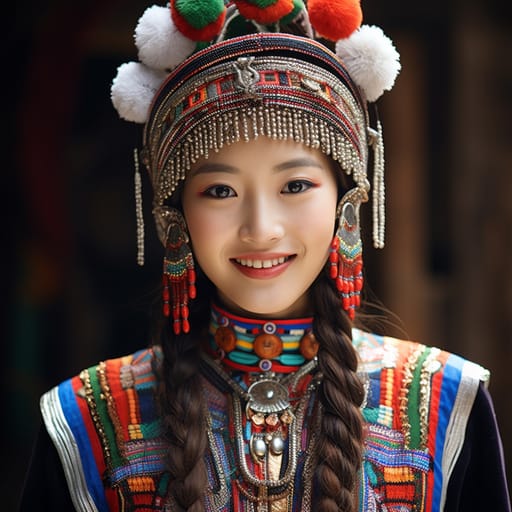
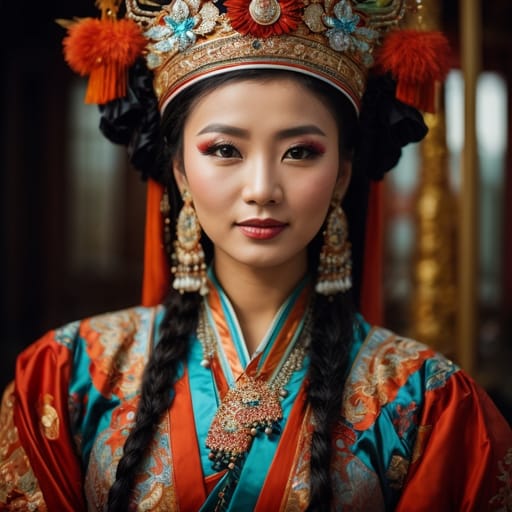
Typical Xianbei Phenotypes
Reference for AI generation: hair, eyes, skin, facial structure, build
Xianbei Body & Anatomy Reference
East Asian Sinitic / Mongoloid phenotype: anatomy reference for AI nude generation
Xianbei Boobs & Breasts
Xianbei tits and boobs run small-to-medium cup, modest projection, the classic East Asian Sinitic / Mongoloid bust profile. Xianbei nipples and areolas show light-pink to medium-brown areolar pigmentation against the light-to-medium skin tone, with areolar diameter typically in the 26-36mm range and forward-set positioning rather than the fuller South Asian or Levantine bust profile. Xianbei breasts trend firm and modestly projecting; smaller cup size than the South Asian or Western Asian average, a function of the ectomorph-to-mesomorph, lean frame body habitus and the mean adult female BMI 20-23. For anatomically accurate AI-generated Xianbei nudes the render preserves the small-to-medium cup, modest projection shape, 26-36mm areolas with light-pink to medium-brown pigmentation, and the torso proportions of the East Asian Sinitic / Mongoloid phenotype.
Xianbei Ass & Hips
Xianbei hips and butt usually read as small-to-medium, modest projection, narrower hip profile. The skeletal base is narrower iliac crests, less gluteal-femoral fat deposition, the East Asian Sinitic / Mongoloid pattern. Set against the fuller projected glutes of the West African or Polynesian phenotype, the difference is easy to see, and the hip-to-waist ratio is often what identifies Xianbei women in photos.
Xianbei Vagina & Pussy
Expect light-pink to medium-brown labial pigmentation, smaller labia minora on Xianbei women, in keeping with East Asian Sinitic / Mongoloid ancestry. The pubic hair is straight fine texture, sparser distribution than the South Asian norm. Coloring should run evenly from the light to medium skin of the thighs to the labia, and Xianbei nude imagery should keep the hair's straight fine texture.
Xianbei Dicks & Penis
Xianbei dick and penile anatomy in adult AI generation should anchor on the regional reference data: regional mean ~11-12cm erect, moderate girth, and light-brown shaft pigmentation. The Xianbei cock profile reflects the East Asian Sinitic / Mongoloid population's anthropometric measurements. The shaft pigmentation should track the surrounding light to medium skin tone, and the pubic hair should keep its straight fine texture in the typical inverted-V escutcheon.
Xianbei Body, Curves & Build
Xianbei body type: ectomorph-to-mesomorph, lean frame, with mean adult female BMI 20-23. This is the typical East Asian Sinitic / Mongoloid build. Height range, shoulder-to-hip ratio and fat distribution all follow from it, which is what an accurate Xianbei nude body should show.
Xianbei Skin Tone & Hair Texture
Xianbei skin tone falls in the light to medium (Fitzpatrick II-IV) band, the surface signal most often miscalibrated by generic AI nude generators. Xianbei hair texture is typically straight 1A, fine-to-medium, predominantly black, characteristic of the East Asian Sinitic / Mongoloid phenotype. In Xianbei nude renders the skin should hold that band consistently across the body.
Explore phenotype categories
Structured taxonomy with peer-reviewed scales · 22 anatomical categories
Erotic Poses & Sex Positions
From the pose catalog: 219 named positions with reference skeletons
Frequently asked questions about Xianbei people
Where is the Xianbei homeland?
The Xianbei homeland is Greater Khingan range and eastern Inner Mongolia, later the Mongolian Plateau and northern China (present-day China and Mongolia) in East Asia.
What language do Xianbei people speak?
Xianbei people primarily speak Xianbei (Para-Mongolic; unwritten, known only from Chinese glosses, closest to Khitan), with Tungusic and Turkic speakers inside the confederation; later Chinese.
What religion do Xianbei people practice?
The predominant religion among Xianbei people is Shamanism and sky worship; the Tuoba Northern Wei became major patrons of Buddhism after a Daoist-backed persecution in the 440s.






Make your own Xianbei images
Five a day, free, no credits to buy. The studio starts from this group's phenotype data, so you can set body type, pose and style and keep the traits accurate.
Start with Xianbei