No portrait yet
Tai Nua Erotic
Dehong Dai and Jingpo Autonomous Prefecture and nearby areas of western Yunnan, China; adjoining northern Shan State, Myanmar; smaller communities in Laos, Thailand and Vietnam
Tai Nüa, also called Dehong Dai or Tai Le (Kra-Dai, Southwestern Tai), written in the Tai Le script; Mandarin widely spoken as a second language
Theravada Buddhism, practiced alongside veneration of village and land guardian spirits
Southwestern Tai peoples; grouped in China within the Dai nationality alongside the Tai Lue; closely related to the Shan and Tai Mao of Myanmar
About Tai Nua People
The Tai Nua are the Tai of the upper valleys. Nua means upper or northern, and the name fits: they live at the northern edge of the Tai-speaking world, in the lowland river valleys of western Yunnan around the Shweli, where China meets Myanmar. Beijing counts them within the official Dai nationality, Burmese speakers have long called them Chinese Shan, and they call themselves Tai. A modern border runs straight through their country, with Ruili on the Chinese side and Muse on the Myanmar side facing each other across it. Smaller communities live farther afield in Laos, Thailand and Vietnam.
Their language belongs to the Southwestern Tai branch of the Kra-Dai family. It is a close relative of Shan and a more distant cousin of Thai and Lao. It has its own writing system, the Tai Le script, a Brahmic-derived alphabet of rounded letters that was reformed in the 1950s and again in the 1980s. Most Tai Nua in China also speak the local Yunnan variety of Mandarin. The peoples in the surrounding hills speak languages with no Tai connection at all: Jingpo, Lisu, Achang, De'ang. The valley floors are Tai and the slopes above belong to others, a split between lowland and upland peoples that runs across much of the region.
Religious life runs through Theravada Buddhism, the same school practiced in Myanmar and Thailand. Village monasteries with tiered roofs set the calendar. There is the rainy-season Buddhist Lent, when many older villagers take on extra precepts, and there is the water-splashing festival that opens the new year each April. Buddhism was added on top of older practice rather than replacing it. Villages still honor guardian spirits of the settlement and the land, and those rites go on alongside offerings to the monks.
The valleys once held real power. Möng Mao, a Tai state centered on the Shweli, expanded hard in the fourteenth century, raiding deep into Upper Burma and pushing against Chinese authority. The Ming dynasty answered with a series of campaigns in the 1430s and 1440s that broke it. Afterward the region was run through hereditary Tai chieftains, called saopha in Tai and tusi in Chinese records. They kept their seats under imperial oversight until land reform ended the system in the 1950s.
Some customs have spread well beyond the people who made them. The Dai peacock dance is now a fixture of the Chinese national stage, but it has deep roots in Dehong villages, where men traditionally danced it to the beat of the elephant-foot drum. Dress once showed a woman's marital status plainly. Unmarried women wore trousers with short fitted jackets, married women switched to the long tube skirt, and in some districts married women wrapped their hair in a tall black cloth turban.
Related ethnic groups
Groups that share Tai Nua's homeland, region, language, or religious tradition. These are likely candidates for comparative phenotype reference.

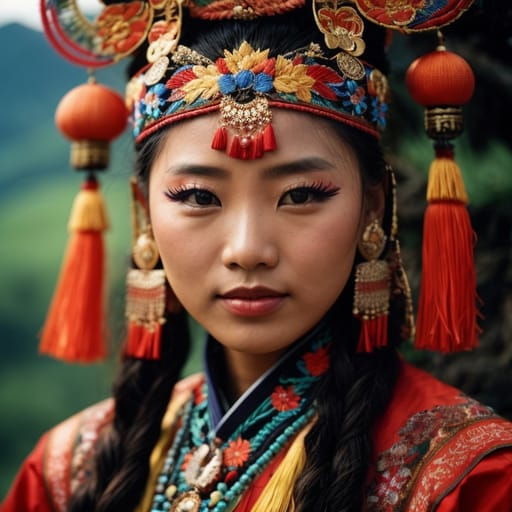
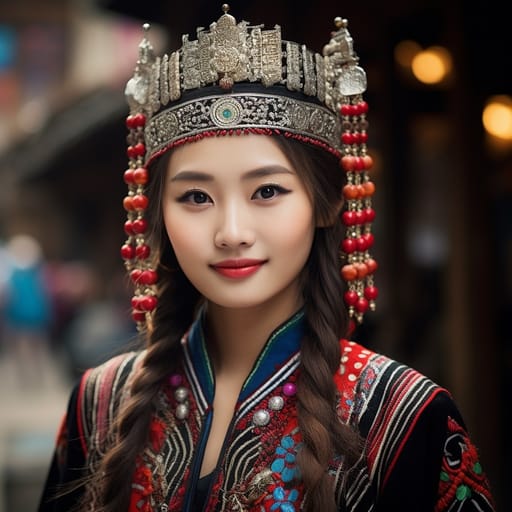

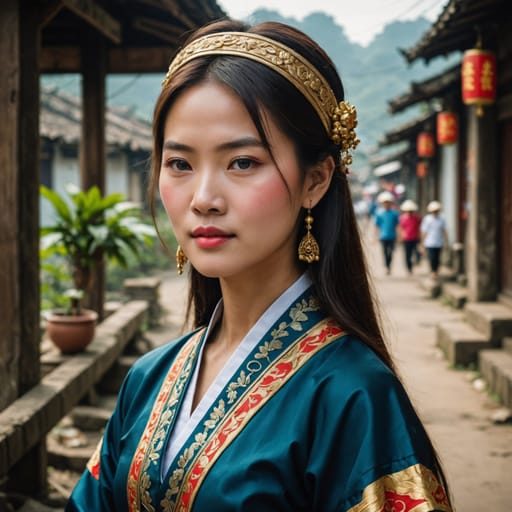
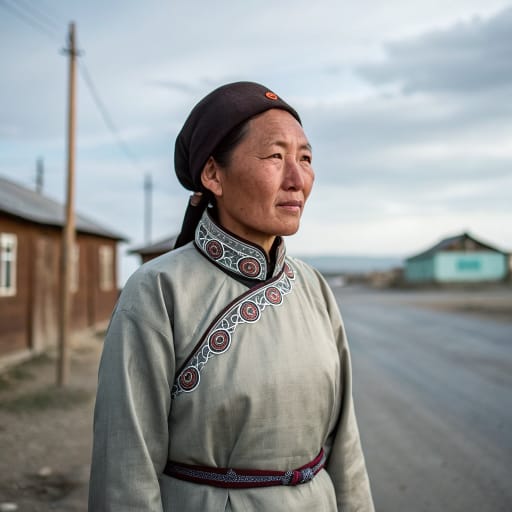
Typical Tai Nua Phenotypes
Reference for AI generation: hair, eyes, skin, facial structure, build
Tai Nua Body & Anatomy Reference
East Asian Sinitic / Mongoloid phenotype: anatomy reference for AI nude generation
Tai Nua Boobs & Breasts
Tai Nua boobs follow the East Asian Sinitic / Mongoloid profile: small-to-medium cup, modest projection. Areolar diameter is usually 26-36mm, and the coloring is light-pink to medium-brown areolar pigmentation against the light-to-medium skin tone. Breast shape tracks body composition (ectomorph-to-mesomorph, lean frame, mean adult female BMI 20-23), so Tai Nua breasts tend to be firm and modestly projecting; smaller cup size than the South Asian or Western Asian average. Expect a forward-set shape, not the fuller South Asian or Levantine bust profile.
Tai Nua Ass & Hips
Tai Nua ass and hip morphology presents as small-to-medium, modest projection, narrower hip profile, distinctly different from the fuller projected glutes of the West African or Polynesian phenotype. The Tai Nua pelvic profile shows narrower iliac crests, less gluteal-femoral fat deposition, anchored in the East Asian Sinitic / Mongoloid skeletal pattern. Tai Nua butt shots in adult AI imagery should render the small-to-medium, modest projection, narrower hip profile silhouette with the overall build (ectomorph-to-mesomorph, lean frame) and the fat distribution typical of the East Asian Sinitic / Mongoloid phenotype.
Tai Nua Vagina & Pussy
Tai Nua pussy anatomy typically shows light-pink to medium-brown labial pigmentation, smaller labia minora. Pubic hair is usually straight fine texture, sparser distribution than the South Asian norm. In AI-generated Tai Nua nudes, labial color should blend into the light to medium skin with a gradual transition, and the hair should keep its straight fine texture.
Tai Nua Dicks & Penis
Penis reference for Tai Nua men: regional mean ~11-12cm erect, moderate girth. Coloring: light-brown shaft pigmentation. An accurate Tai Nua cock in AI imagery matches the surrounding light to medium skin rather than a generic porn default. Circumcision depends on religion and custom, not ancestry.
Tai Nua Body, Curves & Build
The Tai Nua figure is generally ectomorph-to-mesomorph, lean frame, with mean adult female BMI 20-23, characteristic of East Asian Sinitic / Mongoloid ancestry. AI image tools tend to flatten regional body types into a few stock shapes; here the Tai Nua build is kept as its own reference.
Tai Nua Skin Tone & Hair Texture
Skin: light to medium (Fitzpatrick II-IV). Hair: straight 1A, fine-to-medium, predominantly black. Both are typical of East Asian Sinitic / Mongoloid ancestry. The most common mistake in AI nudes of Tai Nua women is a body rendered lighter than the face.
Explore phenotype categories
Structured taxonomy with peer-reviewed scales · 22 anatomical categories
Erotic Poses & Sex Positions
From the pose catalog: 219 named positions with reference skeletons
Frequently asked questions about Tai Nua people
Where is the Tai Nua homeland?
The Tai Nua homeland is Dehong Dai and Jingpo Autonomous Prefecture and nearby areas of western Yunnan, China; adjoining northern Shan State, Myanmar; smaller communities in Laos, Thailand and Vietnam in East Asia.
What language do Tai Nua people speak?
Tai Nua people primarily speak Tai Nüa, also called Dehong Dai or Tai Le (Kra-Dai, Southwestern Tai), written in the Tai Le script; Mandarin widely spoken as a second language.
What religion do Tai Nua people practice?
The predominant religion among Tai Nua people is Theravada Buddhism, practiced alongside veneration of village and land guardian spirits.






Make your own Tai Nua images
Five a day, free, no credits to buy. The studio starts from this group's phenotype data, so you can set body type, pose and style and keep the traits accurate.
Start with Tai Nua