No portrait yet
Taensa Erotic
West bank of the Mississippi River around Lake St. Joseph, in present-day Tensas Parish, northeastern Louisiana, United States; later Mobile Bay in Alabama and the Red River and Bayou Boeuf country of central Louisiana.
Taensa (Natchezan; a close relative or dialect of Natchez, a language isolate sometimes placed in the proposed Gulf grouping)
Indigenous solar and temple religion: a perpetual sacred fire, a ruling lineage identified with the sun, and mortuary sacrifice at a ruler's death; brief Catholic mission contact from 1700.
Natchezan speakers, alongside the Natchez and the Avoyel; culturally part of the Plaquemine and late Mississippian mound-building tradition of the lower Mississippi.
About Taensa People
The Taensa were a people of the lower Mississippi Valley who lived in seven or eight villages on the west bank of the river, around the oxbow now called Lake St. Joseph in Tensas Parish, Louisiana, and who ceased to exist as a distinct nation by the middle of the nineteenth century, their survivors absorbed into neighboring peoples farther south. When La Salle's party came down the river in 1682 they found something that had already vanished nearly everywhere else: a working Mississippian chiefdom, still running. A hereditary ruler whose lineage was identified with the sun held real authority over commoners and lesser chiefs. A mud-walled temple stood on a mound at the head of the plaza, roofed with carved wooden birds, watched over by the skulls of enemies set on posts, and kept alive by a fire that priests were charged with never letting go out. Retainers were expected to follow a dead ruler into the grave. Ordinary houses were square, plastered in mud, domed with cane thatch. The Taensa spoke a tongue close enough to Natchez that the two peoples understood each other, and that small family, Natchez with Taensa and Avoyel, has no demonstrated relatives among the Tunica, Chitimacha and Muskogean languages that surrounded it.
In 1700 lightning struck the temple and burned it. The French priest Paul du Ru, on the spot, recorded that mothers threw infants into the flames to quiet the offended spirit before he and others intervened, an account that says as much about the crisis the town was in as about its religion. Slave raiding finished what epidemics had started. Around 1706, pressed by Yazoo and Chickasaw war parties armed by English traders out of Carolina, the Taensa left the homeland for the Houma on Bayou Manchac, then turned on their hosts and took the town. From there they moved to Mobile Bay, where the Tensaw River still carries their name, then back to Louisiana, to the Red River and Bayou Boeuf, selling off the last of their land early in the nineteenth century and thinning out of the record within two generations. What remains is a scatter of place names and a cautionary tale for linguists: in the 1880s a French seminarian published a full grammar and a body of songs in what he claimed was Taensa, and European scholars took it seriously for years before Daniel Brinton and later John Swanton showed he had invented the whole thing. The actual language survives in a short list of words the French happened to write down.
Related ethnic groups
Groups that share Taensa's homeland, region, language, or religious tradition. These are likely candidates for comparative phenotype reference.

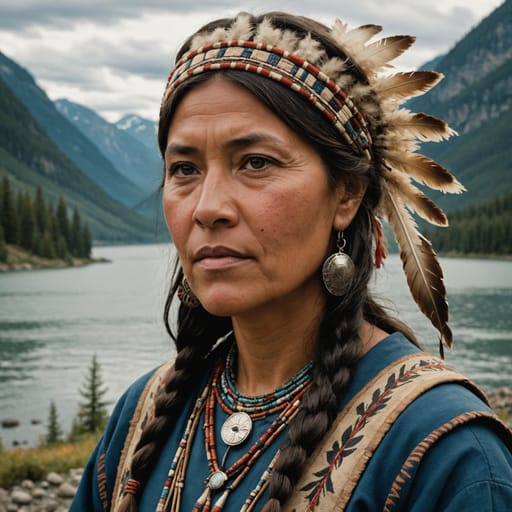
Typical Taensa Phenotypes
Reference for AI generation: hair, eyes, skin, facial structure, build
Taensa Body & Anatomy Reference
Indigenous Northern American / Algonquian-Iroquoian phenotype: anatomy reference for AI nude generation
Taensa Boobs & Breasts
Taensa boobs follow the Indigenous Northern American / Algonquian-Iroquoian profile: medium cup, moderate projection. Areolar diameter is usually 30-44mm, and the coloring is medium-brown areolar pigmentation against the copper-to-medium-brown skin tone. Breast shape tracks body composition (mesomorph, broader frame in northern Indigenous populations, mean adult female BMI 25-28), so Taensa breasts tend to be full and moderate projection. Expect a forward-set shape, not the smaller East Asian bust.
Taensa Ass & Hips
Taensa ass and hip morphology presents as medium, moderate-to-full projection, distinctly different from the slim East Asian narrow-hip profile. The Taensa pelvic profile shows medium iliac crests, anchored in the Indigenous Northern American / Algonquian-Iroquoian skeletal pattern. Taensa butt shots in adult AI imagery should render the medium, moderate-to-full projection silhouette with the overall build (mesomorph, broader frame in northern Indigenous populations) and the fat distribution typical of the Indigenous Northern American / Algonquian-Iroquoian phenotype.
Taensa Vagina & Pussy
Taensa pussy anatomy typically shows medium-brown labial pigmentation. Pubic hair is usually straight medium-coarse texture. In AI-generated Taensa nudes, labial color should blend into the copper to medium-brown skin with a gradual transition, and the hair should keep its straight medium-coarse texture.
Taensa Dicks & Penis
Penis reference for Taensa men: regional mean ~13cm erect, moderate girth. Coloring: medium-brown shaft pigmentation. An accurate Taensa cock in AI imagery matches the surrounding copper to medium-brown skin rather than a generic porn default. Circumcision depends on religion and custom, not ancestry.
Taensa Body, Curves & Build
The Taensa figure is generally mesomorph, broader frame in northern Indigenous populations, with mean adult female BMI 25-28, characteristic of Indigenous Northern American / Algonquian-Iroquoian ancestry. AI image tools tend to flatten regional body types into a few stock shapes; here the Taensa build is kept as its own reference.
Taensa Skin Tone & Hair Texture
Skin: copper to medium-brown (Fitzpatrick III-V). Hair: straight 1A, dark-brown to black, often thick and dense. Both are typical of Indigenous Northern American / Algonquian-Iroquoian ancestry. The most common mistake in AI nudes of Taensa women is a body rendered lighter than the face.
Explore phenotype categories
Structured taxonomy with peer-reviewed scales · 22 anatomical categories
Erotic Poses & Sex Positions
From the pose catalog: 219 named positions with reference skeletons
Frequently asked questions about Taensa people
Where is the Taensa homeland?
The Taensa homeland is West bank of the Mississippi River around Lake St. Joseph, in present-day Tensas Parish, northeastern Louisiana, United States; later Mobile Bay in Alabama and the Red River and Bayou Boeuf country of central Louisiana. in North America.
What language do Taensa people speak?
Taensa people primarily speak Taensa (Natchezan; a close relative or dialect of Natchez, a language isolate sometimes placed in the proposed Gulf grouping).
What religion do Taensa people practice?
The predominant religion among Taensa people is Indigenous solar and temple religion: a perpetual sacred fire, a ruling lineage identified with the sun, and mortuary sacrifice at a ruler's death; brief Catholic mission contact from 1700..






Make your own Taensa images
Five a day, free, no credits to buy. The studio starts from this group's phenotype data, so you can set body type, pose and style and keep the traits accurate.
Start with Taensa