Help us get this right
Does this portrait look right for Taa?
Nobody has judged this one yet. You would be the first.
Taa Erotic
Southern Kalahari, southwestern Botswana and eastern Namibia
Taa (ǃXóõ), Tuu family
Traditional San beliefs
ǃXóõ, Nǀohan
About Taa People
The Taa, also known as the ǃXóõ (ǃXoon or Nǀohan), are a San people of the southern Kalahari, living principally in southwestern Botswana and adjacent parts of eastern Namibia. They are best known to linguists for their language, Taa (ǃXóõ), which possesses one of the largest sound inventories of any documented human language, including an exceptionally rich set of click consonants. It belongs to the Tuu family. The number of speakers is usually estimated in the low thousands.
Society and subsistence
Traditionally the Taa are hunter-gatherers of the arid savanna and semi-desert, hunting antelope and small game with bows and poison-tipped arrows and gathering melons, tubers, nuts, and other bush foods, with water often drawn from plants and stored in ostrich eggshells through the dry months. Their society is egalitarian and band-based, structured by extensive kinship networks, marriage alliances, and gift-exchange relationships that spread risk across a harsh and unpredictable environment. Sharing of meat and cooperative childcare are strong social norms, and leadership is informal, resting on persuasion and respect rather than inherited authority. Like other San of the Kalahari, the Taa have increasingly been drawn into farm labour, settlement schemes, and the cash economy, with corresponding pressures on language, land, and traditional livelihoods.
Appearance and adornment
The Taa share the physical traits characteristic of San peoples: short stature, light yellowish-brown skin, high cheekbones, epicanthic eye folds, and tightly coiled hair. Traditional clothing was made of softened animal hides: leather aprons and cloak-like karosses that served as garment, blanket, and carrying bag. Ostrich-eggshell beads, painstakingly ground and drilled, were strung into necklaces, headbands, bracelets, and decorative aprons, and remain a signature San craft. Ornament, dance, and music accompany social gatherings, and the healing or trance dance holds a central place in spiritual life, in which healers enter altered states to treat illness and restore balance. Belief centres on a creator, lesser divinities, and the spirits of the dead, expressed through ritual, myth, and a deep, practical reverence for the animals and plants that sustain desert life.
Related ethnic groups
Groups that share Taa's homeland, region, language, or religious tradition. These are likely candidates for comparative phenotype reference.


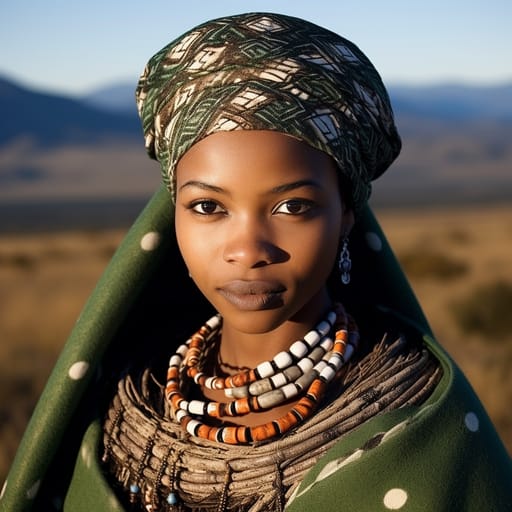

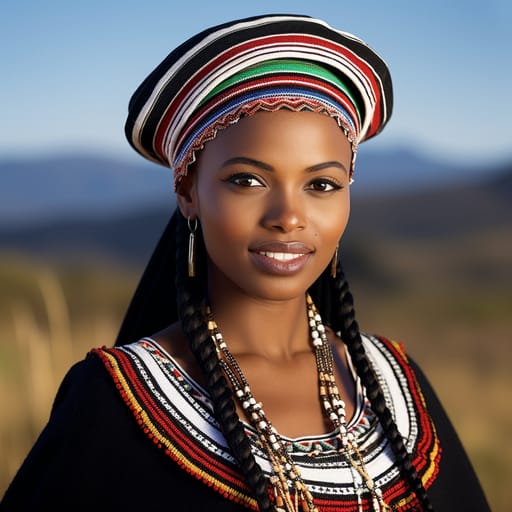

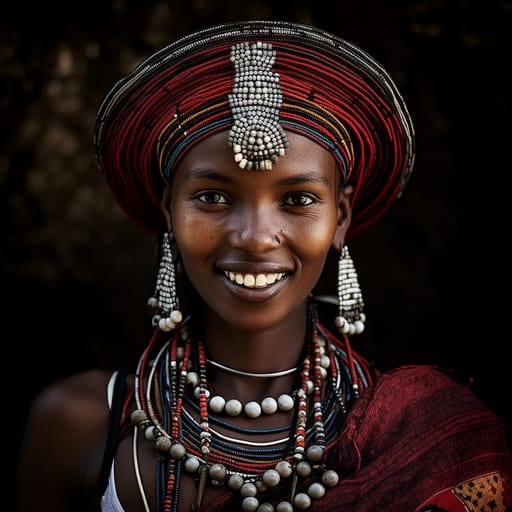

Typical Taa Phenotypes
Reference for AI generation: hair, eyes, skin, facial structure, build
Taa Body & Anatomy Reference
Per-feature anatomical profile for AI nude generation: Bantu / Khoisan Southern African phenotype
Taa Boobs & Breasts
Taa boobs follow the Bantu / Khoisan Southern African profile: medium cup, full but moderate projection. Areolar diameter is usually 30-44mm, and the coloring is medium-brown to deep-brown areolar pigmentation. Breast shape tracks body composition (mesomorph; Khoisan-descended sub-populations show distinctive steatopygic fat deposition, mean adult female BMI 24-28), so Taa breasts tend to be moderately full; less projecting than West African norm. Expect a forward-set shape, not the heavier West African bust.
Taa Ass & Hips
Taa ass and hip morphology presents as the distinctive Khoisan-influenced steatopygic profile in some sub-populations (San, Khoekhoe); broader gluteal projection in Bantu-speaking groups, distinctly different from the slim Cushitic East African profile. The Taa pelvic profile shows wide iliac crests with notable lordosis in Khoisan-descended sub-populations, anchored in the Bantu / Khoisan Southern African skeletal pattern. Taa butt shots in adult AI imagery should render the the distinctive Khoisan-influenced steatopygic profile in some sub-populations (San, Khoekhoe); broader gluteal projection in Bantu-speaking groups silhouette with the overall build (mesomorph; Khoisan-descended sub-populations show distinctive steatopygic fat deposition) and the fat distribution typical of the Bantu / Khoisan Southern African phenotype.
Taa Vagina & Pussy
Taa pussy anatomy typically shows deep-brown labial pigmentation; the elongated labia minora documented in some Khoisan-descended populations. Pubic hair is usually tightly-coiled coarse texture. In AI-generated Taa nudes, labial color should blend into the medium-brown to deep-brown skin with a gradual transition, and the hair should keep its tightly-coiled coarse texture.
Taa Dicks & Penis
Penis reference for Taa men: regional mean ~14cm erect, moderate-to-above-average girth. Coloring: deep-brown shaft pigmentation. An accurate Taa cock in AI imagery matches the surrounding medium-brown to deep-brown skin rather than a generic porn default. Circumcision depends on religion and custom, not ancestry.
Taa Body, Curves & Build
The Taa figure is generally mesomorph; Khoisan-descended sub-populations show distinctive steatopygic fat deposition, with mean adult female BMI 24-28, characteristic of Bantu / Khoisan Southern African ancestry. AI image tools tend to flatten regional body types into a few stock shapes; here the Taa build is kept as its own reference.
Taa Skin Tone & Hair Texture
Skin: medium-brown to deep-brown (Fitzpatrick V-VI); lighter in Khoisan-descended populations. Hair: tightly-coiled 4A-4C; the distinctive 'peppercorn' tight-spiral texture in Khoisan-descended populations. Both are typical of Bantu / Khoisan Southern African ancestry. The most common mistake in AI nudes of Taa women is a body rendered lighter than the face.
Explore phenotype categories
Structured taxonomy with peer-reviewed scales · 22 anatomical categories
Erotic Poses & Sex Positions
From the pose catalog: 219 named positions with reference skeletons
Frequently asked questions about Taa people
Where is the Taa homeland?
The Taa homeland is Southern Kalahari, southwestern Botswana and eastern Namibia in Southern Africa.
What language do Taa people speak?
Taa people primarily speak Taa (ǃXóõ), Tuu family.
What religion do Taa people practice?
The predominant religion among Taa people is Traditional San beliefs.






Make your own Taa images
Five a day, free, no credits to buy. The studio starts from this group's phenotype data, so you can set body type, pose and style and keep the traits accurate.
Start with Taa