Help us get this right
Does this portrait look right for Manahoac?
Nobody has judged this one yet. You would be the first.
Manahoac Erotic
Upper Rappahannock and Rapidan river valleys in the Virginia Piedmont, between the fall line near Fredericksburg and the Blue Ridge, United States
Manahoac, known only from a few recorded names (presumed Siouan, probably close to Tutelo)
Traditional Indigenous beliefs, largely unrecorded
A group of towns recorded in 1608, including Mahaskahod, Hassinunga, Tanxsnitania, Shackaconia, Ontponea, Tegninateo, Whonkenti and Stegaraki; allied with the Monacan among the Virginia Siouan peoples
About Manahoac People
The Manahoac were a Native people of the Virginia Piedmont. They lived along the upper Rappahannock and Rapidan rivers, between the fall line near present-day Fredericksburg and the Blue Ridge, until war and disease broke them apart in the late 1600s. Their survivors are thought to have joined neighboring Siouan peoples such as the Saponi and Tutelo. Their location set them apart. Below the falls lay the Powhatan chiefdoms, whose people spoke Algonquian languages and saw the upland peoples as enemies. The Manahoac belonged to the interior. They were close allies of the Monacan on the James River and, as far as anyone can tell, part of the Siouan-speaking world that reached south into the Carolinas.
Nearly everything written about them comes from a single summer. In August 1608 John Smith took a barge up the Rappahannock to the falls, and a Manahoac party attacked his men from the woods. In the fight the English captured a wounded man named Amoroleck, and his answers to their questions are the heart of the record. He said his people had come down to the falls to hunt. He named the Monacan as friends, and the Powhatan and the northern Massawomeck as enemies. Asked what lay beyond the mountains, he said the sun, and that he knew nothing more because the woods there were not burnt. That answer hints at how much fire shaped the country the hunters did know. Smith wrote down town names including Mahaskahod, Hassinunga, Shackaconia and Stegarake, and the two sides made a truce.
Their language survives only in a few names, so scholars classify it by geography and by their alliances. Most place it in the Siouan family, probably close to Tutelo. Their religion went almost entirely unrecorded. After Smith, the Manahoac show up only in scattered colonial records. Haudenosaunee war parties raided from the north, epidemics moved inland ahead of the colonists, and English settlement crept up the Rappahannock. Within a few generations their country was empty, and by the early 1700s the name had nearly vanished from the record. Their legacy lives on in the Piedmont itself, in archaeological sites along the river valleys, and in present-day Virginia Siouan communities such as the Monacan Indian Nation, which count this history as part of their own.
Related ethnic groups
Groups that share Manahoac's homeland, region, language, or religious tradition. These are likely candidates for comparative phenotype reference.
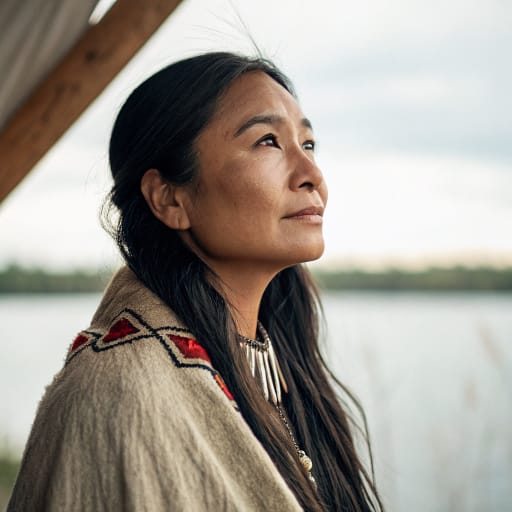
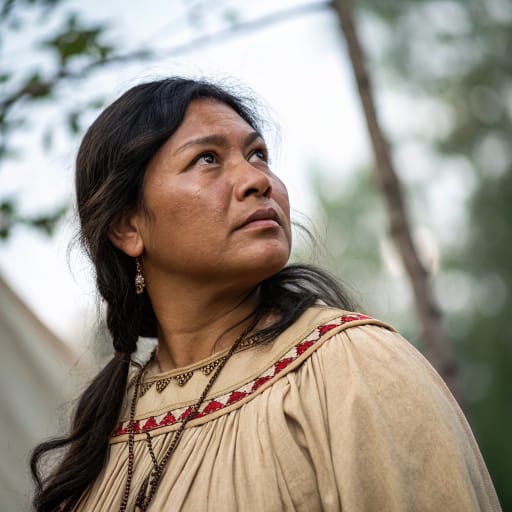
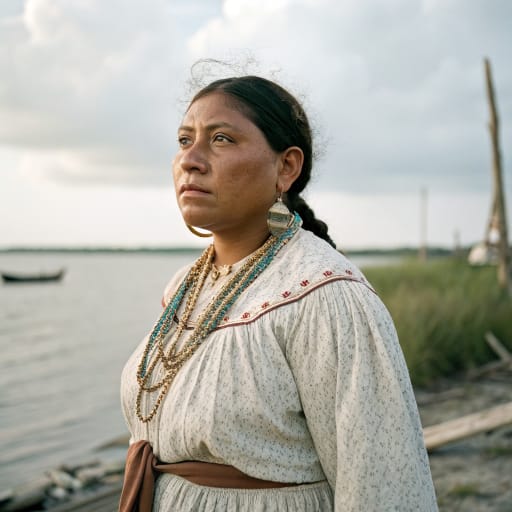
Typical Manahoac Phenotypes
Reference for AI generation: hair, eyes, skin, facial structure, build
Manahoac Body & Anatomy Reference
Indigenous Northern American / Algonquian-Iroquoian phenotype: anatomy reference for AI nude generation
Manahoac Boobs & Breasts
Manahoac tits and boobs run medium cup, moderate projection, the classic Indigenous Northern American / Algonquian-Iroquoian bust profile. Manahoac nipples and areolas show medium-brown areolar pigmentation against the copper-to-medium-brown skin tone, with areolar diameter typically in the 30-44mm range and forward-set positioning rather than the smaller East Asian bust. Manahoac breasts trend full and moderate projection, a function of the mesomorph, broader frame in northern Indigenous populations body habitus and the mean adult female BMI 25-28. For anatomically accurate AI-generated Manahoac nudes the render preserves the medium cup, moderate projection shape, 30-44mm areolas with medium-brown pigmentation, and the torso proportions of the Indigenous Northern American / Algonquian-Iroquoian phenotype.
Manahoac Ass & Hips
Manahoac hips and butt usually read as medium, moderate-to-full projection. The skeletal base is medium iliac crests, the Indigenous Northern American / Algonquian-Iroquoian pattern. Set against the slim East Asian narrow-hip profile, the difference is easy to see, and the hip-to-waist ratio is often what identifies Manahoac women in photos.
Manahoac Vagina & Pussy
Expect medium-brown labial pigmentation on Manahoac women, in keeping with Indigenous Northern American / Algonquian-Iroquoian ancestry. The pubic hair is straight medium-coarse texture. Coloring should run evenly from the copper to medium-brown skin of the thighs to the labia, and Manahoac nude imagery should keep the hair's straight medium-coarse texture.
Manahoac Dicks & Penis
Manahoac dick and penile anatomy in adult AI generation should anchor on the regional reference data: regional mean ~13cm erect, moderate girth, and medium-brown shaft pigmentation. The Manahoac cock profile reflects the Indigenous Northern American / Algonquian-Iroquoian population's anthropometric measurements. The shaft pigmentation should track the surrounding copper to medium-brown skin tone, and the pubic hair should keep its straight medium-coarse texture in the typical inverted-V escutcheon.
Manahoac Body, Curves & Build
Manahoac body type: mesomorph, broader frame in northern Indigenous populations, with mean adult female BMI 25-28. This is the typical Indigenous Northern American / Algonquian-Iroquoian build. Height range, shoulder-to-hip ratio and fat distribution all follow from it, which is what an accurate Manahoac nude body should show.
Manahoac Skin Tone & Hair Texture
Manahoac skin tone falls in the copper to medium-brown (Fitzpatrick III-V) band, the surface signal most often miscalibrated by generic AI nude generators. Manahoac hair texture is typically straight 1A, dark-brown to black, often thick and dense, characteristic of the Indigenous Northern American / Algonquian-Iroquoian phenotype. In Manahoac nude renders the skin should hold that band consistently across the body.
Explore phenotype categories
Structured taxonomy with peer-reviewed scales · 22 anatomical categories
Erotic Poses & Sex Positions
From the pose catalog: 219 named positions with reference skeletons
Frequently asked questions about Manahoac people
Where is the Manahoac homeland?
The Manahoac homeland is Upper Rappahannock and Rapidan river valleys in the Virginia Piedmont, between the fall line near Fredericksburg and the Blue Ridge, United States in North America.
What language do Manahoac people speak?
Manahoac people primarily speak Manahoac, known only from a few recorded names (presumed Siouan, probably close to Tutelo).
What religion do Manahoac people practice?
The predominant religion among Manahoac people is Traditional Indigenous beliefs, largely unrecorded.






Make your own Manahoac images
Five a day, free, no credits to buy. The studio starts from this group's phenotype data, so you can set body type, pose and style and keep the traits accurate.
Start with Manahoac