Help us get this right
Does this portrait look right for Karankawa?
Nobody has judged this one yet. You would be the first.
Karankawa Erotic
The Texas Gulf Coast from Galveston Bay south to Corpus Christi Bay, including the barrier islands and the lower Colorado and Brazos river valleys, United States.
Karankawa (language isolate, now extinct; roughly a hundred words recorded)
Indigenous coastal belief with shamans and mitote ceremonies; partial and unstable Catholic conversion at the Spanish missions.
Independent bands including the Karankawa proper (Carancaguases), Cocos, Cujanes, Coapites and Copanes.
About Karankawa People
The Karankawa lived along the Texas Gulf Coast for centuries before European contact and ceased to exist as an organized people by the middle of the 1800s, though families in Texas still trace descent from them. Their country ran from Galveston Bay south toward Corpus Christi Bay: barrier islands, salt marsh, bays too shallow for a keeled boat, and the lower Colorado and Brazos valleys. They were never a single tribe. Several independent bands, among them the Cocos, Cujanes, Coapites and Copanes, shared a language and a seasonal rhythm, and it is mostly the language that lets us treat them as one people. It appears to have been related to nothing nearby. Around a hundred words survive, a good number of them written down in the 1880s from the childhood recollections of a woman raised near Matagorda Bay. The year had two halves: cold months on the coast living on oysters, redfish and black drum, warmer months inland after prickly pear, pecans, deer and bison. Everything had to travel. Hide huts could be struck in an hour, cottonwood dugouts were poled through knee-deep water rather than paddled, and pottery was waterproofed with asphaltum picked off the beach, which is still how archaeologists identify a Karankawa site.
Contact came early and went badly. Cabeza de Vaca washed up among coastal people near Galveston in 1528 and recorded that his hosts fed the starving Spaniards and wept over their misfortune, and also that they were revolted to learn some of the castaways had eaten each other. That detail is worth holding onto, because in Texas folklore the Karankawa are known chiefly as cannibals. There is real evidence for the ritual eating of enemies, a practice shared with other Gulf peoples, but the man-eater reputation was inflated afterward and put to work: it made a people easier to clear off land. They finished off what was left of La Salle's Fort St. Louis at the end of the 1680s, moved in and out of the Spanish missions at Rosario and Refugio without ever fully settling, then met Stephen F. Austin's colonists in the 1820s, who campaigned against them for the better part of two decades. Disease did the rest. The last band on record was destroyed in 1858 near the Rio Grande, and Texas schoolbooks have called them extinct ever since. That framing has been challenged in recent years by descendants organizing as Karankawa Kadla, who surfaced publicly around 2021 opposing industrial construction over shell middens and burials on Corpus Christi Bay.
Related ethnic groups
Groups that share Karankawa's homeland, region, language, or religious tradition. These are likely candidates for comparative phenotype reference.
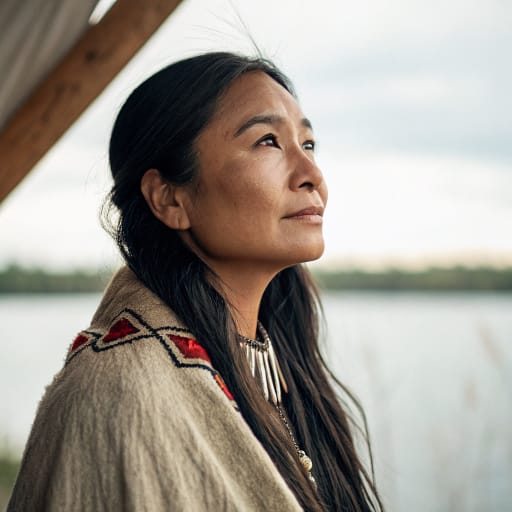
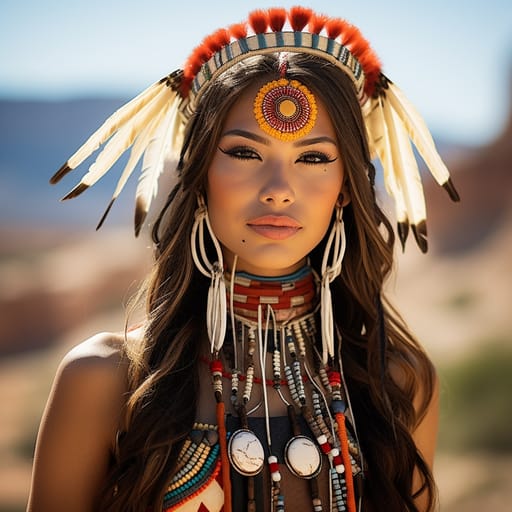
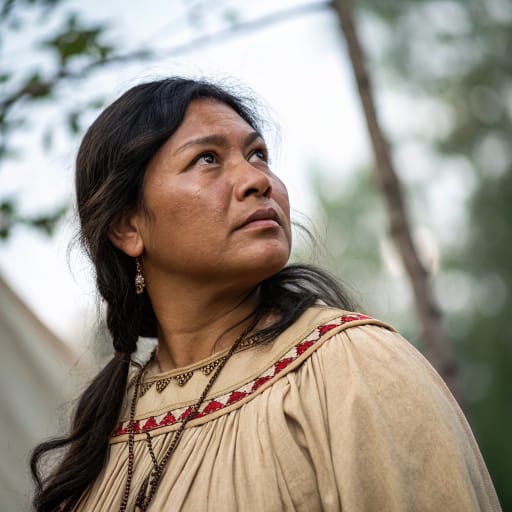
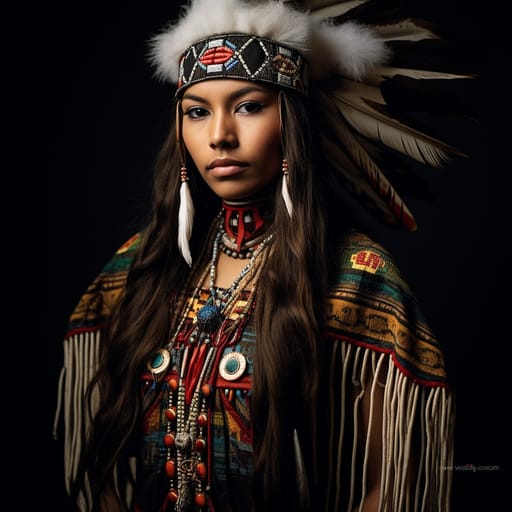
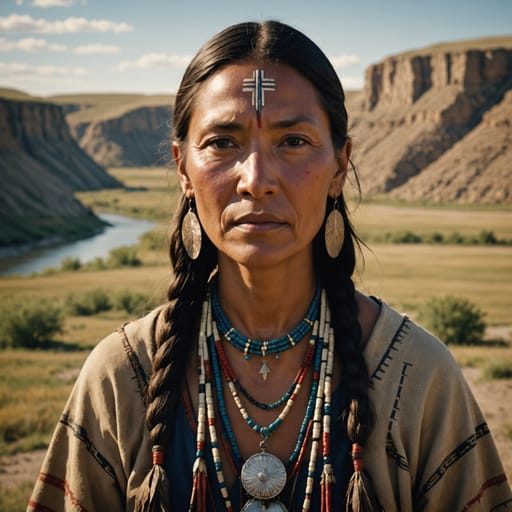
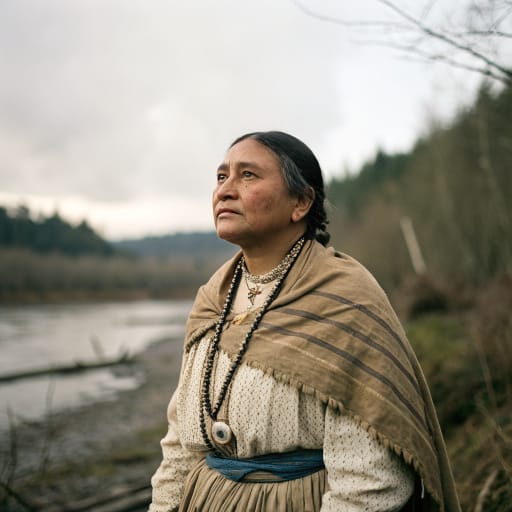
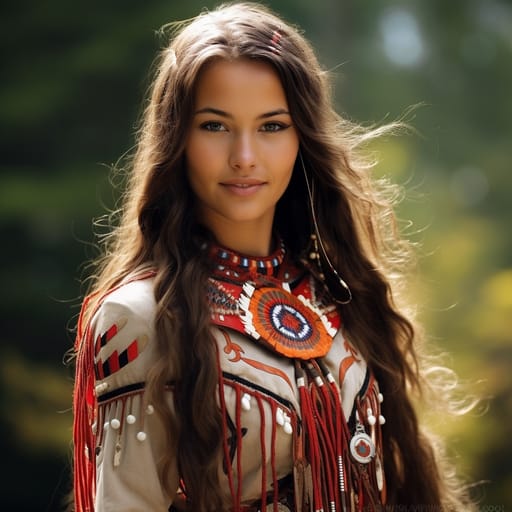
Typical Karankawa Phenotypes
Reference for AI generation: hair, eyes, skin, facial structure, build
Karankawa Body & Anatomy Reference
Anatomy by feature, Indigenous Northern American / Algonquian-Iroquoian phenotype
Karankawa Boobs & Breasts
The typical Karankawa bust is medium cup, moderate projection, in line with the wider Indigenous Northern American / Algonquian-Iroquoian pattern. Areolas usually fall in the 30-44mm range, with medium-brown areolar pigmentation against the copper-to-medium-brown skin tone. Compared with the smaller East Asian bust, Karankawa breasts sit forward and are generally full and moderate projection. A faithful AI render of Karankawa tits keeps that shape and areola size.
Karankawa Ass & Hips
Butt shape among Karankawa women: medium, moderate-to-full projection, over medium iliac crests. This follows Indigenous Northern American / Algonquian-Iroquoian ancestry and looks quite unlike the slim East Asian narrow-hip profile. An accurate Karankawa ass in adult AI imagery keeps both the silhouette and the overall build (mesomorph, broader frame in northern Indigenous populations) instead of a generic average.
Karankawa Vagina & Pussy
Vulvar anatomy among Karankawa women: medium-brown labial pigmentation. Pubic hair tends to be straight medium-coarse texture, in the usual inverted-triangle pattern. Both follow Indigenous Northern American / Algonquian-Iroquoian pigmentation, which is why Karankawa pussy renders should not fall back on a pale, sparse Western template.
Karankawa Dicks & Penis
The Karankawa cock profile, from Indigenous Northern American / Algonquian-Iroquoian anthropometric data: regional mean ~13cm erect; moderate girth; medium-brown shaft pigmentation. Pubic hair has a straight medium-coarse texture and forms the usual inverted-V pattern. Whether Karankawa men are circumcised follows religious and cultural practice rather than phenotype.
Karankawa Body, Curves & Build
Build and curves among Karankawa women follow the Indigenous Northern American / Algonquian-Iroquoian pattern: mesomorph, broader frame in northern Indigenous populations, mean adult female BMI 25-28. Proportions matter as much as skin tone, so Karankawa figures should keep their regional height and limb ratios.
Karankawa Skin Tone & Hair Texture
The Karankawa skin range is copper to medium-brown (Fitzpatrick III-V), and hair tends to be straight 1A, dark-brown to black, often thick and dense. That combination marks the Indigenous Northern American / Algonquian-Iroquoian phenotype, and skin tone is the trait AI generators most often get wrong for Karankawa women.
Explore phenotype categories
Structured taxonomy with peer-reviewed scales · 22 anatomical categories
Erotic Poses & Sex Positions
From the pose catalog: 219 named positions with reference skeletons
Frequently asked questions about Karankawa people
Where is the Karankawa homeland?
The Karankawa homeland is The Texas Gulf Coast from Galveston Bay south to Corpus Christi Bay, including the barrier islands and the lower Colorado and Brazos river valleys, United States. in North America.
What language do Karankawa people speak?
Karankawa people primarily speak Karankawa (language isolate, now extinct; roughly a hundred words recorded).
What religion do Karankawa people practice?
The predominant religion among Karankawa people is Indigenous coastal belief with shamans and mitote ceremonies; partial and unstable Catholic conversion at the Spanish missions..






Make your own Karankawa images
Five a day, free, no credits to buy. The studio starts from this group's phenotype data, so you can set body type, pose and style and keep the traits accurate.
Start with Karankawa