Help us get this right
Does this portrait look right for Ojibwe?
One tap. It takes a second and it is recorded.
1 says it looks right, 0 say it looks off.
Ojibwe Erotic
Anishinaabeland (Canada, United States)
Algic / Algonquian / Ojibwe
Midewiwin
Oji-Cree, Odawa, Potawatomi, Mississaugas
About Ojibwe People
The Ojibwe are one of the largest Indigenous nations on the continent, spread across a homeland that arcs from the woodlands of Quebec through the Great Lakes basin and out into the prairies of Manitoba and the Dakotas. They call themselves Anishinaabeg, "the original people," and the broader Anishinaabe family includes the closely related Odawa, Potawatomi, Mississaugas, and the Oji-Cree of the northern bush — distinct nations bound by a shared language, council tradition, and the old Three Fires Confederacy. Their territory is defined less by borders than by water: the inland seas of Lakes Superior, Huron, and Michigan, and the network of rivers, portages, and wild rice marshes that made them the dominant power of the Upper Great Lakes by the eighteenth century.
Ojibwemowin belongs to the Algonquian branch of the Algic family, related to Cree, Innu, and the languages of the Atlantic coast — a polysynthetic language built around verbs, where a single word can carry information that takes English a full clause. It is one of the more widely spoken Indigenous languages north of Mexico, with serious revitalization work underway in immersion schools on both sides of the border, though fluency skews older and the situation remains fragile. Dialects shift noticeably across the territory: the Ojibwe of northern Ontario and the Oji-Cree of the Severn River speak forms quite distinct from those heard around the western lakes.
Religious life centers on the Midewiwin, the Grand Medicine Society — a graded healing and ceremonial order whose teachings were historically recorded on birchbark scrolls in a system of pictographs used as mnemonic aids. Christian missions made deep inroads from the seventeenth century onward, and many Ojibwe communities today are Catholic or belong to various Protestant denominations, often without seeing a contradiction between church attendance and participation in ceremony, drum societies, or sweat lodge. The seasonal round still organizes a great deal of community life: spring sugar bush, summer fishing, the late-summer wild rice harvest by canoe in the shallow lakes, and winter trapping. Treaty rights to hunt, fish, and gather across ceded territories have been the legal battleground of the past half-century, and the resulting court victories — Marshall in Canada, the Voigt and Mille Lacs decisions in the United States — have shaped how the Ojibwe relate to the surrounding settler states as a matter of practical, not just symbolic, sovereignty.
Related ethnic groups
Groups that share Ojibwe's homeland, region, language, or religious tradition. These are likely candidates for comparative phenotype reference.
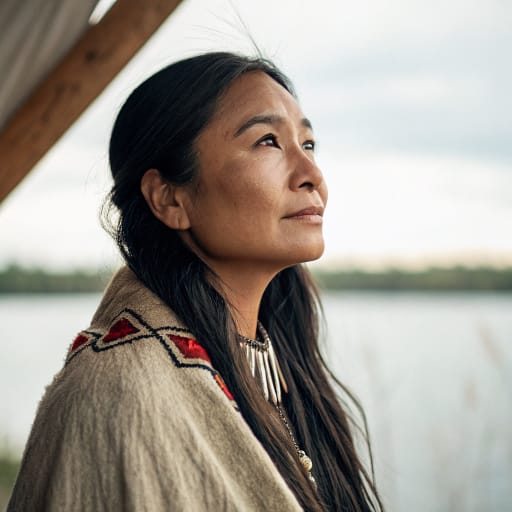
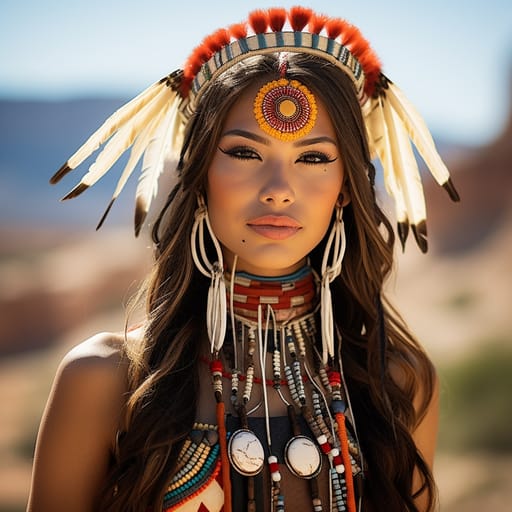
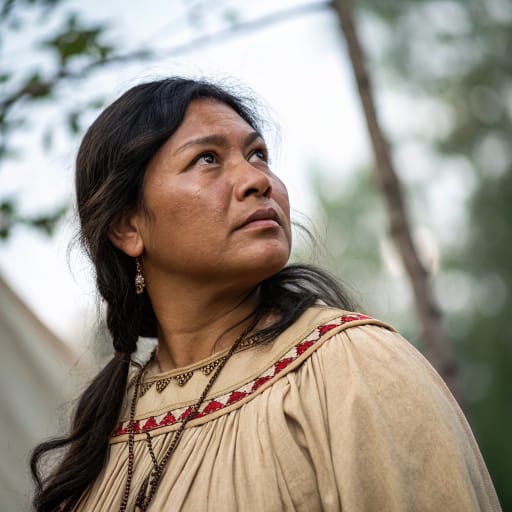
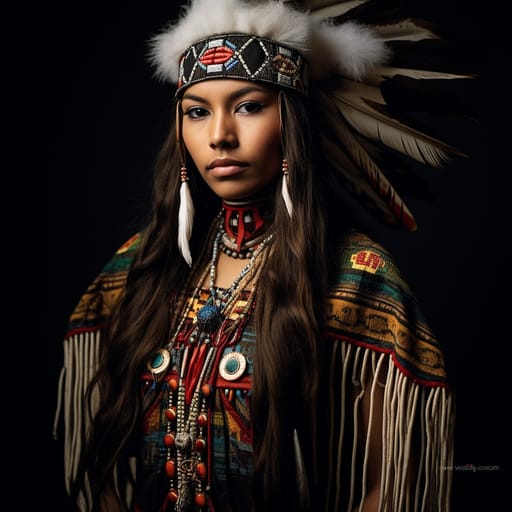
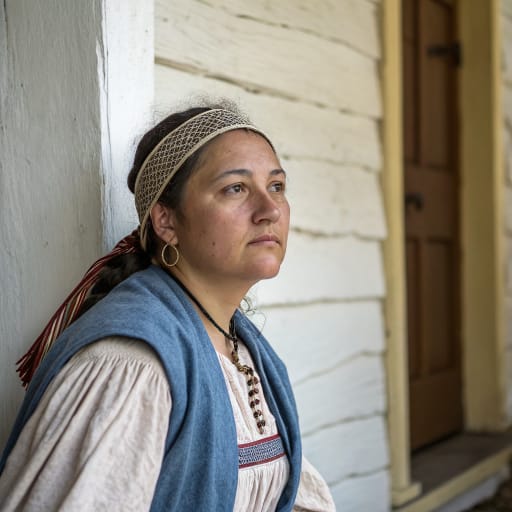
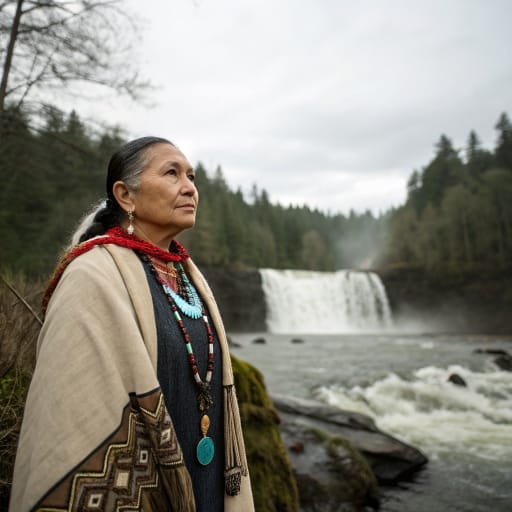
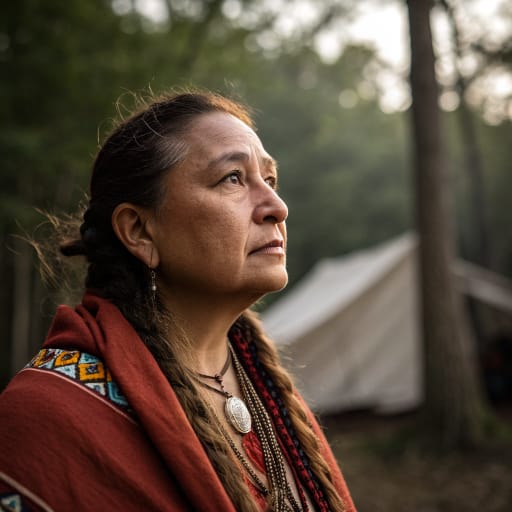
Typical Ojibwe Phenotypes
Reference for AI generation: hair, eyes, skin, facial structure, build
Ojibwe phenotype sits within the broader Northeast Woodlands and Subarctic Algonquian range, with structural traits shared across the Anishinaabe confederacy — Ojibwe proper, Oji-Cree, Odawa, Potawatomi, and Mississaugas — and a meaningful minority of mixed-ancestry individuals reflecting centuries of fur-trade contact with French, Scots, and African-descended traders.
Hair is almost uniformly black or very dark brown, straight to gently wavy, with the thick coarse texture typical of Indigenous North American populations. Premature graying is uncommon; many elders retain dark hair into late life. Body and facial hair is generally sparse. Eyes run dark brown to near-black, with a smaller share of medium brown; the eyelid usually carries a soft inner-corner fold rather than a pronounced epicanthic fold, and the eye opening tends to be moderately almond-shaped and set on a relatively flat orbital plane.
Skin tone spans Fitzpatrick III to V, most commonly a warm coppery or olive-bronze IV with red and yellow undertones. Northern Oji-Cree communities trend slightly lighter and cooler-toned; southern Odawa and Potawatomi populations and individuals with European admixture show more variation, including hazel eyes and lighter brown hair. Ojibwe-African American lineages — the Bongas of Minnesota, the sculptor Edmonia Lewis — produced a recognizable phenotype with deeper skin, looser-curl Type 3 hair, and Anishinaabe facial bone structure.
The face is broad through the cheekbones with a strong malar shelf, a square or moderately wide jaw, and a nose that is straight to slightly convex with a medium bridge and modest alar width — narrower than Plains profiles, broader than European. Lips are medium-full, the lower fuller than the upper. Build is mid-stature: men commonly 5'7"–5'10", women 5'2"–5'5", with sturdy, broad-shouldered torsos, comparatively short distal limbs, and a tendency toward muscular mesomorphy that historically translated into endurance for canoe travel and winter hunting. Body fat distributes centrally rather than peripherally, a pattern documented across Algonquian populations.
Ojibwe Body & Anatomy Reference
Indigenous Northern American / Algonquian-Iroquoian phenotype: anatomy reference for AI nude generation
Ojibwe Boobs & Breasts
Ojibwe tits and boobs run medium cup, moderate projection, the classic Indigenous Northern American / Algonquian-Iroquoian bust profile. Ojibwe nipples and areolas show medium-brown areolar pigmentation against the copper-to-medium-brown skin tone, with areolar diameter typically in the 30-44mm range and forward-set positioning rather than the smaller East Asian bust. Ojibwe breasts trend full and moderate projection, a function of the mesomorph, broader frame in northern Indigenous populations body habitus and the mean adult female BMI 25-28. For anatomically accurate AI-generated Ojibwe nudes the render preserves the medium cup, moderate projection shape, 30-44mm areolas with medium-brown pigmentation, and the torso proportions of the Indigenous Northern American / Algonquian-Iroquoian phenotype.
Ojibwe Ass & Hips
Ojibwe hips and butt usually read as medium, moderate-to-full projection. The skeletal base is medium iliac crests, the Indigenous Northern American / Algonquian-Iroquoian pattern. Set against the slim East Asian narrow-hip profile, the difference is easy to see, and the hip-to-waist ratio is often what identifies Ojibwe women in photos.
Ojibwe Vagina & Pussy
Expect medium-brown labial pigmentation on Ojibwe women, in keeping with Indigenous Northern American / Algonquian-Iroquoian ancestry. The pubic hair is straight medium-coarse texture. Coloring should run evenly from the copper to medium-brown skin of the thighs to the labia, and Ojibwe nude imagery should keep the hair's straight medium-coarse texture.
Ojibwe Dicks & Penis
Ojibwe dick and penile anatomy in adult AI generation should anchor on the regional reference data: regional mean ~13cm erect, moderate girth, and medium-brown shaft pigmentation. The Ojibwe cock profile reflects the Indigenous Northern American / Algonquian-Iroquoian population's anthropometric measurements. The shaft pigmentation should track the surrounding copper to medium-brown skin tone, and the pubic hair should keep its straight medium-coarse texture in the typical inverted-V escutcheon.
Ojibwe Body, Curves & Build
Ojibwe body type: mesomorph, broader frame in northern Indigenous populations, with mean adult female BMI 25-28. This is the typical Indigenous Northern American / Algonquian-Iroquoian build. Height range, shoulder-to-hip ratio and fat distribution all follow from it, which is what an accurate Ojibwe nude body should show.
Ojibwe Skin Tone & Hair Texture
Ojibwe skin tone falls in the copper to medium-brown (Fitzpatrick III-V) band, the surface signal most often miscalibrated by generic AI nude generators. Ojibwe hair texture is typically straight 1A, dark-brown to black, often thick and dense, characteristic of the Indigenous Northern American / Algonquian-Iroquoian phenotype. In Ojibwe nude renders the skin should hold that band consistently across the body.
Data depth
0/100Coverage of image-grounded phenotype observations · drives AI generation diversity
- Sample size
- 0/40· 0 images
- Image quality
- 0/30· 0% high
- Confidence
- 0/20
- Source diversity
- 0/10
- ·No image observations yet
Explore phenotype categories
Structured taxonomy with peer-reviewed scales · 22 anatomical categories
Notable Ojibwe People
25 reference figures, sourced from Wikipedia
- Francis Assikinack, 1824-1863), historian from Manitoulin Island
- Stephen Bonga, Ojibwe/African-American fur trader and interpreter
- Shadawish, first Ojibwe in Wisconsin.
- George Bonga, 1802-1880), Ojibwe/African-American fur trader and interpreter
- Jeanne L'Strange Cappel, 1873-1949), writer, teacher and clubwoman
- Hanging Cloud, 19th c. Lac Courte Oreilles Ojibwe woman warrior
- George Copway, 1818-1869), missionary and writer
- Margaret Bonga Fahlstrom, c. 1797-1880), Ojibwe-African American woman in the early Methodist Episcopal…
- Philip B. Gordon, Fr. Philip B. Gordon (1885-1948), Roman Catholic priest and activist from Gor…
- Hole in the Day, 1825-1868), Chief of the Mississippi Band of the Minnesota Ojibwe
- Peter Jones, 1802-1856), Mississauga missionary and writer
- Kechewaishke, Gichi-Weshkiinh, Buffalo) (ca. 1759-1855), chief
- Edmonia Lewis, ca. 1844-1907), Mississauga Ojibwe/African-American sculptor
- Maungwudaus, 1811-1888), performer, interpreter, mission worker, and herbalist
- Medweganoonind, 19th-century Red Lake Ojibwe chief
- O-saw-wah-pon, early 19th century, leader of the Saginaw band
- Ozaawindib, Yellow Head), early 19th c. nonbinary warrior, guide
- Chief Bender, Early baseball pitcher with a career 2.46 ERA and a .625 winning percentage.
- Chief Rocky Boy, fl. late 19th c.), chief
- Jane Johnston Schoolcraft, 1800-1842), author, wife of Henry Rowe Schoolcraft, born in Sault Ste. Marie
- John Smith, ca. 1824-1922, chief, from Cass Lake, Minnesota
- Alfred Michael "Chief" Venne, 1879-1971), athletic manager and coach from Leroy, North Dakota
- Waabaanakwad, White Cloud) (ca. 1830-1898), Gull Lake chief
- William Whipple Warren, 1825-1853), first historical writer of the Ojibwe people, territorial legislator
- Zheewegonab, fl. 1780-1805), band leader among the northern Ojibwe
Erotic Poses & Sex Positions
From the pose catalog: 219 named positions with reference skeletons
Frequently asked questions about Ojibwe people
Where is the Ojibwe homeland?
The Ojibwe homeland is Anishinaabeland (Canada, United States) in North America.
What language do Ojibwe people speak?
Ojibwe people primarily speak Algic / Algonquian / Ojibwe.
What religion do Ojibwe people practice?
The predominant religion among Ojibwe people is Midewiwin.






Make your own Ojibwe images
Five a day, free, no credits to buy. The studio starts from this group's phenotype data, so you can set body type, pose and style and keep the traits accurate.
Start with Ojibwe