Help us get this right
Does this portrait look right for Han Taiwanese?
One tap. It takes a second and it is recorded.
1 says it looks right, 0 say it looks off.
Han Taiwanese Erotic
Taiwan, mostly on the western plains. Most ancestors came from southern Fujian and eastern Guangdong, China; a later wave came from across mainland China after 1945.
Mandarin, Taiwanese Hokkien and Hakka (Sino-Tibetan, Sinitic branch)
Chinese folk religion blended with Taoism and Buddhism, centered on ancestor veneration and temple deities such as Mazu; small Christian minority.
Hoklo (Hokkien speakers, the majority), Hakka, and waishengren (arrivals from mainland China after 1945); Hoklo and Hakka together are called benshengren. Part of the wider Han Chinese people.
About Han Taiwanese People
Han Taiwanese are defined less by where their ancestors came from than by what happened after they landed. About 95 percent of Taiwan's roughly 23 million people trace some or all of their lineage to settlers who crossed the strait from southern China. The society those settlers built was shaped by the island: frontier rice farming, then Dutch, Zheng and Qing rule, fifty years as a Japanese colony and nearly four decades of martial law that ended in 1987. In long-running surveys, most now call themselves simply Taiwanese. People still sort themselves by when their families arrived and what they speak. The Hoklo are the largest group. Most of their ancestors came from Quanzhou and Zhangzhou in Fujian, and they speak Taiwanese Hokkien, a Southern Min language salted with Japanese loanwords. The Hakka came from the hill country of eastern Guangdong and western Fujian and live mostly in Taoyuan, Hsinchu, Miaoli and the southern Liudui settlements. The waishengren came between 1945 and 1949 with the defeated Nationalist government, bringing Mandarin and cooking from across China. The 1947 crackdown known as the 228 Incident opened a rift between older settlers and newcomers that took generations to ease. Mandarin became the language of school and state, and children were once punished for speaking Hokkien or Hakka in class. Both languages have since won legal recognition, and slipping between Mandarin and a home language mid-sentence is ordinary talk. Settlers also married into lowland Indigenous peoples. An old saying holds that settlers had a mainland grandfather but no mainland grandmother, though how true that is remains debated.
Religion here is something people practice, not something they join. Most households blend folk religion, Taoism and Buddhism without worrying about where one ends and the next begins. They keep ancestral tablets on a home altar and burn incense and paper offerings on set days. Mazu, the sea goddess credited with protecting the crossing, draws the largest crowds. Each spring the Dajia pilgrimage carries her palanquin through central Taiwan for nine days, followed by hundreds of thousands of people. People put questions to the gods with a pair of crescent moon blocks, dropping them on the temple floor until one lands flat side up and the other flat side down. During Ghost Month, the seventh lunar month, shops and households set out tables of food for wandering spirits. In southern fishing towns such as Donggang, people periodically burn ornate wooden boats to carry plague gods out to sea. Hakka communities keep their own observances, among them the Yimin festival for militia who died in the Lin Shuangwen uprising of the 1780s. Weddings and temple festivals are still marked with bando, open-air banquets cooked by traveling chefs under tarps in the street.
Related ethnic groups
Groups that share Han Taiwanese's homeland, region, language, or religious tradition. These are likely candidates for comparative phenotype reference.

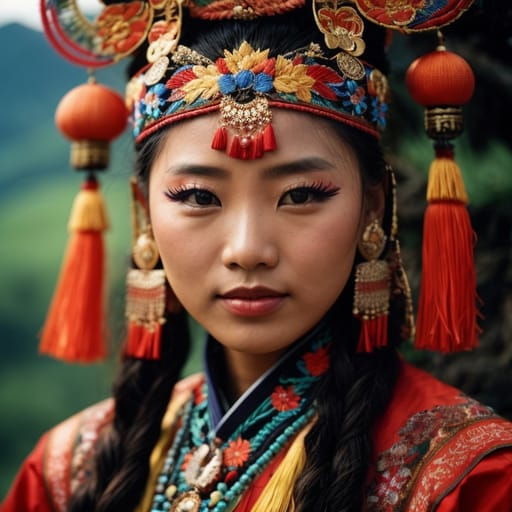
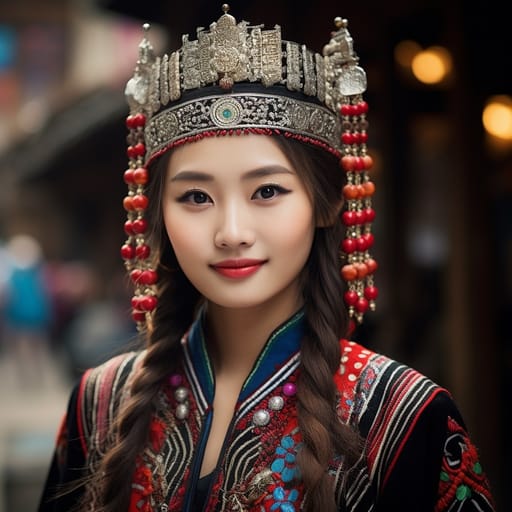
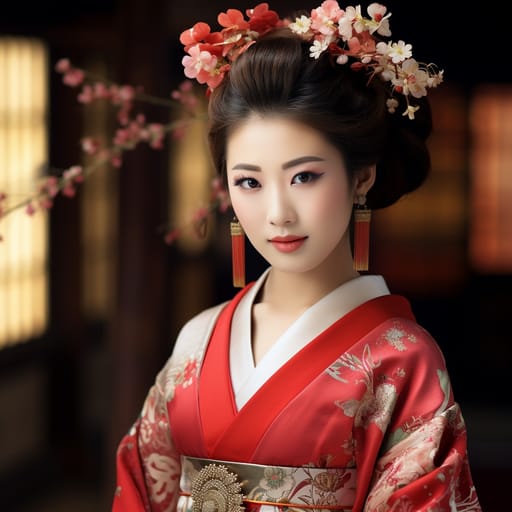
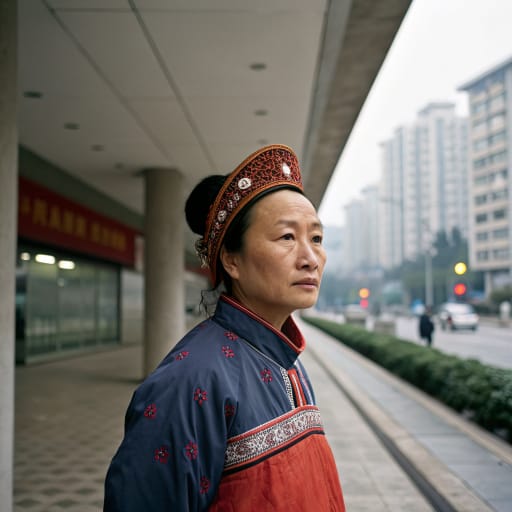
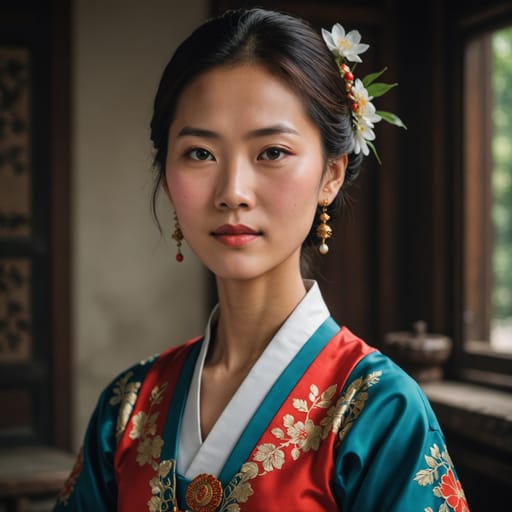
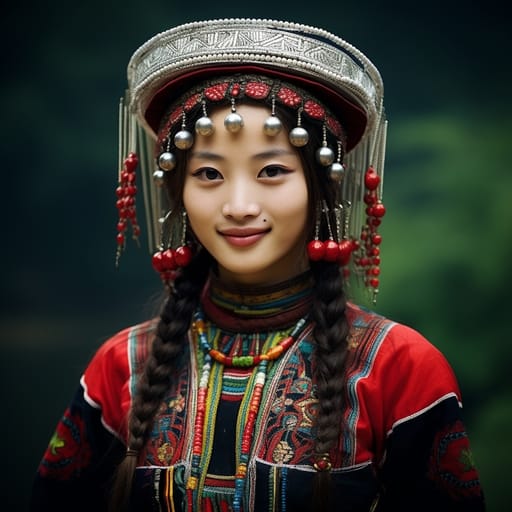
Typical Han Taiwanese Phenotypes
Reference for AI generation: hair, eyes, skin, facial structure, build
Han Taiwanese Body & Anatomy Reference
Per-feature anatomical profile for AI nude generation: East Asian Sinitic / Mongoloid phenotype
Han Taiwanese Boobs & Breasts
Han Taiwanese tits and boobs run small-to-medium cup, modest projection, the classic East Asian Sinitic / Mongoloid bust profile. Han Taiwanese nipples and areolas show light-pink to medium-brown areolar pigmentation against the light-to-medium skin tone, with areolar diameter typically in the 26-36mm range and forward-set positioning rather than the fuller South Asian or Levantine bust profile. Han Taiwanese breasts trend firm and modestly projecting; smaller cup size than the South Asian or Western Asian average, a function of the ectomorph-to-mesomorph, lean frame body habitus and the mean adult female BMI 20-23. For anatomically accurate AI-generated Han Taiwanese nudes the render preserves the small-to-medium cup, modest projection shape, 26-36mm areolas with light-pink to medium-brown pigmentation, and the torso proportions of the East Asian Sinitic / Mongoloid phenotype.
Han Taiwanese Ass & Hips
Han Taiwanese hips and butt usually read as small-to-medium, modest projection, narrower hip profile. The skeletal base is narrower iliac crests, less gluteal-femoral fat deposition, the East Asian Sinitic / Mongoloid pattern. Set against the fuller projected glutes of the West African or Polynesian phenotype, the difference is easy to see, and the hip-to-waist ratio is often what identifies Han Taiwanese women in photos.
Han Taiwanese Vagina & Pussy
Expect light-pink to medium-brown labial pigmentation, smaller labia minora on Han Taiwanese women, in keeping with East Asian Sinitic / Mongoloid ancestry. The pubic hair is straight fine texture, sparser distribution than the South Asian norm. Coloring should run evenly from the light to medium skin of the thighs to the labia, and Han Taiwanese nude imagery should keep the hair's straight fine texture.
Han Taiwanese Dicks & Penis
Han Taiwanese dick and penile anatomy in adult AI generation should anchor on the regional reference data: regional mean ~11-12cm erect, moderate girth, and light-brown shaft pigmentation. The Han Taiwanese cock profile reflects the East Asian Sinitic / Mongoloid population's anthropometric measurements. The shaft pigmentation should track the surrounding light to medium skin tone, and the pubic hair should keep its straight fine texture in the typical inverted-V escutcheon.
Han Taiwanese Body, Curves & Build
Han Taiwanese body type: ectomorph-to-mesomorph, lean frame, with mean adult female BMI 20-23. This is the typical East Asian Sinitic / Mongoloid build. Height range, shoulder-to-hip ratio and fat distribution all follow from it, which is what an accurate Han Taiwanese nude body should show.
Han Taiwanese Skin Tone & Hair Texture
Han Taiwanese skin tone falls in the light to medium (Fitzpatrick II-IV) band, the surface signal most often miscalibrated by generic AI nude generators. Han Taiwanese hair texture is typically straight 1A, fine-to-medium, predominantly black, characteristic of the East Asian Sinitic / Mongoloid phenotype. In Han Taiwanese nude renders the skin should hold that band consistently across the body.
Explore phenotype categories
Structured taxonomy with peer-reviewed scales · 22 anatomical categories
Erotic Poses & Sex Positions
From the pose catalog: 219 named positions with reference skeletons
Frequently asked questions about Han Taiwanese people
Where is the Han Taiwanese homeland?
The Han Taiwanese homeland is Taiwan, mostly on the western plains. Most ancestors came from southern Fujian and eastern Guangdong, China; a later wave came from across mainland China after 1945. in East Asia.
What language do Han Taiwanese people speak?
Han Taiwanese people primarily speak Mandarin, Taiwanese Hokkien and Hakka (Sino-Tibetan, Sinitic branch).
What religion do Han Taiwanese people practice?
The predominant religion among Han Taiwanese people is Chinese folk religion blended with Taoism and Buddhism, centered on ancestor veneration and temple deities such as Mazu; small Christian minority..






Make your own Han Taiwanese images
Five a day, free, no credits to buy. The studio starts from this group's phenotype data, so you can set body type, pose and style and keep the traits accurate.
Start with Han Taiwanese