No portrait yet
Myangad Erotic
Khovd Province in western Mongolia, mainly Myangad District on the lower Khovd River near Khar-Us Lake
Myangad dialect of Mongolian, usually grouped with Oirat but carrying Khalkha features (Mongolic)
Tibetan Buddhism (Gelug school) with folk practices such as ovoo cairn offerings and fire reverence
Western Mongols, usually counted among the Oirats alongside the Dörbet, Torguud and Zakhchin; their own traditions also claim a Khalkha origin
About Myangad People
The Myangad are a small Mongol people of western Mongolia whose name is a job description. It comes from myangan, the word for a thousand, the basic military unit of the Mongol Empire, and the most widely held view is that they began as one such unit of households, posted to the western frontier and left there long enough to become a people. Several thousand of them live in Khovd Province today, concentrated in the district that carries their name on the lower Khovd River as it approaches Khar-Us Lake. It is herding country: sheep and goats on the steppe, cattle in the river bottoms, horses and Bactrian camels for the moves between seasonal camps. Most Myangad households still keep animals even when part of the family has settled in Khovd city.
Where they belong within the Mongol world is a live argument, and the Myangad themselves are of two minds. Their neighbors in Khovd are mostly Oirats, the western Mongols who built the Dzungar Khanate in the seventeenth century, and the Myangad are usually filed as Oirats alongside the Dörbet, Torguud and Zakhchin. But their own traditions also claim a Khalkha origin, an eastern lineage pulled into the Oirat orbit by war and resettlement, and their speech backs both stories at once. Myangad Mongolian is generally counted as an Oirat dialect, yet it keeps enough Khalkha features that linguists still disagree on where to file it. The Qing conquest of the Dzungars in the 1750s reorganized the surviving western groups into banners under the Manchu governor at Khovd, and the Myangad were given one of their own, which fixed their territory and their separate identity for the next century and a half.
Religion is Tibetan Buddhism of the Gelug school, layered over older habits that never went away: stone cairns on the passes still get their offerings and blue scarves, fire in the ger is still treated with respect, and the Lunar New Year and the summer Naadam games anchor the calendar. The socialist state shut the monasteries in the 1930s, and open practice only returned after 1990. What the region kept more completely is its performance culture, above all biyelgee, the seated dance in which the performer works shoulders, arms and chest in imitation of riding, milking and everyday chores, usually to the two-stringed ikel fiddle. It is an Oirat form shared across Khovd and Uvs, and the Myangad are counted among its carriers.
Related ethnic groups
Groups that share Myangad's homeland, region, language, or religious tradition. These are likely candidates for comparative phenotype reference.

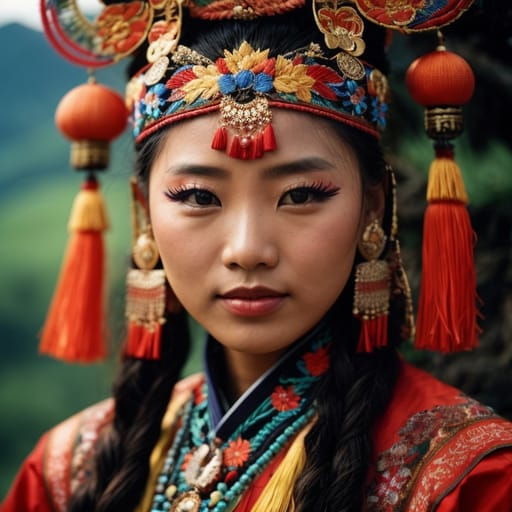
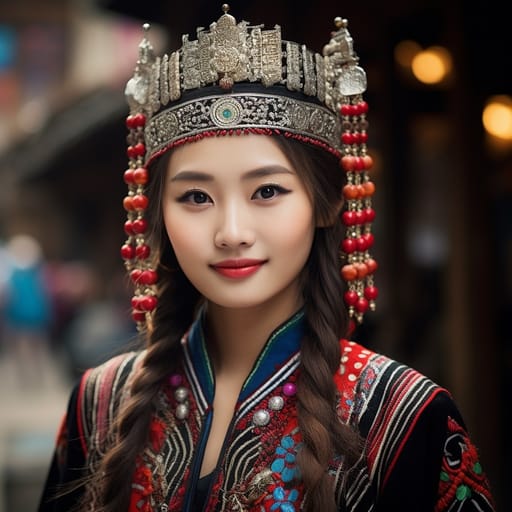

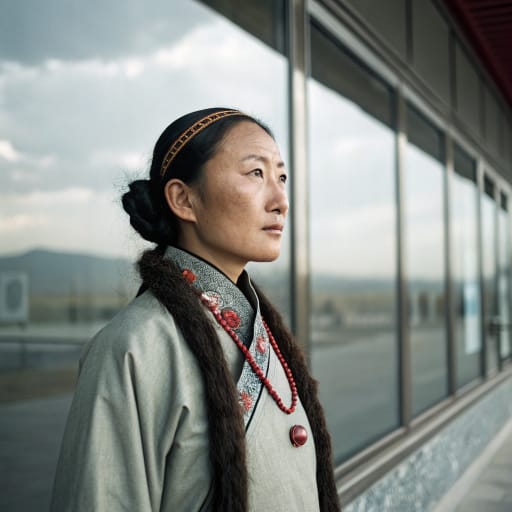
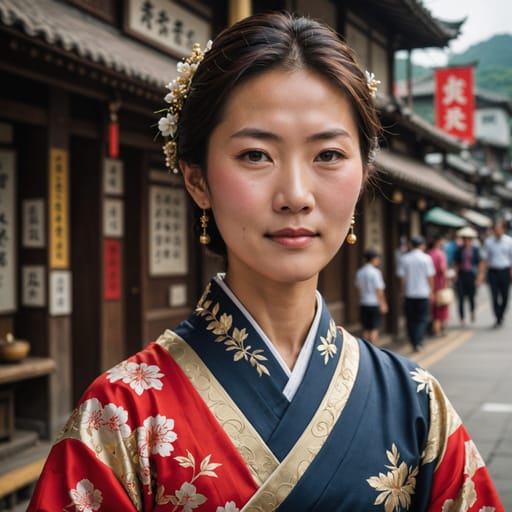
Typical Myangad Phenotypes
Reference for AI generation: hair, eyes, skin, facial structure, build
Myangad Body & Anatomy Reference
East Asian Sinitic / Mongoloid phenotype: anatomy reference for AI nude generation
Myangad Boobs & Breasts
Bust reference for Myangad women: small-to-medium cup, modest projection, which is typical of East Asian Sinitic / Mongoloid ancestry. Areolas measure about 26-36mm across, with light-pink to medium-brown pigmentation. Body type (ectomorph-to-mesomorph, lean frame) shapes the bust as well, so Myangad tits are usually firm and modestly projecting; smaller cup size than the South Asian or Western Asian average. In AI imagery, keep the forward-set shape rather than drifting toward the fuller South Asian or Levantine bust profile.
Myangad Ass & Hips
The Myangad ass is typically small-to-medium, modest projection, narrower hip profile, which sets it apart from the fuller projected glutes of the West African or Polynesian phenotype. Underneath, the pelvis shows narrower iliac crests, less gluteal-femoral fat deposition, part of the East Asian Sinitic / Mongoloid skeletal pattern. For Myangad butt pics and AI renders, match that silhouette and the overall build (ectomorph-to-mesomorph, lean frame).
Myangad Vagina & Pussy
Myangad pussy and vulvar anatomy presents light-pink to medium-brown labial pigmentation, smaller labia minora, consistent with the East Asian Sinitic / Mongoloid phenotype's pigmentation pattern. Myangad pubic hair is typically straight fine texture, sparser distribution than the South Asian norm, in the inverted-triangle pattern. For anatomically accurate Myangad pussy renders the labial coloration should match the surrounding light to medium skin tone with a continuous gradient, and the hair should keep its straight fine texture.
Myangad Dicks & Penis
Myangad dicks follow the East Asian Sinitic / Mongoloid reference data: regional mean ~11-12cm erect; moderate girth; light-brown shaft pigmentation. Shaft color should track the light to medium skin tone with a smooth change toward the glans, and Myangad pubic hair keeps its straight fine texture.
Myangad Body, Curves & Build
Myangad body type and overall build presents as ectomorph-to-mesomorph, lean frame, with mean adult female BMI 20-23: the characteristic East Asian Sinitic / Mongoloid habitus. Myangad curves and proportions should keep the regional skeletal frame (height, shoulder-to-hip ratio, limb proportions) rather than a generic mesomorph default.
Myangad Skin Tone & Hair Texture
Myangad skin sits in the light to medium (Fitzpatrick II-IV) band. Hair is typically straight 1A, fine-to-medium, predominantly black, in keeping with the East Asian Sinitic / Mongoloid phenotype. In nude renders the skin should stay one even tone from face to body, and body, pubic and head hair should match.
Explore phenotype categories
Structured taxonomy with peer-reviewed scales · 22 anatomical categories
Erotic Poses & Sex Positions
From the pose catalog: 219 named positions with reference skeletons
Frequently asked questions about Myangad people
Where is the Myangad homeland?
The Myangad homeland is Khovd Province in western Mongolia, mainly Myangad District on the lower Khovd River near Khar-Us Lake in East Asia.
What language do Myangad people speak?
Myangad people primarily speak Myangad dialect of Mongolian, usually grouped with Oirat but carrying Khalkha features (Mongolic).
What religion do Myangad people practice?
The predominant religion among Myangad people is Tibetan Buddhism (Gelug school) with folk practices such as ovoo cairn offerings and fire reverence.






Make your own Myangad images
Five a day, free, no credits to buy. The studio starts from this group's phenotype data, so you can set body type, pose and style and keep the traits accurate.
Start with Myangad