Help us get this right
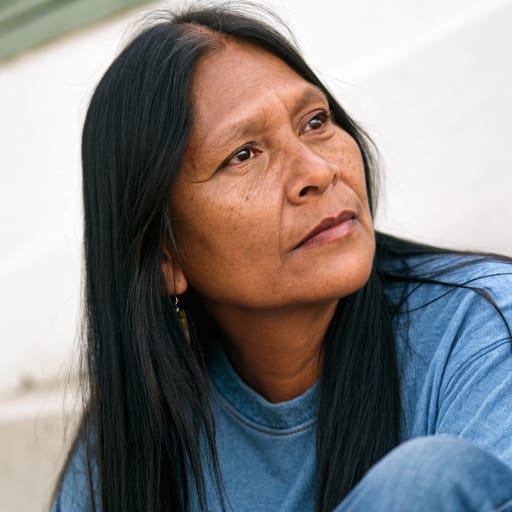
Does this portrait look right for Chitimacha?
Nobody has judged this one yet. You would be the first.
Chitimacha Erotic
Atchafalaya Basin and lower Mississippi delta of south Louisiana, United States; today centered on the reservation at Charenton, St. Mary Parish
Chitimacha (language isolate, dormant since 1940 and under revitalization); English (Indo-European, Germanic)
Predominantly Roman Catholic, with traditional beliefs surviving in oral tradition
Historically four divisions: Chitimacha proper, Washa, Chawasha and Yagenechito; today a single federally recognized tribe, the Chitimacha Tribe of Louisiana
About Chitimacha People
The Chitimacha are the only Native people in Louisiana still living on part of the land they held before Europeans arrived. Their reservation sits at Charenton on Bayou Teche, at the western edge of the Atchafalaya Basin, and that fact shapes how they describe themselves: not a tribe that was removed and resettled, but one that held on. Their historic range was far larger, covering the swamps and bayous of the lower delta from Bayou Lafourche west to Grand Lake. They were water people, moving by cypress dugout, living on fish, shellfish, alligator and waterfowl, and building on the shell ridges above the flood line. Their own name for themselves translates roughly as men altogether red.
Contact with the French turned violent early. In 1706 a Chitimacha party killed a missionary, and Governor Bienville answered with a twelve-year war in which allied tribes raided Chitimacha villages and captives were sold in New Orleans. Chitimacha made up a large share of the Indians enslaved in early Louisiana. Peace came in 1718, but disease and dispersal did the rest, and by the early twentieth century the community at Charenton had shrunk to a few dozen people about to lose their last acres at a sheriff's sale. Sarah Avery McIlhenny of the Tabasco family bought the land in 1916 and had it placed in federal trust, which made the Chitimacha the first federally recognized tribe in the state. More than a thousand enrolled members, a tribal school and a casino now stand on that base.
The Chitimacha language is an isolate, related to nothing else known. Its last fluent speaker died in 1940, but the linguist Morris Swadesh had recorded it in the 1930s, and from those recordings the tribe rebuilt a curriculum, working with Rosetta Stone in the 2000s to produce lessons now taught to children at the tribal school. The other survival is basketry. Weavers split river cane into fine strips, dye them black, red and yellow with walnut, dock and other plant dyes, and work them into double-walled baskets, an inner and outer basket made as one piece, tight enough to hold water. Pattern names come from the swamp: alligator entrails, blackbird's eye, muscadine rind. Clara Darden and later Ada Thomas carried the craft through the lean decades, and it remains the tribe's signature art. Most Chitimacha today are Catholic, a legacy of Acadian and Creole neighbors, and daily life looks like rural south Louisiana, with regalia and older customs kept for tribal gatherings and powwows.
Related ethnic groups
Groups that share Chitimacha's homeland, region, language, or religious tradition. These are likely candidates for comparative phenotype reference.
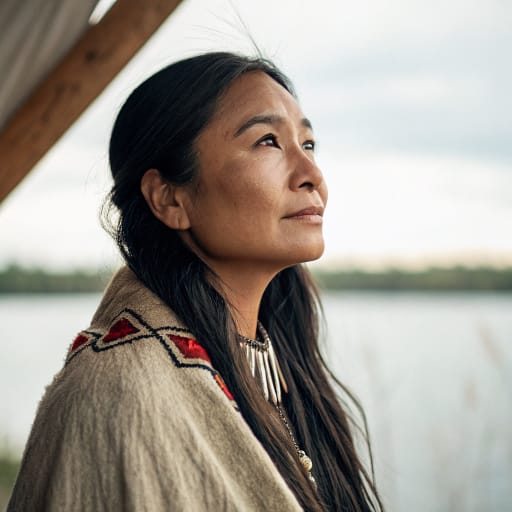
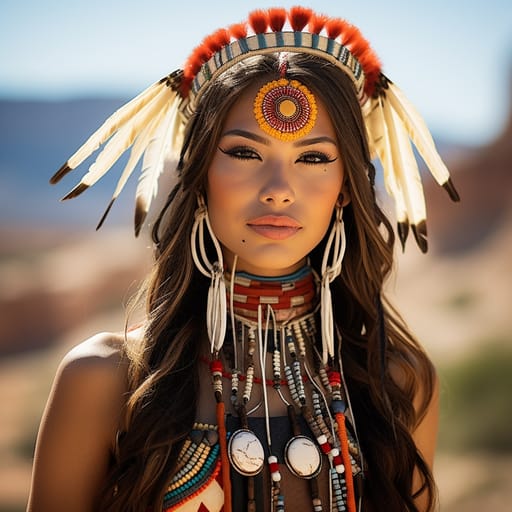
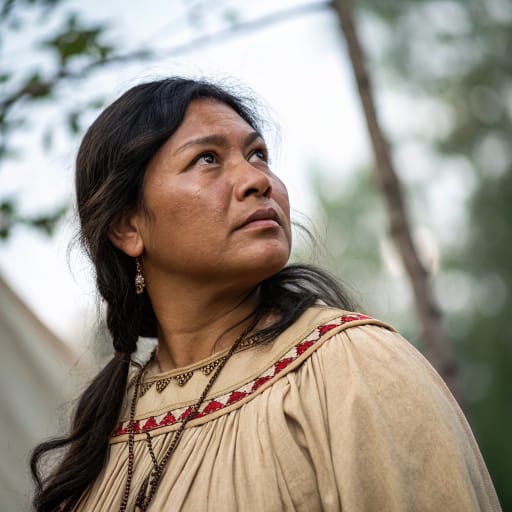
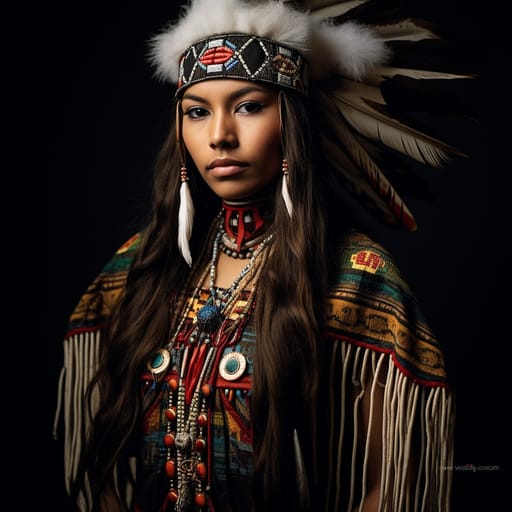
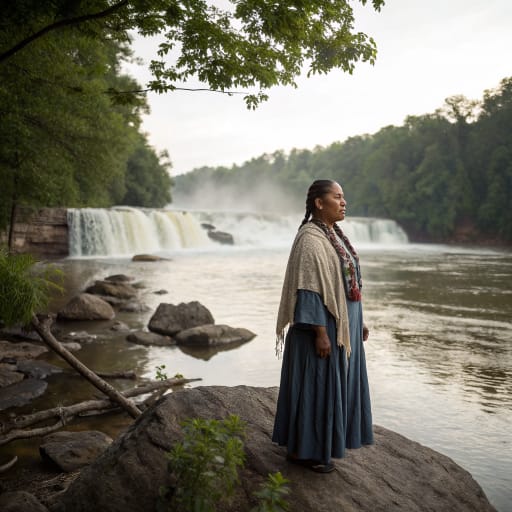
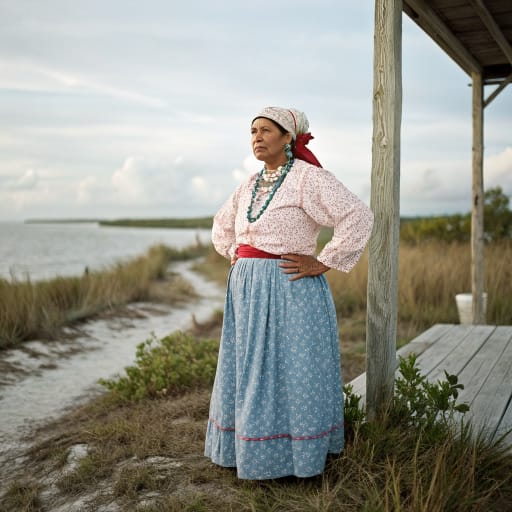
Typical Chitimacha Phenotypes
Reference for AI generation: hair, eyes, skin, facial structure, build
Chitimacha Body & Anatomy Reference
Anatomy by feature, Indigenous Northern American / Algonquian-Iroquoian phenotype
Chitimacha Boobs & Breasts
The typical Chitimacha bust is medium cup, moderate projection, in line with the wider Indigenous Northern American / Algonquian-Iroquoian pattern. Areolas usually fall in the 30-44mm range, with medium-brown areolar pigmentation against the copper-to-medium-brown skin tone. Compared with the smaller East Asian bust, Chitimacha breasts sit forward and are generally full and moderate projection. A faithful AI render of Chitimacha tits keeps that shape and areola size.
Chitimacha Ass & Hips
Butt shape among Chitimacha women: medium, moderate-to-full projection, over medium iliac crests. This follows Indigenous Northern American / Algonquian-Iroquoian ancestry and looks quite unlike the slim East Asian narrow-hip profile. An accurate Chitimacha ass in adult AI imagery keeps both the silhouette and the overall build (mesomorph, broader frame in northern Indigenous populations) instead of a generic average.
Chitimacha Vagina & Pussy
Vulvar anatomy among Chitimacha women: medium-brown labial pigmentation. Pubic hair tends to be straight medium-coarse texture, in the usual inverted-triangle pattern. Both follow Indigenous Northern American / Algonquian-Iroquoian pigmentation, which is why Chitimacha pussy renders should not fall back on a pale, sparse Western template.
Chitimacha Dicks & Penis
The Chitimacha cock profile, from Indigenous Northern American / Algonquian-Iroquoian anthropometric data: regional mean ~13cm erect; moderate girth; medium-brown shaft pigmentation. Pubic hair has a straight medium-coarse texture and forms the usual inverted-V pattern. Whether Chitimacha men are circumcised follows religious and cultural practice rather than phenotype.
Chitimacha Body, Curves & Build
Build and curves among Chitimacha women follow the Indigenous Northern American / Algonquian-Iroquoian pattern: mesomorph, broader frame in northern Indigenous populations, mean adult female BMI 25-28. Proportions matter as much as skin tone, so Chitimacha figures should keep their regional height and limb ratios.
Chitimacha Skin Tone & Hair Texture
The Chitimacha skin range is copper to medium-brown (Fitzpatrick III-V), and hair tends to be straight 1A, dark-brown to black, often thick and dense. That combination marks the Indigenous Northern American / Algonquian-Iroquoian phenotype, and skin tone is the trait AI generators most often get wrong for Chitimacha women.
Explore phenotype categories
Structured taxonomy with peer-reviewed scales · 22 anatomical categories
Erotic Poses & Sex Positions
From the pose catalog: 219 named positions with reference skeletons
Frequently asked questions about Chitimacha people
Where is the Chitimacha homeland?
The Chitimacha homeland is Atchafalaya Basin and lower Mississippi delta of south Louisiana, United States; today centered on the reservation at Charenton, St. Mary Parish in North America.
What language do Chitimacha people speak?
Chitimacha people primarily speak Chitimacha (language isolate, dormant since 1940 and under revitalization); English (Indo-European, Germanic).
What religion do Chitimacha people practice?
The predominant religion among Chitimacha people is Predominantly Roman Catholic, with traditional beliefs surviving in oral tradition.






Make your own Chitimacha images
Five a day, free, no credits to buy. The studio starts from this group's phenotype data, so you can set body type, pose and style and keep the traits accurate.
Start with Chitimacha