Help us get this right
Does this portrait look right for Buduma?
Nobody has judged this one yet. You would be the first.
Buduma Erotic
Islam
About Buduma People
The Buduma live on the islands of Lake Chad — a few hundred low, reed-fringed scraps of land scattered across the shrinking inland sea where Chad, Nigeria, Cameroon, and Niger converge. The name outsiders use, Buduma, means "people of the grass" in Kanuri, a reference to the papyrus that defines almost every part of their life. They call themselves Yedina. Calling them a fishing people undersells it: they are an aquatic people, in the sense that the lake, not the surrounding mainland, is the organizing fact of their existence. Houses sit on islands that themselves drift and reform; cattle are swum between pastures; the long, prowed kadei reed boats are bound, not built, and a Yedina who cannot handle one is unusual.
Their language, Yedina, belongs to the Chadic branch of Afroasiatic — the same broad family as Hausa, far to the south, though the two are not mutually intelligible. Within Chadic it sits in a small Kotoko-adjacent cluster, surrounded on all sides by Kanuri speakers (Saharan, a different family entirely) and by Shuwa Arabic. That linguistic island matches the geographic one. Most adult Buduma also speak Kanuri as a trade language, and increasingly Hausa or Arabic depending on which shore they market on.
Islam came late and gradually. Through much of the nineteenth century the Buduma had a reputation among the Bornu sultanate as raiders and cattle-thieves who used the lake as a refuge — the islands were difficult to police and easy to disappear into. Conversion through the late nineteenth and twentieth centuries was real but layered onto older practices around the lake itself, particularly around the Kuri cattle, a long-horned amphibious breed the Buduma developed and which is essentially unique to them. The Kuri's bulbous, buoyant horns let it swim long distances between island pastures; the breed is now endangered as the lake contracts.
That contraction is the modern story. Lake Chad has lost roughly nine-tenths of its surface area since the 1960s, and the Buduma, more than any other group on its shores, have had to absorb the consequences — failed islands, displaced households, and an insurgency (Boko Haram) that has used the same archipelago geography the Buduma once relied on for autonomy. The Yedina remain on the water where they can, but the water itself is no longer reliably there.
Related ethnic groups
Groups that share Buduma's homeland, region, language, or religious tradition. These are likely candidates for comparative phenotype reference.
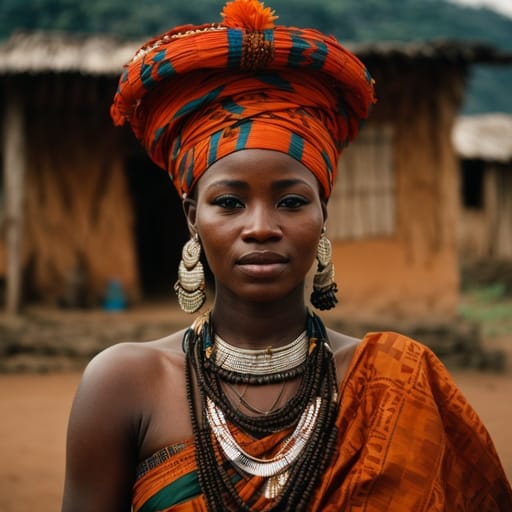
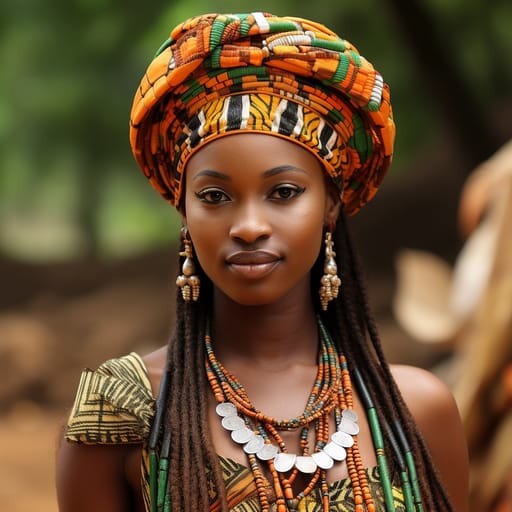
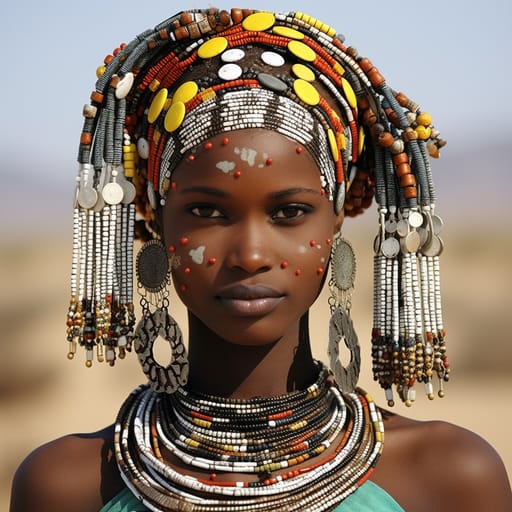
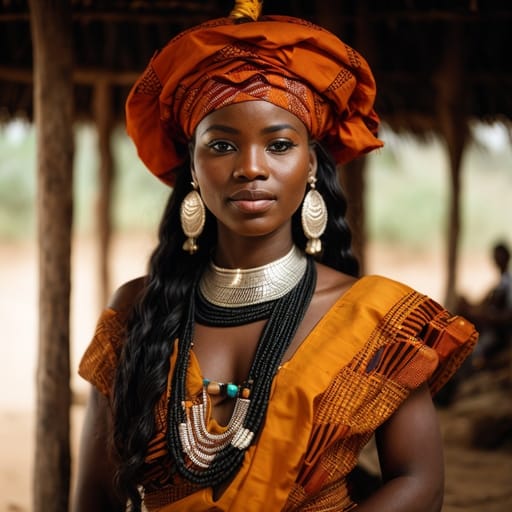
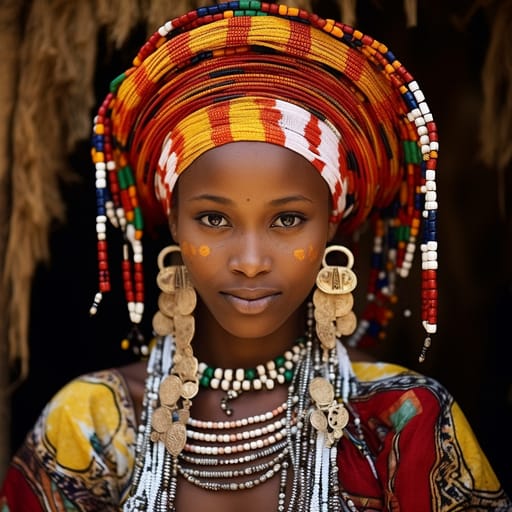
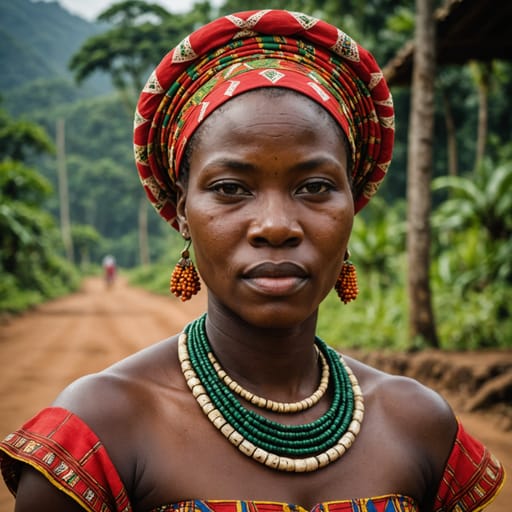
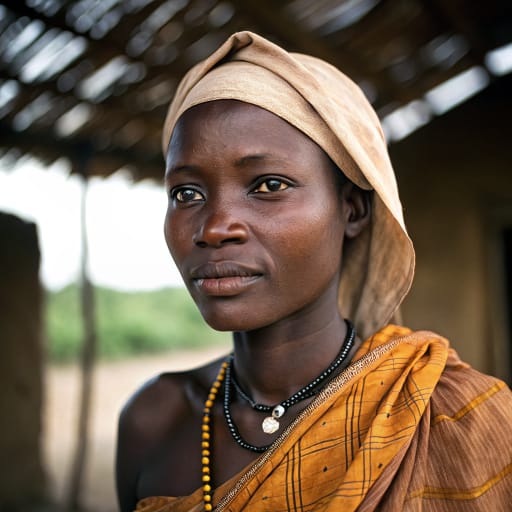
Typical Buduma Phenotypes
Reference for AI generation: hair, eyes, skin, facial structure, build
The Buduma — known to themselves as Yedina, "people of the grass" — are the island-dwelling fishers and cattle-herders of Lake Chad, and their phenotype reflects a long Sahelian Chadic ancestry with relatively little admixture from neighboring Kanuri or Arab populations. Skin tone sits at the dark end of the Sahelian range, Fitzpatrick VI, with cool blue-black or deep brown undertones rather than the reddish cast common further south in the Congo basin. The lake's intense reflected sunlight reinforces uniform pigmentation across the body; tan lines are minimal.
Hair is tightly coiled Type 4, typically 4B to 4C, worn close-cropped on men and frequently styled in cornrows, twisted plaits, or braided crests on women. Color runs a flat blue-black; natural lightening from sun and lake spray gives older fishermen a reddish-brown cast at the tips. Eyes are dark brown to near-black, with no epicanthic fold; eye shape tends to be wide-set and almond, set under a relatively flat brow ridge.
Facial structure is the Buduma's most recognizable signature. The face is narrow and long for a Central African population, with a notably tall forehead, high cheekbones, and a long, straight or slightly convex nose with a moderately narrow bridge — closer in form to Nilotic or Kanuri profiles than to forest-zone West African ones. Lips are full but not everted, and the jaw is finely tapered, giving an overall elongated rather than rounded look.
Build is the Sahelian fisher-pastoralist physique: tall, with men commonly 178–185 cm, women 165–172 cm, both with long limbs, narrow hips, and low body fat carried mostly on the shoulders and thighs from paddling reed canoes and wading. Musculature reads lean and stringy rather than bulky. Sub-group variation is modest — mainland-village Buduma trend slightly shorter and broader-featured than the island clans of Bol and Kuri, who keep the most attenuated, classically Yedina look.
Buduma Body & Anatomy Reference
Anatomy by feature, Bantu / Central African Niger-Congo phenotype
Buduma Boobs & Breasts
Buduma boobs follow the Bantu / Central African Niger-Congo profile: medium-to-large cup, full, projecting. Areolar diameter is usually 32-48mm, and the coloring is deep-brown areolar pigmentation against the deep-brown skin tone. Breast shape tracks body composition (mesomorph with strong gluteal-femoral fat deposition, mean adult female BMI 23-26), so Buduma breasts tend to be fuller projection than East African; comparable to West African norm. Expect a forward-set shape, not the smaller East African conical profile.
Buduma Ass & Hips
Buduma ass and hip morphology presents as full, projected, wide-set glutes, distinctly different from the slim narrow-hip Cushitic East African profile. The Buduma pelvic profile shows broad iliac crests, gynoid pelvic pattern, anchored in the Bantu / Central African Niger-Congo skeletal pattern. Buduma butt shots in adult AI imagery should render the full, projected, wide-set glutes silhouette with the overall build (mesomorph with strong gluteal-femoral fat deposition) and the fat distribution typical of the Bantu / Central African Niger-Congo phenotype.
Buduma Vagina & Pussy
Buduma pussy anatomy typically shows deep-brown labial pigmentation, fuller labia minora. Pubic hair is usually tightly-coiled coarse texture, dense distribution. In AI-generated Buduma nudes, labial color should blend into the deep-brown skin with a gradual transition, and the hair should keep its tightly-coiled coarse texture.
Buduma Dicks & Penis
Penis reference for Buduma men: regional mean ~14cm erect, above-average girth. Coloring: deep-brown shaft pigmentation. An accurate Buduma cock in AI imagery matches the surrounding deep-brown skin rather than a generic porn default. Circumcision depends on religion and custom, not ancestry.
Buduma Body, Curves & Build
The Buduma figure is generally mesomorph with strong gluteal-femoral fat deposition, with mean adult female BMI 23-26, characteristic of Bantu / Central African Niger-Congo ancestry. AI image tools tend to flatten regional body types into a few stock shapes; here the Buduma build is kept as its own reference.
Buduma Skin Tone & Hair Texture
Skin: deep-brown (Fitzpatrick VI). Hair: tight 4A-4C coil. Both are typical of Bantu / Central African Niger-Congo ancestry. The most common mistake in AI nudes of Buduma women is a body rendered lighter than the face.
Data depth
0/100Coverage of image-grounded phenotype observations · drives AI generation diversity
- Sample size
- 0/40· 0 images
- Image quality
- 0/30· 0% high
- Confidence
- 0/20
- Source diversity
- 0/10
- ·No image observations yet
Explore phenotype categories
Structured taxonomy with peer-reviewed scales · 22 anatomical categories
Erotic Poses & Sex Positions
From the pose catalog: 219 named positions with reference skeletons
Frequently asked questions about Buduma people
Where is the Buduma homeland?
The Buduma homeland is Lake Chad (Chad, Nigeria, Cameroon) in Central Africa.
What language do Buduma people speak?
Buduma people primarily speak Afroasiatic / Chadic / Yedina.
What religion do Buduma people practice?
The predominant religion among Buduma people is Islam.






Make your own Buduma images
Five a day, free, no credits to buy. The studio starts from this group's phenotype data, so you can set body type, pose and style and keep the traits accurate.
Start with Buduma