Help us get this right
Does this portrait look right for Bamum?
Nobody has judged this one yet. You would be the first.
Bamum Erotic
West Region (Cameroon)
Islam
About Bamum People
The Bamum are a kingdom people of the Cameroon Grassfields — the volcanic highlands northwest of Yaoundé where ridges and crater lakes break the country into a patchwork of small chiefdoms. Their seat is Foumban, and unlike most of their neighbors the Bamum have a written history of their own making. Around 1896, King Njoya invented a script — eventually called Shü-mom — to record the kingdom's chronicles, laws, and pharmacopoeia in a Bamum hand rather than in Latin or Arabic letters. The script went through several revisions, dropping from several hundred pictograms toward a tighter syllabary, and remains one of the very few indigenous African writing systems devised in the modern era. Manuscripts in Shü-mom still sit in the Foumban palace archives.
The language itself belongs to the Grassfields branch of Niger–Congo, closely related to the dozens of small Bamileke tongues spoken in the surrounding hills but distinct enough that Bamum and Bamileke are not casually mutually intelligible. Bamum is tonal, like its neighbors, and is the working language of Foumban's markets and palace court alongside French. Religion in the kingdom moves on two tracks. The dynasty converted to Islam in the early twentieth century — Njoya again, after a flirtation with Christianity — and most Bamum today are Muslim, though the older royal cult, with its masked societies and ancestral shrines, has not disappeared so much as braided itself into the Islamic calendar. The biennial Nguon festival, in which the king is ritually called to account by his subjects before being reaffirmed, predates Islam by centuries and is still the kingdom's defining public event.
Bamum craftsmanship has a particular reputation in the region: lost-wax brass casting, beaded thrones and pipes, carved double-faced masks, and the long-stemmed tobacco pipes that show up in nearly every museum collection of Cameroonian art. Foumban's artisan quarter is the most concentrated workshop district in the Grassfields and supplies dealers across West and Central Africa. The kingdom is structurally still a kingdom — the mfon reigns from a palace built in the 1910s in a mixed Sudano-Sahelian and local idiom — operating in parallel with the Cameroonian state rather than against it, an arrangement the Bamum have negotiated, more or less continuously, since the German colonial period.
Related ethnic groups
Groups that share Bamum's homeland, region, language, or religious tradition. These are likely candidates for comparative phenotype reference.
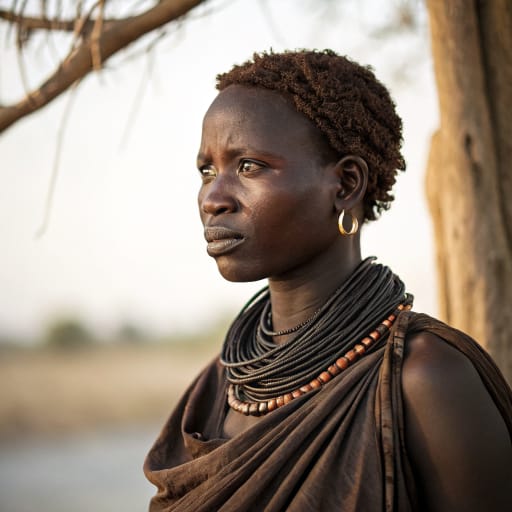
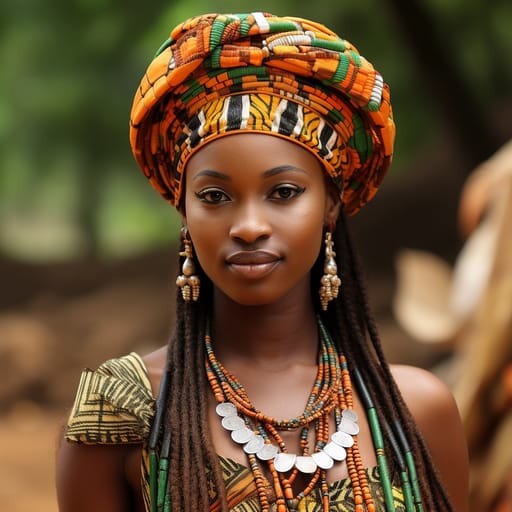
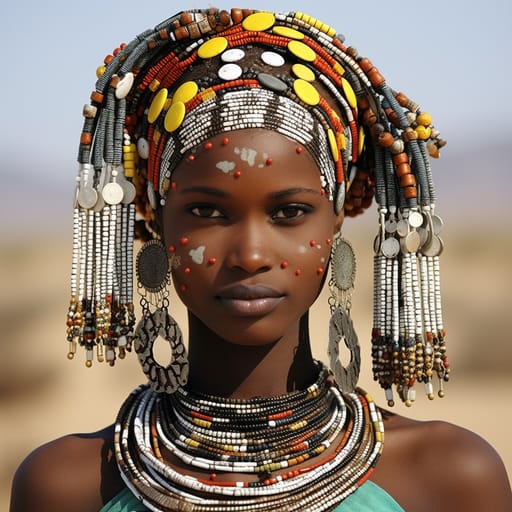
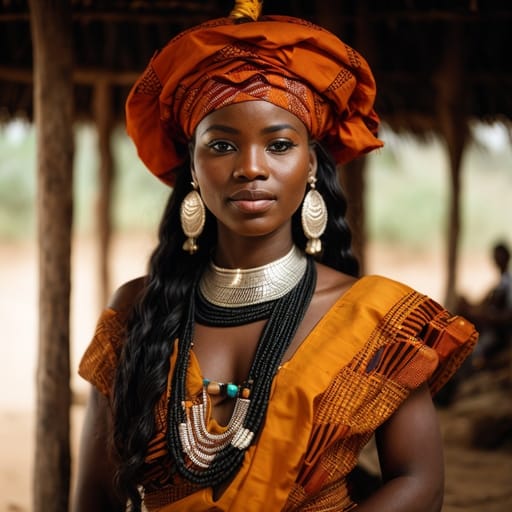
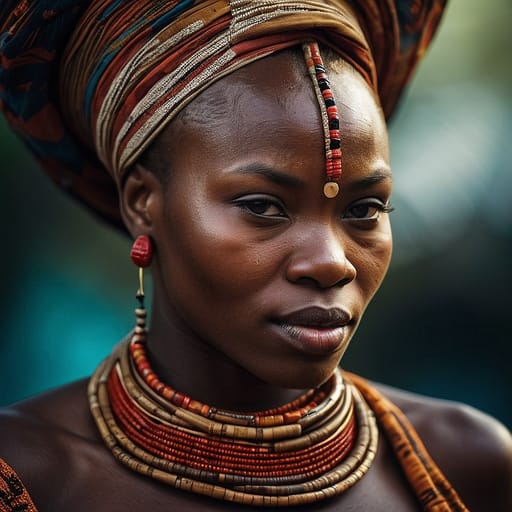
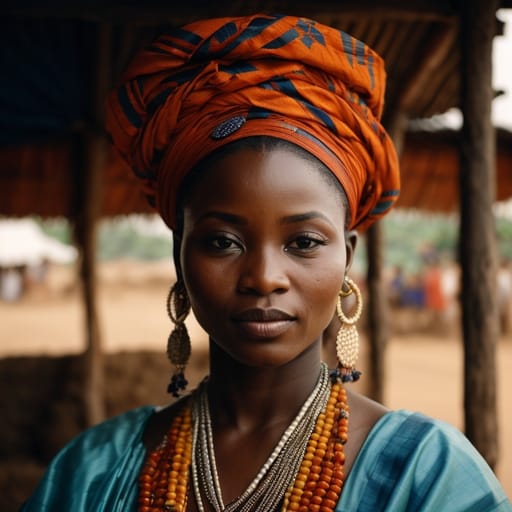
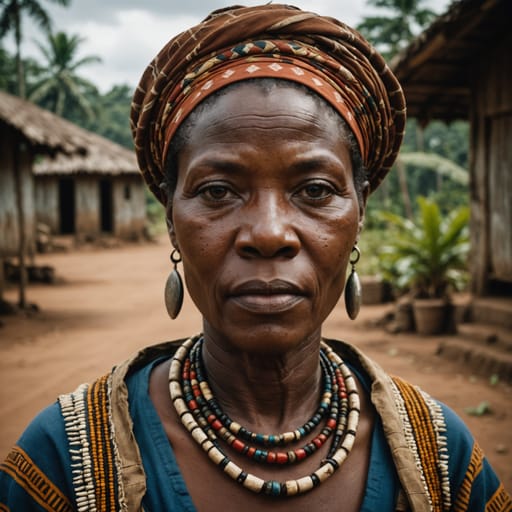
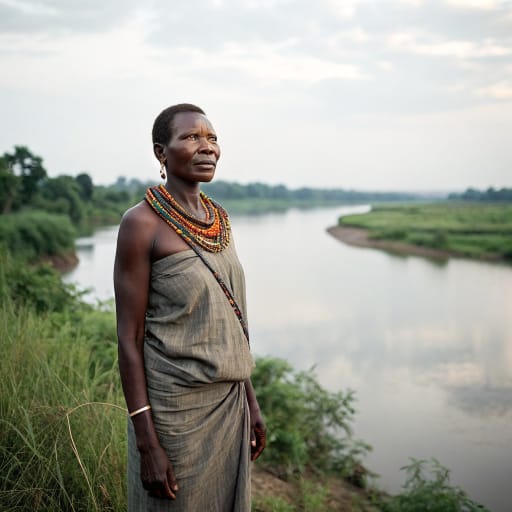
Typical Bamum Phenotypes
Reference for AI generation: hair, eyes, skin, facial structure, build
The Bamum are a Grassfields people of Cameroon's western highlands, and their phenotype reflects that plateau geography — a population shaped by long settlement on volcanic uplands rather than the lowland forest belt. Skin tone runs deep brown to very dark brown, predominantly Fitzpatrick VI with a smaller share at the lighter end of V; undertones lean warm, with a reddish-mahogany cast more common than the cool blue-black register seen further south in Equatorial forest groups. Hair is uniformly Type 4 — tightly coiled, often Type 4C with the densest spring pattern — and color sits in true black, with grey appearing later than average and rarely any natural brown. Eye color is overwhelmingly dark brown to near-black; epicanthic folds are absent, and the eye opening tends to be moderately wide with a clean upper crease.
Facial architecture is one of the more distinctive Grassfields signatures. Cheekbones are broad and high-set, the midface carries real width, and the jaw is square rather than tapered — a heavier, more sculpted bone structure than you typically see in coastal Bantu populations. Noses are broad with a low-to-medium bridge and full alar wings, though a noticeable minority show a more bridged, narrower nose linked to the older royal lineages of Foumban. Lips are full top and bottom, with a well-defined vermilion border. Foreheads read tall and slightly rounded.
Build is medium to medium-tall — adult men commonly 170–178 cm, women 158–165 cm — with broad shoulders, fairly long limbs, and lower body fat than neighboring forest populations; muscle tends to attach densely, giving a solid, compact frame rather than a lean one. The clearest internal variation is between the aristocratic Foumban core and the surrounding peasant villages: the palace lineages historically intermarried with neighboring Tikar and Fulani Muslim populations, producing somewhat lighter skin, narrower features, and finer hair texture than the broader Bamum population around them.
Bamum Body & Anatomy Reference
Bantu / Central African Niger-Congo phenotype: anatomy reference for AI nude generation
Bamum Boobs & Breasts
Bamum boobs follow the Bantu / Central African Niger-Congo profile: medium-to-large cup, full, projecting. Areolar diameter is usually 32-48mm, and the coloring is deep-brown areolar pigmentation against the deep-brown skin tone. Breast shape tracks body composition (mesomorph with strong gluteal-femoral fat deposition, mean adult female BMI 23-26), so Bamum breasts tend to be fuller projection than East African; comparable to West African norm. Expect a forward-set shape, not the smaller East African conical profile.
Bamum Ass & Hips
Bamum ass and hip morphology presents as full, projected, wide-set glutes, distinctly different from the slim narrow-hip Cushitic East African profile. The Bamum pelvic profile shows broad iliac crests, gynoid pelvic pattern, anchored in the Bantu / Central African Niger-Congo skeletal pattern. Bamum butt shots in adult AI imagery should render the full, projected, wide-set glutes silhouette with the overall build (mesomorph with strong gluteal-femoral fat deposition) and the fat distribution typical of the Bantu / Central African Niger-Congo phenotype.
Bamum Vagina & Pussy
Bamum pussy anatomy typically shows deep-brown labial pigmentation, fuller labia minora. Pubic hair is usually tightly-coiled coarse texture, dense distribution. In AI-generated Bamum nudes, labial color should blend into the deep-brown skin with a gradual transition, and the hair should keep its tightly-coiled coarse texture.
Bamum Dicks & Penis
Penis reference for Bamum men: regional mean ~14cm erect, above-average girth. Coloring: deep-brown shaft pigmentation. An accurate Bamum cock in AI imagery matches the surrounding deep-brown skin rather than a generic porn default. Circumcision depends on religion and custom, not ancestry.
Bamum Body, Curves & Build
The Bamum figure is generally mesomorph with strong gluteal-femoral fat deposition, with mean adult female BMI 23-26, characteristic of Bantu / Central African Niger-Congo ancestry. AI image tools tend to flatten regional body types into a few stock shapes; here the Bamum build is kept as its own reference.
Bamum Skin Tone & Hair Texture
Skin: deep-brown (Fitzpatrick VI). Hair: tight 4A-4C coil. Both are typical of Bantu / Central African Niger-Congo ancestry. The most common mistake in AI nudes of Bamum women is a body rendered lighter than the face.
Data depth
0/100Coverage of image-grounded phenotype observations · drives AI generation diversity
- Sample size
- 0/40· 0 images
- Image quality
- 0/30· 0% high
- Confidence
- 0/20
- Source diversity
- 0/10
- ·No image observations yet
Explore phenotype categories
Structured taxonomy with peer-reviewed scales · 22 anatomical categories
Erotic Poses & Sex Positions
From the pose catalog: 219 named positions with reference skeletons
Frequently asked questions about Bamum people
Where is the Bamum homeland?
The Bamum homeland is West Region (Cameroon) in Central Africa.
What language do Bamum people speak?
Bamum people primarily speak Niger-Congo / Grassfields / Bamum.
What religion do Bamum people practice?
The predominant religion among Bamum people is Islam.






Make your own Bamum images
Five a day, free, no credits to buy. The studio starts from this group's phenotype data, so you can set body type, pose and style and keep the traits accurate.
Start with Bamum