Help us get this right
Does this portrait look right for Bagyeli?
Nobody has judged this one yet. You would be the first.
Bagyeli Erotic
Ocean department, South Region, southern Cameroon
Gyele (Kola), a Bantu language (A80)
Traditional animism
Bakola
About Bagyeli People
The Bagyeli, also known as the Bakola or Gyele, are a forest-dwelling hunter-gatherer people of southern Cameroon, with related communities extending toward Equatorial Guinea. They are one of several Central African peoples historically grouped under the collective label Pygmy, a term that refers to characteristically short stature rather than to any single culture or origin. The Bagyeli inhabit the dense equatorial rainforest of the coastal hinterland, especially the Ocean department of Cameroon's South Region, where their numbers are usually estimated in the low thousands.
They speak Gyele (also called Kola), a Bantu language of the A80 group, which is unusual among forest foragers who often share the language of neighbouring farmers. Many Bagyeli are bilingual in the tongues of the Bantu agriculturalists, such as the Bulu, Ngumba, and Fang, with whom they maintain longstanding exchange relationships.
Society and subsistence
Traditionally the Bagyeli live in small, mobile bands organised around kinship, moving seasonally through the forest to hunt, gather, and fish. Men take game such as duiker, monkeys, and forest pigs using nets, spears, crossbows, and snares, while women and children gather wild yams, nuts, honey, mushrooms, and caterpillars. Deep botanical and zoological knowledge underpins both their diet and a rich pharmacopoeia of medicinal plants. They stand in a complex, often unequal patron-client relationship with settled villagers, trading forest products, meat, and labour for iron tools, salt, cultivated food, and manufactured goods. Leadership is informal and egalitarian, reached by consensus, with no hereditary chiefs. In recent decades, logging, plantation agriculture, conservation zoning, and pressure to settle along roads have eroded their forest access and threatened this way of life.
Appearance and adornment
Like other Central African forest foragers, the Bagyeli are of short stature, with dark brown skin, compact muscular builds, and tightly coiled hair. Traditional attire was minimal and suited to the humid forest: loincloths of pounded bark cloth or plant fibre, at times supplemented with simple strings of beads, seeds, or plant ornaments. Bodies might be marked with vegetable dyes for ritual occasions such as hunts, dances, and initiations. Music, polyphonic singing, and dance remain central to Bagyeli social and spiritual life. Their religion is animist, centred on forest spirits and a benevolent forest understood as provider and protector, engaged through ritual specialists and communal ceremony.
Related ethnic groups
Groups that share Bagyeli's homeland, region, language, or religious tradition. These are likely candidates for comparative phenotype reference.
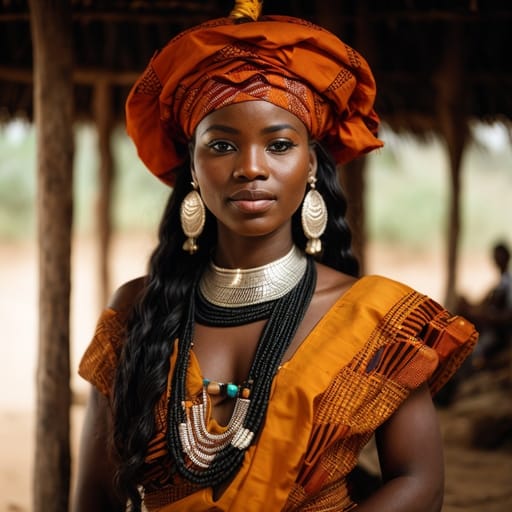
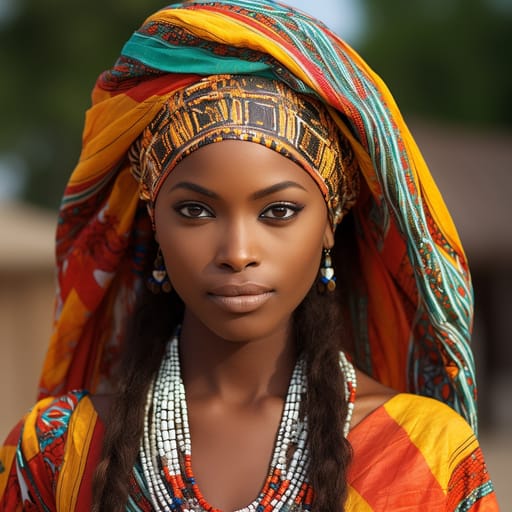
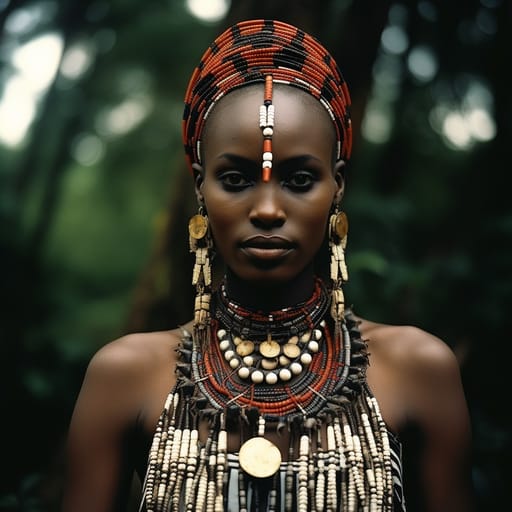
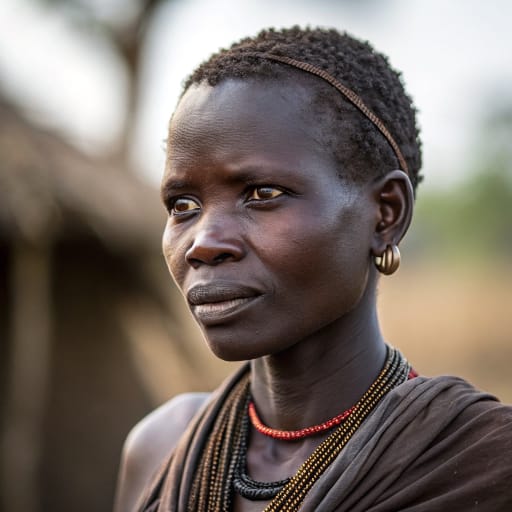
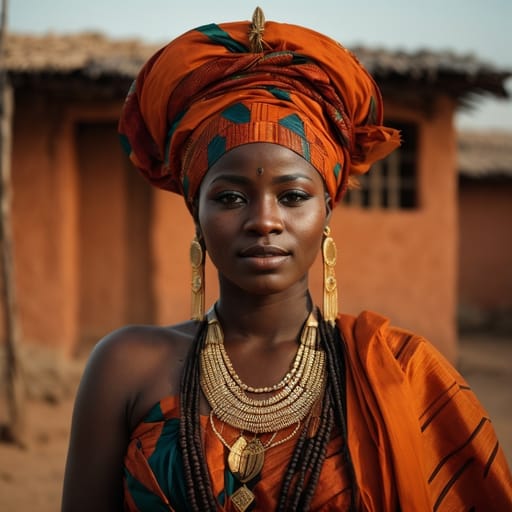
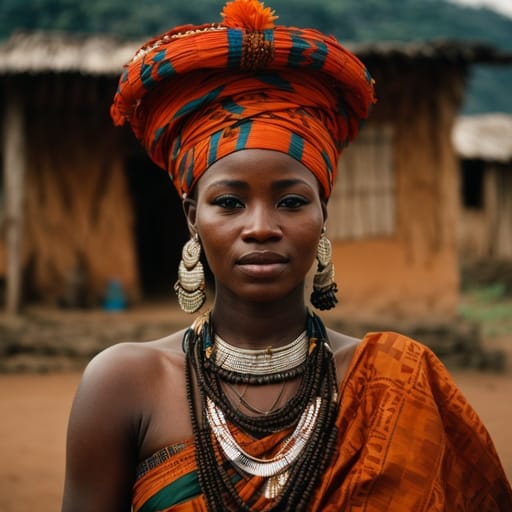
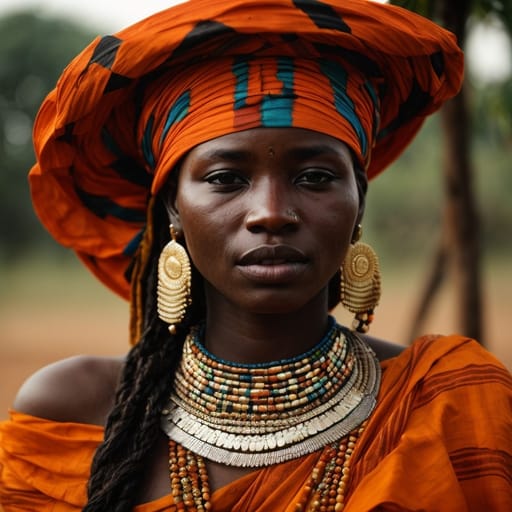
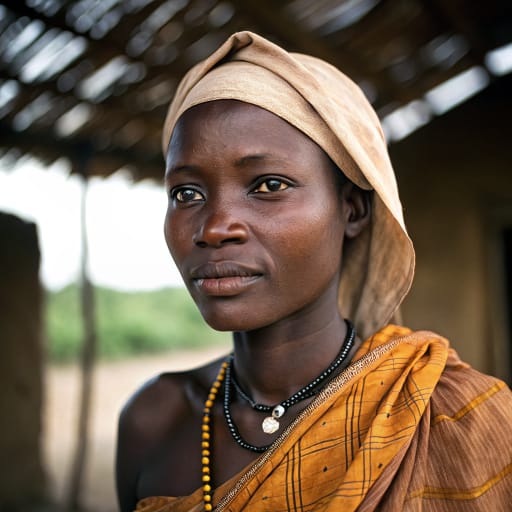
Typical Bagyeli Phenotypes
Reference for AI generation: hair, eyes, skin, facial structure, build
Bagyeli Body & Anatomy Reference
Per-feature anatomical profile for AI nude generation: Bantu / Central African Niger-Congo phenotype
Bagyeli Boobs & Breasts
Bust reference for Bagyeli women: medium-to-large cup, full, projecting, which is typical of Bantu / Central African Niger-Congo ancestry. Areolas measure about 32-48mm across, with deep-brown pigmentation. Body type (mesomorph with strong gluteal-femoral fat deposition) shapes the bust as well, so Bagyeli tits are usually fuller projection than East African; comparable to West African norm. In AI imagery, keep the forward-set shape rather than drifting toward the smaller East African conical profile.
Bagyeli Ass & Hips
The Bagyeli ass is typically full, projected, wide-set glutes, which sets it apart from the slim narrow-hip Cushitic East African profile. Underneath, the pelvis shows broad iliac crests, gynoid pelvic pattern, part of the Bantu / Central African Niger-Congo skeletal pattern. For Bagyeli butt pics and AI renders, match that silhouette and the overall build (mesomorph with strong gluteal-femoral fat deposition).
Bagyeli Vagina & Pussy
Bagyeli pussy and vulvar anatomy presents deep-brown labial pigmentation, fuller labia minora, consistent with the Bantu / Central African Niger-Congo phenotype's pigmentation pattern. Bagyeli pubic hair is typically tightly-coiled coarse texture, dense distribution, in the inverted-triangle pattern. For anatomically accurate Bagyeli pussy renders the labial coloration should match the surrounding deep-brown skin tone with a continuous gradient, and the hair should keep its tightly-coiled coarse texture.
Bagyeli Dicks & Penis
Bagyeli dicks follow the Bantu / Central African Niger-Congo reference data: regional mean ~14cm erect; above-average girth; deep-brown shaft pigmentation. Shaft color should track the deep-brown skin tone with a smooth change toward the glans, and Bagyeli pubic hair keeps its tightly-coiled coarse texture.
Bagyeli Body, Curves & Build
Bagyeli body type and overall build presents as mesomorph with strong gluteal-femoral fat deposition, with mean adult female BMI 23-26: the characteristic Bantu / Central African Niger-Congo habitus. Bagyeli curves and proportions should keep the regional skeletal frame (height, shoulder-to-hip ratio, limb proportions) rather than a generic mesomorph default.
Bagyeli Skin Tone & Hair Texture
Bagyeli skin sits in the deep-brown (Fitzpatrick VI) band. Hair is typically tight 4A-4C coil, in keeping with the Bantu / Central African Niger-Congo phenotype. In nude renders the skin should stay one even tone from face to body, and body, pubic and head hair should match.
Explore phenotype categories
Structured taxonomy with peer-reviewed scales · 22 anatomical categories
Erotic Poses & Sex Positions
From the pose catalog: 219 named positions with reference skeletons
Frequently asked questions about Bagyeli people
Where is the Bagyeli homeland?
The Bagyeli homeland is Ocean department, South Region, southern Cameroon in Central Africa.
What language do Bagyeli people speak?
Bagyeli people primarily speak Gyele (Kola), a Bantu language (A80).
What religion do Bagyeli people practice?
The predominant religion among Bagyeli people is Traditional animism.






Make your own Bagyeli images
Five a day, free, no credits to buy. The studio starts from this group's phenotype data, so you can set body type, pose and style and keep the traits accurate.
Start with Bagyeli