Help us get this right
Does this portrait look right for Luba?
One tap. It takes a second and it is recorded.
1 says it looks right, 0 say it looks off.
Luba Erotic
Lubaland (Democratic Republic of the Congo)
Christianity
Luba-Kasai, Luba-Katanga, Hemba (including Bangubangu), Songe, Lulua
About Luba People
The Luba are not a single community so much as a family of related peoples who trace themselves back to the savannah and lake country of south-central Congo — the broad belt around the upper Lualaba and the Kasai headwaters that outsiders eventually labeled Lubaland. The name covers several distinct branches: the Luba-Katanga to the southeast around the lakes, the much larger Luba-Kasai to the west, and the Hemba, Songe, and Lulua, each with their own dialects, sculptural traditions, and political memory. They speak languages of the Luban cluster within Bantu, close enough that a Luba-Kasai speaker and a Luba-Katanga speaker can usually find common ground, distant enough that linguists treat them as separate tongues rather than dialects of one.
What holds the cluster together is less a shared modern identity than a shared origin story. The Luba kingdom that emerged around Lake Kisale in the fifteenth and sixteenth centuries left a political grammar that radiated outward — a model of sacred kingship called bulopwe, in which legitimate rule was understood as a substance inherited through specific bloodlines, conferred in specific rites, and impossible to fake. That kingdom collapsed under the slave-raiding pressures of the nineteenth century and the colonial carve-up that followed, but its institutional vocabulary survived in the courts of dozens of smaller polities. So did its mnemonic culture: the lukasa, a hand-held wooden board studded with beads and pins, was used by members of the Mbudye association to encode genealogies, migration routes, and royal lists — a tactile archive read by trained specialists rather than written down.
Most Luba today are Christian, predominantly Catholic in the Kasai and a mix of Catholic and Protestant in Katanga, with the Kimbanguist church drawing significant numbers as well. The older religious world — ancestral veneration, the spirits called vidye, divination through bowls and figurines — has not so much been displaced as folded into the background, surfacing at funerals, illnesses, and succession disputes. The twentieth century was hard on the Luba in particular ways: the Kasai diamond economy pulled labor out of the villages, the Katanga secession of the 1960s drew Luba-Katanga into a war that ended badly for them, and the anti-Luba pogroms in Katanga in the early 1990s sent hundreds of thousands of Luba-Kasai families fleeing back toward Kasai with what they could carry. That displacement is recent enough to still shape who lives where.
Related ethnic groups
Groups that share Luba's homeland, region, language, or religious tradition. These are likely candidates for comparative phenotype reference.
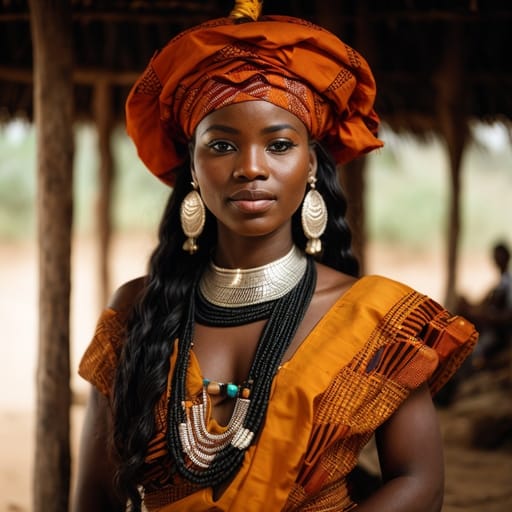
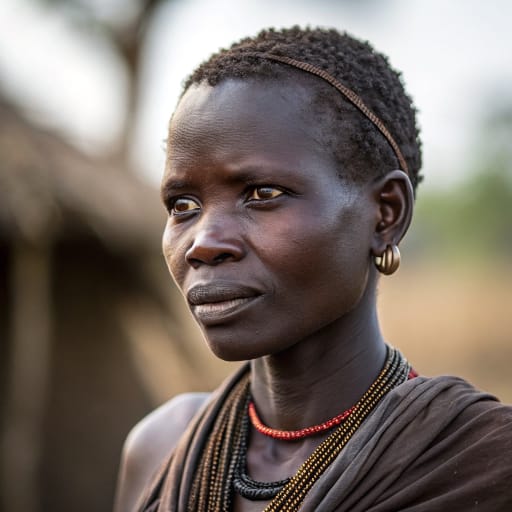
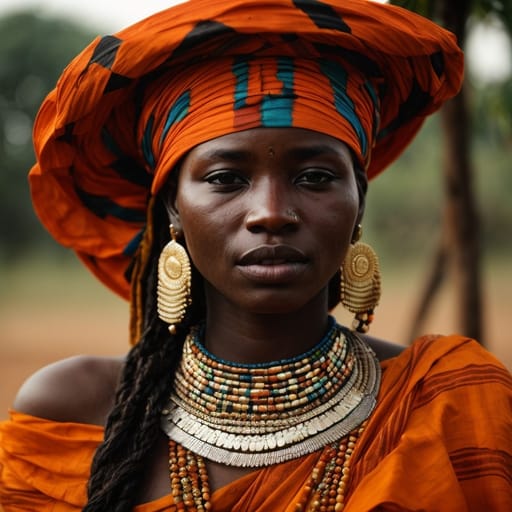
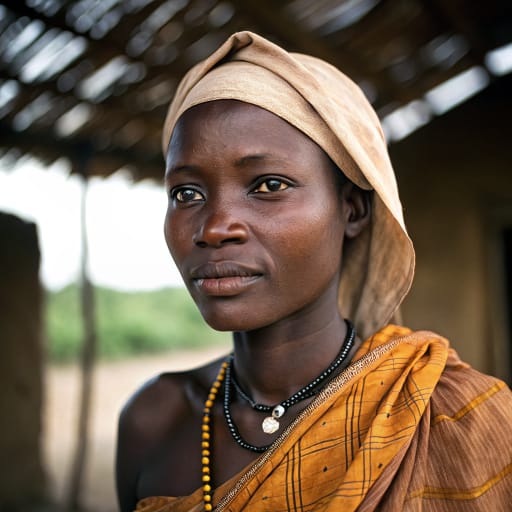
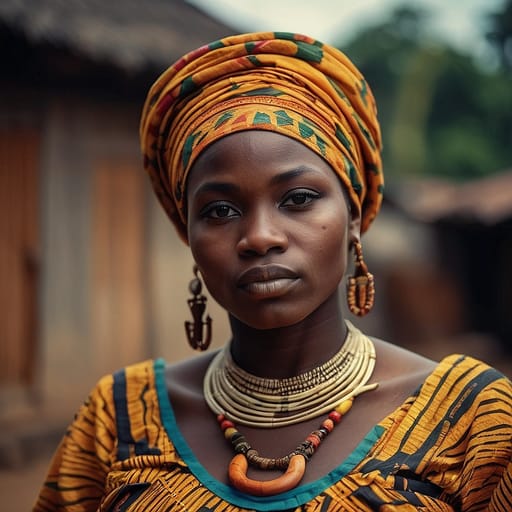
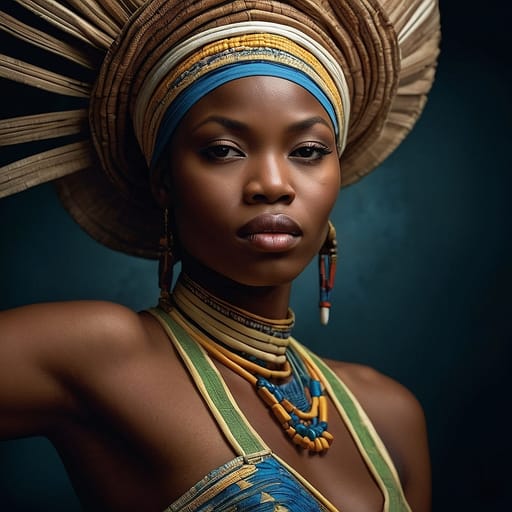
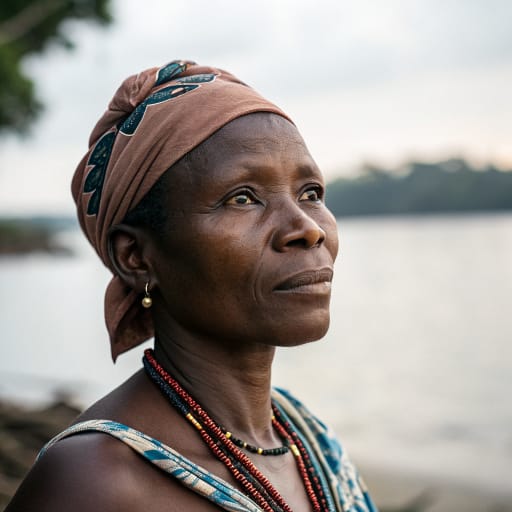
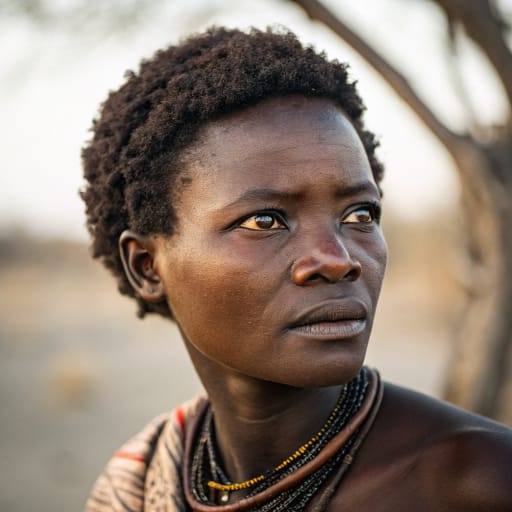
Geographic Distribution: Luba populations across 1 country
Each row is ranked by the group's share of that country's population, with the source citation drawn from published census and demographic surveys. Click through for the full per-country phenotype profile.
| Country | Share | Source |
|---|---|---|
| Democratic Republic of the Congo | 18.0% | DRC demographic estimates (DRC has not had a comprehensive census since 1984); Luba (~18%, ~18M+ of ~100M+ total). Bantu / Tshiluba language. Concentrated in Kasaï region |
Typical Luba Phenotypes
Reference for AI generation: hair, eyes, skin, facial structure, build
The Luba phenotype sits firmly in the Central Bantu visual range, with the structural signatures that come from a population centered for centuries on the savanna-forest mosaic of the southern Congo basin. Skin tone runs predominantly in the Fitzpatrick V–VI band — deep brown to near-black, with warm red-brown or olive undertones rather than the cooler blue-black common further east in the Nilotic belt. Dikembe Mutombo offers a useful anchor: very dark, matte-finished skin with a high-set, broad-boned face that reads instantly as Central African rather than West African.
Hair is almost uniformly Type 4 — tightly coiled, fine-to-medium strand diameter, with the dense afro-textured pattern that holds sculpted shapes well; this is the hair tradition behind the elaborate stepped and crested coiffures Luba artisans carved into their headrests and ancestor figures. Natural color is black to very dark brown; reddish sun-bleached tips appear on children and outdoor workers. Eyes are dark brown to near-black, almond-shaped, set under a moderately prominent brow with no epicanthic fold and only occasional mild upper-lid hooding.
Facial structure is the most distinctive register. Cheekbones are wide and high, the midface relatively flat, and the jaw squared rather than tapered — a bone architecture echoed almost literally in classical Luba sculpture. Noses tend to a low-to-moderate bridge with broad alar wings and rounded tips; lips are full on both upper and lower, with a clearly defined vermilion border. Foreheads read tall and rounded.
Build is typically lean-muscular and long-limbed, with narrow hips and broad shoulders; documented stature skews tall for the region, and the basketball-and-football pipeline (Mutombo, Ilunga, Mulamba) reflects a real anthropometric tendency rather than selection bias alone. Subgroup variation is subtle but visible: Luba-Katanga and Hemba populations trend taller and more gracile, while Luba-Kasai and Lulua often show slightly broader, more compact builds and somewhat fuller facial features. Songe individuals frequently fall between the two.
Luba Body & Anatomy Reference
Anatomy by feature, Bantu / Central African Niger-Congo phenotype
Luba Boobs & Breasts
Luba tits and boobs run medium-to-large cup, full, projecting, the classic Bantu / Central African Niger-Congo bust profile. Luba nipples and areolas show deep-brown areolar pigmentation against the deep-brown skin tone, with areolar diameter typically in the 32-48mm range and forward-set positioning rather than the smaller East African conical profile. Luba breasts trend fuller projection than East African; comparable to West African norm, a function of the mesomorph with strong gluteal-femoral fat deposition body habitus and the mean adult female BMI 23-26. For anatomically accurate AI-generated Luba nudes the render preserves the medium-to-large cup, full, projecting shape, 32-48mm areolas with deep-brown pigmentation, and the torso proportions of the Bantu / Central African Niger-Congo phenotype.
Luba Ass & Hips
Luba hips and butt usually read as full, projected, wide-set glutes. The skeletal base is broad iliac crests, gynoid pelvic pattern, the Bantu / Central African Niger-Congo pattern. Set against the slim narrow-hip Cushitic East African profile, the difference is easy to see, and the hip-to-waist ratio is often what identifies Luba women in photos.
Luba Vagina & Pussy
Expect deep-brown labial pigmentation, fuller labia minora on Luba women, in keeping with Bantu / Central African Niger-Congo ancestry. The pubic hair is tightly-coiled coarse texture, dense distribution. Coloring should run evenly from the deep-brown skin of the thighs to the labia, and Luba nude imagery should keep the hair's tightly-coiled coarse texture.
Luba Dicks & Penis
Luba dick and penile anatomy in adult AI generation should anchor on the regional reference data: regional mean ~14cm erect, above-average girth, and deep-brown shaft pigmentation. The Luba cock profile reflects the Bantu / Central African Niger-Congo population's anthropometric measurements. The shaft pigmentation should track the surrounding deep-brown skin tone, and the pubic hair should keep its tightly-coiled coarse texture in the typical inverted-V escutcheon.
Luba Body, Curves & Build
Luba body type: mesomorph with strong gluteal-femoral fat deposition, with mean adult female BMI 23-26. This is the typical Bantu / Central African Niger-Congo build. Height range, shoulder-to-hip ratio and fat distribution all follow from it, which is what an accurate Luba nude body should show.
Luba Skin Tone & Hair Texture
Luba skin tone falls in the deep-brown (Fitzpatrick VI) band, the surface signal most often miscalibrated by generic AI nude generators. Luba hair texture is typically tight 4A-4C coil, characteristic of the Bantu / Central African Niger-Congo phenotype. In Luba nude renders the skin should hold that band consistently across the body.
Data depth
49/100Coverage of image-grounded phenotype observations · drives AI generation diversity
- Sample size
- 22/40· 13 images
- Image quality
- 12/30· 23% high
- Confidence
- 15/20· mean 0.78
- Source diversity
- 0/10· wikipedia
- ·Modest sample (n<25)
- ·Mostly low-quality source images
- ·Wikipedia-only source, not population-representative
Observed Distribution: Image Sample
Empirical observations from analyzed photographs · supplementary signal, not population truth
Sample: 13 images analyzed (13 wikipedia). Quality: 3 high, 7 medium, 3 low, 0 very_low. Avg analyzer confidence: 0.78.
Skin tone (Fitzpatrick): VI (100%)
Hair color: black (85%), gray/white (15%)
Hair texture: coily (92%), covered (8%)
Eye color: dark brown (100%)
Epicanthic fold: 0% present, 100% absent, 0% unclear
Caveats: Sample size 13 is modest, so secondary patterns may not be reliable. Quality skews toward older or low-resolution photos; phenotype detail may be lossy. Sample is 100% Wikipedia notable people, which skews toward male, public-life, and modern figures, not population-representative.
Last aggregated: May 7, 2026
Explore phenotype categories
Structured taxonomy with peer-reviewed scales · 22 anatomical categories
Notable Luba People
21 reference figures, sourced from Wikipedia
- Herita Ilunga, footballer
- Albert Kalonji, politician, elected Mulopwe of Kasai
- Bill Clinton Kalonji, musician
- Jean-Bedel Mpiana wa Tshituka, musician founder of Ndombolo
- Grand Kalle, musician
- Pepe Kalle, musician
- Nico Kasanda, musician
- Oscar Kashala, politician
- Évariste Kimba, journalist and politician
- Gabriel Kyungu wa Kumwanza, politician
- Dieudonné Kayembe Mbandakulu, Lieutenant General of the Armed Forces of the Democratic Republic of Congo
- Tshala Muana, musician
- Ndaye Mulamba, footballer
- Dikembe Mutombo, basketball player
- Jean Kalala N'Tumba, footballer
- John Numbi, Military General in DRC
- Jason Sendwe, politician ex President of Balubakat
- Laurent Desire Kabila, 3rd president of DRC ex President of Jeunesse Balubakat
- Étienne Tshisekedi wa Mulumba, He founded the Union for Democracy and Social Progress (UDPS) in 1982, the co…
- Joseph Kabila Kabange, 4th president of DRC
- Félix Antoine Tshisekedi Tshilombo, 5th president of DRC
Erotic Poses & Sex Positions
From the pose catalog: 219 named positions with reference skeletons
Frequently asked questions about Luba people
Where is the Luba homeland?
The Luba homeland is Lubaland (Democratic Republic of the Congo) in Central Africa.
What countries do Luba people live in?
Luba populations are documented across 1 country: Democratic Republic of the Congo.
What language do Luba people speak?
Luba people primarily speak Niger-Congo / Bantu / Luban.
What religion do Luba people practice?
The predominant religion among Luba people is Christianity.






Make your own Luba images
Five a day, free, no credits to buy. The studio starts from this group's phenotype data, so you can set body type, pose and style and keep the traits accurate.
Start with Luba