Help us get this right
Does this portrait look right for Bagirmi?
Nobody has judged this one yet. You would be the first.
Bagirmi Erotic
The Chari-Baguirmi region of southwestern Chad, along the lower Chari River southeast of N'Djamena, centered on the old royal town of Massenya.
Bagirmi, or Tar Barma (Central Sudanic, Sara-Bagirmi branch); Chadian Arabic is widely spoken as a second language.
Sunni Islam.
Speakers of the Bagirmi languages within the Sara-Bagirmi group, related to the Kenga, Naba, Disa and other nearby peoples, with wider language kinship to the Sara.
About Bagirmi People
The Barma, known to outsiders as the Bagirmi, share their name with a kingdom. For more than three centuries the Sultanate of Baguirmi ruled the flat country along the lower Chari River southeast of what is now N'Djamena. Being Barma still means belonging to the people who formed its core. The mbang, the sultan, still has his seat at Massenya. The office lost its political power under the French, but it remains the center of Barma identity and ceremony.
The kingdom took shape in the early sixteenth century. Islam came in through the court and spread out to the villages over generations. Today the Barma are Sunni Muslims, and the faith sets the pattern for prayer, dress, marriage and the yearly calendar. Baguirmi was never the strongest state in the Lake Chad basin. For long stretches it paid tribute to Bornu to the west or Wadai to the east. Much of its own wealth came from raiding the non-Muslim peoples to the south for captives, the Sara above all. Southern Chad has not forgotten that history.
The late nineteenth century nearly finished the kingdom. Wadai sacked Massenya in the 1870s. In the 1890s the Sudanese warlord Rabih az-Zubayr swept through and left the country in ruins. In 1897 Mbang Gaourang signed a protectorate treaty with France, betting that the French would help him outlast Rabih. The bet paid off when Rabih was killed at Kousséri in 1900, but the price was colonial rule, and the sultanate became a traditional office inside a French colony.
The Barma language, Tar Barma, belongs to the Sara-Bagirmi branch of the Central Sudanic family. That makes it a cousin of the Sara languages, spoken by the very peoples the kingdom once raided. It is unrelated to most of what surrounds it: Chadic languages such as Kotoko to the west, Kanembu to the north, and Chadian Arabic. Many Barma speak Chadian Arabic as a second language, since it is the common tongue of markets and towns across the region.
Village life follows the river and the rains. Families grow millet and sorghum, fish the Chari and its floodplain, and keep cattle and goats. Arab herding communities share Chari-Baguirmi with them, and Barma farmers and Arab herders have lived side by side on the same land for generations, trading, intermarrying and sometimes clashing over fields and grazing.
Related ethnic groups
Groups that share Bagirmi's homeland, region, language, or religious tradition. These are likely candidates for comparative phenotype reference.
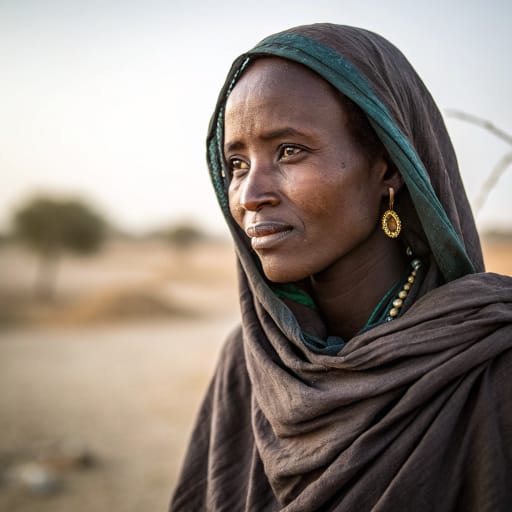
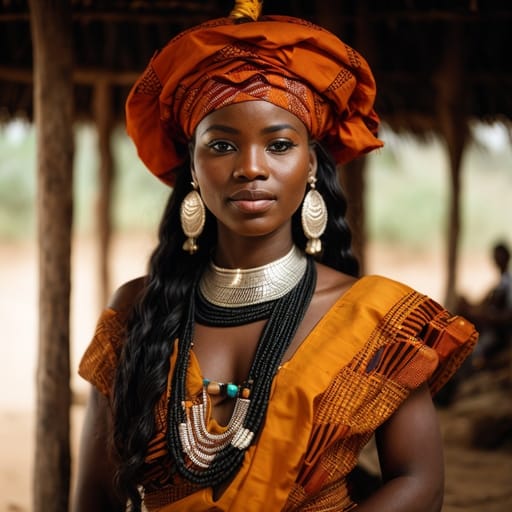
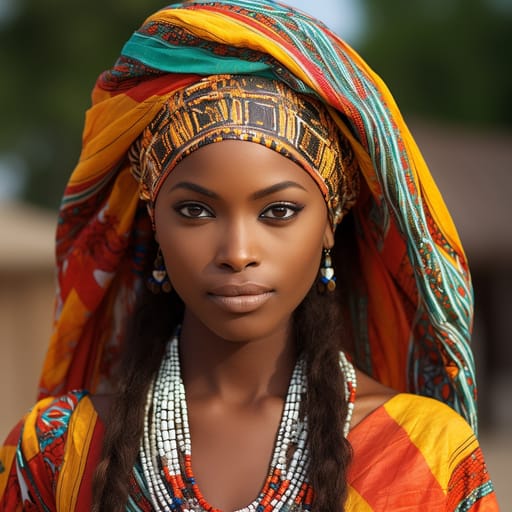
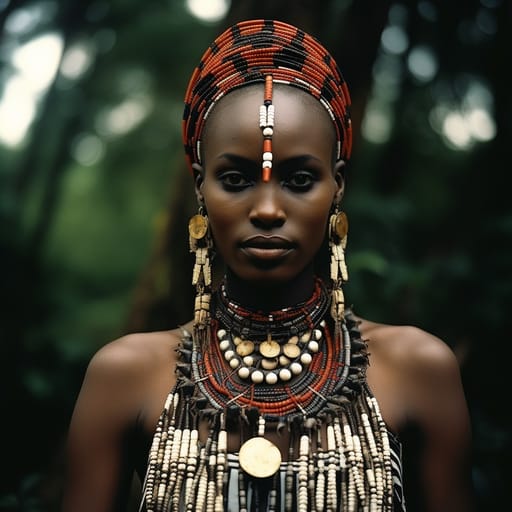
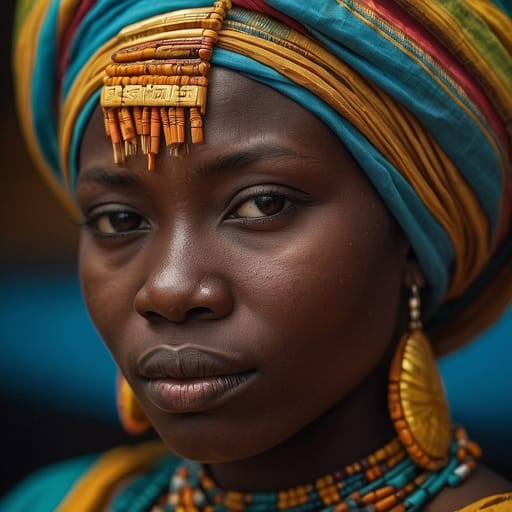
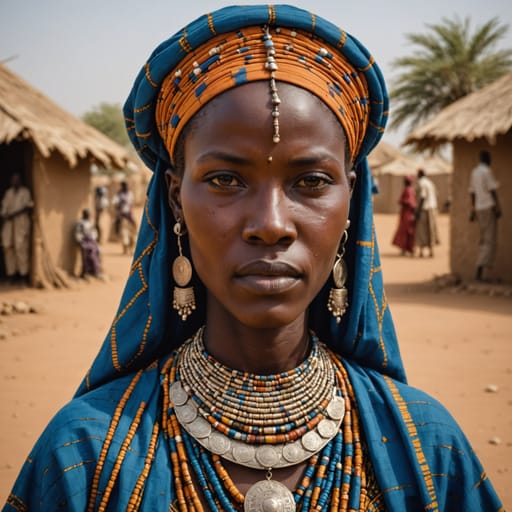
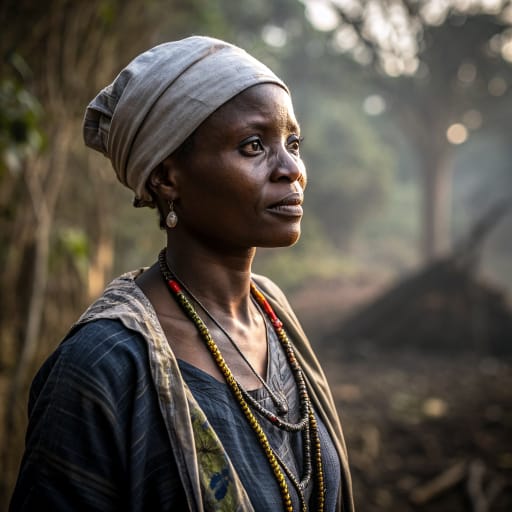
Typical Bagirmi Phenotypes
Reference for AI generation: hair, eyes, skin, facial structure, build
Bagirmi Body & Anatomy Reference
Per-feature anatomical profile for AI nude generation: Bantu / Central African Niger-Congo phenotype
Bagirmi Boobs & Breasts
Bust reference for Bagirmi women: medium-to-large cup, full, projecting, which is typical of Bantu / Central African Niger-Congo ancestry. Areolas measure about 32-48mm across, with deep-brown pigmentation. Body type (mesomorph with strong gluteal-femoral fat deposition) shapes the bust as well, so Bagirmi tits are usually fuller projection than East African; comparable to West African norm. In AI imagery, keep the forward-set shape rather than drifting toward the smaller East African conical profile.
Bagirmi Ass & Hips
The Bagirmi ass is typically full, projected, wide-set glutes, which sets it apart from the slim narrow-hip Cushitic East African profile. Underneath, the pelvis shows broad iliac crests, gynoid pelvic pattern, part of the Bantu / Central African Niger-Congo skeletal pattern. For Bagirmi butt pics and AI renders, match that silhouette and the overall build (mesomorph with strong gluteal-femoral fat deposition).
Bagirmi Vagina & Pussy
Bagirmi pussy and vulvar anatomy presents deep-brown labial pigmentation, fuller labia minora, consistent with the Bantu / Central African Niger-Congo phenotype's pigmentation pattern. Bagirmi pubic hair is typically tightly-coiled coarse texture, dense distribution, in the inverted-triangle pattern. For anatomically accurate Bagirmi pussy renders the labial coloration should match the surrounding deep-brown skin tone with a continuous gradient, and the hair should keep its tightly-coiled coarse texture.
Bagirmi Dicks & Penis
Bagirmi dicks follow the Bantu / Central African Niger-Congo reference data: regional mean ~14cm erect; above-average girth; deep-brown shaft pigmentation. Shaft color should track the deep-brown skin tone with a smooth change toward the glans, and Bagirmi pubic hair keeps its tightly-coiled coarse texture.
Bagirmi Body, Curves & Build
Bagirmi body type and overall build presents as mesomorph with strong gluteal-femoral fat deposition, with mean adult female BMI 23-26: the characteristic Bantu / Central African Niger-Congo habitus. Bagirmi curves and proportions should keep the regional skeletal frame (height, shoulder-to-hip ratio, limb proportions) rather than a generic mesomorph default.
Bagirmi Skin Tone & Hair Texture
Bagirmi skin sits in the deep-brown (Fitzpatrick VI) band. Hair is typically tight 4A-4C coil, in keeping with the Bantu / Central African Niger-Congo phenotype. In nude renders the skin should stay one even tone from face to body, and body, pubic and head hair should match.
Explore phenotype categories
Structured taxonomy with peer-reviewed scales · 22 anatomical categories
Erotic Poses & Sex Positions
From the pose catalog: 219 named positions with reference skeletons
Frequently asked questions about Bagirmi people
Where is the Bagirmi homeland?
The Bagirmi homeland is The Chari-Baguirmi region of southwestern Chad, along the lower Chari River southeast of N'Djamena, centered on the old royal town of Massenya. in Central Africa.
What language do Bagirmi people speak?
Bagirmi people primarily speak Bagirmi, or Tar Barma (Central Sudanic, Sara-Bagirmi branch); Chadian Arabic is widely spoken as a second language..
What religion do Bagirmi people practice?
The predominant religion among Bagirmi people is Sunni Islam..






Make your own Bagirmi images
Five a day, free, no credits to buy. The studio starts from this group's phenotype data, so you can set body type, pose and style and keep the traits accurate.
Start with Bagirmi