Help us get this right
Does this portrait look right for Fali?
Nobody has judged this one yet. You would be the first.
Fali Erotic
Hill massifs and surrounding lowlands north and northwest of Garoua, in the North Region of Cameroon
Fali, divided into North Fali and South Fali (usually classed as Adamawa, Niger-Congo, though the classification is debated); Fulfulde and French widely used as second languages
Traditional ancestral religion alongside Christianity and Islam
Four main divisions: Tinguelin, Kangou, Bossoum and Bori-Peské; counted among the non-Muslim hill peoples of northern Cameroon historically called Kirdi
About Fali People
The Fali are hill farmers of northern Cameroon, and their story is tied to rock. Their villages sit on and around the massifs north and northwest of Garoua, where the Benue lowlands break into steep outcrops. For much of the last two centuries those heights were a refuge as much as a home. The Fali fall into four divisions, each named for the hill country it holds: Tinguelin, Kangou, Bossoum and Bori-Peské. All four share a name, closely related speech and a way of building that outsiders have studied for generations.
Their language is usually split into North and South Fali. Linguists have generally placed it among the Adamawa languages of the Niger-Congo family, though that placement has been argued over. Either way it stands apart from the Chadic languages spoken by many hill peoples farther north in the Mandara range. In markets, schools and offices, Fali speakers also use Fulfulde, the region's common trade language, and French.
History here turns on the Fulbe. Early in the nineteenth century, the jihad led by Modibo Adama built a Muslim emirate across the upper Benue valley, and Garoua became one of its main seats. Hill communities that refused to convert were raided for slaves and tribute. The Fulbe lumped them all together as Kirdi, a dismissive word for pagans that some of the region's non-Muslim peoples have since taken up as a shared identity. German and then French colonial rule ended the raiding but not the imbalance of power between the plains and the hills.
What made the Fali known to scholars is the house. A Fali compound is a ring of round, thatch-roofed rooms and clay granaries joined by walls into one closed unit. In the middle of the twentieth century the French ethnographer Jean-Paul Lebeuf recorded how people read that layout as a map of the human body and of an ordered world, one where opposing forces are kept in balance. A building was never just shelter: where a granary stood and how the rooms related to each other carried meaning. His study made Fali dwellings a standard example in writing on African architecture.
Religious life today is layered. Ancestral religion, bound up with lineage and the farming year, is still a real presence. Christian missions and Islam have both won converts, often within the same extended family. Most Fali still farm millet, sorghum and other crops, and the rains still set the pace of the year.
Related ethnic groups
Groups that share Fali's homeland, region, language, or religious tradition. These are likely candidates for comparative phenotype reference.
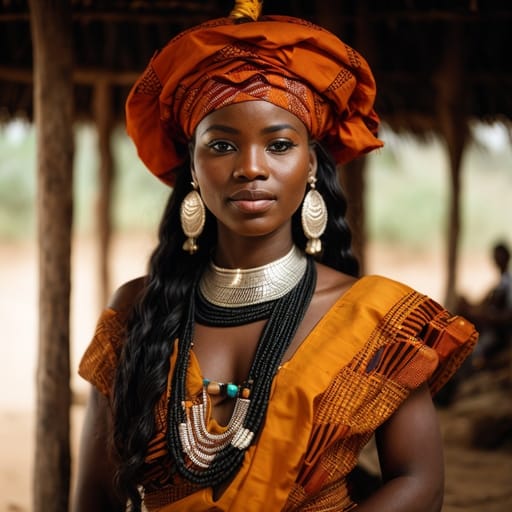
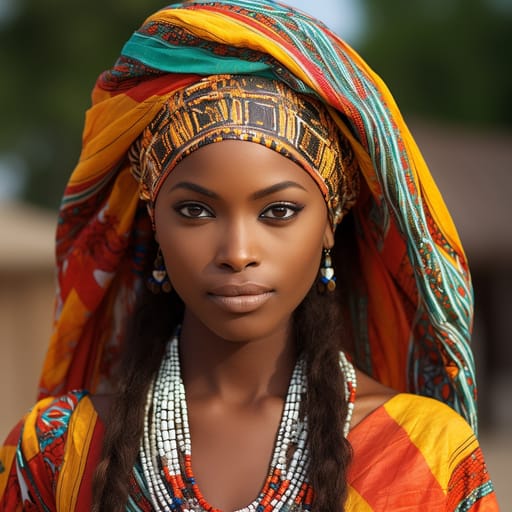
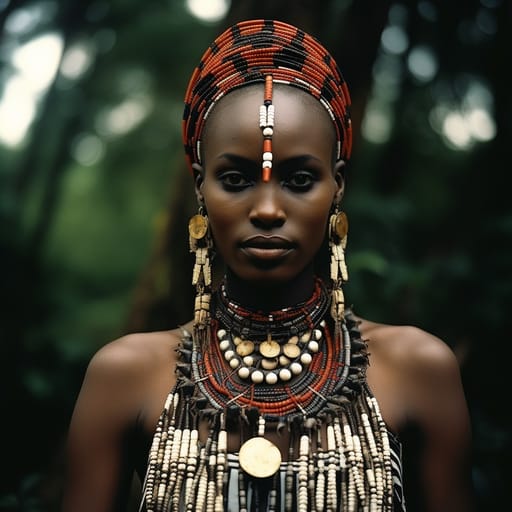
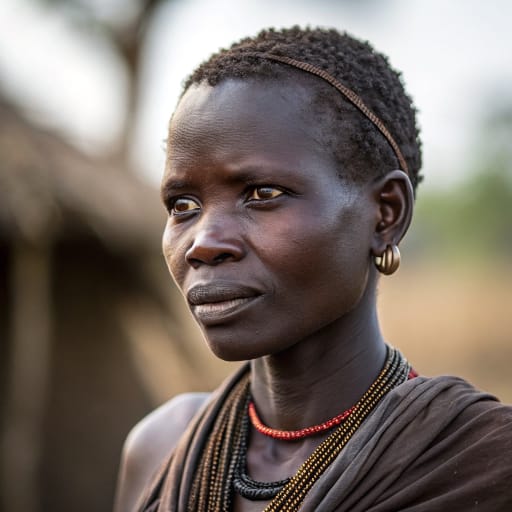
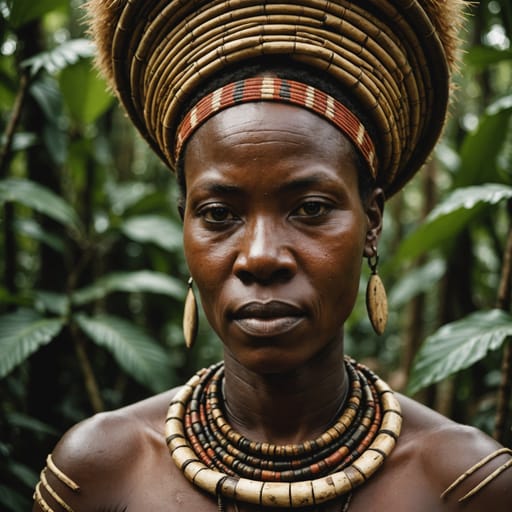
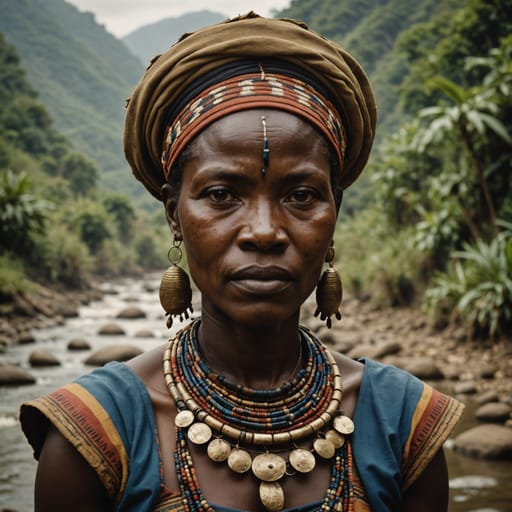
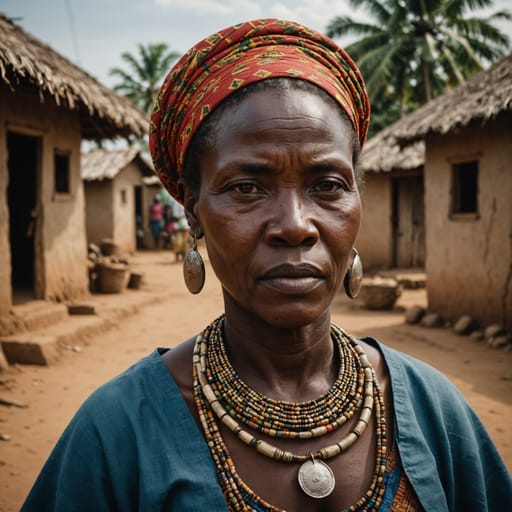
Typical Fali Phenotypes
Reference for AI generation: hair, eyes, skin, facial structure, build
Fali Body & Anatomy Reference
Bantu / Central African Niger-Congo phenotype: anatomy reference for AI nude generation
Fali Boobs & Breasts
Fali tits and boobs run medium-to-large cup, full, projecting, the classic Bantu / Central African Niger-Congo bust profile. Fali nipples and areolas show deep-brown areolar pigmentation against the deep-brown skin tone, with areolar diameter typically in the 32-48mm range and forward-set positioning rather than the smaller East African conical profile. Fali breasts trend fuller projection than East African; comparable to West African norm, a function of the mesomorph with strong gluteal-femoral fat deposition body habitus and the mean adult female BMI 23-26. For anatomically accurate AI-generated Fali nudes the render preserves the medium-to-large cup, full, projecting shape, 32-48mm areolas with deep-brown pigmentation, and the torso proportions of the Bantu / Central African Niger-Congo phenotype.
Fali Ass & Hips
Fali hips and butt usually read as full, projected, wide-set glutes. The skeletal base is broad iliac crests, gynoid pelvic pattern, the Bantu / Central African Niger-Congo pattern. Set against the slim narrow-hip Cushitic East African profile, the difference is easy to see, and the hip-to-waist ratio is often what identifies Fali women in photos.
Fali Vagina & Pussy
Expect deep-brown labial pigmentation, fuller labia minora on Fali women, in keeping with Bantu / Central African Niger-Congo ancestry. The pubic hair is tightly-coiled coarse texture, dense distribution. Coloring should run evenly from the deep-brown skin of the thighs to the labia, and Fali nude imagery should keep the hair's tightly-coiled coarse texture.
Fali Dicks & Penis
Fali dick and penile anatomy in adult AI generation should anchor on the regional reference data: regional mean ~14cm erect, above-average girth, and deep-brown shaft pigmentation. The Fali cock profile reflects the Bantu / Central African Niger-Congo population's anthropometric measurements. The shaft pigmentation should track the surrounding deep-brown skin tone, and the pubic hair should keep its tightly-coiled coarse texture in the typical inverted-V escutcheon.
Fali Body, Curves & Build
Fali body type: mesomorph with strong gluteal-femoral fat deposition, with mean adult female BMI 23-26. This is the typical Bantu / Central African Niger-Congo build. Height range, shoulder-to-hip ratio and fat distribution all follow from it, which is what an accurate Fali nude body should show.
Fali Skin Tone & Hair Texture
Fali skin tone falls in the deep-brown (Fitzpatrick VI) band, the surface signal most often miscalibrated by generic AI nude generators. Fali hair texture is typically tight 4A-4C coil, characteristic of the Bantu / Central African Niger-Congo phenotype. In Fali nude renders the skin should hold that band consistently across the body.
Explore phenotype categories
Structured taxonomy with peer-reviewed scales · 22 anatomical categories
Erotic Poses & Sex Positions
From the pose catalog: 219 named positions with reference skeletons
Frequently asked questions about Fali people
Where is the Fali homeland?
The Fali homeland is Hill massifs and surrounding lowlands north and northwest of Garoua, in the North Region of Cameroon in Central Africa.
What language do Fali people speak?
Fali people primarily speak Fali, divided into North Fali and South Fali (usually classed as Adamawa, Niger-Congo, though the classification is debated); Fulfulde and French widely used as second languages.
What religion do Fali people practice?
The predominant religion among Fali people is Traditional ancestral religion alongside Christianity and Islam.






Make your own Fali images
Five a day, free, no credits to buy. The studio starts from this group's phenotype data, so you can set body type, pose and style and keep the traits accurate.
Start with Fali