No portrait yet
Yaka Erotic
Kwango River region of southwestern Democratic Republic of the Congo, centered on Kasongo-Lunda and Popokabaka, with smaller communities in northern Angola and a large urban population in Kinshasa
Kiyaka (Bantu, Niger-Congo), closely related to Suku; Kituba, Lingala and French are widely used as second languages
Mainly Christian (Catholic and Protestant), alongside ancestor-centered belief, divination and healing associations
Bantu people of the Kwango region, closely related to the Suku and part of the wider Kongo cultural world, with a ruling line of Lunda origin
About Yaka People
The name Yaka turns up more than once in central Africa. It is also used for forest foragers in the Central African Republic and the Republic of the Congo, but the Yaka here are a farming people. They live in the Kwango River country of southwestern Democratic Republic of the Congo, and smaller numbers live across the border in northern Angola. Two things make them one people: their language, Kiyaka, and a political memory built around the Kiamfu, the paramount chief whose court sat at Kasongo-Lunda.
That title points east. Yaka tradition traces the ruling line to Lunda newcomers who moved west into the Kwango valley and set themselves above the people already living there. That is why people whose language belongs to the Kongo world answer to a chief with Lunda roots. Further back, the story gets murky. Portuguese accounts describe Jaga raiders who sacked the Kongo capital in 1568, and generations of writers cast the Yaka as their descendants. Historians still dispute this, so the link is best treated as unproven.
Kiyaka is a Bantu language closest to Suku, which the Yaka's eastern neighbors speak. Most speakers use more than one language. Kituba is the regional trade language, and in Kinshasa, home to a sizable Yaka community, Lingala and French take over. In the villages, life still turns on cassava fields, which are largely women's work, and on hunting, long a point of pride for men.
Most Yaka today are Christian, the result of Catholic and Protestant missions that spread through the Kwango under Belgian rule. Older practice has not gone quiet, though. Diviners called ngoombu are consulted when misfortune strikes, and healing associations treat illness and troubled fertility as a problem for the whole family line, not one person. The best-known Yaka institution is n-khanda, the initiation camp where boys are circumcised and kept apart for a time before returning home as young men. Its closing celebrations brought out the masks that made Yaka carving known far beyond the Kwango. They have raffia fringes and sharply upturned noses, and are often topped with small carved figures or scenes. Collectors abroad saw them as sculpture, but to the Yaka they were part of a performance. Their job was to mark the moment a generation of boys crossed into adulthood in front of everyone watching.
Related ethnic groups
Groups that share Yaka's homeland, region, language, or religious tradition. These are likely candidates for comparative phenotype reference.
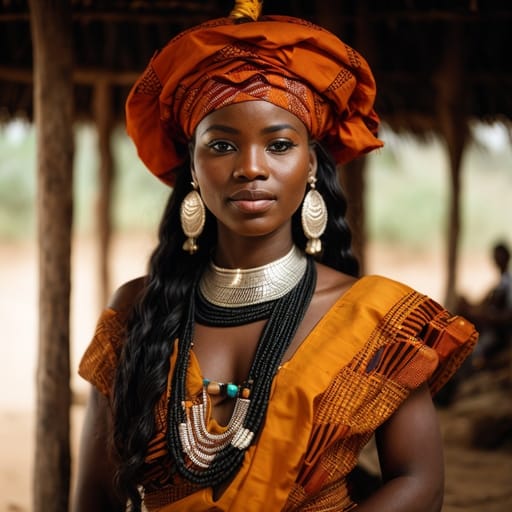
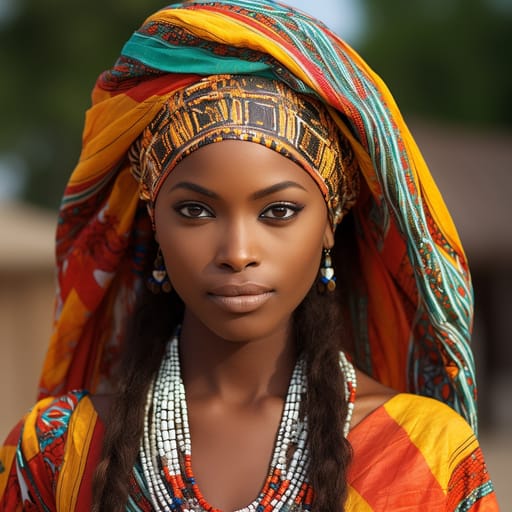
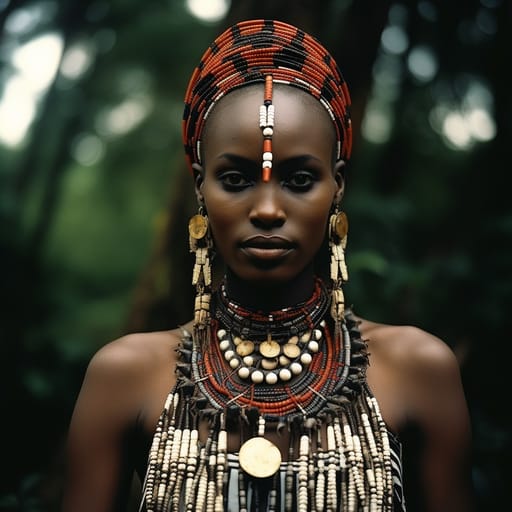
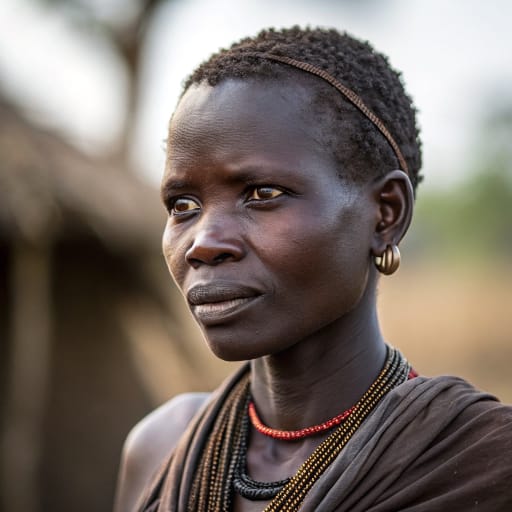
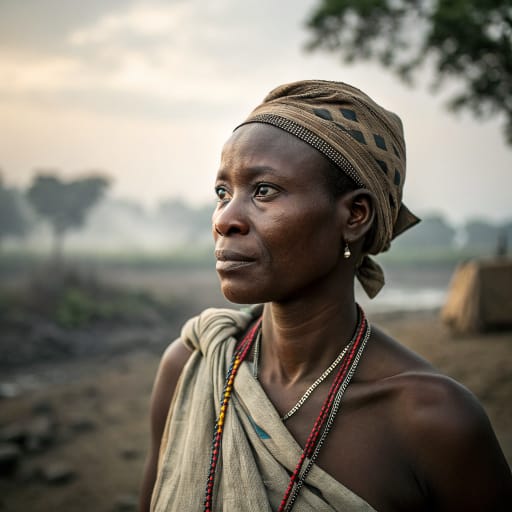
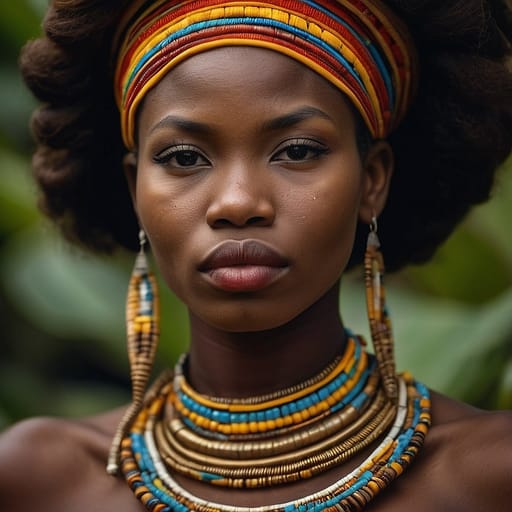
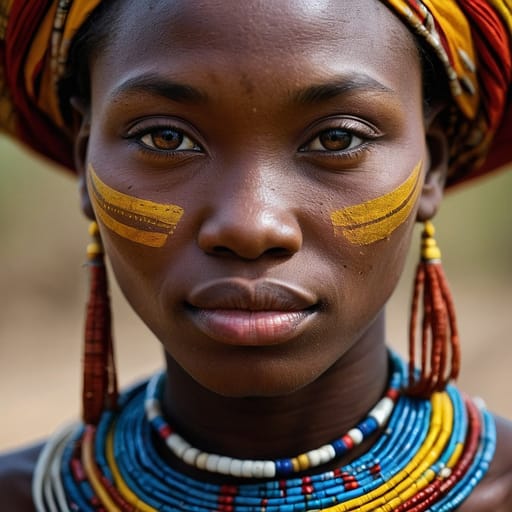
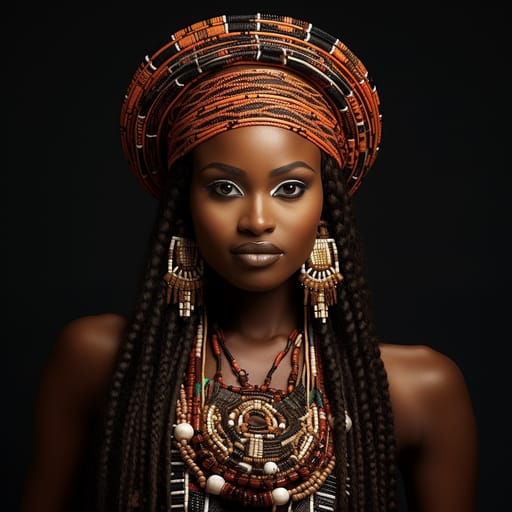
Typical Yaka Phenotypes
Reference for AI generation: hair, eyes, skin, facial structure, build
Yaka Body & Anatomy Reference
Per-feature anatomical profile for AI nude generation: Bantu / Central African Niger-Congo phenotype
Yaka Boobs & Breasts
Yaka tits and boobs run medium-to-large cup, full, projecting, the classic Bantu / Central African Niger-Congo bust profile. Yaka nipples and areolas show deep-brown areolar pigmentation against the deep-brown skin tone, with areolar diameter typically in the 32-48mm range and forward-set positioning rather than the smaller East African conical profile. Yaka breasts trend fuller projection than East African; comparable to West African norm, a function of the mesomorph with strong gluteal-femoral fat deposition body habitus and the mean adult female BMI 23-26. For anatomically accurate AI-generated Yaka nudes the render preserves the medium-to-large cup, full, projecting shape, 32-48mm areolas with deep-brown pigmentation, and the torso proportions of the Bantu / Central African Niger-Congo phenotype.
Yaka Ass & Hips
Yaka hips and butt usually read as full, projected, wide-set glutes. The skeletal base is broad iliac crests, gynoid pelvic pattern, the Bantu / Central African Niger-Congo pattern. Set against the slim narrow-hip Cushitic East African profile, the difference is easy to see, and the hip-to-waist ratio is often what identifies Yaka women in photos.
Yaka Vagina & Pussy
Expect deep-brown labial pigmentation, fuller labia minora on Yaka women, in keeping with Bantu / Central African Niger-Congo ancestry. The pubic hair is tightly-coiled coarse texture, dense distribution. Coloring should run evenly from the deep-brown skin of the thighs to the labia, and Yaka nude imagery should keep the hair's tightly-coiled coarse texture.
Yaka Dicks & Penis
Yaka dick and penile anatomy in adult AI generation should anchor on the regional reference data: regional mean ~14cm erect, above-average girth, and deep-brown shaft pigmentation. The Yaka cock profile reflects the Bantu / Central African Niger-Congo population's anthropometric measurements. The shaft pigmentation should track the surrounding deep-brown skin tone, and the pubic hair should keep its tightly-coiled coarse texture in the typical inverted-V escutcheon.
Yaka Body, Curves & Build
Yaka body type: mesomorph with strong gluteal-femoral fat deposition, with mean adult female BMI 23-26. This is the typical Bantu / Central African Niger-Congo build. Height range, shoulder-to-hip ratio and fat distribution all follow from it, which is what an accurate Yaka nude body should show.
Yaka Skin Tone & Hair Texture
Yaka skin tone falls in the deep-brown (Fitzpatrick VI) band, the surface signal most often miscalibrated by generic AI nude generators. Yaka hair texture is typically tight 4A-4C coil, characteristic of the Bantu / Central African Niger-Congo phenotype. In Yaka nude renders the skin should hold that band consistently across the body.
Explore phenotype categories
Structured taxonomy with peer-reviewed scales · 22 anatomical categories
Erotic Poses & Sex Positions
From the pose catalog: 219 named positions with reference skeletons
Frequently asked questions about Yaka people
Where is the Yaka homeland?
The Yaka homeland is Kwango River region of southwestern Democratic Republic of the Congo, centered on Kasongo-Lunda and Popokabaka, with smaller communities in northern Angola and a large urban population in Kinshasa in Central Africa.
What language do Yaka people speak?
Yaka people primarily speak Kiyaka (Bantu, Niger-Congo), closely related to Suku; Kituba, Lingala and French are widely used as second languages.
What religion do Yaka people practice?
The predominant religion among Yaka people is Mainly Christian (Catholic and Protestant), alongside ancestor-centered belief, divination and healing associations.






Make your own Yaka images
Five a day, free, no credits to buy. The studio starts from this group's phenotype data, so you can set body type, pose and style and keep the traits accurate.
Start with Yaka