Help us get this right
Does this portrait look right for Mafa?
Nobody has judged this one yet. You would be the first.
Mafa Erotic
Christianity
About Mafa People
The Mafa live in the Mandara Mountains, the broken volcanic spine that runs along the Cameroon–Nigeria border in the far north of Cameroon. Their territory is vertical: terraced fields climbing the slopes in dry-stone walls, compounds tucked into the folds of the rock, granaries perched where no one would think to build. This landscape is not incidental. The Mafa are mountain people in the strict sense — their ancestors retreated upward over generations to escape the slave-raiding cavalries of the plains kingdoms, and the difficulty of the terrain became, for centuries, a defense.
Their language belongs to the Chadic branch of Afroasiatic, which puts it in the same broad family as Hausa to the west and, more distantly, Arabic and the Berber languages. Within the Mandara range itself, Chadic varieties cluster densely — neighbors a valley away may speak something close but not quite mutually intelligible — and Mafa is one of the larger members of that local cluster, with several hundred thousand speakers. Most are bilingual in Fulfulde, the regional lingua franca of the Cameroonian north, and increasingly in French through schooling.
Christianity, mostly Catholic with a significant Protestant presence, is now the dominant religious affiliation, the result of twentieth-century mission work that took root partly because the Mafa had remained outside the Islamic expansion that swept the surrounding lowlands. Older practices have not disappeared so much as folded into the rhythm of village life: ancestor veneration, ritual specialists who handle relations with the unseen, a calendar shaped by the agricultural year. The most distinctive of the surviving customs is the bull festival, maray, in which a household fattens a bull in a stall for years before slaughtering it in a public ceremony that confers prestige on the family and redistributes meat across kin networks. It is the kind of institution that does work — economic, social, ritual — all at once.
Subsistence is built around sorghum and millet grown on those terraces, supplemented by groundnuts, beans, and small livestock. Iron-working has a long history in the range, and Mafa blacksmiths, as in many societies of the region, form a distinct endogamous group with ritual responsibilities that go well beyond metalwork — they handle burials and certain ceremonies that other Mafa do not touch. The pattern of a tightly bounded smith caste embedded in a farming society is widespread across the Sahel, and among the Mafa it remains legible in everyday social life.
Related ethnic groups
Groups that share Mafa's homeland, region, language, or religious tradition. These are likely candidates for comparative phenotype reference.
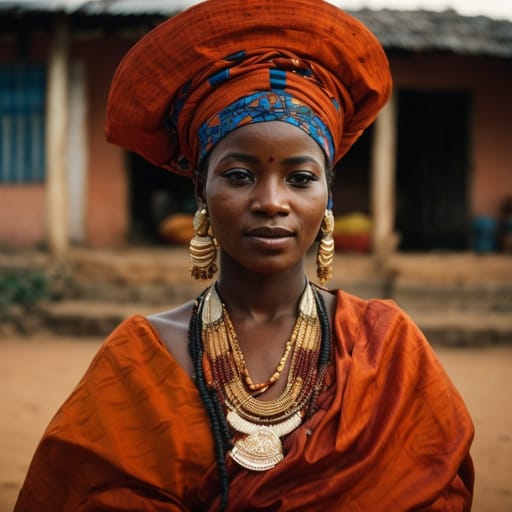
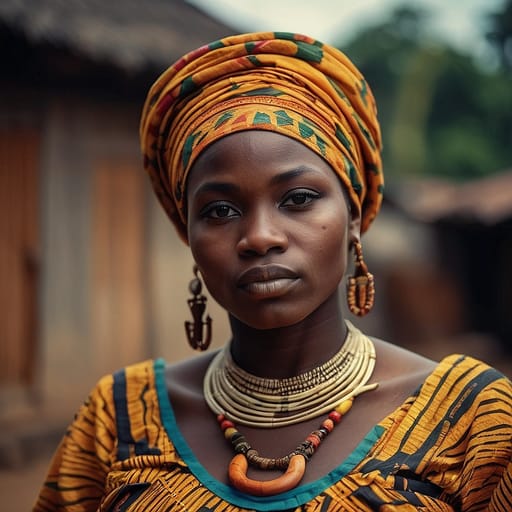
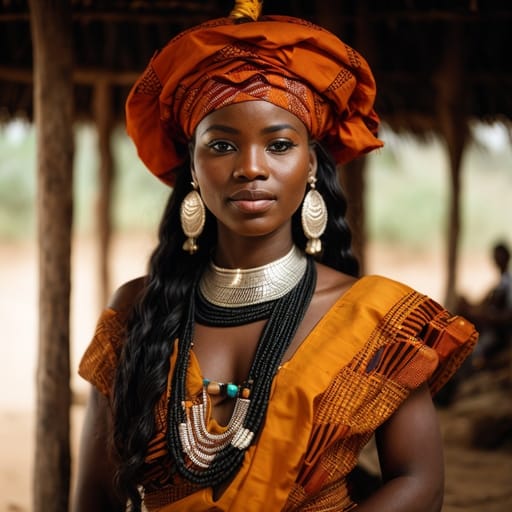
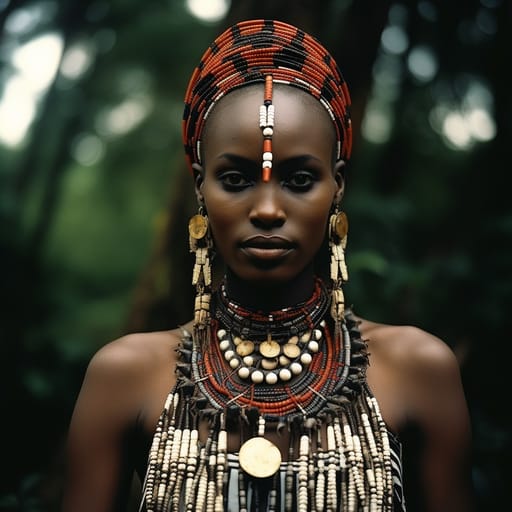
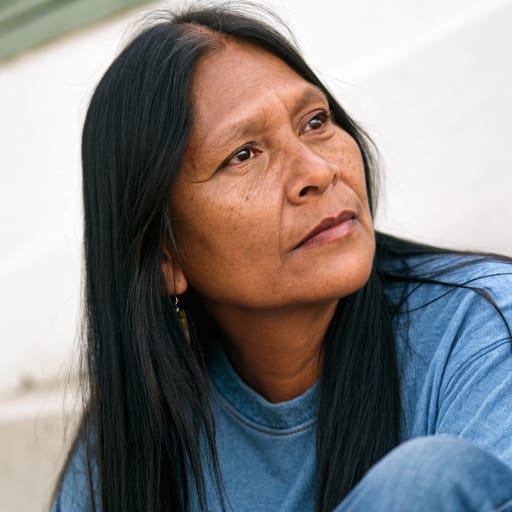
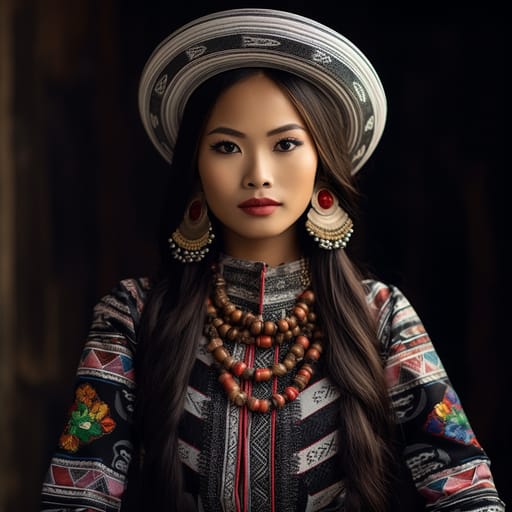

Typical Mafa Phenotypes
Reference for AI generation: hair, eyes, skin, facial structure, build
The Mafa are a Chadic-speaking mountain people of the Mandara range straddling far-northern Cameroon and northeastern Nigeria, and their phenotype reflects long isolation in rocky, terraced highlands rather than the riverine West African baseline most readers default to. Skin tones cluster at the deepest end of the Fitzpatrick scale — type VI is the norm, with warm umber to near-black undertones and very little of the reddish cast seen in groups further south. Hair is uniformly Type 4, tightly coiled to kinked, almost always black; traditional women's styles often involve close cropping or braided patterns that sit flat to the skull, and grey arrives late.
Eyes are dark brown to black, set under a smooth, moderately prominent supraorbital ridge. Epicanthic folds are absent. The eye opening tends to be horizontal and not especially wide, giving a steady, level gaze rather than the rounder aperture common in Bantu-speaking neighbours.
Facial architecture is where Mafa distinctiveness reads most clearly. Noses are broad at the alae but with a more defined, slightly higher bridge than is typical for forest-Bantu populations — a Chadic/Sahelian pattern shared with Hausa and Kanuri neighbours. Lips are full but proportionate, not everted. Jaws are square and the chin is firm; cheekbones sit high and wide, and the overall face shape is closer to a broad oval than a long oval. Foreheads are tall and unbroken.
Build runs lean and wiry rather than tall. Average male stature sits around 168–172 cm, with women noticeably shorter; decades of terrace farming and millet-based diets produce low body fat, well-defined deltoids and calves, and narrow hips on both sexes. Shoulders are square but not especially broad. The signature Mafa silhouette is compact, sinewy, and hard-edged — a mountain-farmer body, not a lowland one. Sub-group variation is modest: the Mafa proper, Bulahay, and related Mafahay communities differ more in dialect and ritual than in visible phenotype.
Mafa Body & Anatomy Reference
Anatomy by feature, Bantu / Central African Niger-Congo phenotype
Mafa Boobs & Breasts
The typical Mafa bust is medium-to-large cup, full, projecting, in line with the wider Bantu / Central African Niger-Congo pattern. Areolas usually fall in the 32-48mm range, with deep-brown areolar pigmentation against the deep-brown skin tone. Compared with the smaller East African conical profile, Mafa breasts sit forward and are generally fuller projection than East African; comparable to West African norm. A faithful AI render of Mafa tits keeps that shape and areola size.
Mafa Ass & Hips
Butt shape among Mafa women: full, projected, wide-set glutes, over broad iliac crests, gynoid pelvic pattern. This follows Bantu / Central African Niger-Congo ancestry and looks quite unlike the slim narrow-hip Cushitic East African profile. An accurate Mafa ass in adult AI imagery keeps both the silhouette and the overall build (mesomorph with strong gluteal-femoral fat deposition) instead of a generic average.
Mafa Vagina & Pussy
Vulvar anatomy among Mafa women: deep-brown labial pigmentation, fuller labia minora. Pubic hair tends to be tightly-coiled coarse texture, dense distribution, in the usual inverted-triangle pattern. Both follow Bantu / Central African Niger-Congo pigmentation, which is why Mafa pussy renders should not fall back on a pale, sparse Western template.
Mafa Dicks & Penis
The Mafa cock profile, from Bantu / Central African Niger-Congo anthropometric data: regional mean ~14cm erect; above-average girth; deep-brown shaft pigmentation. Pubic hair has a tightly-coiled coarse texture and forms the usual inverted-V pattern. Whether Mafa men are circumcised follows religious and cultural practice rather than phenotype.
Mafa Body, Curves & Build
Build and curves among Mafa women follow the Bantu / Central African Niger-Congo pattern: mesomorph with strong gluteal-femoral fat deposition, mean adult female BMI 23-26. Proportions matter as much as skin tone, so Mafa figures should keep their regional height and limb ratios.
Mafa Skin Tone & Hair Texture
The Mafa skin range is deep-brown (Fitzpatrick VI), and hair tends to be tight 4A-4C coil. That combination marks the Bantu / Central African Niger-Congo phenotype, and skin tone is the trait AI generators most often get wrong for Mafa women.
Data depth
0/100Coverage of image-grounded phenotype observations · drives AI generation diversity
- Sample size
- 0/40· 0 images
- Image quality
- 0/30· 0% high
- Confidence
- 0/20
- Source diversity
- 0/10
- ·No image observations yet
Explore phenotype categories
Structured taxonomy with peer-reviewed scales · 22 anatomical categories
Erotic Poses & Sex Positions
From the pose catalog: 219 named positions with reference skeletons
Frequently asked questions about Mafa people
Where is the Mafa homeland?
The Mafa homeland is Cameroon in Central Africa.
What language do Mafa people speak?
Mafa people primarily speak Afroasiatic / Chadic / Mafa.
What religion do Mafa people practice?
The predominant religion among Mafa people is Christianity.






Make your own Mafa images
Five a day, free, no credits to buy. The studio starts from this group's phenotype data, so you can set body type, pose and style and keep the traits accurate.
Start with Mafa