Help us get this right
Does this portrait look right for Bakossi?
One tap. It takes a second and it is recorded.
1 says it looks right, 0 say it looks off.
Bakossi Erotic
Bakossi Mountains (Cameroon)
Christianity / Catholicism
About Bakossi People
The Bakossi live on the slopes and high valleys of the Bakossi Mountains in Cameroon's Southwest Region, a band of forested volcanic highlands between Mount Kupe and the Manengouba massif. The terrain shapes almost everything: villages cling to ridges, footpaths climb between them, and the surrounding rainforest — one of the densest patches of montane forest left in West-Central Africa — has historically hemmed the group in and given them a strong sense of being a mountain people distinct from the lowlanders around them. They are concentrated in the Kupe-Muanenguba and Meme divisions, with the towns of Bangem and Tombel functioning as their cultural and administrative anchors.
Their language, Akoose (Bakossi), belongs to the Bantu branch of Niger–Congo and sits among a cluster of closely related "Mbo" languages spoken by neighboring peoples on the same mountain system. Speakers tend to think of these as variants of a shared linguistic continuum rather than separate tongues, and intermarriage along this corridor is routine. Christianity arrived through both Basel/Presbyterian and Catholic missions in the colonial period and is now the default religious frame — Sunday observance, mission schools, and church-run clinics are part of ordinary life — but older ideas about the land have not been displaced so much as layered underneath. Lake Edib and Lake Manengouba, the twin crater lakes above the plateau, remain spiritually charged places, and beliefs about ekong (a kind of soul-trafficking witchcraft tied to sudden wealth) still surface in village conversation in ways a missionary census would never capture.
The Bakossi trace descent patrilineally from Ngoe and his wife Sumediang, the founding ancestors from whom most clans claim a line; this genealogy doubles as a political map of who is related to whom across the mountains, and clan names are still used to place a stranger socially. Subsistence is built around cocoa as the cash crop and cocoyam, plantain, and bush meat for the household, with hunting in the surrounding forest a respected male occupation. The defining historical bruise is the 1956 Tombel massacre, when communal violence between Bakossi and Bamileke settlers left several hundred people dead and reshaped relations between the highlanders and the migrants who had come to work the cocoa farms — an event still referenced when land disputes flare up in the region.
Related ethnic groups
Groups that share Bakossi's homeland, region, language, or religious tradition. These are likely candidates for comparative phenotype reference.
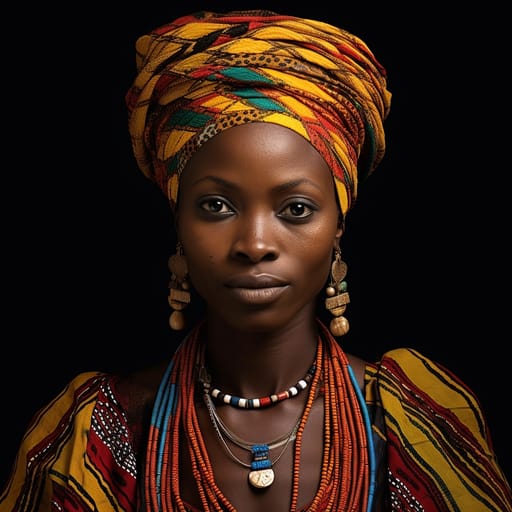
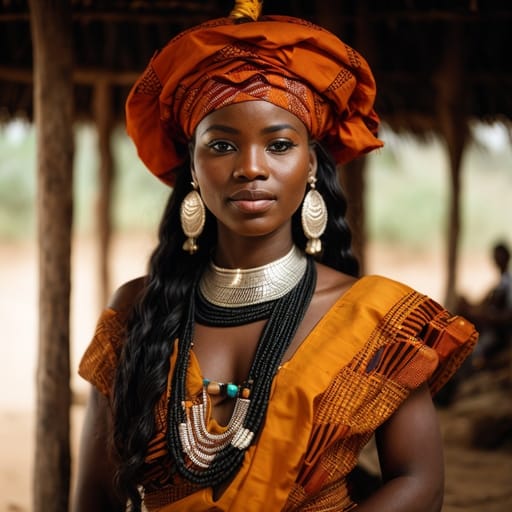
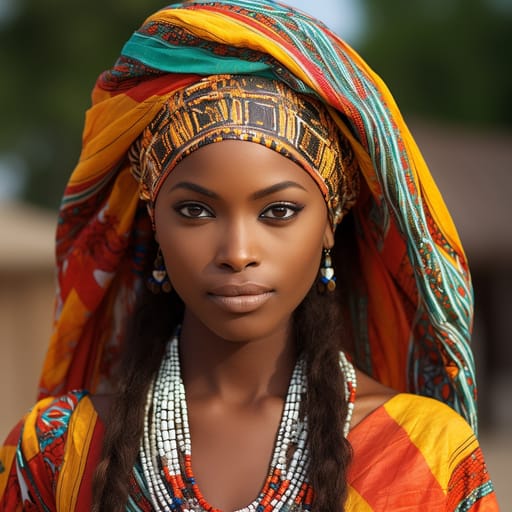
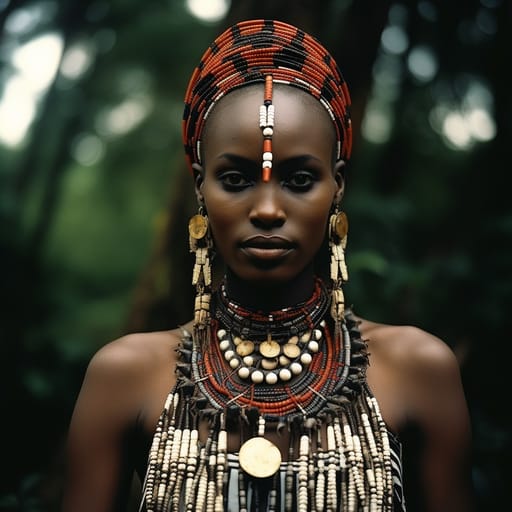
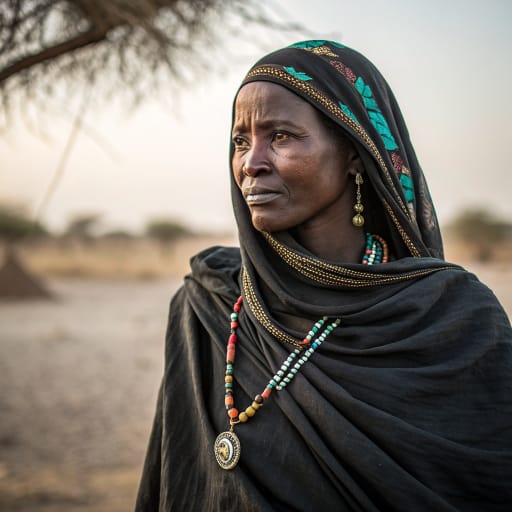
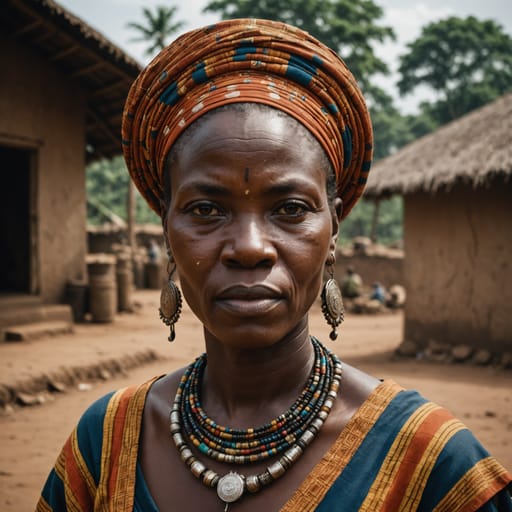
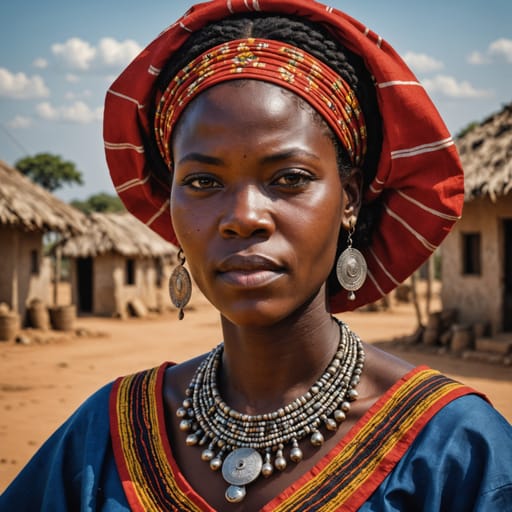
Typical Bakossi Phenotypes
Reference for AI generation: hair, eyes, skin, facial structure, build
The Bakossi are a Bantu people of the forested volcanic slopes around Mount Kupé and Mount Muanenguba in southwest Cameroon, and their phenotype reflects the broader Grassfields-adjacent Bantu cluster rather than the slighter, narrower-faced populations of the coastal littoral. Hair is uniformly Type 4 — tightly coiled, dense, with a low porosity feel and a high curl frequency that holds shape close to the scalp. Natural color sits in true black to deep brown-black; sun-bleached red-brown tips occur in children and in adults who spend long days in upland farms, but never as a baseline color. Greying tends to come late and concentrates first at the temples.
Eyes are dark brown to near-black, with the sclera often carrying a faint warm cast rather than blue-white. The eye opening is moderately wide and almond-shaped; epicanthic folds are absent, and the upper lid sits cleanly without the heavy hooding seen further north in the Sahel. Skin tone covers Fitzpatrick V through deep VI, with warm red-brown to cool blue-black undertones — the cooler, almost matte register is more common in the mountain villages, while lower-altitude Bakossi communities show a slightly warmer mahogany.
Facial structure is the giveaway for the broader Bantu-Grassfields zone: a relatively short, broad nose with a low-to-medium bridge and rounded alar wings, full and well-defined lips with a clear vermilion border, and a strong rounded jaw. Cheekbones are present but not high-set in the East African sense — the midface reads broad and softly modeled rather than carved. Foreheads are typically high and smooth.
Build runs medium-stature and muscular, with shoulders and glutes carrying visible mass from a farming and load-carrying tradition; women often show pronounced hip-to-waist contrast with sturdy thighs. Extreme tall or extreme slight builds are uncommon. Sub-group variation across the Akoose-speaking clans is minor and mostly tonal — slightly darker and more compact in the highland villages, slightly warmer-toned and taller toward the Mungo River lowlands.
Data depth
0/100Coverage of image-grounded phenotype observations · drives AI generation diversity
- Sample size
- 0/40· 0 images
- Image quality
- 0/30· 0% high
- Confidence
- 0/20
- Source diversity
- 0/10
- ·No image observations yet
Explore phenotype categories
Structured taxonomy with peer-reviewed scales · 22 anatomical categories
Erotic Poses & Sex Positions
From the pose catalog: 219 named positions with reference skeletons
Frequently asked questions about Bakossi people
Where is the Bakossi homeland?
The Bakossi homeland is Bakossi Mountains (Cameroon) in Central Africa.
What language do Bakossi people speak?
Bakossi people primarily speak Niger-Congo / Bantu / Akoose.
What religion do Bakossi people practice?
The predominant religion among Bakossi people is Christianity / Catholicism.






Make your own Bakossi images
Five a day, free, no credits to buy. The studio starts from this group's phenotype data, so you can set body type, pose and style and keep the traits accurate.
Start with Bakossi