Help us get this right
Does this portrait look right for Gbaya?
Nobody has judged this one yet. You would be the first.
Gbaya Erotic
Islam
Bokoto, Kàrà, Buli (including Toongo), Ali, Mandja, Gbaya-Bossangoa, Bozom, Mbodomo, Gbanu, Bangandu
About Gbaya People
The Gbaya are one of the demographic anchors of the Central African Republic and extend west across the Adamawa plateau into eastern Cameroon, with smaller communities in northern Congo and the southwestern DRC. Calling them a single people requires some caution — what scholars label "Gbaya" is really a cluster of closely related groups (Bokoto, Kàrà, Buli, Ali, Mandja, Gbanu, Bozom, Mbodomo, Bangandu and others) speaking varieties of a common language that shade into one another across savanna, forest edge, and river valley. They are farmers above all: cassava is the staple their food economy is built around, and coffee became, for a stretch of the twentieth century, both a cash crop and a colonial burden.
The Gbaya language sits within the Ubangian branch — a cluster that occupies a kind of linguistic island between the Bantu languages spreading up from the south and the Adamawa and Chadic languages of the Sahelian fringe. This middle position has shaped Gbaya life for centuries: trade, intermarriage, and pressure from larger neighbors all run through it. The Fulani jihad states of the nineteenth century pushed cattle and Islam into the northern fringes of Gbaya country, and the slave-raiding that came with that period left long memories.
The defining historical episode is the Kongo-Wara rebellion of 1928–31 — sometimes called the War of the Hoe Handle — when the Gbaya prophet Karnu (Karinou) rallied tens of thousands across the region against French forced labor, rubber quotas, and porterage. The French crushed it, but the rising remains foundational to how Gbaya communities narrate their relationship to outside power. More recent waves of violence in the CAR have fallen heavily on Gbaya villages, and large numbers have spent stretches of the past two decades displaced.
Cultural life carries strong oral traditions, with proverbs and tale-cycles in particular drawing serious linguistic and ethnographic study. The labi initiation — a months-long forest seclusion that historically marked the passage to adulthood — is widely associated with Gbaya practice, though it has thinned in many areas. There is a useful Gbaya term, dùà, that gets translated approximately as "the good thing" or "rightness": a guiding ethical-aesthetic concept that runs through how people talk about conduct, craft, and even speech well delivered.
Related ethnic groups
Groups that share Gbaya's homeland, region, language, or religious tradition. These are likely candidates for comparative phenotype reference.
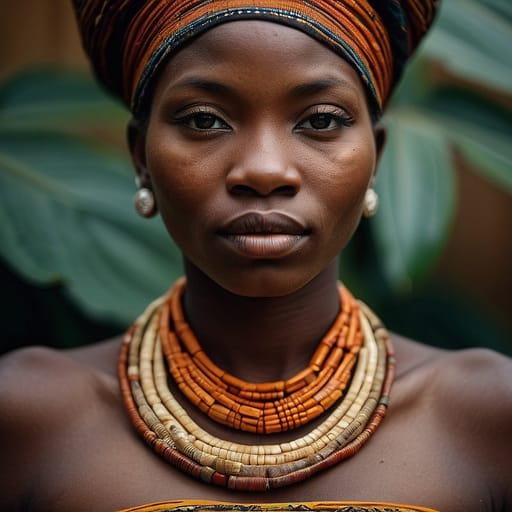
Baya
same homeland (Central African Republic, Cameroon)
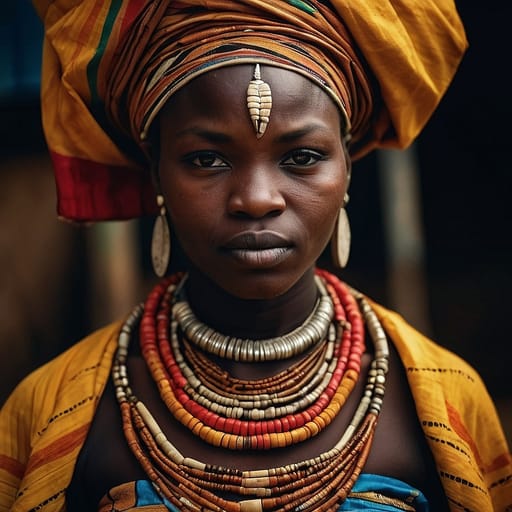
Mboum Mbum
same homeland (Central African Republic, Cameroon)
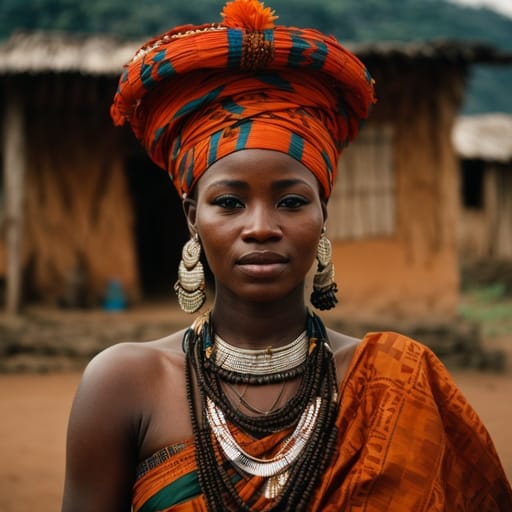
Bamum
same region (Central Africa)
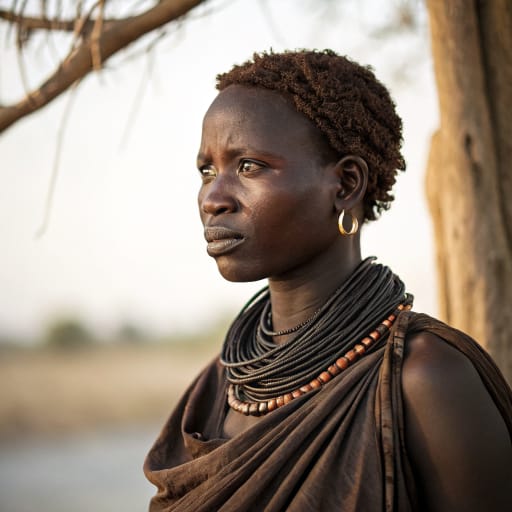
Buduma
same region (Central Africa)
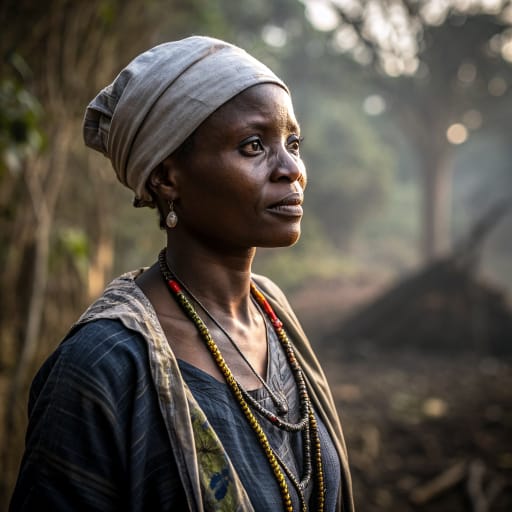
Fali
same region (Central Africa)
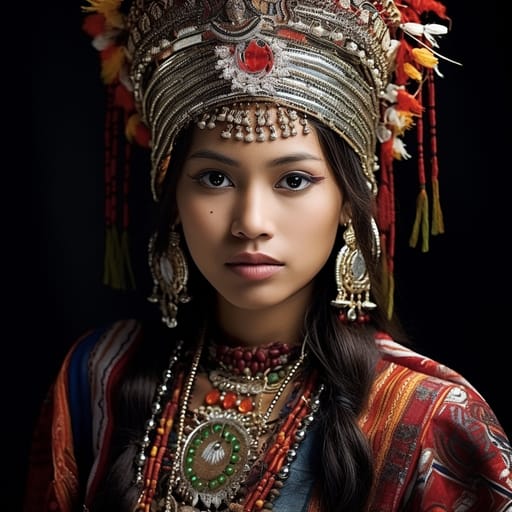
Mandarese
same religion
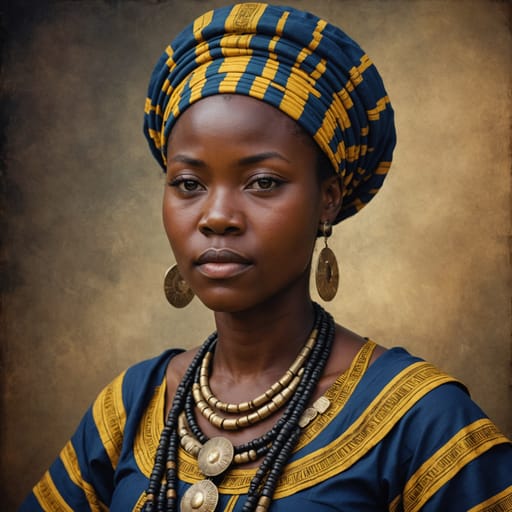
Myene
same region (Central Africa)
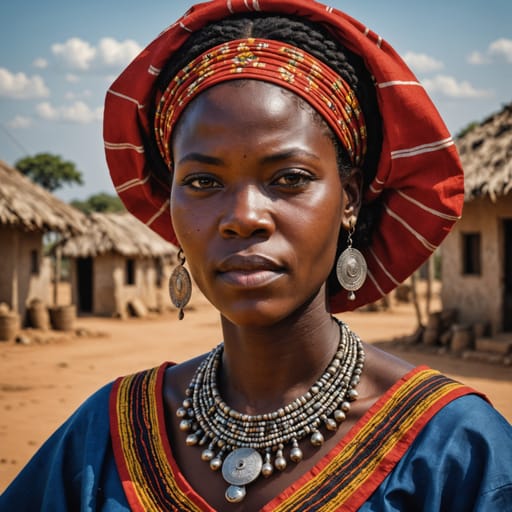
Ganguela
same region (Central Africa)
Typical Gbaya Phenotypes
Reference for AI generation: hair, eyes, skin, facial structure, build
The Gbaya cluster across the savanna-forest transition of the western Central African Republic and eastern Cameroon, and their phenotype reads as classically Central African Bantu-adjacent rather than Sahelian — they sit south of the Chadic and Adamawa belts that introduce more elongated features further north. Skin tone runs through the deeper end of the Fitzpatrick VI range, with warm red-brown and cool blue-black undertones both common; the savanna sun keeps exposed skin uniformly dark, and there is little of the lighter mid-brown range seen among neighboring forest-edge populations to the south.
Hair is almost universally Type 4 — tightly coiled, with a dense Z-pattern that holds shape close to the scalp. Natural color is true black with occasional very dark brown; sun-bleaching to a reddish cast at the tips is visible on children and on adults who work outdoors. Eyes are dark brown to near-black, set under a moderate brow ridge with no epicanthic fold and a gently almond-to-round shape.
Facial structure tends toward broad, balanced proportions: a wide nasal base with a low-to-medium bridge, full and well-defined lips with a pronounced vermilion border, and rounded cheekbones rather than the high angular cheekbones of more Nilotic-influenced groups. Jawlines are typically squared in men and softly oval in women. Foreheads are moderately broad. Dental decoration — historically filed incisors among older generations — is now rare.
Build is medium rather than tall. Adult men commonly fall in the 168–175 cm range, women 158–165 cm, with mesomorphic proportions, broad shoulders relative to hip width in men, and a tendency toward muscular legs from agricultural work. Sub-group variation is modest: the western Bokoto and Gbanu near Cameroon show slightly lighter average skin tone and somewhat finer facial features reflecting historical contact with Adamawa populations, while the Mandja and Bossangoa branches in the CAR interior present the heavier-set, deeper-toned phenotype most associated with the Gbaya as a whole.
Gbaya Body & Anatomy Reference
Per-feature anatomical profile for AI nude generation: Bantu / Central African Niger-Congo phenotype
Gbaya Boobs & Breasts
Gbaya boobs follow the Bantu / Central African Niger-Congo profile: medium-to-large cup, full, projecting. Areolar diameter is usually 32-48mm, and the coloring is deep-brown areolar pigmentation against the deep-brown skin tone. Breast shape tracks body composition (mesomorph with strong gluteal-femoral fat deposition, mean adult female BMI 23-26), so Gbaya breasts tend to be fuller projection than East African; comparable to West African norm. Expect a forward-set shape, not the smaller East African conical profile.
Gbaya Ass & Hips
Gbaya ass and hip morphology presents as full, projected, wide-set glutes, distinctly different from the slim narrow-hip Cushitic East African profile. The Gbaya pelvic profile shows broad iliac crests, gynoid pelvic pattern, anchored in the Bantu / Central African Niger-Congo skeletal pattern. Gbaya butt shots in adult AI imagery should render the full, projected, wide-set glutes silhouette with the overall build (mesomorph with strong gluteal-femoral fat deposition) and the fat distribution typical of the Bantu / Central African Niger-Congo phenotype.
Gbaya Vagina & Pussy
Gbaya pussy anatomy typically shows deep-brown labial pigmentation, fuller labia minora. Pubic hair is usually tightly-coiled coarse texture, dense distribution. In AI-generated Gbaya nudes, labial color should blend into the deep-brown skin with a gradual transition, and the hair should keep its tightly-coiled coarse texture.
Gbaya Dicks & Penis
Penis reference for Gbaya men: regional mean ~14cm erect, above-average girth. Coloring: deep-brown shaft pigmentation. An accurate Gbaya cock in AI imagery matches the surrounding deep-brown skin rather than a generic porn default. Circumcision depends on religion and custom, not ancestry.
Gbaya Body, Curves & Build
The Gbaya figure is generally mesomorph with strong gluteal-femoral fat deposition, with mean adult female BMI 23-26, characteristic of Bantu / Central African Niger-Congo ancestry. AI image tools tend to flatten regional body types into a few stock shapes; here the Gbaya build is kept as its own reference.
Gbaya Skin Tone & Hair Texture
Skin: deep-brown (Fitzpatrick VI). Hair: tight 4A-4C coil. Both are typical of Bantu / Central African Niger-Congo ancestry. The most common mistake in AI nudes of Gbaya women is a body rendered lighter than the face.
Data depth
0/100Coverage of image-grounded phenotype observations · drives AI generation diversity
- Sample size
- 0/40· 0 images
- Image quality
- 0/30· 0% high
- Confidence
- 0/20
- Source diversity
- 0/10
- ·No image observations yet
Explore phenotype categories
Structured taxonomy with peer-reviewed scales · 22 anatomical categories
Erotic Poses & Sex Positions
From the pose catalog: 219 named positions with reference skeletons
Frequently asked questions about Gbaya people
Where is the Gbaya homeland?
The Gbaya homeland is Central African Republic, Cameroon in Central Africa.
What language do Gbaya people speak?
Gbaya people primarily speak Niger-Congo / Ubangian / Gbaya.
What religion do Gbaya people practice?
The predominant religion among Gbaya people is Islam.






Make your own Gbaya images
Five a day, free, no credits to buy. The studio starts from this group's phenotype data, so you can set body type, pose and style and keep the traits accurate.
Start with Gbaya