Help us get this right
Does this portrait look right for Balti?
One tap. It takes a second and it is recorded.
2 say it looks right, 3 say it looks off.
Balti Erotic
Gilgit-Baltistan (Pakistan)
Islam / Shia Islam
About Balti People
The Balti are a Tibetan people who became Muslim. That single sentence carries most of what makes them unusual. Their homeland is Baltistan — the high valleys around Skardu and Khaplu in northern Pakistan, walled in by the Karakoram and threaded by the upper Indus. The land is Tibetan in every physical sense: thin air, barley terraces clinging to glacial fans, apricot orchards in the river bends, winters that close the passes for months. But the people praying in the village mosques are mostly Twelver Shia, with a substantial Noorbakhshi minority — a Sufi-inflected order that survives almost nowhere else — and small Sunni and Ismaili communities at the edges.
Their language, Balti, is Tibetic, a close cousin of the speech of Ladakh just across the ceasefire line and a more distant relation of Lhasa Tibetan. It preserves archaic features that mainstream Tibetan has shed, which is why linguists keep returning to it. For centuries Balti was written in the Tibetan script; conversion to Islam, completed gradually between the 14th and 17th centuries through missionaries from Kashmir and Persia, eventually pushed the script toward a Perso-Arabic form, though the older orthography has been revived in recent decades by writers who do not want it lost. The vocabulary tells the same layered story — a Tibetan core under a heavy dusting of Persian, Urdu, and Arabic loans for anything to do with religion, governance, or trade.
Baltistan was its own constellation of small kingdoms — Skardu, Khaplu, Shigar, Kharmang, Rondu — until the Dogras absorbed it in the 1840s. Partition in 1947 and the war that followed left it on the Pakistani side of the line, separated from culturally identical Ladakhi cousins by one of the most militarized borders on earth; families divided then are still divided now. That rupture shapes Balti self-understanding more than outsiders tend to realize.
Day-to-day culture sits comfortably in both inheritances. Polo is the regional sport, played hard and without much ceremony on rough grounds at altitude. The cuisine runs to barley flour, apricot kernels, butter tea, and slow-cooked meat dishes like balay and mamtu dumplings that would be recognizable in any Tibetan kitchen. Muharram observances in Skardu are intense and central to the civic year. Hospitality toward strangers is taken seriously, but the Balti reputation, fairly earned, is for understatement — a quiet people in a loud landscape.
Related ethnic groups
Groups that share Balti's homeland, region, language, or religious tradition. These are likely candidates for comparative phenotype reference.
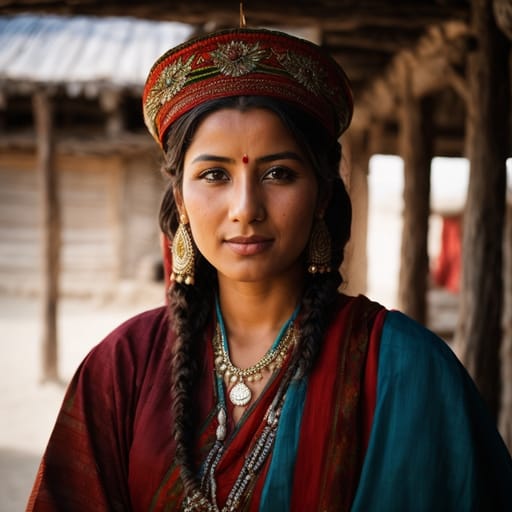
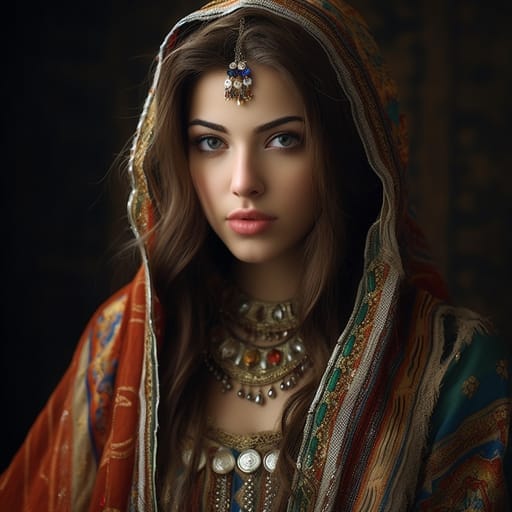
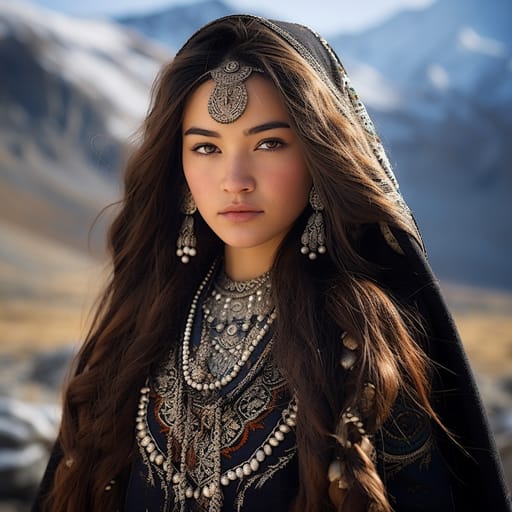
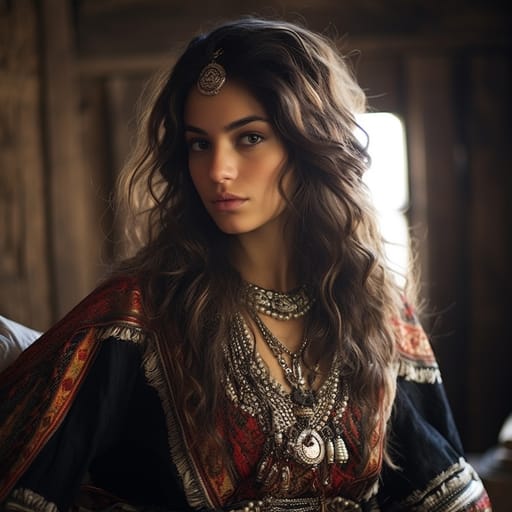
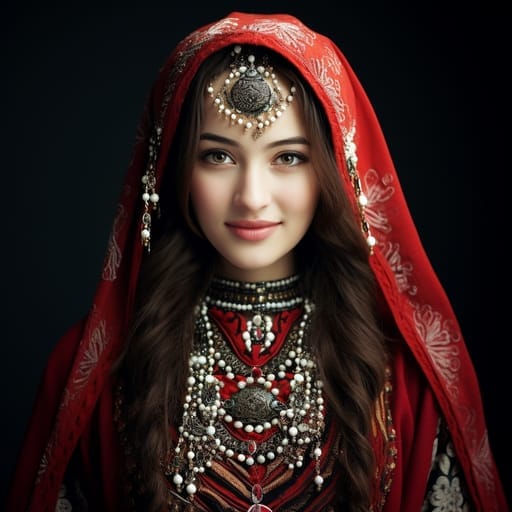
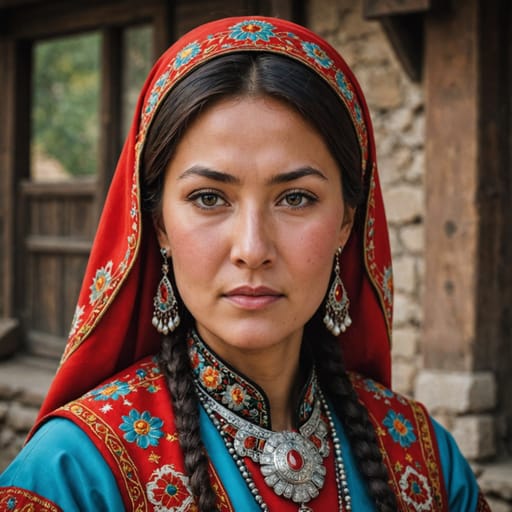
Typical Balti Phenotypes
Reference for AI generation: hair, eyes, skin, facial structure, build
The Balti are one of the few Tibetan-descended populations living west of the Himalayan crest, and their phenotype reads as exactly that: a Tibetic genetic core layered with centuries of contact with Dardic, Kashmiri, and Iranian-speaking neighbors in the Karakoram valleys. The result is recognizably Central Asian rather than South Asian, but with softer edges than the Tibetan plateau populations to the east.
Hair runs near-universally black or very dark brown, predominantly straight to gently wavy, with the coarse, heavy texture characteristic of East Asian-descended hair. True curl is uncommon. Premature graying is not unusual at high altitude. Eye color is overwhelmingly dark brown, occasionally lighter hazel-brown in individuals with more visible Dardic admixture in Skardu and the lower Indus valleys. The epicanthic fold is present but usually partial — softer and less pronounced than in Han or central Tibetan populations, often reading as a subtle inner-corner fold rather than a full Mongolic eye shape. Palpebral fissures tend to be moderately narrow.
Skin tone clusters in Fitzpatrick III to IV, with warm wheatish to light-olive undertones. Cheeks frequently carry the high-altitude flush — visible capillary coloring across the malar area from chronic UV and cold exposure above 2,000 meters. Faces are typically broad and flat-planed with high, prominent cheekbones, low-bridged noses with moderate alar width, and relatively short philtrums. Lips are medium in fullness, neither thin nor pronounced. Jawlines tend toward rounded rather than angular.
Build is compact and stocky — adult men typically 5'4" to 5'7", women 4'11" to 5'3" — with the broad chest and dense musculature associated with generational high-altitude adaptation. Body fat distribution favors the trunk. Among Pakistan's ethnic groups, the Balti are the most visibly East Asian in feature, and side-by-side with neighboring Burusho or Shina populations the contrast in eye shape, nose bridge height, and facial planar structure is immediate.
Balti Body & Anatomy Reference
Anatomy by feature, Central Asian Turkic-Mongolic phenotype
Balti Boobs & Breasts
Balti tits and boobs run medium cup, moderate projection, the classic Central Asian Turkic-Mongolic bust profile. Balti nipples and areolas show medium-brown areolar pigmentation against the tan-to-light-brown skin tone, with areolar diameter typically in the 30-42mm range and forward-set positioning rather than the smaller East Asian bust. Balti breasts trend full and modestly projecting, a function of the mesomorph, broader frame than the East Asian norm body habitus and the mean adult female BMI 23-26. For anatomically accurate AI-generated Balti nudes the render preserves the medium cup, moderate projection shape, 30-42mm areolas with medium-brown pigmentation, and the torso proportions of the Central Asian Turkic-Mongolic phenotype.
Balti Ass & Hips
Balti hips and butt usually read as medium, moderate projection, broader hip profile than the East Asian norm. The skeletal base is medium iliac crests, moderate gluteal-femoral fat deposition, the Central Asian Turkic-Mongolic pattern. Set against the slim East Asian narrow-hip profile, the difference is easy to see, and the hip-to-waist ratio is often what identifies Balti women in photos.
Balti Vagina & Pussy
Expect medium-brown labial pigmentation on Balti women, in keeping with Central Asian Turkic-Mongolic ancestry. The pubic hair is straight-to-wavy medium-coarse texture. Coloring should run evenly from the tan to light-brown skin of the thighs to the labia, and Balti nude imagery should keep the hair's straight-to-wavy medium-coarse texture.
Balti Dicks & Penis
Balti dick and penile anatomy in adult AI generation should anchor on the regional reference data: regional mean ~13cm erect, moderate girth, and medium-brown shaft pigmentation. The Balti cock profile reflects the Central Asian Turkic-Mongolic population's anthropometric measurements. The shaft pigmentation should track the surrounding tan to light-brown skin tone, and the pubic hair should keep its straight-to-wavy medium-coarse texture in the typical inverted-V escutcheon.
Balti Body, Curves & Build
Balti body type: mesomorph, broader frame than the East Asian norm, with mean adult female BMI 23-26. This is the typical Central Asian Turkic-Mongolic build. Height range, shoulder-to-hip ratio and fat distribution all follow from it, which is what an accurate Balti nude body should show.
Balti Skin Tone & Hair Texture
Balti skin tone falls in the tan to light-brown (Fitzpatrick III-IV) band, the surface signal most often miscalibrated by generic AI nude generators. Balti hair texture is typically straight 1A-1B, dark-brown to black, characteristic of the Central Asian Turkic-Mongolic phenotype. In Balti nude renders the skin should hold that band consistently across the body.
Data depth
8/100Coverage of image-grounded phenotype observations · drives AI generation diversity
- Sample size
- 3/40· 1 image
- Image quality
- 0/30· 0% high
- Confidence
- 5/20· mean 0.45
- Source diversity
- 0/10· wikipedia
- ·No image observations yet
- ·Low overall confidence
- ·Wikipedia-only source, not population-representative
Explore phenotype categories
Structured taxonomy with peer-reviewed scales · 22 anatomical categories
Notable Balti People
2 reference figures, sourced from Wikipedia
- Gilgit−Baltistan, Baltistan
- Three Cups of Tea, a book about an American humanitarian involved in building schools in Baltist…
Erotic Poses & Sex Positions
From the pose catalog: 219 named positions with reference skeletons
Frequently asked questions about Balti people
Where is the Balti homeland?
The Balti homeland is Gilgit-Baltistan (Pakistan) in Central Asia.
What language do Balti people speak?
Balti people primarily speak Sino-Tibetan / Tibetic / Balti.
What religion do Balti people practice?
The predominant religion among Balti people is Islam / Shia Islam.






Make your own Balti images
Five a day, free, no credits to buy. The studio starts from this group's phenotype data, so you can set body type, pose and style and keep the traits accurate.
Start with Balti