Help us get this right
Does this portrait look right for Alasha?
Nobody has judged this one yet. You would be the first.
Alasha Erotic
Western Kazakhstan, in the steppe and Caspian lowlands around the Ural (Zhaiyk) River.
Kazakh (Turkic, Kipchak branch); Russian widely spoken as a second language.
Sunni Islam (Hanafi school), mixed with steppe customs of honoring ancestors and their spirits (aruaq).
One of the twelve tribes of the Bayuly confederation, part of the Junior Zhuz (Kishi Zhuz) of the Kazakhs.
About Alasha People
The Alasha are a tribe within a nation, not a nation of their own. They are one of the twelve tribes of the Bayuly, a confederation of the Kazakh Junior Zhuz, the horde that held the western end of the Kazakh steppe. A person is Alasha through their father's line, and that descent is kept in the shezhire, the genealogies Kazakh families still memorize and more and more often write down. No passport records it. Even so, asking another Kazakh about their tribe is still an ordinary way to start a conversation, especially outside the big cities. The name also carries extra weight. Alash is the legendary forefather claimed by all Kazakhs and the old battle cry of the steppe. It is also the name the Alash Orda autonomy movement took between 1917 and 1920.
Bayuly country is the far west of Kazakhstan: dry, wind-scoured steppe falling toward the Caspian Sea and cut by the Ural River, which Kazakhs call the Zhaiyk. For centuries its families moved sheep, horses and camels between summer and winter pastures. The Junior Zhuz was the first Kazakh horde to accept Russian protection, in 1731. In the early nineteenth century many Bayuly clans crossed west of the Ural into the newly formed Bukey Horde. Soviet collectivization ended nomadic life for good, and the famine of the early 1930s killed a huge share of the Kazakh people. Today Alasha families live in the villages and oil towns of the west, alongside Kazakhs of every other lineage.
They speak Kazakh, a Kipchak Turkic language close enough to Karakalpak and Nogai that speakers can follow much of each other's speech. Russian has been widely used as a second language since Soviet times. Their faith is Sunni Islam of the Hanafi school, practiced in the way of the steppe. Prayer and the fast of Ramadan sit alongside visits to family graves and a real respect for the aruaq, the spirits of the dead. Families remember them with memorial meals and by frying flatbreads whose smell is meant to reach them. The custom outsiders least expect is jeti ata, the rule that two people who share a male-line ancestor within seven generations may not marry. That rule is a big part of why lineage knowledge has survived. Before a match, families still check the genealogy, and the old question of which tribe someone belongs to turns out to have a practical answer.
Related ethnic groups
Groups that share Alasha's homeland, region, language, or religious tradition. These are likely candidates for comparative phenotype reference.
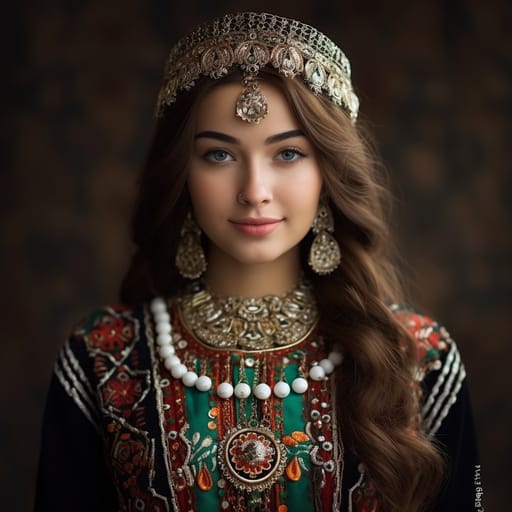
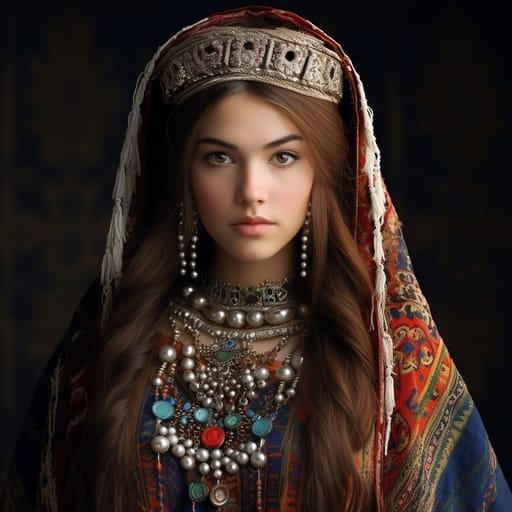
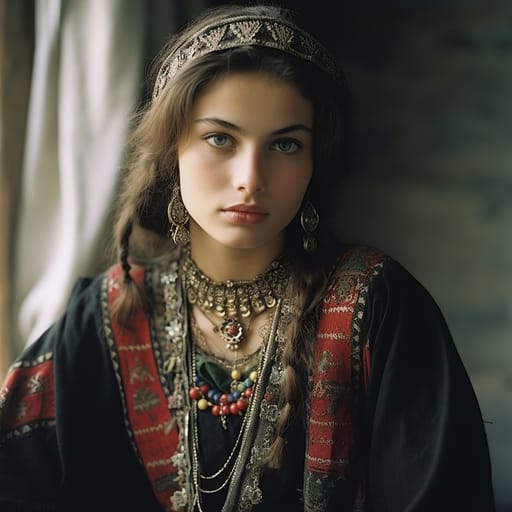
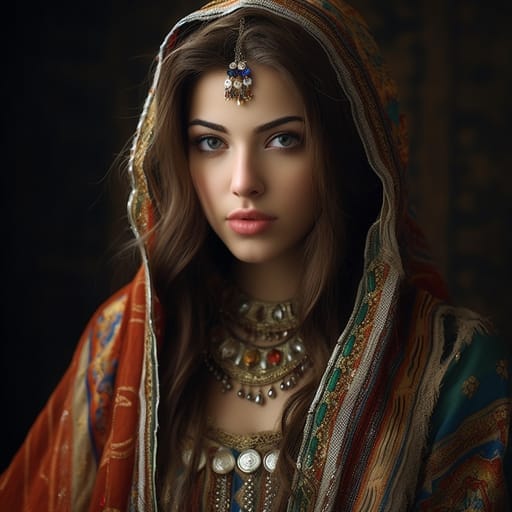
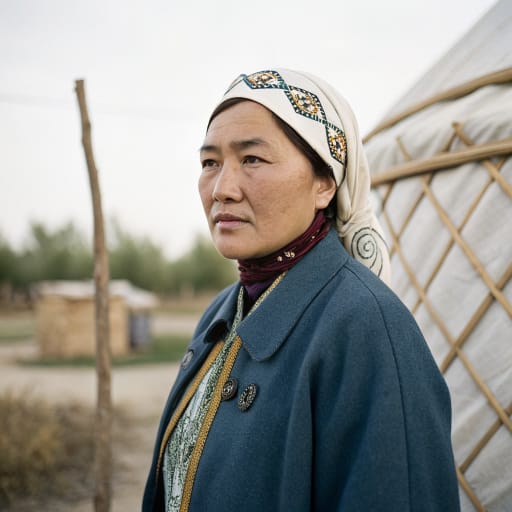
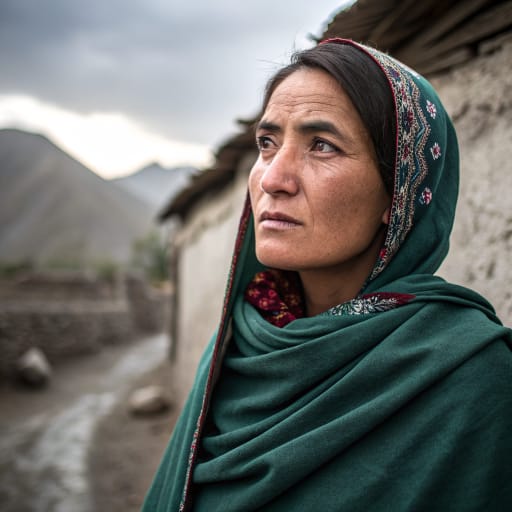

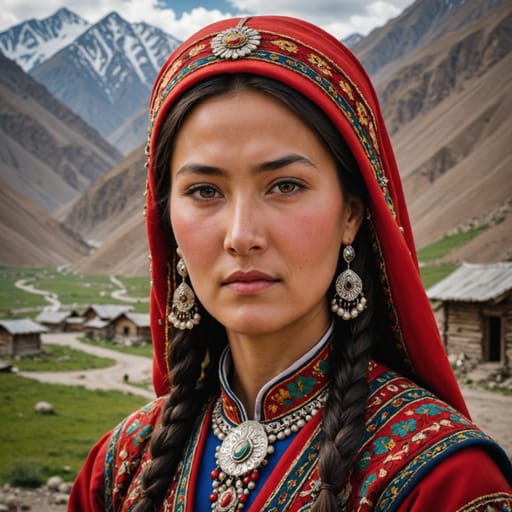
Typical Alasha Phenotypes
Reference for AI generation: hair, eyes, skin, facial structure, build
Alasha Body & Anatomy Reference
Central Asian Turkic-Mongolic phenotype: anatomy reference for AI nude generation
Alasha Boobs & Breasts
Alasha tits and boobs run medium cup, moderate projection, the classic Central Asian Turkic-Mongolic bust profile. Alasha nipples and areolas show medium-brown areolar pigmentation against the tan-to-light-brown skin tone, with areolar diameter typically in the 30-42mm range and forward-set positioning rather than the smaller East Asian bust. Alasha breasts trend full and modestly projecting, a function of the mesomorph, broader frame than the East Asian norm body habitus and the mean adult female BMI 23-26. For anatomically accurate AI-generated Alasha nudes the render preserves the medium cup, moderate projection shape, 30-42mm areolas with medium-brown pigmentation, and the torso proportions of the Central Asian Turkic-Mongolic phenotype.
Alasha Ass & Hips
Alasha hips and butt usually read as medium, moderate projection, broader hip profile than the East Asian norm. The skeletal base is medium iliac crests, moderate gluteal-femoral fat deposition, the Central Asian Turkic-Mongolic pattern. Set against the slim East Asian narrow-hip profile, the difference is easy to see, and the hip-to-waist ratio is often what identifies Alasha women in photos.
Alasha Vagina & Pussy
Expect medium-brown labial pigmentation on Alasha women, in keeping with Central Asian Turkic-Mongolic ancestry. The pubic hair is straight-to-wavy medium-coarse texture. Coloring should run evenly from the tan to light-brown skin of the thighs to the labia, and Alasha nude imagery should keep the hair's straight-to-wavy medium-coarse texture.
Alasha Dicks & Penis
Alasha dick and penile anatomy in adult AI generation should anchor on the regional reference data: regional mean ~13cm erect, moderate girth, and medium-brown shaft pigmentation. The Alasha cock profile reflects the Central Asian Turkic-Mongolic population's anthropometric measurements. The shaft pigmentation should track the surrounding tan to light-brown skin tone, and the pubic hair should keep its straight-to-wavy medium-coarse texture in the typical inverted-V escutcheon.
Alasha Body, Curves & Build
Alasha body type: mesomorph, broader frame than the East Asian norm, with mean adult female BMI 23-26. This is the typical Central Asian Turkic-Mongolic build. Height range, shoulder-to-hip ratio and fat distribution all follow from it, which is what an accurate Alasha nude body should show.
Alasha Skin Tone & Hair Texture
Alasha skin tone falls in the tan to light-brown (Fitzpatrick III-IV) band, the surface signal most often miscalibrated by generic AI nude generators. Alasha hair texture is typically straight 1A-1B, dark-brown to black, characteristic of the Central Asian Turkic-Mongolic phenotype. In Alasha nude renders the skin should hold that band consistently across the body.
Explore phenotype categories
Structured taxonomy with peer-reviewed scales · 22 anatomical categories
Erotic Poses & Sex Positions
From the pose catalog: 219 named positions with reference skeletons
Frequently asked questions about Alasha people
Where is the Alasha homeland?
The Alasha homeland is Western Kazakhstan, in the steppe and Caspian lowlands around the Ural (Zhaiyk) River. in Central Asia.
What language do Alasha people speak?
Alasha people primarily speak Kazakh (Turkic, Kipchak branch); Russian widely spoken as a second language..
What religion do Alasha people practice?
The predominant religion among Alasha people is Sunni Islam (Hanafi school), mixed with steppe customs of honoring ancestors and their spirits (aruaq)..






Make your own Alasha images
Five a day, free, no credits to buy. The studio starts from this group's phenotype data, so you can set body type, pose and style and keep the traits accurate.
Start with Alasha