Help us get this right
Does this portrait look right for Lakai?
Nobody has judged this one yet. You would be the first.
Lakai Erotic
Southern Tajikistan: the Hisor valley and the hills of Khatlon south and east of Dushanbe; smaller communities in Surxondaryo, Uzbekistan, and in northern Afghanistan
Lakai dialect of Uzbek, Kipchak type (Turkic); Tajik (Iranian, Indo-European) widely spoken as a second language
Sunni Islam (Hanafi), with shrine visits and folk practice
An Uzbek tribal group of Dasht-i Kipchak origin; four main branches: Esankhoja, Badrakli, Bayram, Turtuul
About Lakai People
The Lakai are horse people. Among the Uzbek-speaking tribes that settled the hills and river valleys of what is now southern Tajikistan, they have held on to a tribal name, a genealogy and a reputation: breeders of tough mountain horses, hard riders at kopkari (the goat-carcass game known elsewhere as buzkashi), and, in the 1920s, the core of armed resistance to Soviet rule in eastern Bukhara. Most live today in the Hisor valley and the low ranges of Khatlon south and east of Dushanbe, with smaller communities across the border in Uzbekistan's Surxondaryo region and in northern Afghanistan, where many families fled when that fight was lost.
Their speech is a Kipchak-type dialect of Uzbek, the kind that says j where literary Uzbek says y. It marks them off audibly from the settled Uzbek of the towns, and entirely from their Tajik neighbors, whose language is Iranian, though most Lakai get by in Tajik as well. Ethnographers place them among the steppe tribes of the Dasht-i Kipchak who moved south in the wake of the Shaybanid conquest of the sixteenth century. The tribe is reckoned in four main branches, Esankhoja, Badrakli, Bayram and Turtuul, each split into lineages that people can still name. They are Sunni Muslims of the Hanafi school, with the familiar Central Asian layer of shrine visits, amulets and life-cycle feasts on top of mosque practice.
Until the early twentieth century the Lakai were semi-nomadic, wintering in villages and moving flocks and horse herds to summer pasture. Collectivization ended that. Before it did, Ibrahim Bek, a Lakai of the Esankhoja branch, led the Basmachi war against the Red Army through the 1920s, first from the hills of eastern Bukhara and then from exile in Afghanistan, until his capture in 1931. The memory cuts both ways: pride inside the community, and decades of official suspicion outside it. In the civil war of the 1990s Lakai militias fought on the side of the Popular Front that brought the present government to power. Tajikistan's censuses of 2000 and 2010 counted the Lakai separately from other Uzbeks, at about 51,000 and then 65,000 people. Some welcome that as recognition; others read it as a way to shrink the Uzbek total.
Outside the region the name travels on two things. One is the Lokai horse, a small, sure-footed breed still raised in Tajikistan. The other is Lakai embroidery: small silk-stitched hangings and bags worked by women in bold, off-kilter motifs, nothing like the orderly floral suzanis of Bukhara and Samarkand, and now chased by textile collectors worldwide.
Related ethnic groups
Groups that share Lakai's homeland, region, language, or religious tradition. These are likely candidates for comparative phenotype reference.
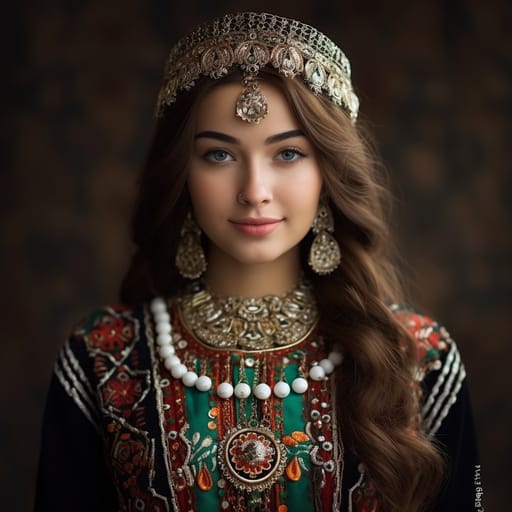
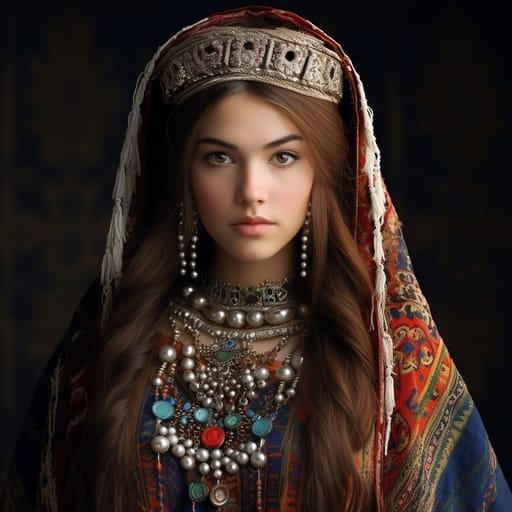
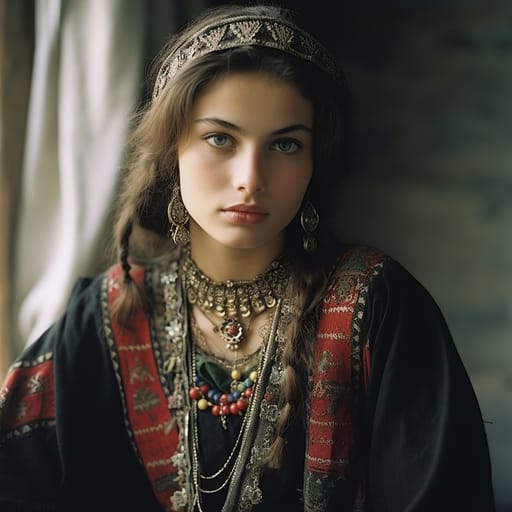
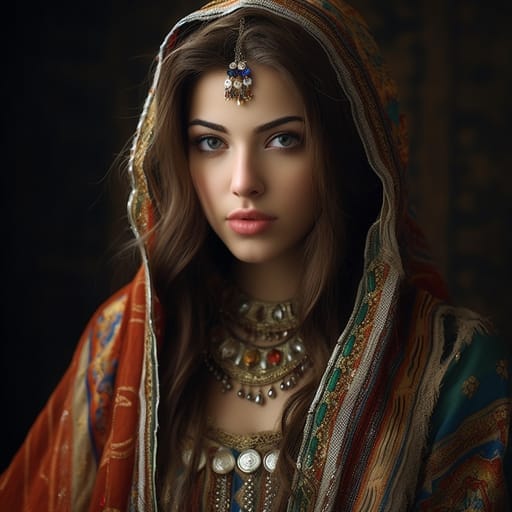
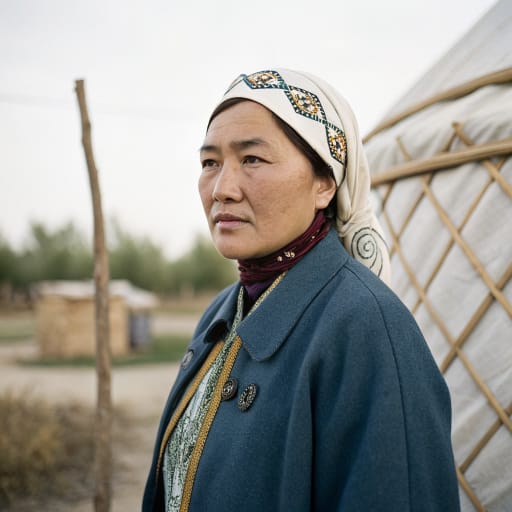
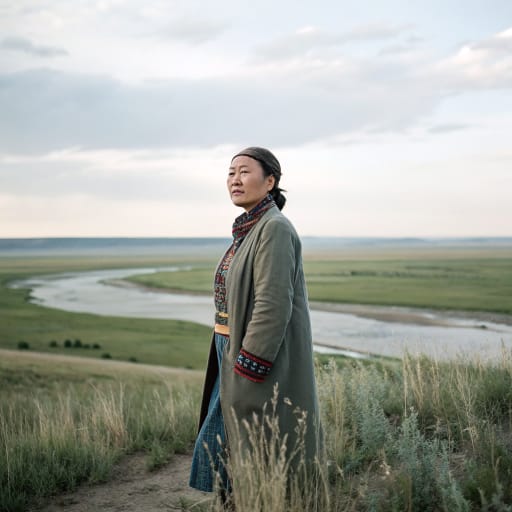
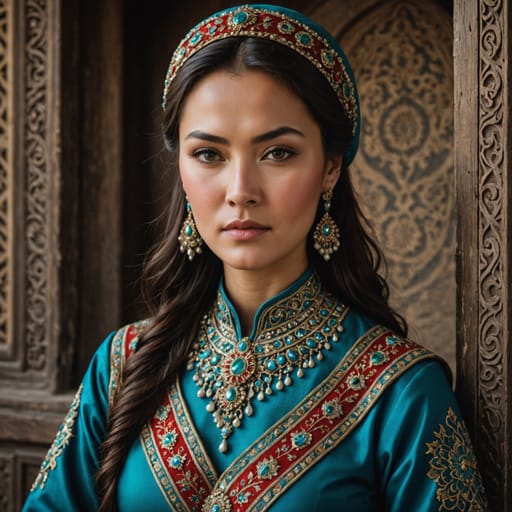
Typical Lakai Phenotypes
Reference for AI generation: hair, eyes, skin, facial structure, build
Lakai Body & Anatomy Reference
Central Asian Turkic-Mongolic phenotype: anatomy reference for AI nude generation
Lakai Boobs & Breasts
Lakai boobs follow the Central Asian Turkic-Mongolic profile: medium cup, moderate projection. Areolar diameter is usually 30-42mm, and the coloring is medium-brown areolar pigmentation against the tan-to-light-brown skin tone. Breast shape tracks body composition (mesomorph, broader frame than the East Asian norm, mean adult female BMI 23-26), so Lakai breasts tend to be full and modestly projecting. Expect a forward-set shape, not the smaller East Asian bust.
Lakai Ass & Hips
Lakai ass and hip morphology presents as medium, moderate projection, broader hip profile than the East Asian norm, distinctly different from the slim East Asian narrow-hip profile. The Lakai pelvic profile shows medium iliac crests, moderate gluteal-femoral fat deposition, anchored in the Central Asian Turkic-Mongolic skeletal pattern. Lakai butt shots in adult AI imagery should render the medium, moderate projection, broader hip profile than the East Asian norm silhouette with the overall build (mesomorph, broader frame than the East Asian norm) and the fat distribution typical of the Central Asian Turkic-Mongolic phenotype.
Lakai Vagina & Pussy
Lakai pussy anatomy typically shows medium-brown labial pigmentation. Pubic hair is usually straight-to-wavy medium-coarse texture. In AI-generated Lakai nudes, labial color should blend into the tan to light-brown skin with a gradual transition, and the hair should keep its straight-to-wavy medium-coarse texture.
Lakai Dicks & Penis
Penis reference for Lakai men: regional mean ~13cm erect, moderate girth. Coloring: medium-brown shaft pigmentation. An accurate Lakai cock in AI imagery matches the surrounding tan to light-brown skin rather than a generic porn default. Circumcision depends on religion and custom, not ancestry.
Lakai Body, Curves & Build
The Lakai figure is generally mesomorph, broader frame than the East Asian norm, with mean adult female BMI 23-26, characteristic of Central Asian Turkic-Mongolic ancestry. AI image tools tend to flatten regional body types into a few stock shapes; here the Lakai build is kept as its own reference.
Lakai Skin Tone & Hair Texture
Skin: tan to light-brown (Fitzpatrick III-IV). Hair: straight 1A-1B, dark-brown to black. Both are typical of Central Asian Turkic-Mongolic ancestry. The most common mistake in AI nudes of Lakai women is a body rendered lighter than the face.
Explore phenotype categories
Structured taxonomy with peer-reviewed scales · 22 anatomical categories
Erotic Poses & Sex Positions
From the pose catalog: 219 named positions with reference skeletons
Frequently asked questions about Lakai people
Where is the Lakai homeland?
The Lakai homeland is Southern Tajikistan: the Hisor valley and the hills of Khatlon south and east of Dushanbe; smaller communities in Surxondaryo, Uzbekistan, and in northern Afghanistan in Central Asia.
What language do Lakai people speak?
Lakai people primarily speak Lakai dialect of Uzbek, Kipchak type (Turkic); Tajik (Iranian, Indo-European) widely spoken as a second language.
What religion do Lakai people practice?
The predominant religion among Lakai people is Sunni Islam (Hanafi), with shrine visits and folk practice.






Make your own Lakai images
Five a day, free, no credits to buy. The studio starts from this group's phenotype data, so you can set body type, pose and style and keep the traits accurate.
Start with Lakai