Help us get this right
Does this portrait look right for Bukharan Jews?
One tap. It takes a second and it is recorded.
1 says it looks right, 0 say it looks off.
Bukharan Jews Erotic
Bukhara and Samarkand, Uzbekistan (and Tajikistan)
Bukhori / Judeo-Tajik (Indo-European, Iranian; Persian)
Judaism (Orthodox)
Persian Jewish diaspora; Central Asian Mizrahim
About Bukharan Jews People
Bukharan Jews, also called Bukharian Jews, are a Jewish community from Central Asia, historically centered in the oasis cities of Bukhara and Samarkand in present-day Uzbekistan and in Tajikistan. They speak Bukhori, a Judeo-Tajik dialect of the Persian language within the Indo-European family, traditionally written in Hebrew script. After large migrations the majority now live in Israel and the United States, where Queens in New York City hosts one of the largest communities.
Society and subsistence
For centuries Bukharan Jews were woven into the commercial life of the Silk Road cities, working as dyers, silk and cotton weavers, textile merchants, barbers and musicians. They were especially associated with indigo dyeing and with the classical Shashmaqam musical tradition of Central Asia, in which Bukharan Jewish performers played a leading role. Community life was tightly knit and religiously observant, organized around the synagogue, the extended family and distinctive Bukharan rites and cuisine. Periods of forced conversion under earlier rulers produced the chala, crypto-Jews who later returned to open practice.
Appearance and adornment
Bukharan Jews share the Persianate and Central Asian appearance of their homeland, typically with olive skin, dark hair and brown eyes. Traditional festive dress is striking: men wear long robes of striped or ikat silk, the joma or chapan, tied with a sash and topped by an embroidered skullcap. Women wear flowing dresses of vivid atlas and adras ikat silk, with gold thread embroidery, coral and gold jewelry and embroidered caps or headscarves. Gold-embroidered garments in particular became a hallmark of Bukharan ceremony. In daily life most now wear modern clothing, reserving the silk robes for weddings and holidays.
Related ethnic groups
Groups that share Bukharan Jews's homeland, region, language, or religious tradition. These are likely candidates for comparative phenotype reference.
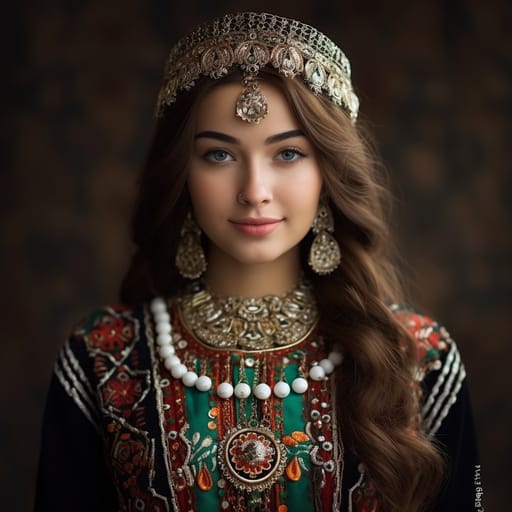
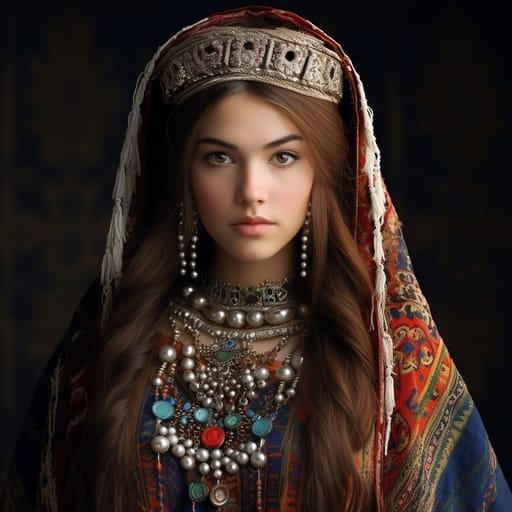
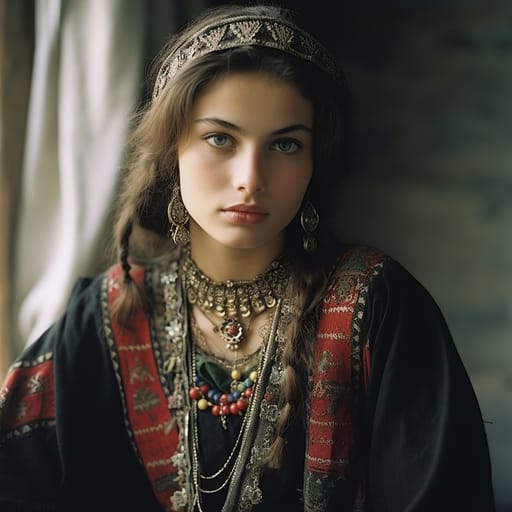
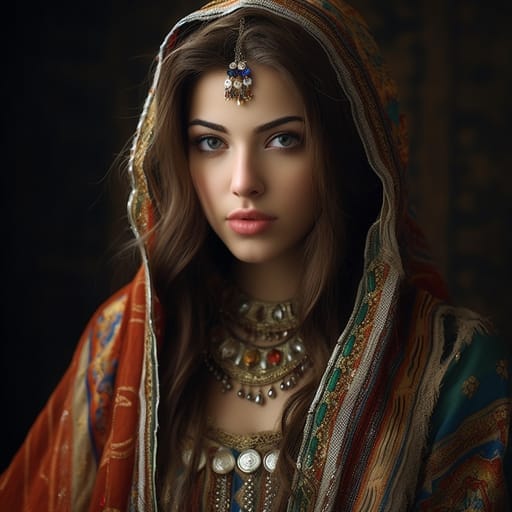
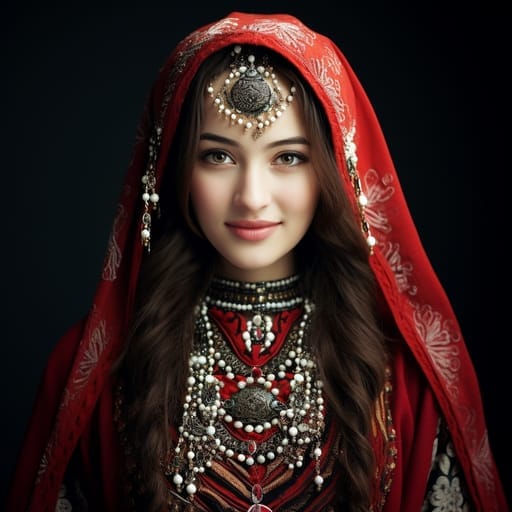
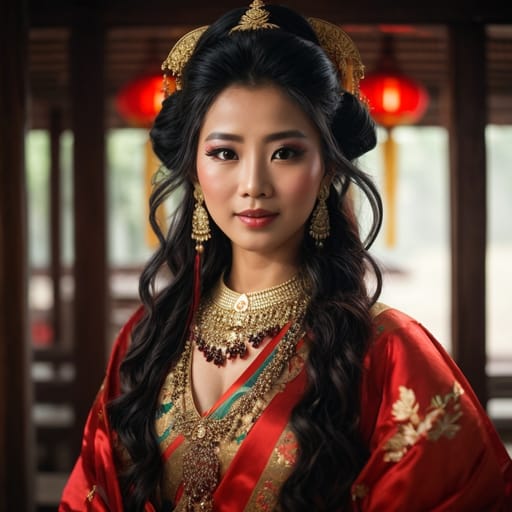
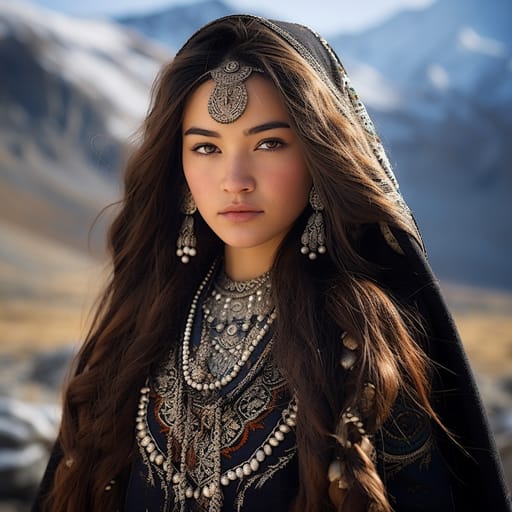
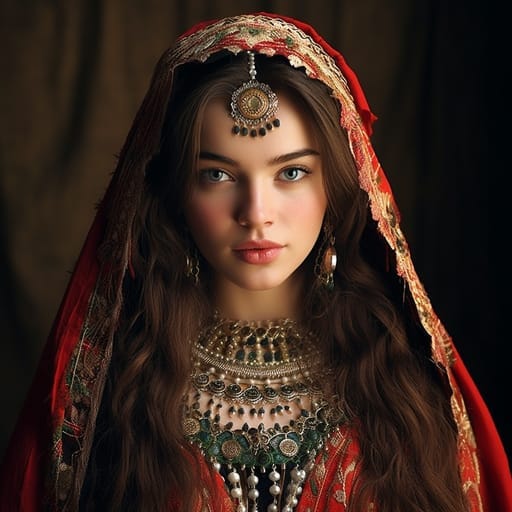
Typical Bukharan Jews Phenotypes
Reference for AI generation: hair, eyes, skin, facial structure, build
Explore phenotype categories
Structured taxonomy with peer-reviewed scales · 22 anatomical categories
Notable Bukharan Jews People
63 reference figures, sourced from Wikipedia
- Messiah, Claimants
- Jerusalem, in Judaism
- Schisms, Pharisees, Sadducees, Essenes, Zealots, Sicarii)
- Second Temple Judaism, Hellenistic Judaism)
- Ashkenazim, Galician Litvak
- Crypto-Jews, Anusim Dönmeh Marranos Neofiti Xueta
- Ethiopia, Beta Israel
- Uganda, Abayudaya
- Greece, Romaniote
- Russia, Soviet Union
- Spain, Sephardic
- United Kingdom, England Scotland Wales
- Orthodox, Modern Haredi Hasidic
- Hebrew, Biblical Mishnaic Medieval Modern
- Bichak, stuffed baked or fried pastry, traditional for Rosh Hashanah and Sukkot.
- Chakchak, a popular sweet made from unleavened dough cut and rolled into hazelnut-sized…
- Assi Azar, television host and screenwriter
- Yisrael Aharoni, celebrity chef and restaurateur
- Mordekhai Batchaev, poet and radio broadcaster
- Avi Benedi, singer and songwriter
- Yoni Ben-Menachem, journalist, General Director of Israel Broadcasting Authority
- Amnon Cohen, politician, member of the Knesset for Shas
- Oded Davidoff, film and TV director
- Guy Haimov, professional football player
- Shimon Hakham, Bukharan rabbi, writer, one of the founders of the Bukharan Quarter
- Robert Ilatov, politician, member of the Knesset for Yisrael Beiteinu
- Avi Issacharoff, journalist and creator of the series Fauda
- Lev Leviev, billionaire businessman, investor, philanthropist, president of the World Con…
- Nitzan Kaikov, songwriter and music producer
- Moshe Mishaelof, professional football player
- Shlomo Moussaieff, co-founder of the Bukharan Quarter in Jerusalem
- Dorrit Moussaieff, former First Lady of Iceland
- Rafael Pinhasi, politician; member of the Knesset for Shas
- Albert Pinhasov, researcher; Rector of Ariel University
- Gideon Sa'ar, politician who served as a member of Knesset for New Hope
- Yulia Shamalov-Berkovich, politician who served as a member of the Knesset for Kadima
- Esther Roth-Shahamorov, national athlete
- Idan Yaniv, singer, "2007 Israeli Artist of the Year"
- Benjamin Yusupov, classical composer, conductor and pianist
- Jacob Arabo, proprietor of Jacob & Co.
- Michael Aronov, actor and playwright, Tony Award winner
- Boris Kandov, president of the Bukharian Jewish Congress of the US and Canada
- Jacob Nasirov, Bukharan-American rabbi from Afghanistan (member of the Bukharian Rabbinical …
- Rus Yusupov, Internet entrepreneur; co-founder of Vine
- Iosef Yusupov, designer
- Yvonne Green, née Mammon), poet and translator
- Jeremy Issacharoff, diplomat and ambassador for Israel
- Anthony Yadgaroff, businessman, Jewish community leader
- Assaf Atchildi, doctor and surgeon. He is credited for saving over 300 Jews in Nazi-occupied …
- Alexandre Reza, jeweler known for his diverse and rare collection of precious gemstones
- Ari Babakhanov, musician from Uzbekistan
- Eson Kandov, singer, Honored People's Artist of the USSR
- Rena Galibova, Soviet actress, "People's Artist of Tajikistan" (an awarded title, alluding t…
- Meirkhaim Gavrielov, journalist murdered in Tajikistan in 1998
- Barno Itzhakova, vocalist, famous for her rendition of traditional Shashmaqom songs in Tajik a…
- Malika Kalontarova, dancer, "People's Artist of Soviet Union" (Queen of Eastern Dance)
- Fatima Kuinova, Soviet singer, "Merited Artist of the Soviet Union"
- Ilyas Malayev, musician and poet from Uzbekistan, "Honoured Artist of Uzbekistan"
- Shoista Mullodzhanova, Shashmakon singer, "People's Artist of Tajikistan" (Queen of Shashmakom music)
- Gavriel Mullokandov, popular Shashmakom artist, "People's Artist of Uzbekistan"
- Suleiman Yudakov, Soviet composer and musician, "People's Artist of the Uzbek SSR"
- Yakhiel Sabzanov, Soviet composer, "People's Artist of the Tajik SSR"
- Zablon Simintov, widely regarded as the last remaining Jew in Afghanistan, evacuated to Israel…
Erotic Poses & Sex Positions
From the pose catalog: 219 named positions with reference skeletons
Frequently asked questions about Bukharan Jews people
Where is the Bukharan Jews homeland?
The Bukharan Jews homeland is Bukhara and Samarkand, Uzbekistan (and Tajikistan) in Central Asia.
What language do Bukharan Jews people speak?
Bukharan Jews people primarily speak Bukhori / Judeo-Tajik (Indo-European, Iranian; Persian).
What religion do Bukharan Jews people practice?
The predominant religion among Bukharan Jews people is Judaism (Orthodox).






Make your own Bukharan Jews images
Five a day, free, no credits to buy. The studio starts from this group's phenotype data, so you can set body type, pose and style and keep the traits accurate.
Start with Bukharan Jews