Help us get this right
Does this portrait look right for Pamiris?
One tap. It takes a second and it is recorded.
2 say it looks right, 4 say it looks off.
Pamiris Erotic
Pamir Mountains (Tajikistan, Afghanistan, China)
Islam / Shia Islam
Shughni, Sarikoli (including Tajiks of Xinjiang), Yazghulami, Munji, Yidgha, Sanglechi, Ishkashimi, Wakhi
About Pamiris People
The Pamiris are the people of the high valleys — a cluster of Eastern Iranian-speaking communities scattered across the Pamir Mountains where Tajikistan, Afghanistan, China's Xinjiang, and a sliver of northern Pakistan meet. They are not one people in the way nation-states like to count, and they will tell you so. Shughni speakers in the Bartang and Shughnan valleys cannot easily understand a Wakhi herder from the Hindu Kush corridor, and neither can read the Sarikoli of Tashkurgan without effort. What binds them is geography, a religious tradition, and the shared experience of living above 2,000 meters in country that punishes carelessness.
Their languages are the surviving eastern branch of the Iranian family — closer in deep ancestry to the long-extinct Sogdian and Bactrian than to Persian, even though Tajik Persian is the regional lingua franca and the language of school and state. Linguists treat Pamir not as a single tongue but as a small family in its own right: Shughni-Rushani, Yazghulami, Wakhi, Ishkashimi-Sanglechi, and the smaller Munji and Yidgha communities on the Afghan side. Several of these are spoken by only a few thousand people and exist almost entirely as oral languages; Tajik and Russian, or Dari and Pashto, do the writing.
Religiously, most Pamiris are Ismaili Shia, followers of the Aga Khan, which sets them apart from the Sunni Tajiks and Pashtuns who surround them. The Wakhi of the Pakistani and Chinese sides are mostly Ismaili too; the Sarikoli of Xinjiang are Shia and stand out among the overwhelmingly Sunni Turkic Muslims of that region. Ismaili practice in the Pamirs is quiet and domestic — there are few formal mosques in the Tajik Pamirs, and the prayer space is often a corner of the house. The traditional Pamiri house itself, the chid, is a piece of theology: five wooden pillars named for figures of the household of the Prophet, a stepped skylight that aligns with the sun, a single open room where guests, family, and livestock-keeping all happen within a few steps of each other.
Soviet rule pulled the Tajik Pamirs into the cash economy and built the road that now defines life in Gorno-Badakhshan; the civil war of the 1990s and the chronic isolation that followed pushed many young Pamiris toward Russia for work. The communities on the Afghan side of the Panj River, in the Wakhan Corridor, remain among the most physically remote populations in Asia.
Related ethnic groups
Groups that share Pamiris's homeland, region, language, or religious tradition. These are likely candidates for comparative phenotype reference.
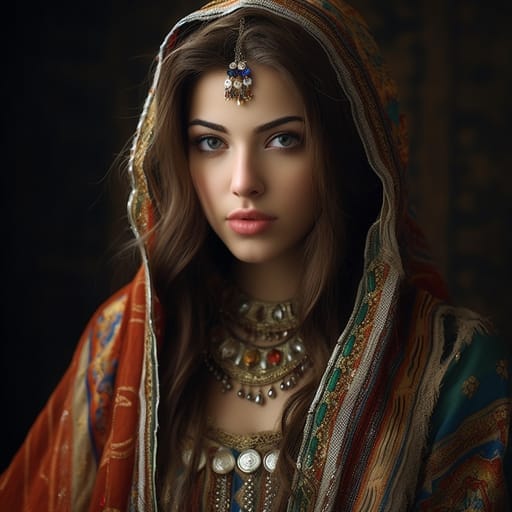
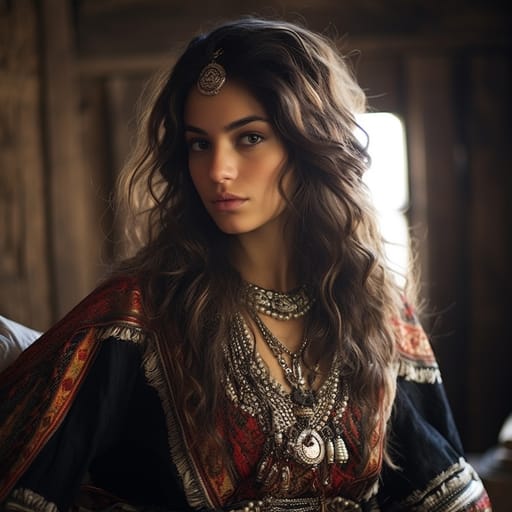
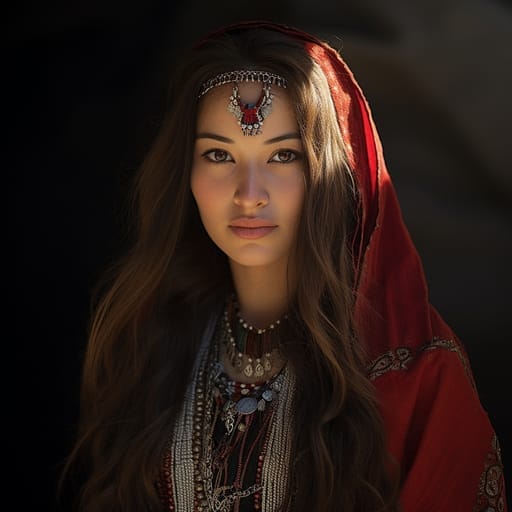
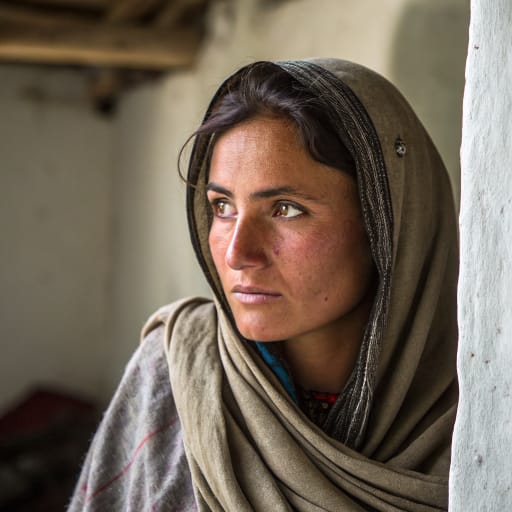
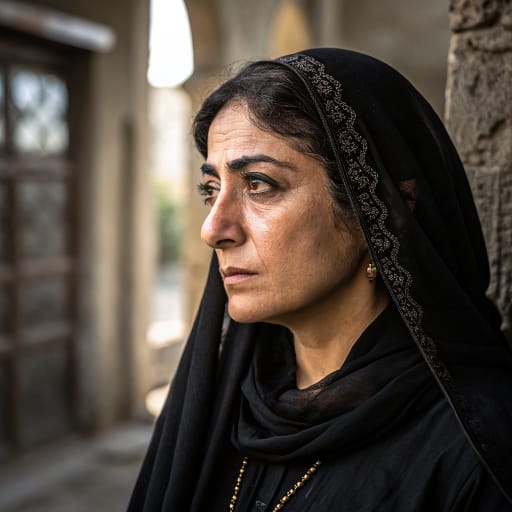
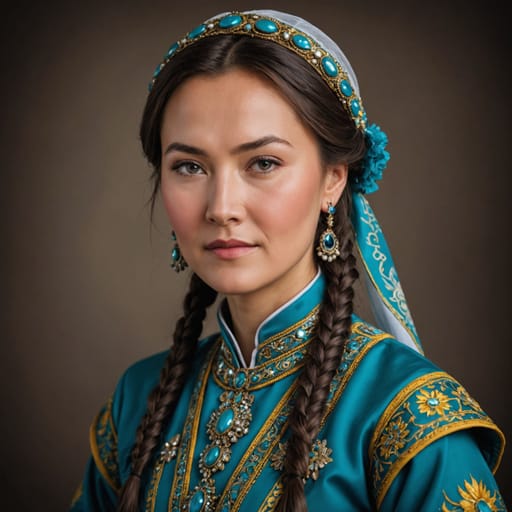
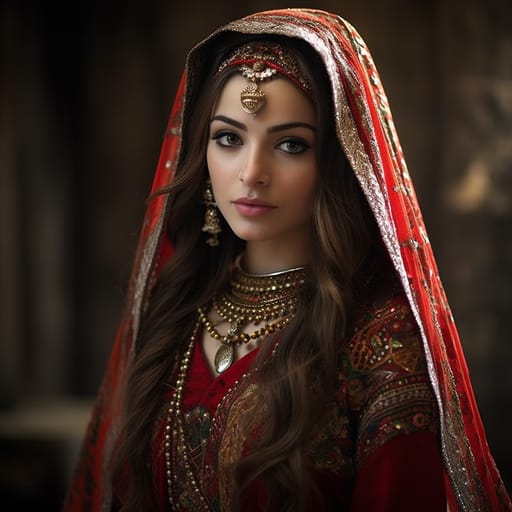
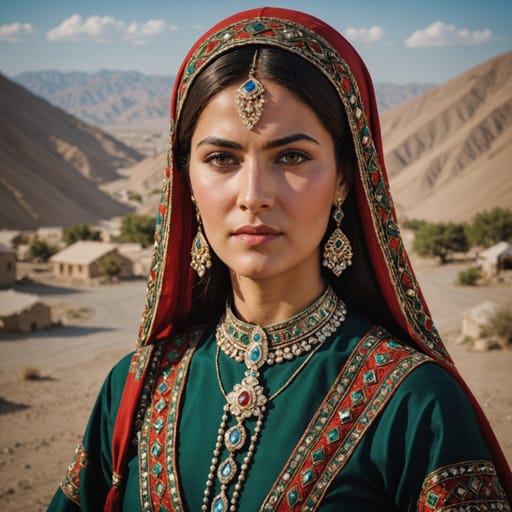
Typical Pamiris Phenotypes
Reference for AI generation: hair, eyes, skin, facial structure, build
The Pamiris are one of the most phenotypically European-leaning populations in Central Asia, and the contrast with surrounding Turkic and Tajik plains populations is the first thing observers note. Centuries of relative isolation in high-altitude valleys preserved a predominantly Eastern Iranian gene pool, and the result is a population where light eyes and chestnut hair appear at frequencies closer to the Caucasus or eastern Europe than to neighboring Kyrgyz or Uyghur groups.
Hair runs from dark brown to black across most of the population, but ash-brown and genuine chestnut tones are common, and outright blond children are documented across Shughni and Wakhi villages, often darkening with age. Texture is typically straight to loosely wavy, fine to medium in diameter, and full beards in men are the norm. Eye color is the most striking feature: green, hazel, grey, and pale blue appear at rates well above the Central Asian average — estimates from Badakhshan field studies place light-eye frequency in some Pamir valleys at 30–40%. The epicanthic fold is generally absent or vestigial, and eye shape reads as European-Iranian rather than East Asian, with deep-set sockets and prominent brow ridges in men.
Skin sits in Fitzpatrick II–IV, with cool to neutral undertones; weathered ruddiness from high-altitude UV exposure is common across cheeks and nose in older adults. Faces tend to be long and narrow, with high-bridged, often aquiline noses, narrow alar bases, moderate lip fullness, and strong jawlines. Cheekbones are present but less laterally projected than in Turkic neighbors. Builds are lean and wiry — adapted to thin air and rugged terrain — with men averaging around 170–172 cm and a slender frame that thickens only modestly with age.
Among the sub-groups, the Wakhi and Ishkashimi of the southern valleys trend slightly darker in hair and eye color, while Shughni and Yazghulami populations of the central Pamirs show the highest incidence of light eyes and lighter hair.
Pamiris Body & Anatomy Reference
Per-feature anatomical profile for AI nude generation: Central Asian Turkic-Mongolic phenotype
Pamiris Boobs & Breasts
The typical Pamiris bust is medium cup, moderate projection, in line with the wider Central Asian Turkic-Mongolic pattern. Areolas usually fall in the 30-42mm range, with medium-brown areolar pigmentation against the tan-to-light-brown skin tone. Compared with the smaller East Asian bust, Pamiris breasts sit forward and are generally full and modestly projecting. A faithful AI render of Pamiris tits keeps that shape and areola size.
Pamiris Ass & Hips
Butt shape among Pamiris women: medium, moderate projection, broader hip profile than the East Asian norm, over medium iliac crests, moderate gluteal-femoral fat deposition. This follows Central Asian Turkic-Mongolic ancestry and looks quite unlike the slim East Asian narrow-hip profile. An accurate Pamiris ass in adult AI imagery keeps both the silhouette and the overall build (mesomorph, broader frame than the East Asian norm) instead of a generic average.
Pamiris Vagina & Pussy
Vulvar anatomy among Pamiris women: medium-brown labial pigmentation. Pubic hair tends to be straight-to-wavy medium-coarse texture, in the usual inverted-triangle pattern. Both follow Central Asian Turkic-Mongolic pigmentation, which is why Pamiris pussy renders should not fall back on a pale, sparse Western template.
Pamiris Dicks & Penis
The Pamiris cock profile, from Central Asian Turkic-Mongolic anthropometric data: regional mean ~13cm erect; moderate girth; medium-brown shaft pigmentation. Pubic hair has a straight-to-wavy medium-coarse texture and forms the usual inverted-V pattern. Whether Pamiris men are circumcised follows religious and cultural practice rather than phenotype.
Pamiris Body, Curves & Build
Build and curves among Pamiris women follow the Central Asian Turkic-Mongolic pattern: mesomorph, broader frame than the East Asian norm, mean adult female BMI 23-26. Proportions matter as much as skin tone, so Pamiris figures should keep their regional height and limb ratios.
Pamiris Skin Tone & Hair Texture
The Pamiris skin range is tan to light-brown (Fitzpatrick III-IV), and hair tends to be straight 1A-1B, dark-brown to black. That combination marks the Central Asian Turkic-Mongolic phenotype, and skin tone is the trait AI generators most often get wrong for Pamiris women.
Data depth
45/100Coverage of image-grounded phenotype observations · drives AI generation diversity
- Sample size
- 15/40· 7 images
- Image quality
- 30/30· 86% high
- Confidence
- 0/20· mean 0.03
- Source diversity
- 0/10· wikipedia
- ·Small sample (n<10)
- ·Low overall confidence
- ·Wikipedia-only source, not population-representative
Observed Distribution: Image Sample
Empirical observations from analyzed photographs · supplementary signal, not population truth
Sample: 7 images analyzed (7 wikipedia). Quality: 6 high, 1 medium, 0 low, 0 very_low. Avg analyzer confidence: 0.03.
Skin tone (Fitzpatrick): unclear (100%)
Hair color: unclear (100%)
Hair texture: wavy (14%), unclear (86%)
Eye color: unclear (100%)
Epicanthic fold: 0% present, 0% absent, 100% unclear
Caveats: Sample size 7 is small, so the observed distribution should be treated as suggestive, not definitive. Low average analyzer confidence: many photos partially obscured or historical. Sample is 100% Wikipedia notable people, which skews toward male, public-life, and modern figures, not population-representative.
Last aggregated: May 7, 2026
Explore phenotype categories
Structured taxonomy with peer-reviewed scales · 22 anatomical categories
Notable Pamiris People
13 reference figures, sourced from Wikipedia
- Middle East Technical University, Davlatshoev, Suhrobsho (2006). The formation and consolidation of Pamiri ethn…
- Daftary, Farhad, 2007). The Ismā'īlīs: Their History and Doctrines (Second ed.). Cambridge Uni…
- Cambria Press, Iloliev, Abdulmamad (2008). The Ismaili-Sufi Sage of Pamir: Mubarak-i Wakhani…
- I. B. Tauris, Elnazarov, Hakim; Aksakolov, Sultonbek (2011). "The Nizari Ismailis of Centra…
- School of Oriental and African Studies, Nourmamadchoev, Nourmamadcho (2014). The Ismāʿīlīs of Badakhshan: History, Po…
- ISBN, Kılavuz, I. T. (2014). Power, Networks and Violent Conflict in Central Asia: …
- Routledge, Straub, D. P. (2014). Akyildiz, Sevket; Carlson, Richard (eds.). Social and C…
- Moscow State Art and Cultural University, Nazarkhudoeva, D. S. (2015). "The current stage of development of ethnic iden…
- Humboldt-Universität zu Berlin, Goibnazarov, Chorshanbe (2017). Qasīda-khonī: A Musical Expression of Identit…
- University of Toronto, Gulamadov, Shaftolu (2018). The Hagiography of Nāṣir-i Khusraw and the Ismāʿī…
- Институт востоковедения РАН, Лашкарбеков, Б. Б. (2006). Памирская экспедиция (статьи и материалы полевых и…
- Этнографическое обозрение, Каландаров, Т. С. (2018). "Памирские народы, их языки и перепись: этнический …
- ISSN, Додыхудоева, Л. Р. (2018). "Влияние городской среды на носителей памирских яз…
Erotic Poses & Sex Positions
From the pose catalog: 219 named positions with reference skeletons
Frequently asked questions about Pamiris people
Where is the Pamiris homeland?
The Pamiris homeland is Pamir Mountains (Tajikistan, Afghanistan, China) in Central Asia.
What language do Pamiris people speak?
Pamiris people primarily speak Indo-European / Iranian / Pamir.
What religion do Pamiris people practice?
The predominant religion among Pamiris people is Islam / Shia Islam.






Make your own Pamiris images
Five a day, free, no credits to buy. The studio starts from this group's phenotype data, so you can set body type, pose and style and keep the traits accurate.
Start with Pamiris