No portrait yet
Yulu Erotic
Northeastern Central African Republic (Vakaga prefecture), southern Darfur in Sudan, and the Raga area of Western Bahr el Ghazal, South Sudan
Yulu (Central Sudanic, Bongo-Bagirmi branch); Arabic (Semitic) and Sango (Ubangian-based creole) as regional lingua francas
Predominantly Muslim
Closest in language to the Binga and Kara; counted among the Fertit peoples of Western Bahr el Ghazal, South Sudan
About Yulu People
What makes the Yulu a people, and not just a handful of villages along a remote border, is their language and a shared history of holding on in country that raiders spent the better part of a century emptying. They live where the Central African Republic, Sudan and South Sudan meet: in the wooded savanna of the CAR's Vakaga prefecture, on the southern fringe of Darfur, and around Raga in South Sudan's Western Bahr el Ghazal. This is some of the most thinly settled and poorly connected country in Central Africa, where roads turn to mud or vanish in the rainy season.
Yulu is a Central Sudanic language of the Bongo-Bagirmi branch. Like its relatives it is tonal, and its closest kin are Binga and Kara, both spoken in the same borderland. Its wider family reaches west to Bagirmi and the Sara languages of Chad and east to Bongo in South Sudan. The Banda languages heard nearby belong to another family entirely. Arabic carries trade on both sides of the frontier, and in the Central African Republic, Sango is the language of markets and officialdom. Islam, which came into this country along the trade and raiding routes out of Darfur, is the dominant faith.
The name outsiders gave the region tells much of the story. To the sultans of Darfur, the non-Muslim peoples to their south were Fertit, a label that marked them as fair targets for slave raids, and the area became known as Dar Fertit. Armed ivory and slave traders from the Nile built fortified camps across the region in the mid-nineteenth century. Around 1900, al-Sanusi, sultan of Dar al-Kuti, sent raiding columns from Ndélé deep into what is now northeastern CAR. Much of the region was depopulated, and today's small, scattered settlements owe a good deal to that era. French and Anglo-Egyptian rule then ran a border through Yulu country, and South Sudan's independence in 2011 added a second, leaving the Yulu divided among three states. In South Sudan the slavers' word has been turned around: Fertit is now a shared political identity for the smaller peoples of Western Bahr el Ghazal, the Yulu among them.
The borderland has rarely been quiet since. Northeastern CAR was the cradle of the Séléka rebellion in 2012. Western Bahr el Ghazal was fought over in Sudan's civil wars and again in South Sudan's, and the war that broke out in Sudan in 2023 pushed refugees across the frontier. Through it all the Yulu remain a farming people far from any capital, with relatives on more than one side of a line on the map.
Related ethnic groups
Groups that share Yulu's homeland, region, language, or religious tradition. These are likely candidates for comparative phenotype reference.
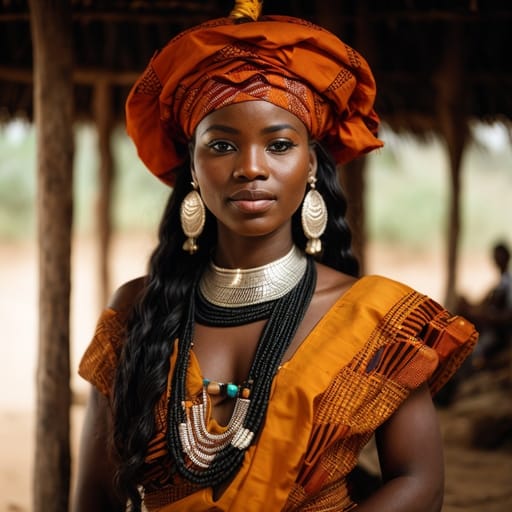
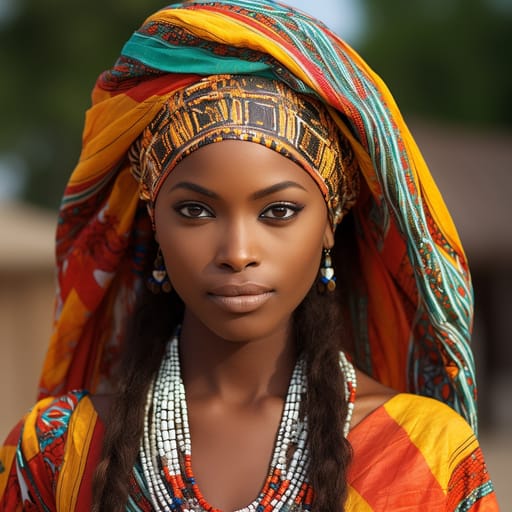
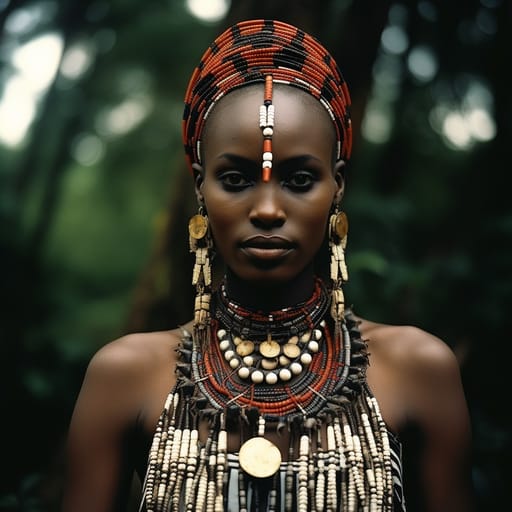
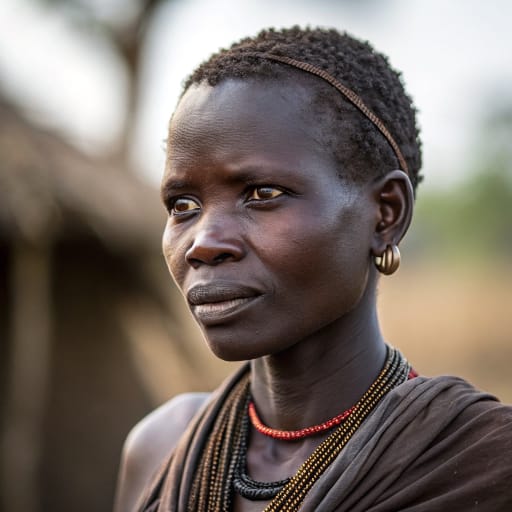
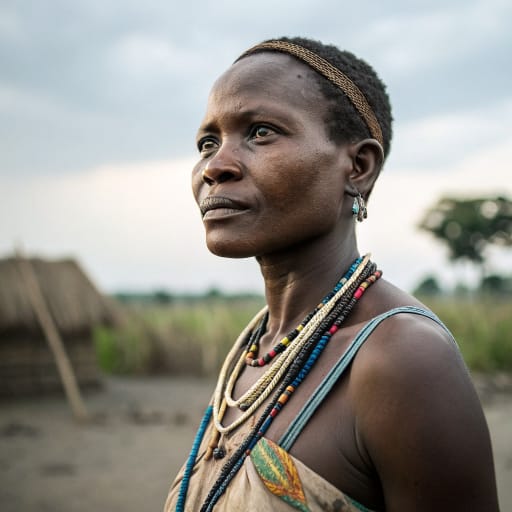
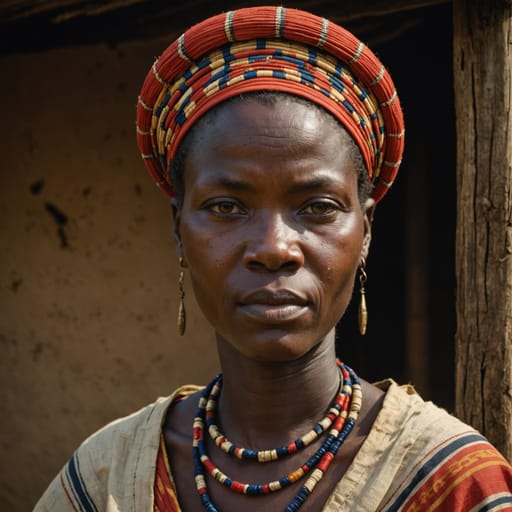
Typical Yulu Phenotypes
Reference for AI generation: hair, eyes, skin, facial structure, build
Yulu Body & Anatomy Reference
Bantu / Central African Niger-Congo phenotype: anatomy reference for AI nude generation
Yulu Boobs & Breasts
Bust reference for Yulu women: medium-to-large cup, full, projecting, which is typical of Bantu / Central African Niger-Congo ancestry. Areolas measure about 32-48mm across, with deep-brown pigmentation. Body type (mesomorph with strong gluteal-femoral fat deposition) shapes the bust as well, so Yulu tits are usually fuller projection than East African; comparable to West African norm. In AI imagery, keep the forward-set shape rather than drifting toward the smaller East African conical profile.
Yulu Ass & Hips
The Yulu ass is typically full, projected, wide-set glutes, which sets it apart from the slim narrow-hip Cushitic East African profile. Underneath, the pelvis shows broad iliac crests, gynoid pelvic pattern, part of the Bantu / Central African Niger-Congo skeletal pattern. For Yulu butt pics and AI renders, match that silhouette and the overall build (mesomorph with strong gluteal-femoral fat deposition).
Yulu Vagina & Pussy
Yulu pussy and vulvar anatomy presents deep-brown labial pigmentation, fuller labia minora, consistent with the Bantu / Central African Niger-Congo phenotype's pigmentation pattern. Yulu pubic hair is typically tightly-coiled coarse texture, dense distribution, in the inverted-triangle pattern. For anatomically accurate Yulu pussy renders the labial coloration should match the surrounding deep-brown skin tone with a continuous gradient, and the hair should keep its tightly-coiled coarse texture.
Yulu Dicks & Penis
Yulu dicks follow the Bantu / Central African Niger-Congo reference data: regional mean ~14cm erect; above-average girth; deep-brown shaft pigmentation. Shaft color should track the deep-brown skin tone with a smooth change toward the glans, and Yulu pubic hair keeps its tightly-coiled coarse texture.
Yulu Body, Curves & Build
Yulu body type and overall build presents as mesomorph with strong gluteal-femoral fat deposition, with mean adult female BMI 23-26: the characteristic Bantu / Central African Niger-Congo habitus. Yulu curves and proportions should keep the regional skeletal frame (height, shoulder-to-hip ratio, limb proportions) rather than a generic mesomorph default.
Yulu Skin Tone & Hair Texture
Yulu skin sits in the deep-brown (Fitzpatrick VI) band. Hair is typically tight 4A-4C coil, in keeping with the Bantu / Central African Niger-Congo phenotype. In nude renders the skin should stay one even tone from face to body, and body, pubic and head hair should match.
Explore phenotype categories
Structured taxonomy with peer-reviewed scales · 22 anatomical categories
Erotic Poses & Sex Positions
From the pose catalog: 219 named positions with reference skeletons
Frequently asked questions about Yulu people
Where is the Yulu homeland?
The Yulu homeland is Northeastern Central African Republic (Vakaga prefecture), southern Darfur in Sudan, and the Raga area of Western Bahr el Ghazal, South Sudan in Central Africa.
What language do Yulu people speak?
Yulu people primarily speak Yulu (Central Sudanic, Bongo-Bagirmi branch); Arabic (Semitic) and Sango (Ubangian-based creole) as regional lingua francas.
What religion do Yulu people practice?
The predominant religion among Yulu people is Predominantly Muslim.






Make your own Yulu images
Five a day, free, no credits to buy. The studio starts from this group's phenotype data, so you can set body type, pose and style and keep the traits accurate.
Start with Yulu