Help us get this right
Does this portrait look right for Swazi?
One tap. It takes a second and it is recorded.
0 say it looks right, 1 says it looks off.
Swazi Erotic
About Swazi People
The Swazi are a southern African Nguni people whose territory straddles a political line that doesn't reflect how they actually live: roughly two-thirds reside in South Africa's Mpumalanga province and the eastern Lowveld, while the remainder make up the overwhelming majority population of Eswatini, the small landlocked kingdom formerly called Swaziland. They are one of the few African groups whose precolonial monarchy survived the colonial era intact and still functions as the central political institution — the King (Ngwenyama, "the Lion") rules jointly with the Queen Mother (Ndlovukati, "the She-Elephant"), a dual-sovereignty arrangement that is genuinely unusual rather than ceremonial.
Linguistically, siSwati belongs to the Nguni branch of southern Bantu, closely related to Zulu and Xhosa — close enough that conversation across the line is possible, distinct enough that Swazi speakers will correct you on it. The group coalesced as a distinct polity in the late eighteenth and early nineteenth centuries under the Dlamini royal house, consolidating smaller clans during the upheaval of the mfecane, the violent reshuffling of southern African peoples that accompanied the rise of the Zulu kingdom. That defensive consolidation is the reason a Swazi nation exists at all in the form it does today; it also explains the tight identification between Swazi-ness and the Dlamini monarchy, which has no real parallel among the larger Nguni groups.
Religion in practice is layered. Most Swazi identify as Christian, but a large share belong to African-initiated Zionist churches rather than the missionary denominations — congregations that fold ancestor veneration, prophecy, and healing rites into a Christian frame, often with white robes and drumming at riverside baptisms. Older ritual life persists alongside this, most visibly in the two great national ceremonies: Incwala, the midsummer kingship rite that ritually renews the monarch's power and is closed to outsiders in its inner stages, and the better-known Umhlanga or Reed Dance, an annual gathering of unmarried women that is simultaneously a coming-of-age ritual, a public affirmation of the Queen Mother's role, and a spectacle the modern state actively curates.
Day-to-day, the Swazi homeland is cattle country shading into sugar plantations and mining concessions, and the social texture reflects that mixture — a rural cultural conservatism centered on chieftaincy and the royal kraal, paired with a population that has long supplied labor to South African mines and now moves freely across a border most Swazi treat as an administrative inconvenience rather than a real division.
Related ethnic groups
Groups that share Swazi's homeland, region, language, or religious tradition. These are likely candidates for comparative phenotype reference.
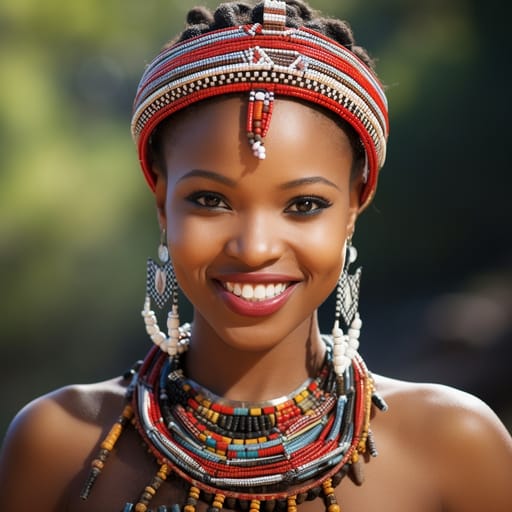
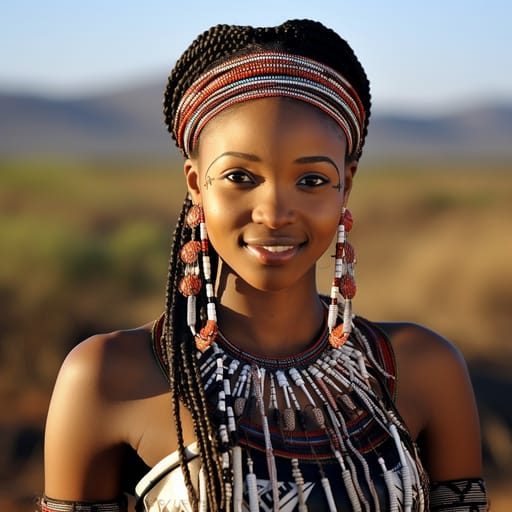
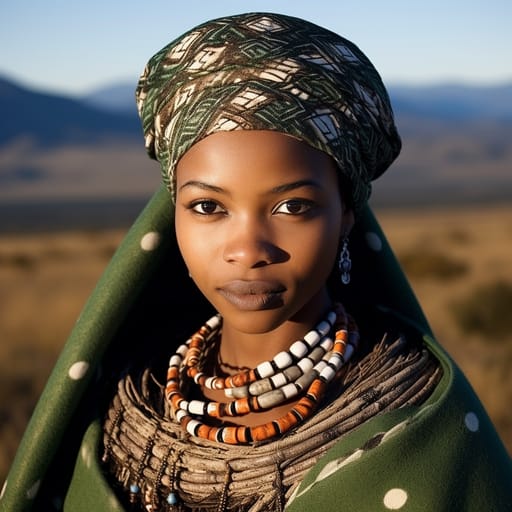
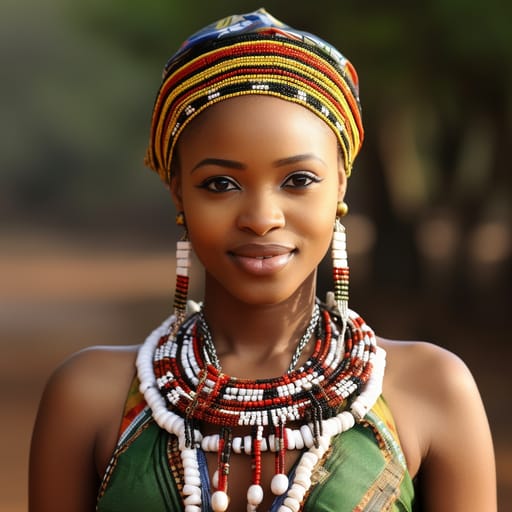
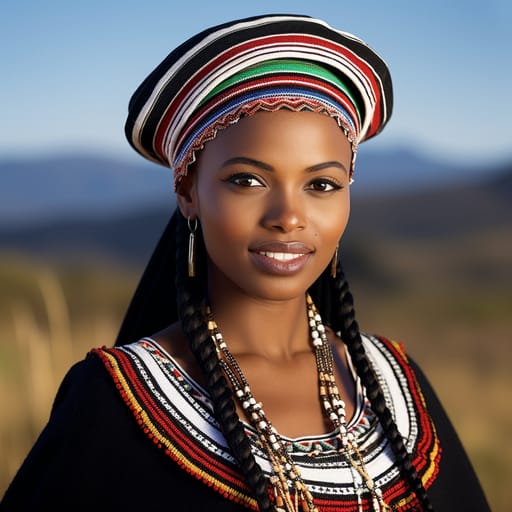

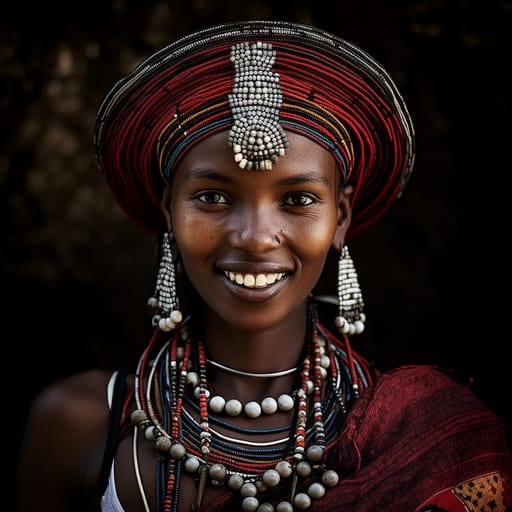
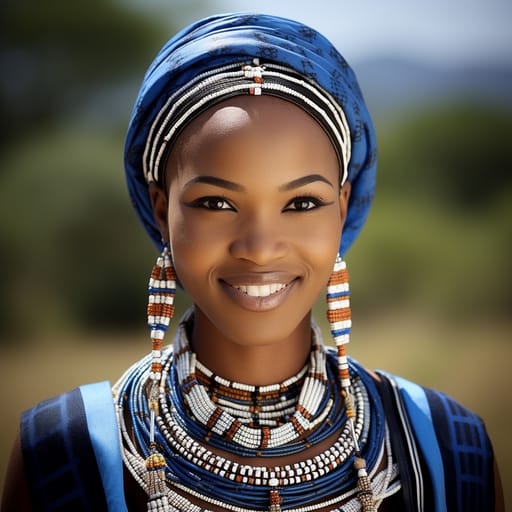
Geographic Distribution: Swazi populations across 1 country
Each row is ranked by the group's share of that country's population, with the source citation drawn from published census and demographic surveys. Click through for the full per-country phenotype profile.
| Country | Share | Source |
|---|---|---|
| Eswatini | 97.0% | Eswatini Population and Housing Census 2017; Swazi / emaSwati (~97%, ~1.1M+ of ~1.2M total). Bantu / siSwati language. Cross-border with South African Swazi populations of Mpumalanga |
Typical Swazi Phenotypes
Reference for AI generation: hair, eyes, skin, facial structure, build
The Swazi sit within the southern Nguni cluster alongside Zulu and Xhosa, and their phenotype tracks closely with that grouping — a Southern Bantu population shaped by deep ancestry on the Highveld and lowveld of what is now eswatini and the eastern escarpment of South Africa. The defining note is dark skin with cool, blue-violet undertones — Fitzpatrick V to VI predominates, with a tendency toward genuinely deep tones rather than the lighter brown range more common further north. Sun exposure adds little; the base pigmentation is already heavy, and even shielded areas (inner arms, torso) read only marginally lighter than exposed skin.
Hair is almost uniformly Type 4 — tightly coiled, dense, with a soft sheen rather than gloss. Natural color is black to blue-black; meaningful variation is rare outside of greying. Eyes follow the same pattern: dark brown to near-black, with a lateral almond shape and clean upper-lid crease. The epicanthic fold is absent; lashes are typically thick and slightly downturned at the outer corner.
Facial structure is where Swazi features become recognizable as Nguni rather than generically Southern African. The nose is broad at the alar base with a low-to-medium bridge, but less platyrrhine than equatorial West African norms — a subtle compression rather than a wide spread. Lips are full and evenly weighted, with a well-defined vermillion border. Cheekbones sit high and wide, jawlines square in men and softly angled in women, and the forehead is typically broad and slightly rounded.
Build leans tall and long-limbed. Men commonly fall in the 175–183 cm range; women 162–170 cm. Body composition runs lean-muscular in younger adults, with notably long femurs and a relatively short trunk — the same proportional signature seen across Zulu and Ndebele populations. Women carry weight in the hips and thighs more than the midsection, with naturally defined waists. Sub-group variation is minimal; the Swazi are ethnically tighter than most regional neighbors, and phenotype reads consistent across the emaSwati clans.
Swazi Body & Anatomy Reference
Per-feature anatomical profile for AI nude generation: Bantu / Khoisan Southern African phenotype
Swazi Boobs & Breasts
Swazi tits and boobs run medium cup, full but moderate projection, the classic Bantu / Khoisan Southern African bust profile. Swazi nipples and areolas show medium-brown to deep-brown areolar pigmentation, with areolar diameter typically in the 30-44mm range and forward-set positioning rather than the heavier West African bust. Swazi breasts trend moderately full; less projecting than West African norm, a function of the mesomorph; Khoisan-descended sub-populations show distinctive steatopygic fat deposition body habitus and the mean adult female BMI 24-28. For anatomically accurate AI-generated Swazi nudes the render preserves the medium cup, full but moderate projection shape, 30-44mm areolas with medium-brown to deep-brown pigmentation, and the torso proportions of the Bantu / Khoisan Southern African phenotype.
Swazi Ass & Hips
Swazi hips and butt usually read as the distinctive Khoisan-influenced steatopygic profile in some sub-populations (San, Khoekhoe); broader gluteal projection in Bantu-speaking groups. The skeletal base is wide iliac crests with notable lordosis in Khoisan-descended sub-populations, the Bantu / Khoisan Southern African pattern. Set against the slim Cushitic East African profile, the difference is easy to see, and the hip-to-waist ratio is often what identifies Swazi women in photos.
Swazi Vagina & Pussy
Expect deep-brown labial pigmentation; the elongated labia minora documented in some Khoisan-descended populations on Swazi women, in keeping with Bantu / Khoisan Southern African ancestry. The pubic hair is tightly-coiled coarse texture. Coloring should run evenly from the medium-brown to deep-brown skin of the thighs to the labia, and Swazi nude imagery should keep the hair's tightly-coiled coarse texture.
Swazi Dicks & Penis
Swazi dick and penile anatomy in adult AI generation should anchor on the regional reference data: regional mean ~14cm erect, moderate-to-above-average girth, and deep-brown shaft pigmentation. The Swazi cock profile reflects the Bantu / Khoisan Southern African population's anthropometric measurements. The shaft pigmentation should track the surrounding medium-brown to deep-brown skin tone, and the pubic hair should keep its tightly-coiled coarse texture in the typical inverted-V escutcheon.
Swazi Body, Curves & Build
Swazi body type: mesomorph; Khoisan-descended sub-populations show distinctive steatopygic fat deposition, with mean adult female BMI 24-28. This is the typical Bantu / Khoisan Southern African build. Height range, shoulder-to-hip ratio and fat distribution all follow from it, which is what an accurate Swazi nude body should show.
Swazi Skin Tone & Hair Texture
Swazi skin tone falls in the medium-brown to deep-brown (Fitzpatrick V-VI); lighter in Khoisan-descended populations band, the surface signal most often miscalibrated by generic AI nude generators. Swazi hair texture is typically tightly-coiled 4A-4C; the distinctive 'peppercorn' tight-spiral texture in Khoisan-descended populations, characteristic of the Bantu / Khoisan Southern African phenotype. In Swazi nude renders the skin should hold that band consistently across the body.
Data depth
0/100Coverage of image-grounded phenotype observations · drives AI generation diversity
- Sample size
- 0/40· 0 images
- Image quality
- 0/30· 0% high
- Confidence
- 0/20
- Source diversity
- 0/10
- ·No image observations yet
Explore phenotype categories
Structured taxonomy with peer-reviewed scales · 22 anatomical categories
Erotic Poses & Sex Positions
From the pose catalog: 219 named positions with reference skeletons
Frequently asked questions about Swazi people
Where is the Swazi homeland?
The Swazi homeland is Mpumalanga (South Africa), Eswatini in Southern Africa.
What countries do Swazi people live in?
Swazi populations are documented across 1 country: Eswatini.
What language do Swazi people speak?
Swazi people primarily speak Niger-Congo / Bantu / Nguni / Swazi.
What religion do Swazi people practice?
The predominant religion among Swazi people is Christianity / African Zionism.






Make your own Swazi images
Five a day, free, no credits to buy. The studio starts from this group's phenotype data, so you can set body type, pose and style and keep the traits accurate.
Start with Swazi