Help us get this right
Does this portrait look right for Ovambo?
One tap. It takes a second and it is recorded.
5 say it looks right, 1 says it looks off.
Ovambo Erotic
About Ovambo People
The Ovambo are the demographic weight of Namibia — close to half the country's population — and their homeland straddles a quiet political line drawn through floodplain country. The historic territory, called Ovamboland on colonial maps and now split between northern Namibia and southern Angola, sits on the Cuvelai drainage: a shallow lattice of seasonal channels that fill in the rains and dry to cracked clay in the off-season. Settlement, cattle, millet farming, and identity all track this water. The Ovambo are not one undifferentiated bloc but a cluster of related groups — the Kwanyama, Ndonga, Kwambi, Ngandjera, Mbalanhu, Kwaluudhi, Mbandja, and others — each historically a kingdom in its own right, each with its own dialect of Oshiwambo, all mutually intelligible enough that a literary standard, mostly Oshindonga and Oshikwanyama, now serves the broader community.
The language belongs to the Bantu branch of Niger–Congo and reads as a southwestern cousin to Herero and the Kavango languages, but it is the dominant tongue of northern Namibia in practice and a working second language well beyond Ovambo households. Christianity arrived through Finnish Lutheran missionaries in the 1870s and took unusually deep root; the Evangelical Lutheran Church in the Republic of Namibia is one of the largest Lutheran churches in Africa, and Protestant observance is woven into village life rather than overlaid on it. Older ritual practice — ancestor remembrance, the authority of the senior matrilineal uncle, initiation rites for girls (olufuko) — survives alongside the church, sometimes in tension, sometimes folded in.
The colonial century was harsh. The Kwanyama king Mandume ya Ndemufayo was killed in 1917 fighting a joint Portuguese–South African campaign, and the border that resulted cut the Kwanyama in half — relatives on opposite sides of a fence drawn by people who did not live there. Under South African rule, Ovamboland became a labor reserve feeding the mines and farms of the south through the contract system, and that grievance powered SWAPO, the liberation movement that emerged largely from Ovambo leadership and now governs independent Namibia. Kinship is reckoned matrilineally: a man's heir is traditionally his sister's son, and clan identity passes through the mother, though Christian and statutory inheritance law have complicated the older pattern.
Daily food still leans on oshifima, a stiff porridge of pearl millet (mahangu) eaten with meat, wild greens, or the small dried fish hauled from the seasonal pans when the floods recede.
Related ethnic groups
Groups that share Ovambo's homeland, region, language, or religious tradition. These are likely candidates for comparative phenotype reference.

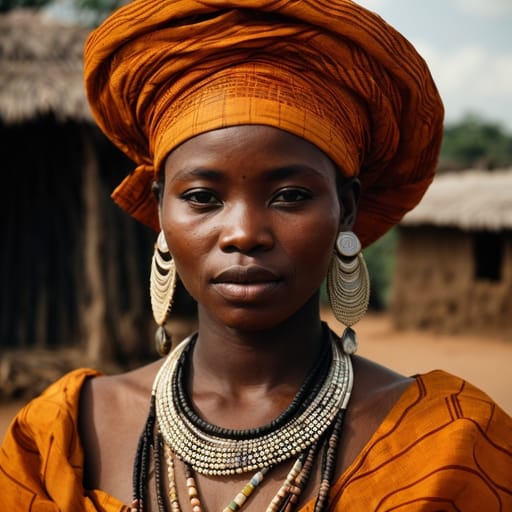
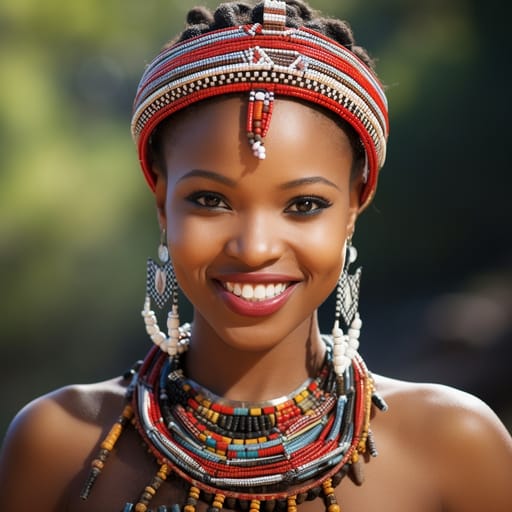
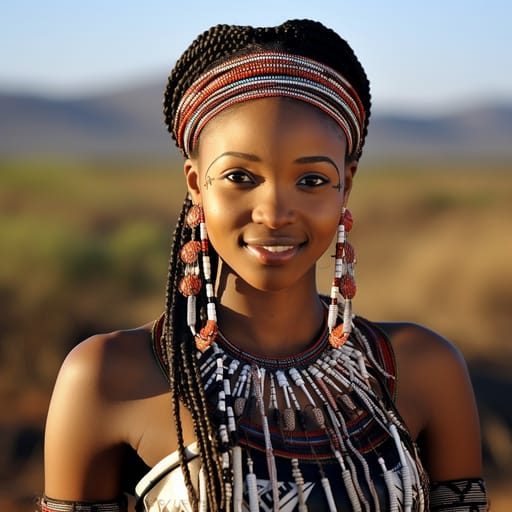
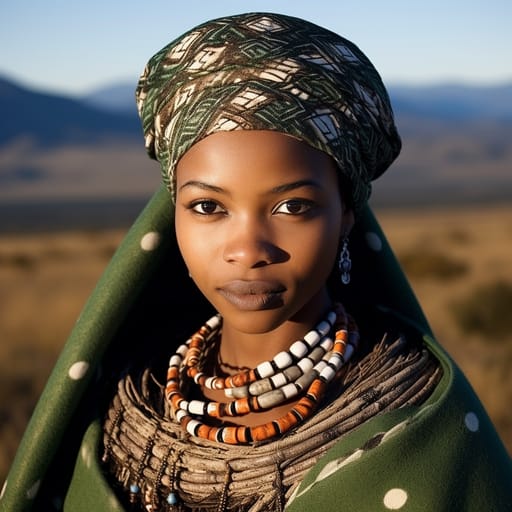
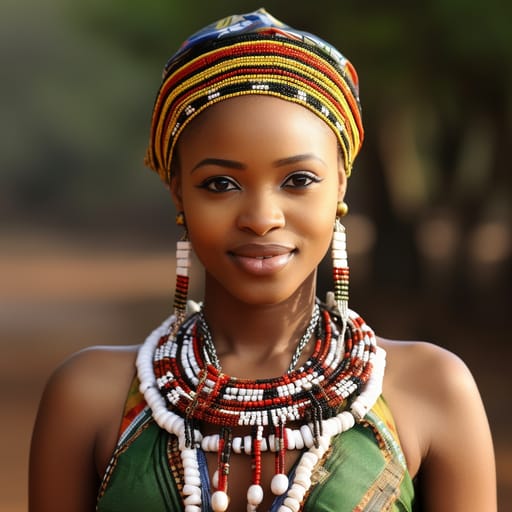
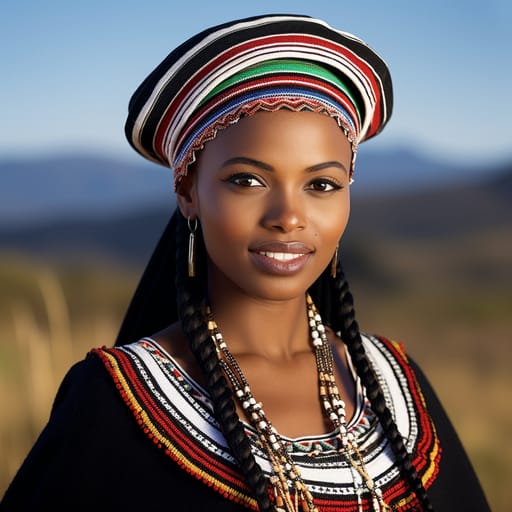
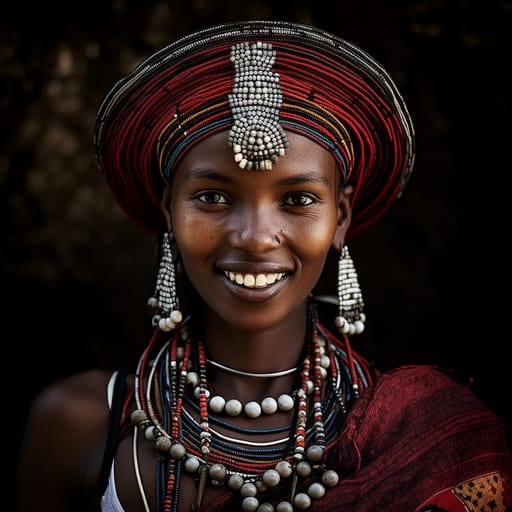
Geographic Distribution: Ovambo populations across 2 countries
Each row is ranked by the group's share of that country's population, with the source citation drawn from published census and demographic surveys. Click through for the full per-country phenotype profile.
| Country | Share | Source |
|---|---|---|
| Namibia | 50.0% | Namibia 2023 Census; Ovambo / Owambo (~50%, ~1.5M+ of ~3M total). Bantu source population, predominantly northern Namibia. Cross-border with Angolan Ovambo. The dominant ethnic group politically since independence 1990 |
| Angola | 2.0% | Estimates; Ovambo (~2%, ~660,000+); concentrated in southern Angola along the Namibian border. Cross-border with Namibia where Ovambo are the largest ethnic group |
Typical Ovambo Phenotypes
Reference for AI generation: hair, eyes, skin, facial structure, build
The Ovambo are the demographic majority of northern Namibia and southern Angola, and their phenotype sits firmly within the Southeastern Bantu cluster — taller and leaner than the Khoisan-influenced groups further south, with deeper pigmentation than most Bantu populations of the wetter equatorial belt. Hair is overwhelmingly Type 4 coily, dense and tightly spiraled, almost universally black; gray comes in late and often patchy. Texture variation is narrow compared to admixed Southern African populations — you won't see the looser curl patterns common in Cape Coloured or San-influenced communities to the south.
Eyes are dark brown to near-black, with a clean almond shape, no epicanthic fold, and a brow ridge that reads more horizontal than arched. Skin sits in the Fitzpatrick V–VI range, leaning VI — a deep, evenly saturated brown with warm red-bronze undertones rather than the cooler blue-black common in West African populations. Years of intense Kalahari-edge sun give exposed skin a weathered matte finish in older adults; younger faces hold a noticeable sheen.
The facial structure is the most recognizable signature: a relatively narrow face for a Bantu population, with a moderate-bridge nose (broader at the alae than European noses but narrower than typical Central African forms), well-defined cheekbones, a strong but not heavy jaw, and lips that are full but more often medium-full than maximally everted. Foreheads tend to be high and clean.
Build is the other distinctive trait — Ovambo are among the taller populations on the African continent, with men frequently in the 178–185 cm range and women correspondingly tall. The frame is long-limbed and lean, narrow-hipped in men, with low subcutaneous fat in younger adults; women carry a more pronounced gluteofemoral distribution typical of southern Bantu groups. Subgroup variation across the eight historical Ovambo branches (Kwanyama, Ndonga, Kwambi, Ngandjera, Mbalantu, Kwaluudhi, Eunda, Nkolonkadhi) is mostly cultural rather than morphological — phenotype reads continuous across them.
Ovambo Body & Anatomy Reference
Per-feature anatomical profile for AI nude generation: Bantu / Khoisan Southern African phenotype
Ovambo Boobs & Breasts
Ovambo boobs follow the Bantu / Khoisan Southern African profile: medium cup, full but moderate projection. Areolar diameter is usually 30-44mm, and the coloring is medium-brown to deep-brown areolar pigmentation. Breast shape tracks body composition (mesomorph; Khoisan-descended sub-populations show distinctive steatopygic fat deposition, mean adult female BMI 24-28), so Ovambo breasts tend to be moderately full; less projecting than West African norm. Expect a forward-set shape, not the heavier West African bust.
Ovambo Ass & Hips
Ovambo ass and hip morphology presents as the distinctive Khoisan-influenced steatopygic profile in some sub-populations (San, Khoekhoe); broader gluteal projection in Bantu-speaking groups, distinctly different from the slim Cushitic East African profile. The Ovambo pelvic profile shows wide iliac crests with notable lordosis in Khoisan-descended sub-populations, anchored in the Bantu / Khoisan Southern African skeletal pattern. Ovambo butt shots in adult AI imagery should render the the distinctive Khoisan-influenced steatopygic profile in some sub-populations (San, Khoekhoe); broader gluteal projection in Bantu-speaking groups silhouette with the overall build (mesomorph; Khoisan-descended sub-populations show distinctive steatopygic fat deposition) and the fat distribution typical of the Bantu / Khoisan Southern African phenotype.
Ovambo Vagina & Pussy
Ovambo pussy anatomy typically shows deep-brown labial pigmentation; the elongated labia minora documented in some Khoisan-descended populations. Pubic hair is usually tightly-coiled coarse texture. In AI-generated Ovambo nudes, labial color should blend into the medium-brown to deep-brown skin with a gradual transition, and the hair should keep its tightly-coiled coarse texture.
Ovambo Dicks & Penis
Penis reference for Ovambo men: regional mean ~14cm erect, moderate-to-above-average girth. Coloring: deep-brown shaft pigmentation. An accurate Ovambo cock in AI imagery matches the surrounding medium-brown to deep-brown skin rather than a generic porn default. Circumcision depends on religion and custom, not ancestry.
Ovambo Body, Curves & Build
The Ovambo figure is generally mesomorph; Khoisan-descended sub-populations show distinctive steatopygic fat deposition, with mean adult female BMI 24-28, characteristic of Bantu / Khoisan Southern African ancestry. AI image tools tend to flatten regional body types into a few stock shapes; here the Ovambo build is kept as its own reference.
Ovambo Skin Tone & Hair Texture
Skin: medium-brown to deep-brown (Fitzpatrick V-VI); lighter in Khoisan-descended populations. Hair: tightly-coiled 4A-4C; the distinctive 'peppercorn' tight-spiral texture in Khoisan-descended populations. Both are typical of Bantu / Khoisan Southern African ancestry. The most common mistake in AI nudes of Ovambo women is a body rendered lighter than the face.
Data depth
0/100Coverage of image-grounded phenotype observations · drives AI generation diversity
- Sample size
- 0/40· 0 images
- Image quality
- 0/30· 0% high
- Confidence
- 0/20
- Source diversity
- 0/10
- ·No image observations yet
Explore phenotype categories
Structured taxonomy with peer-reviewed scales · 22 anatomical categories
Erotic Poses & Sex Positions
From the pose catalog: 219 named positions with reference skeletons
Frequently asked questions about Ovambo people
Where is the Ovambo homeland?
The Ovambo homeland is Ovamboland (Namibia), Angola in Southern Africa.
What countries do Ovambo people live in?
Ovambo populations are documented across 2 countries: Namibia, Angola.
What language do Ovambo people speak?
Ovambo people primarily speak Niger-Congo / Bantu / Ovambo.
What religion do Ovambo people practice?
The predominant religion among Ovambo people is Christianity / Protestantism.






Make your own Ovambo images
Five a day, free, no credits to buy. The studio starts from this group's phenotype data, so you can set body type, pose and style and keep the traits accurate.
Start with Ovambo