No portrait yet
Nottoway Erotic
The Nottoway River basin in southeastern Virginia, chiefly Southampton and Sussex counties, United States.
Historically Nottoway (Iroquoian, Tuscarora-Nottoway branch), no longer spoken since the 19th century; English today.
Historically Cheroenhaka ceremonial practice; today predominantly Protestant Christian, largely Baptist and Methodist, alongside revived tribal ceremony.
Northern Iroquoian, in the Tuscarora-Nottoway branch, closely tied to the Meherrin. Two present-day state-recognized groups: the Nottoway Indian Tribe of Virginia and the Cheroenhaka (Nottoway) Indian Tribe.
About Nottoway People
The Nottoway were an Iroquoian people living in the middle of Algonquian country, and that anomaly is the first thing worth understanding about them. Their towns sat along the river that now carries their name, in the flat pine and swamp country of southeastern Virginia's coastal plain, south of the James. Their neighbors to the north and east belonged to the Powhatan world; to the west were Siouan speakers. The Nottoway, along with the closely related Meherrin and the Tuscarora further south in North Carolina, spoke a language from the same family as Mohawk and Seneca, several hundred miles up the map. Nottoway is not their word for themselves. It comes from an Algonquian term applied to Iroquoian speakers generally, usually glossed as adder or rattlesnake. Their own name was Cheroenhaka, which the modern tribe has taken back.
Colonial Virginia dealt with them as a distinct polity. Edward Bland's 1650 expedition passed through their palisaded towns, and after Bacon's Rebellion the 1677 Treaty of Middle Plantation made them tributaries of the colony, a status that bought some protection and cost them autonomy. Two reservation tracts in Southampton County, known locally as the Circle and the Square, were set aside in the early 1700s; over the next century and a half, state-appointed trustees sold the land off in pieces until almost nothing remained. The language went with it. In 1820 Thomas Jefferson, still chasing his theory of Indian origins, arranged for a vocabulary to be taken down from Edith Turner, an elderly Nottoway woman. That word list is most of what linguists have, and it settled the Iroquoian question. What came after was less a disappearance than a paperwork erasure: under the Racial Integrity Act of 1924 and the long tenure of registrar Walter Plecker, Indian families across Virginia were reclassified as colored on birth and marriage records, which made the community legally invisible for generations while its members went on farming the same counties and keeping track of one another. Two organizations won recognition from the Virginia General Assembly in 2010, the Nottoway Indian Tribe of Virginia and the Cheroenhaka (Nottoway) Indian Tribe, the second of which has bought land near Courtland for a heritage site. Neither is federally recognized. Both are rebuilding from archives, family memory, and a two hundred year old list of words.
Related ethnic groups
Groups that share Nottoway's homeland, region, language, or religious tradition. These are likely candidates for comparative phenotype reference.
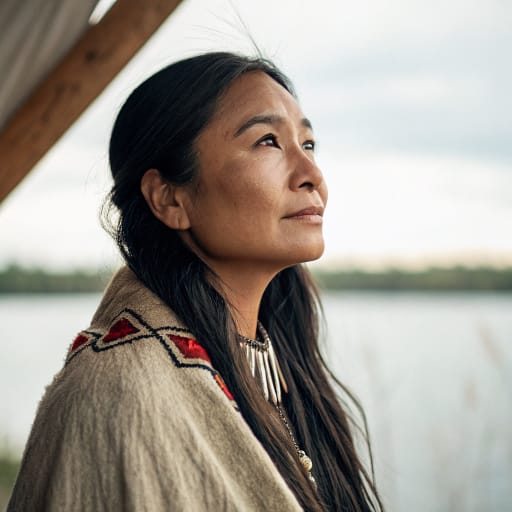
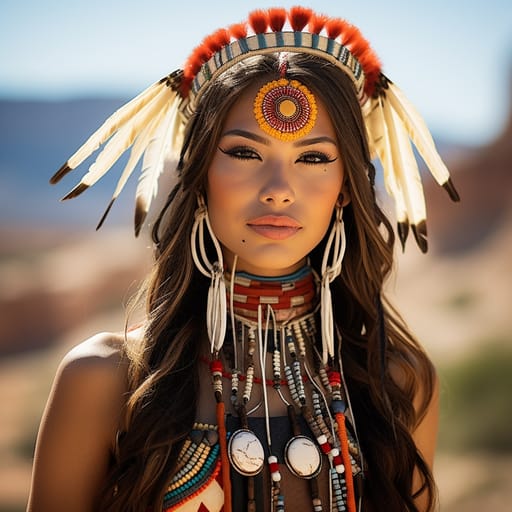
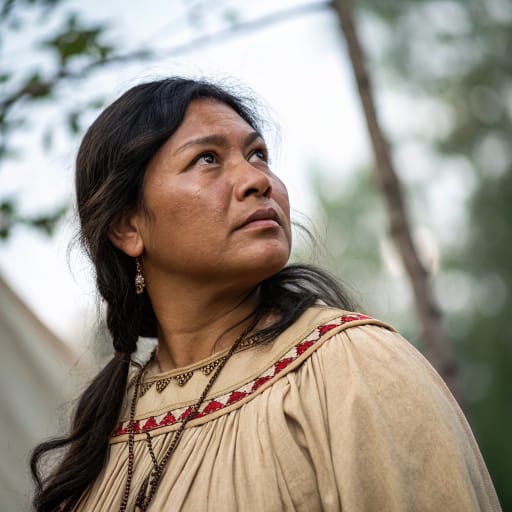
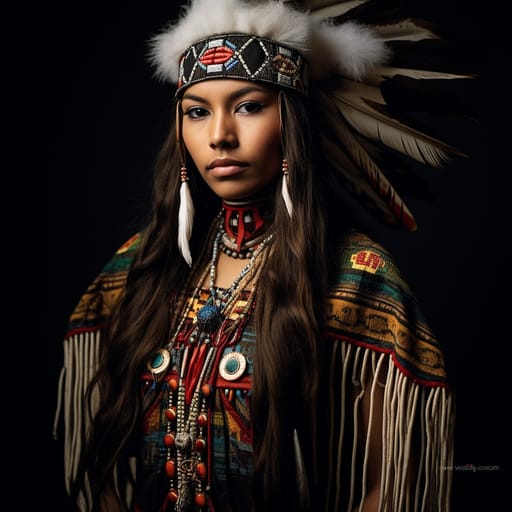
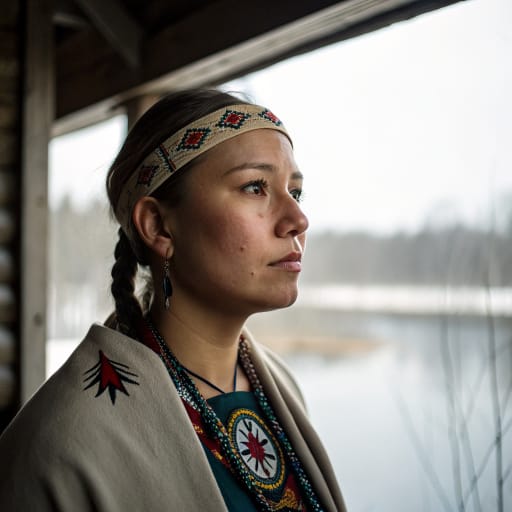
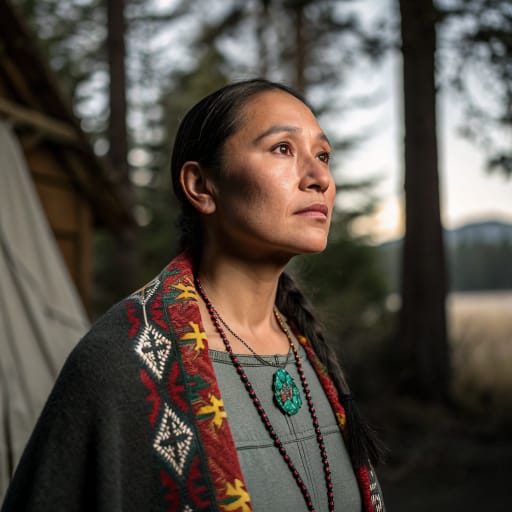
Typical Nottoway Phenotypes
Reference for AI generation: hair, eyes, skin, facial structure, build
Nottoway Body & Anatomy Reference
Indigenous Northern American / Algonquian-Iroquoian phenotype: anatomy reference for AI nude generation
Nottoway Boobs & Breasts
The typical Nottoway bust is medium cup, moderate projection, in line with the wider Indigenous Northern American / Algonquian-Iroquoian pattern. Areolas usually fall in the 30-44mm range, with medium-brown areolar pigmentation against the copper-to-medium-brown skin tone. Compared with the smaller East Asian bust, Nottoway breasts sit forward and are generally full and moderate projection. A faithful AI render of Nottoway tits keeps that shape and areola size.
Nottoway Ass & Hips
Butt shape among Nottoway women: medium, moderate-to-full projection, over medium iliac crests. This follows Indigenous Northern American / Algonquian-Iroquoian ancestry and looks quite unlike the slim East Asian narrow-hip profile. An accurate Nottoway ass in adult AI imagery keeps both the silhouette and the overall build (mesomorph, broader frame in northern Indigenous populations) instead of a generic average.
Nottoway Vagina & Pussy
Vulvar anatomy among Nottoway women: medium-brown labial pigmentation. Pubic hair tends to be straight medium-coarse texture, in the usual inverted-triangle pattern. Both follow Indigenous Northern American / Algonquian-Iroquoian pigmentation, which is why Nottoway pussy renders should not fall back on a pale, sparse Western template.
Nottoway Dicks & Penis
The Nottoway cock profile, from Indigenous Northern American / Algonquian-Iroquoian anthropometric data: regional mean ~13cm erect; moderate girth; medium-brown shaft pigmentation. Pubic hair has a straight medium-coarse texture and forms the usual inverted-V pattern. Whether Nottoway men are circumcised follows religious and cultural practice rather than phenotype.
Nottoway Body, Curves & Build
Build and curves among Nottoway women follow the Indigenous Northern American / Algonquian-Iroquoian pattern: mesomorph, broader frame in northern Indigenous populations, mean adult female BMI 25-28. Proportions matter as much as skin tone, so Nottoway figures should keep their regional height and limb ratios.
Nottoway Skin Tone & Hair Texture
The Nottoway skin range is copper to medium-brown (Fitzpatrick III-V), and hair tends to be straight 1A, dark-brown to black, often thick and dense. That combination marks the Indigenous Northern American / Algonquian-Iroquoian phenotype, and skin tone is the trait AI generators most often get wrong for Nottoway women.
Explore phenotype categories
Structured taxonomy with peer-reviewed scales · 22 anatomical categories
Erotic Poses & Sex Positions
From the pose catalog: 219 named positions with reference skeletons
Frequently asked questions about Nottoway people
Where is the Nottoway homeland?
The Nottoway homeland is The Nottoway River basin in southeastern Virginia, chiefly Southampton and Sussex counties, United States. in North America.
What language do Nottoway people speak?
Nottoway people primarily speak Historically Nottoway (Iroquoian, Tuscarora-Nottoway branch), no longer spoken since the 19th century; English today..
What religion do Nottoway people practice?
The predominant religion among Nottoway people is Historically Cheroenhaka ceremonial practice; today predominantly Protestant Christian, largely Baptist and Methodist, alongside revived tribal ceremony..






Make your own Nottoway images
Five a day, free, no credits to buy. The studio starts from this group's phenotype data, so you can set body type, pose and style and keep the traits accurate.
Start with Nottoway