No portrait yet
Nooksack Erotic
The Nooksack River valley in Whatcom County, in the northwest corner of Washington state, United States, centered on Deming and running up toward Mount Baker, roughly 12 miles south of the British Columbia border.
Lhéchalosem, also called Nooksack (Salishan, Central Coast Salish); dormant since the 1970s and under revival. Halkomelem was widely used historically; English today.
Mostly Catholic and Protestant Christianity, alongside the Indian Shaker Church and the Coast Salish winter longhouse spirit dance.
Coast Salish, Central Coast Salish branch; joined by kinship and marriage to the Sumas, Matsqui and Chilliwack of the Fraser Valley and to the neighboring Lummi and Semiahmoo.
About Nooksack People
The Nooksack take their name from their own word for themselves, noxwsá7aq, usually glossed as something like "always bracken fern roots," a reference to a staple food dug from the valley floor. That is a useful clue to who they are: not an ocean-facing people so much as a river people, oriented upstream. Their country is the Nooksack River watershed in the far northwest corner of Washington, where three forks come down off the glaciers of Mount Baker through foothill timber and open bottomland before the river bends west toward Bellingham Bay. They fished the forks for salmon, hunted high country where mountain goats supplied wool as well as meat, and held permanent villages at the confluences. The international border, fixed in 1846, cut straight across their kinship network. Nooksack families are closely tied to the Sumas, Matsqui and Chilliwack communities of the Fraser Valley just north of the line, and those relationships did not stop mattering because a survey crew came through.
Their language, Lhéchalosem, is Salishan, part of the Central Coast Salish group, and it sat awkwardly among its neighbors: distinct enough to stand as its own language, close enough to Halkomelem that many Nooksack were already conducting daily life in Halkomelem by the nineteenth century. The last people who grew up speaking Lhéchalosem died in the 1970s, and what survives comes largely from documentation done with them in their final years. The tribe teaches it now from those records. Religious life runs on more than one track, with Catholic and Protestant church membership alongside the Indian Shaker Church and the winter longhouse spirit dance, which is private and not staged for outsiders.
The political history is unusual and worth knowing. The 1855 Treaty of Point Elliott did not name the Nooksack as a party, and the federal expectation that they would relocate onto the Lummi Reservation went largely unmet. They stayed in the valley, and from the 1880s many families secured their ground as individual Indian homesteads instead. The result is a tribe with no single contiguous reservation, holding scattered trust parcels around Deming, and one that waited until 1973 for federal recognition. Citizenship traces to a 1942 tribal census, a rule that has produced hard and very public enrollment disputes in recent years.
Related ethnic groups
Groups that share Nooksack's homeland, region, language, or religious tradition. These are likely candidates for comparative phenotype reference.
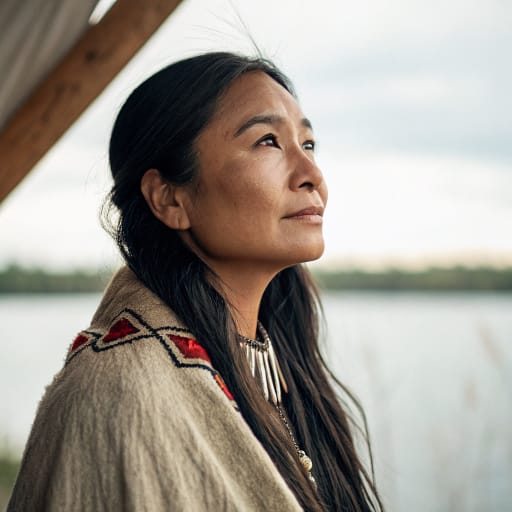
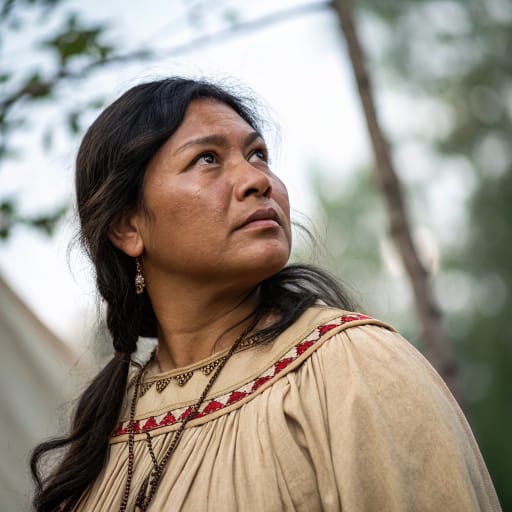
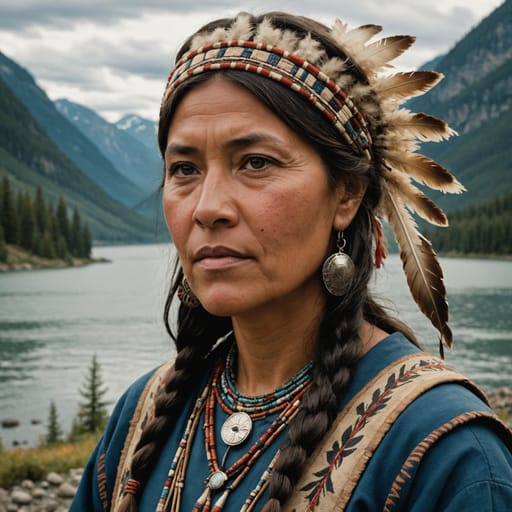
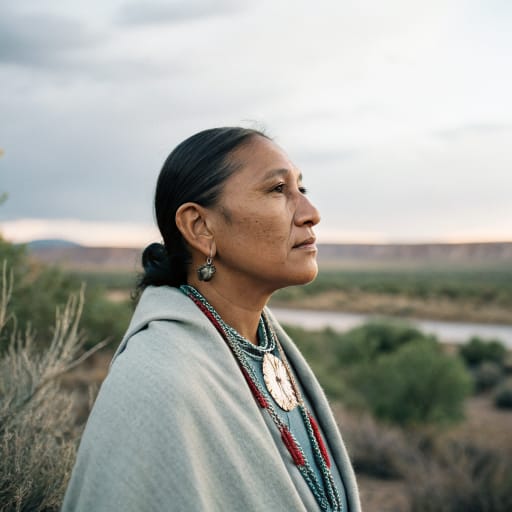
Typical Nooksack Phenotypes
Reference for AI generation: hair, eyes, skin, facial structure, build
Nooksack Body & Anatomy Reference
Indigenous Northern American / Algonquian-Iroquoian phenotype: anatomy reference for AI nude generation
Nooksack Boobs & Breasts
The typical Nooksack bust is medium cup, moderate projection, in line with the wider Indigenous Northern American / Algonquian-Iroquoian pattern. Areolas usually fall in the 30-44mm range, with medium-brown areolar pigmentation against the copper-to-medium-brown skin tone. Compared with the smaller East Asian bust, Nooksack breasts sit forward and are generally full and moderate projection. A faithful AI render of Nooksack tits keeps that shape and areola size.
Nooksack Ass & Hips
Butt shape among Nooksack women: medium, moderate-to-full projection, over medium iliac crests. This follows Indigenous Northern American / Algonquian-Iroquoian ancestry and looks quite unlike the slim East Asian narrow-hip profile. An accurate Nooksack ass in adult AI imagery keeps both the silhouette and the overall build (mesomorph, broader frame in northern Indigenous populations) instead of a generic average.
Nooksack Vagina & Pussy
Vulvar anatomy among Nooksack women: medium-brown labial pigmentation. Pubic hair tends to be straight medium-coarse texture, in the usual inverted-triangle pattern. Both follow Indigenous Northern American / Algonquian-Iroquoian pigmentation, which is why Nooksack pussy renders should not fall back on a pale, sparse Western template.
Nooksack Dicks & Penis
The Nooksack cock profile, from Indigenous Northern American / Algonquian-Iroquoian anthropometric data: regional mean ~13cm erect; moderate girth; medium-brown shaft pigmentation. Pubic hair has a straight medium-coarse texture and forms the usual inverted-V pattern. Whether Nooksack men are circumcised follows religious and cultural practice rather than phenotype.
Nooksack Body, Curves & Build
Build and curves among Nooksack women follow the Indigenous Northern American / Algonquian-Iroquoian pattern: mesomorph, broader frame in northern Indigenous populations, mean adult female BMI 25-28. Proportions matter as much as skin tone, so Nooksack figures should keep their regional height and limb ratios.
Nooksack Skin Tone & Hair Texture
The Nooksack skin range is copper to medium-brown (Fitzpatrick III-V), and hair tends to be straight 1A, dark-brown to black, often thick and dense. That combination marks the Indigenous Northern American / Algonquian-Iroquoian phenotype, and skin tone is the trait AI generators most often get wrong for Nooksack women.
Explore phenotype categories
Structured taxonomy with peer-reviewed scales · 22 anatomical categories
Erotic Poses & Sex Positions
From the pose catalog: 219 named positions with reference skeletons
Frequently asked questions about Nooksack people
Where is the Nooksack homeland?
The Nooksack homeland is The Nooksack River valley in Whatcom County, in the northwest corner of Washington state, United States, centered on Deming and running up toward Mount Baker, roughly 12 miles south of the British Columbia border. in North America.
What language do Nooksack people speak?
Nooksack people primarily speak Lhéchalosem, also called Nooksack (Salishan, Central Coast Salish); dormant since the 1970s and under revival. Halkomelem was widely used historically; English today..
What religion do Nooksack people practice?
The predominant religion among Nooksack people is Mostly Catholic and Protestant Christianity, alongside the Indian Shaker Church and the Coast Salish winter longhouse spirit dance..






Make your own Nooksack images
Five a day, free, no credits to buy. The studio starts from this group's phenotype data, so you can set body type, pose and style and keep the traits accurate.
Start with Nooksack