No portrait yet
Hopi Erotic
Hopi Reservation on First, Second and Third Mesa in northeastern Arizona, United States, surrounded by the Navajo Nation; a smaller enrolled community at the Colorado River Indian Reservation on the Arizona-California border
Hopi (Uto-Aztecan); English; Tewa (Tanoan) in the village of Hano on First Mesa
Traditional Hopi religion centered on the katsina ceremonial cycle; minority Christian congregations
Pueblo peoples; villages grouped by First, Second and Third Mesa, plus Moenkopi; Tewa-speaking Hano; descendants of the Ancestral Puebloans (Hisatsinom)
About Hopi People
The Hopi are the westernmost of the Pueblo peoples, and the ones who stayed put. Their dozen villages sit on the fingertips of three mesas jutting from Black Mesa in northeastern Arizona, on a reservation entirely surrounded by the Navajo Nation. Orayvi, on Third Mesa, has been continuously lived in since around 1100, which makes it one of the oldest settlements in the United States. The Hopi descend from the Ancestral Puebloans they call Hisatsinom, and they read the cliff ruins of the Southwest as waypoints on clan migrations rather than as dead history.
Language marks them off from every neighbor. Hopi belongs to the Uto-Aztecan family, which puts it closer to Comanche, Ute and distantly Nahuatl than to the Tewa, Keres or Zuni spoken in other pueblos. The exception is Hano on First Mesa, a village founded by Tewa refugees after the Pueblo Revolt of 1680, whose people remain bilingual after three centuries. That revolt is the hinge of Hopi history: the Franciscan missions were destroyed, and in 1700 the Hopi themselves razed Awatovi, the one village that had let the friars return. Spain never reconquered them, and Hopi religion came through the colonial period more intact than almost any other in North America. It is a ceremonial calendar built around the katsinam, spirit beings who live in the San Francisco Peaks and come to the villages from the winter solstice until the Niman Home Dance in July, danced by initiated men in kivas and plazas. Clan membership passes through the mother, women own the houses and the harvest, and men carry the ceremonial offices their clans hold.
The practical genius of the place is dry farming. At six thousand feet with roughly ten inches of rain a year, Hopi men grow blue, white and red corn in sand dunes and washes without irrigation, using deep-planted seed and varieties bred over centuries for exactly those conditions. Blue-corn piki, paper-thin sheets baked on a hot stone, is still the bread that matters. The twentieth century brought a split at Orayvi in 1906 over government schooling, which produced the villages of Hotevilla and Bacavi and a lasting tension between the federally chartered tribal council of 1936 and the traditional village chiefs. The decades-long land dispute with the Navajo, and the 2019 shutdown of coal mining on Black Mesa that had bankrolled tribal government, are the current chapters. Outsiders know Hopi work through cottonwood-root katsina dolls, First Mesa pottery in the Sikyatki style revived by Nampeyo, coiled Second Mesa baskets and the postwar overlay silverwork that is now a signature of the tribe.
Related ethnic groups
Groups that share Hopi's homeland, region, language, or religious tradition. These are likely candidates for comparative phenotype reference.
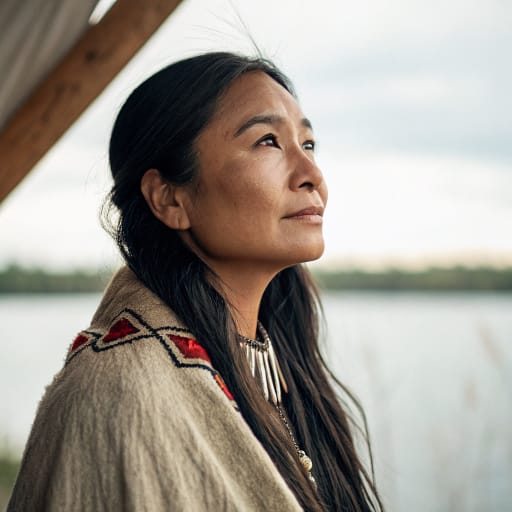
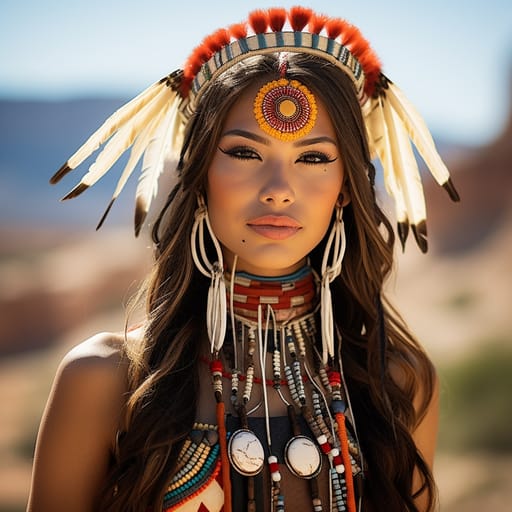
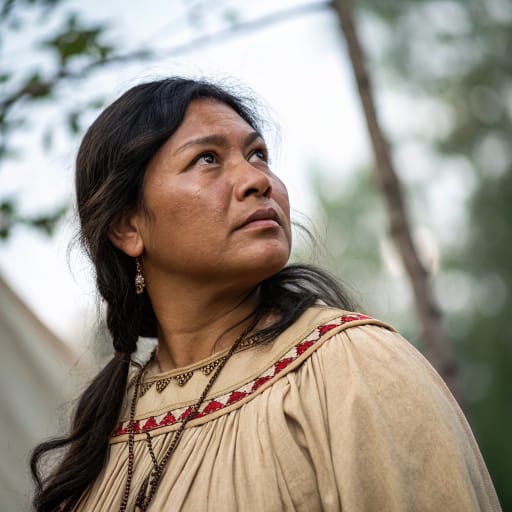
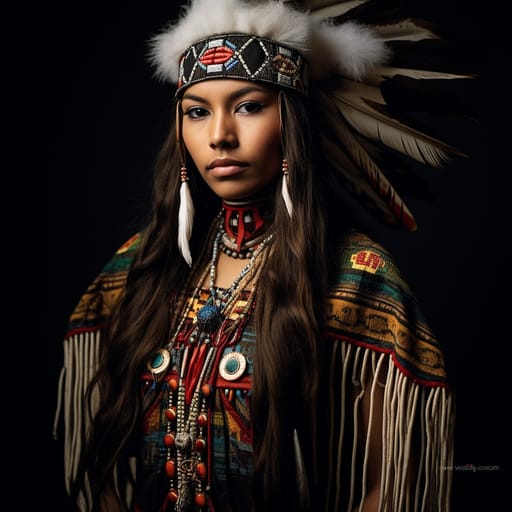

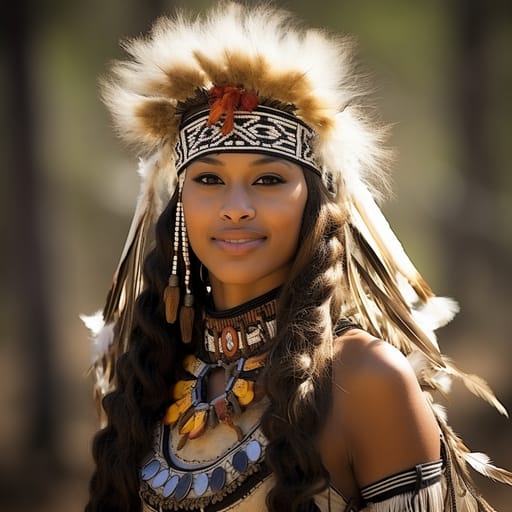
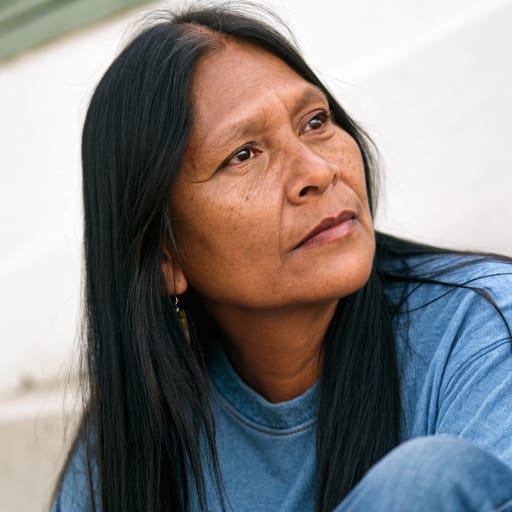
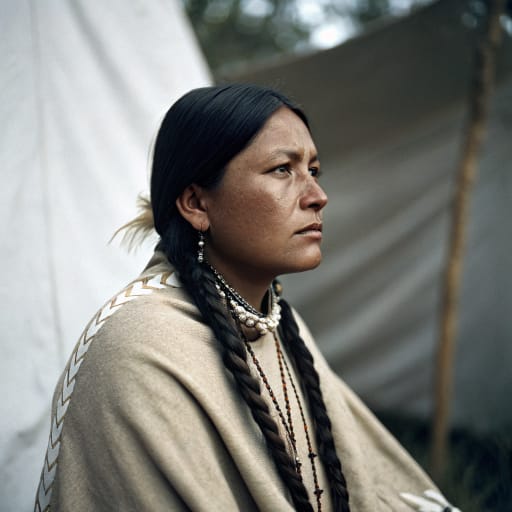
Typical Hopi Phenotypes
Reference for AI generation: hair, eyes, skin, facial structure, build
Hopi Body & Anatomy Reference
Per-feature anatomical profile for AI nude generation: Indigenous Northern American / Algonquian-Iroquoian phenotype
Hopi Boobs & Breasts
Hopi tits and boobs run medium cup, moderate projection, the classic Indigenous Northern American / Algonquian-Iroquoian bust profile. Hopi nipples and areolas show medium-brown areolar pigmentation against the copper-to-medium-brown skin tone, with areolar diameter typically in the 30-44mm range and forward-set positioning rather than the smaller East Asian bust. Hopi breasts trend full and moderate projection, a function of the mesomorph, broader frame in northern Indigenous populations body habitus and the mean adult female BMI 25-28. For anatomically accurate AI-generated Hopi nudes the render preserves the medium cup, moderate projection shape, 30-44mm areolas with medium-brown pigmentation, and the torso proportions of the Indigenous Northern American / Algonquian-Iroquoian phenotype.
Hopi Ass & Hips
Hopi hips and butt usually read as medium, moderate-to-full projection. The skeletal base is medium iliac crests, the Indigenous Northern American / Algonquian-Iroquoian pattern. Set against the slim East Asian narrow-hip profile, the difference is easy to see, and the hip-to-waist ratio is often what identifies Hopi women in photos.
Hopi Vagina & Pussy
Expect medium-brown labial pigmentation on Hopi women, in keeping with Indigenous Northern American / Algonquian-Iroquoian ancestry. The pubic hair is straight medium-coarse texture. Coloring should run evenly from the copper to medium-brown skin of the thighs to the labia, and Hopi nude imagery should keep the hair's straight medium-coarse texture.
Hopi Dicks & Penis
Hopi dick and penile anatomy in adult AI generation should anchor on the regional reference data: regional mean ~13cm erect, moderate girth, and medium-brown shaft pigmentation. The Hopi cock profile reflects the Indigenous Northern American / Algonquian-Iroquoian population's anthropometric measurements. The shaft pigmentation should track the surrounding copper to medium-brown skin tone, and the pubic hair should keep its straight medium-coarse texture in the typical inverted-V escutcheon.
Hopi Body, Curves & Build
Hopi body type: mesomorph, broader frame in northern Indigenous populations, with mean adult female BMI 25-28. This is the typical Indigenous Northern American / Algonquian-Iroquoian build. Height range, shoulder-to-hip ratio and fat distribution all follow from it, which is what an accurate Hopi nude body should show.
Hopi Skin Tone & Hair Texture
Hopi skin tone falls in the copper to medium-brown (Fitzpatrick III-V) band, the surface signal most often miscalibrated by generic AI nude generators. Hopi hair texture is typically straight 1A, dark-brown to black, often thick and dense, characteristic of the Indigenous Northern American / Algonquian-Iroquoian phenotype. In Hopi nude renders the skin should hold that band consistently across the body.
Explore phenotype categories
Structured taxonomy with peer-reviewed scales · 22 anatomical categories
Erotic Poses & Sex Positions
From the pose catalog: 219 named positions with reference skeletons
Frequently asked questions about Hopi people
Where is the Hopi homeland?
The Hopi homeland is Hopi Reservation on First, Second and Third Mesa in northeastern Arizona, United States, surrounded by the Navajo Nation; a smaller enrolled community at the Colorado River Indian Reservation on the Arizona-California border in North America.
What language do Hopi people speak?
Hopi people primarily speak Hopi (Uto-Aztecan); English; Tewa (Tanoan) in the village of Hano on First Mesa.
What religion do Hopi people practice?
The predominant religion among Hopi people is Traditional Hopi religion centered on the katsina ceremonial cycle; minority Christian congregations.






Make your own Hopi images
Five a day, free, no credits to buy. The studio starts from this group's phenotype data, so you can set body type, pose and style and keep the traits accurate.
Start with Hopi