Help us get this right
Does this portrait look right for Monacan?
Nobody has judged this one yet. You would be the first.
Monacan Erotic
Virginia Piedmont along the upper James River, United States; today centered at Bear Mountain in Amherst County, Virginia
English (Indo-European); historically Monacan (Siouan), poorly recorded and no longer spoken
Mostly Christian, with deep Episcopal ties from the mission at Bear Mountain
Siouan-speaking people of the Virginia Piedmont, historically allied with the Mannahoac and related to the Tutelo, Saponi and Occaneechi
About Monacan People
The Monacan are the Native people of Virginia's Piedmont, the rolling country west of the fall line where the James River stops being navigable. To the English at Jamestown, that line marked the edge of the Powhatan world. Beyond it lived a different nation with a different language and a long record of conflict with the Powhatan chiefdoms downriver. Today the Monacan Indian Nation is centered at Bear Mountain in Amherst County, a hilly stretch of the upper James. The community held together there after nearly everything else had been taken.
Before contact, Monacan towns lined the James and the rivers that feed it. The chief town, Rassawek, stood where the Rivanna joins the James. The Monacan and their Mannahoac allies spoke languages usually classed as Siouan. That set them apart from the Algonquian speakers of the coastal plain and tied them to the Tutelo, Saponi and other peoples of the southern Piedmont. Very little of the Monacan language was ever written down, and it is no longer spoken. Their ancestors built burial mounds in layers, adding to them over generations. Thomas Jefferson dug into one near the Rivanna, and that dig is often called the start of systematic archaeology in America.
Colonial expansion, epidemics and war broke up the Piedmont towns in the late 1600s and early 1700s. Some Monacans merged with the Tutelo and Saponi, who later moved north. In 1700, French Huguenot refugees settled on an abandoned Monacan town site, which is where the Virginia place name Manakin comes from. Others pulled back into the Amherst County hills. In the early twentieth century the Episcopal Church opened a mission at Bear Mountain. Under segregation, its school was for decades the main schooling open to Monacan children. That is why Episcopal ties still run deep in the community, and the mission land has since gone back to the tribe.
The harshest chapter was fought on paper. Under Virginia's Racial Integrity Act of 1924, state registrar Walter Plecker changed Native Virginians to "colored" in birth and marriage records, and he went after the Amherst County families with particular hostility. A 1926 eugenics study, Mongrel Virginians, targeted the same community. Many families left Virginia rather than live under those labels. The altered records made recognition a fight that lasted decades: Virginia recognized the tribe in 1989, and federal recognition came in 2018. Since then the nation has pushed a regional water authority to move a planned pumping station off the Rassawek site. Its yearly powwow keeps alive a people that officials once tried to erase from the records.
Related ethnic groups
Groups that share Monacan's homeland, region, language, or religious tradition. These are likely candidates for comparative phenotype reference.
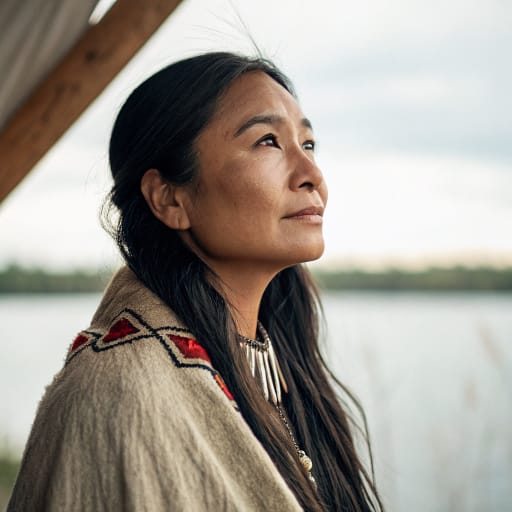
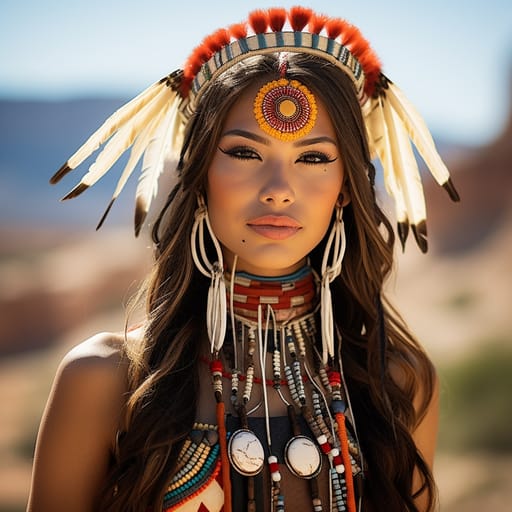
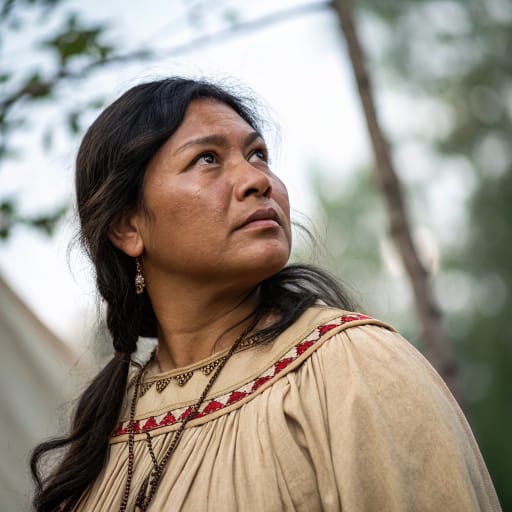
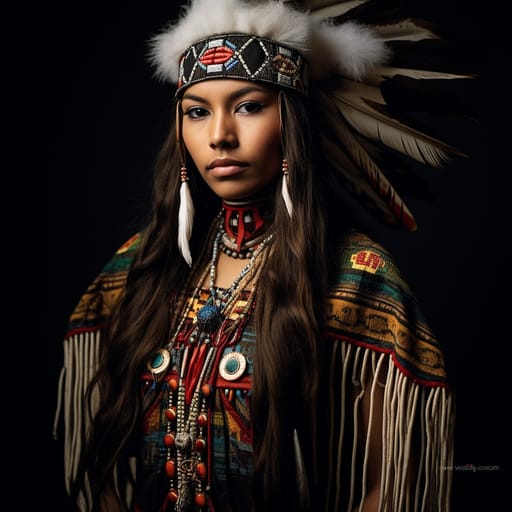
Typical Monacan Phenotypes
Reference for AI generation: hair, eyes, skin, facial structure, build
Monacan Body & Anatomy Reference
Indigenous Northern American / Algonquian-Iroquoian phenotype: anatomy reference for AI nude generation
Monacan Boobs & Breasts
The typical Monacan bust is medium cup, moderate projection, in line with the wider Indigenous Northern American / Algonquian-Iroquoian pattern. Areolas usually fall in the 30-44mm range, with medium-brown areolar pigmentation against the copper-to-medium-brown skin tone. Compared with the smaller East Asian bust, Monacan breasts sit forward and are generally full and moderate projection. A faithful AI render of Monacan tits keeps that shape and areola size.
Monacan Ass & Hips
Butt shape among Monacan women: medium, moderate-to-full projection, over medium iliac crests. This follows Indigenous Northern American / Algonquian-Iroquoian ancestry and looks quite unlike the slim East Asian narrow-hip profile. An accurate Monacan ass in adult AI imagery keeps both the silhouette and the overall build (mesomorph, broader frame in northern Indigenous populations) instead of a generic average.
Monacan Vagina & Pussy
Vulvar anatomy among Monacan women: medium-brown labial pigmentation. Pubic hair tends to be straight medium-coarse texture, in the usual inverted-triangle pattern. Both follow Indigenous Northern American / Algonquian-Iroquoian pigmentation, which is why Monacan pussy renders should not fall back on a pale, sparse Western template.
Monacan Dicks & Penis
The Monacan cock profile, from Indigenous Northern American / Algonquian-Iroquoian anthropometric data: regional mean ~13cm erect; moderate girth; medium-brown shaft pigmentation. Pubic hair has a straight medium-coarse texture and forms the usual inverted-V pattern. Whether Monacan men are circumcised follows religious and cultural practice rather than phenotype.
Monacan Body, Curves & Build
Build and curves among Monacan women follow the Indigenous Northern American / Algonquian-Iroquoian pattern: mesomorph, broader frame in northern Indigenous populations, mean adult female BMI 25-28. Proportions matter as much as skin tone, so Monacan figures should keep their regional height and limb ratios.
Monacan Skin Tone & Hair Texture
The Monacan skin range is copper to medium-brown (Fitzpatrick III-V), and hair tends to be straight 1A, dark-brown to black, often thick and dense. That combination marks the Indigenous Northern American / Algonquian-Iroquoian phenotype, and skin tone is the trait AI generators most often get wrong for Monacan women.
Explore phenotype categories
Structured taxonomy with peer-reviewed scales · 22 anatomical categories
Erotic Poses & Sex Positions
From the pose catalog: 219 named positions with reference skeletons
Frequently asked questions about Monacan people
Where is the Monacan homeland?
The Monacan homeland is Virginia Piedmont along the upper James River, United States; today centered at Bear Mountain in Amherst County, Virginia in North America.
What language do Monacan people speak?
Monacan people primarily speak English (Indo-European); historically Monacan (Siouan), poorly recorded and no longer spoken.
What religion do Monacan people practice?
The predominant religion among Monacan people is Mostly Christian, with deep Episcopal ties from the mission at Bear Mountain.






Make your own Monacan images
Five a day, free, no credits to buy. The studio starts from this group's phenotype data, so you can set body type, pose and style and keep the traits accurate.
Start with Monacan