No portrait yet
Tequesta Erotic
Southeastern Florida around Biscayne Bay, the lower Miami River and the upper Florida Keys, United States
Tequesta, effectively unattested and unclassified; possibly related to Calusa
Indigenous practice, including veneration of chiefly bones; Catholic missions in 1567 and 1743 both failed
South Florida Glades cultural sphere, alongside the Calusa, Mayaimi and Jaega; frequently subordinate to the Calusa
About Tequesta People
The Tequesta were a people of the southeastern tip of Florida, settled around Biscayne Bay, the lower Miami River and the upper Keys for roughly two thousand years, until the last of them were carried off to Havana in 1763 when Spain traded Florida to Britain. Nobody alive carries the name. The Seminole and Miccosukee who live in south Florida today came later and from the north, and are a separate story. What the Tequesta were, unusually for a settled people of their scale, was farmers of nothing at all. They had no reason to be: the bay, the reef and the Everglades margin gave up fish, shark, sea turtle, manatee, deer and shellfish in volumes that let large villages sit in one place for centuries. Those villages sat on their own refuse, mounds of conch and oyster shell laid down layer by layer. The root of the coontie, poisonous raw, was pounded and washed until it gave up a starch that worked like flour. Spanish observers recorded a funeral practice for chiefs in which the body was taken apart, the large bones kept in a chest in the village for veneration and the small bones distributed among kin. Politically the Tequesta lived in the shadow of the Calusa, the power on the Gulf coast, by turns allied, tributary and at war.
Their language is gone past recovery. A handful of words survives in Spanish documents, too few to place it in any family, and the proposals linking it to Calusa or to Muskogean stay proposals. Contact began early in the sixteenth century and went badly by degrees. In 1567 the Spanish planted a Jesuit mission at the river mouth and left a lay brother, Francisco Villarreal, to run it; it was abandoned within a few years. A second attempt in 1743 lasted months. What finished the Tequesta was not conversion but epidemic disease and, in the early 1700s, slave raiding pushed south by English-armed war parties out of Carolina. By 1763 the remnant of every native community in south Florida amounted to fewer than a hundred families. In 1998 a crew clearing Brickell Point for condominium towers cut into a ring of basins carved in the limestone bedrock, about 38 feet across and some two thousand years old. The fight to save it stopped the towers. The Miami Circle is a National Historic Landmark now, and it is the most substantial thing left by a people the city otherwise remembers on street signs.
Related ethnic groups
Groups that share Tequesta's homeland, region, language, or religious tradition. These are likely candidates for comparative phenotype reference.
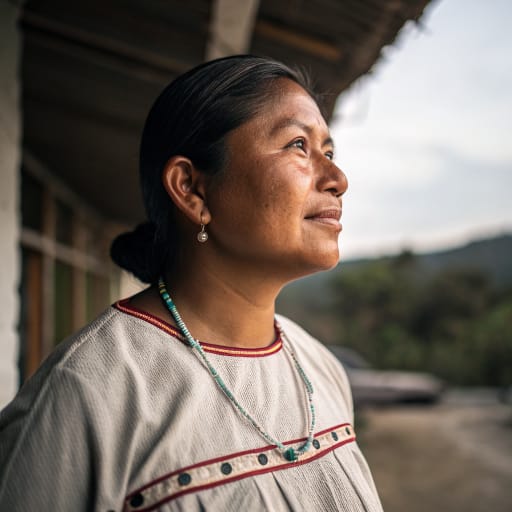
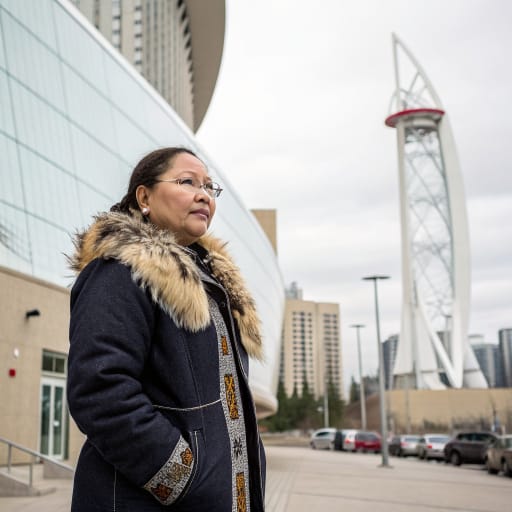
Typical Tequesta Phenotypes
Reference for AI generation: hair, eyes, skin, facial structure, build
Tequesta Body & Anatomy Reference
Anatomy by feature, Indigenous Northern American / Algonquian-Iroquoian phenotype
Tequesta Boobs & Breasts
Tequesta tits and boobs run medium cup, moderate projection, the classic Indigenous Northern American / Algonquian-Iroquoian bust profile. Tequesta nipples and areolas show medium-brown areolar pigmentation against the copper-to-medium-brown skin tone, with areolar diameter typically in the 30-44mm range and forward-set positioning rather than the smaller East Asian bust. Tequesta breasts trend full and moderate projection, a function of the mesomorph, broader frame in northern Indigenous populations body habitus and the mean adult female BMI 25-28. For anatomically accurate AI-generated Tequesta nudes the render preserves the medium cup, moderate projection shape, 30-44mm areolas with medium-brown pigmentation, and the torso proportions of the Indigenous Northern American / Algonquian-Iroquoian phenotype.
Tequesta Ass & Hips
Tequesta hips and butt usually read as medium, moderate-to-full projection. The skeletal base is medium iliac crests, the Indigenous Northern American / Algonquian-Iroquoian pattern. Set against the slim East Asian narrow-hip profile, the difference is easy to see, and the hip-to-waist ratio is often what identifies Tequesta women in photos.
Tequesta Vagina & Pussy
Expect medium-brown labial pigmentation on Tequesta women, in keeping with Indigenous Northern American / Algonquian-Iroquoian ancestry. The pubic hair is straight medium-coarse texture. Coloring should run evenly from the copper to medium-brown skin of the thighs to the labia, and Tequesta nude imagery should keep the hair's straight medium-coarse texture.
Tequesta Dicks & Penis
Tequesta dick and penile anatomy in adult AI generation should anchor on the regional reference data: regional mean ~13cm erect, moderate girth, and medium-brown shaft pigmentation. The Tequesta cock profile reflects the Indigenous Northern American / Algonquian-Iroquoian population's anthropometric measurements. The shaft pigmentation should track the surrounding copper to medium-brown skin tone, and the pubic hair should keep its straight medium-coarse texture in the typical inverted-V escutcheon.
Tequesta Body, Curves & Build
Tequesta body type: mesomorph, broader frame in northern Indigenous populations, with mean adult female BMI 25-28. This is the typical Indigenous Northern American / Algonquian-Iroquoian build. Height range, shoulder-to-hip ratio and fat distribution all follow from it, which is what an accurate Tequesta nude body should show.
Tequesta Skin Tone & Hair Texture
Tequesta skin tone falls in the copper to medium-brown (Fitzpatrick III-V) band, the surface signal most often miscalibrated by generic AI nude generators. Tequesta hair texture is typically straight 1A, dark-brown to black, often thick and dense, characteristic of the Indigenous Northern American / Algonquian-Iroquoian phenotype. In Tequesta nude renders the skin should hold that band consistently across the body.
Explore phenotype categories
Structured taxonomy with peer-reviewed scales · 22 anatomical categories
Erotic Poses & Sex Positions
From the pose catalog: 219 named positions with reference skeletons
Frequently asked questions about Tequesta people
Where is the Tequesta homeland?
The Tequesta homeland is Southeastern Florida around Biscayne Bay, the lower Miami River and the upper Florida Keys, United States in North America.
What language do Tequesta people speak?
Tequesta people primarily speak Tequesta, effectively unattested and unclassified; possibly related to Calusa.
What religion do Tequesta people practice?
The predominant religion among Tequesta people is Indigenous practice, including veneration of chiefly bones; Catholic missions in 1567 and 1743 both failed.






Make your own Tequesta images
Five a day, free, no credits to buy. The studio starts from this group's phenotype data, so you can set body type, pose and style and keep the traits accurate.
Start with Tequesta