Help us get this right
Does this portrait look right for Mescalero?
Nobody has judged this one yet. You would be the first.
Mescalero Erotic
The Sacramento and Guadalupe mountains of south-central New Mexico, historically reaching into west Texas and northern Chihuahua; today the Mescalero Apache Reservation in Otero County, New Mexico, United States
Mescalero-Chiricahua Apache (Southern Athabaskan, Na-Dene family), alongside English
Traditional Apache practice centered on Ussen and the Gahe mountain spirits, together with Catholic and Protestant Christianity and the Native American Church
Southern Athabaskan (Apachean); the reservation community also includes Lipan Apache and Chiricahua Apache descendants
About Mescalero People
The name came from Spanish observers and stuck: mescaleros, the mescal people, after the agave crowns they cut, buried in stone-lined pits, and roasted for days until the fiber turned sweet. Among themselves they are Ndé, the people. They were mountain specialists in country that reads as empty until you learn to move through it vertically: the Sacramento and Guadalupe ranges of south-central New Mexico, the Davis Mountains of west Texas, the basins between them, and the sierras of northern Chihuahua. Winter camps sat low. Summer work followed ripening plants and game up the flanks of Sierra Blanca, the nearly 12,000 foot peak that is still the center of Mescalero geography and of Mescalero religion.
Mescalero speech belongs to the Southern Athabaskan branch, which puts it beside Navajo, Jicarilla, Lipan and the Western Apache languages, and at a long remove beside languages spoken today in the Yukon and interior Alaska. Apaches are recent arrivals in the Southwest by the standards of that region, a southern limb of a northern family, and the grammar carries the evidence. The nineteenth century then compressed everything. In the 1860s the US Army pushed several hundred Mescaleros onto the Bosque Redondo reserve at Fort Sumner alongside thousands of Navajos, into hunger and failed crops; on a night in November 1865 nearly all of them walked off and went home. A reservation in their own mountains followed in 1873, and it later took in two other peoples: Lipan survivors out of Texas and Mexico in the early 1900s, and in 1913 a group of Chiricahuas released after twenty-seven years as prisoners of war. Those three lines still register in family names and in what people remember.
Religious life centers on Ussen, the life giver, and on the Gahe, the mountain spirits, who appear as masked dancers in black hoods and tall painted slat headdresses with a gray clown working the edge of the firelight. The best known ceremony is the four-day rite held each July for girls coming of age, in which the initiate takes on the role of White Painted Woman, dances through the nights, and finishes it an adult with obligations attached. Catholicism sits alongside that rather than over it, as does the Native American Church; the Lipan are generally credited with carrying peyote practice north to the Plains. The tribe now holds close to half a million acres of timber, cattle range and mountain. A ski area on Sierra Blanca and a resort casino are the visible economy. The ceremonial ground is not.
Related ethnic groups
Groups that share Mescalero's homeland, region, language, or religious tradition. These are likely candidates for comparative phenotype reference.
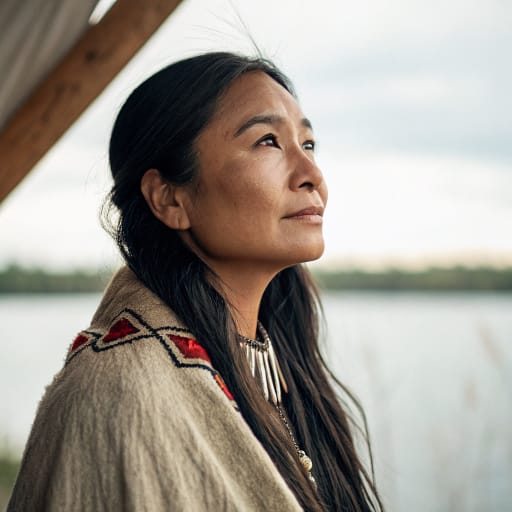
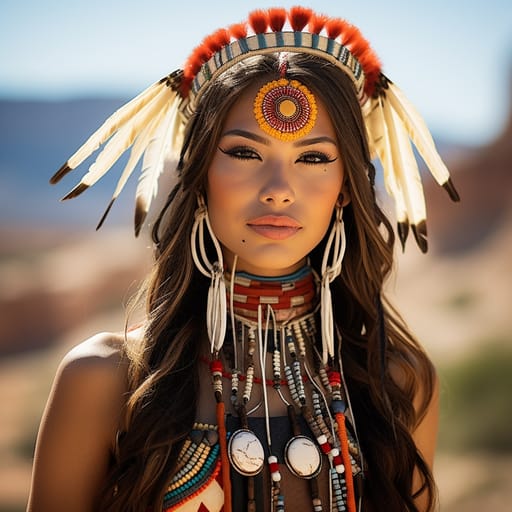
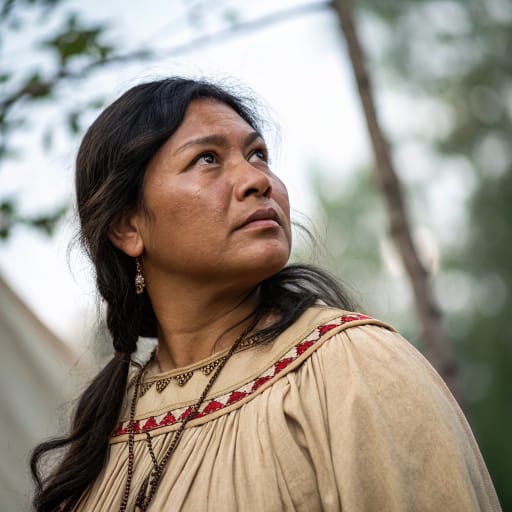
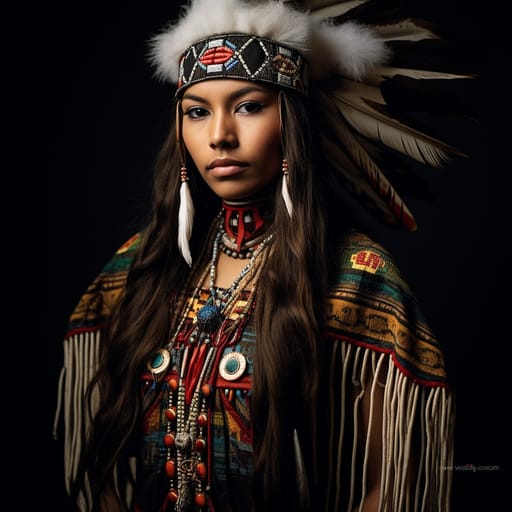
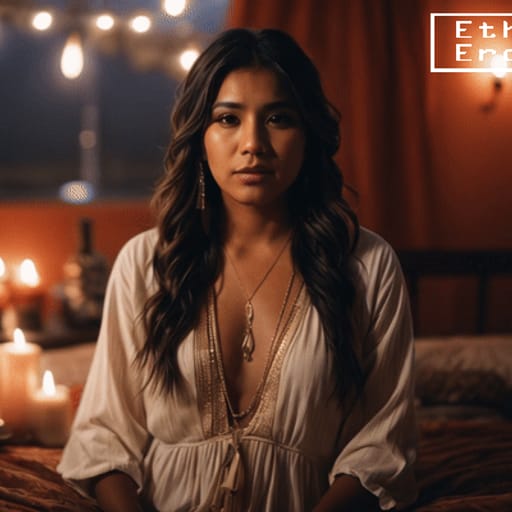
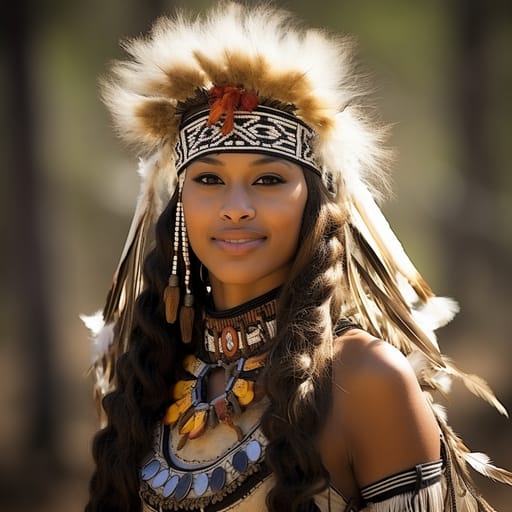
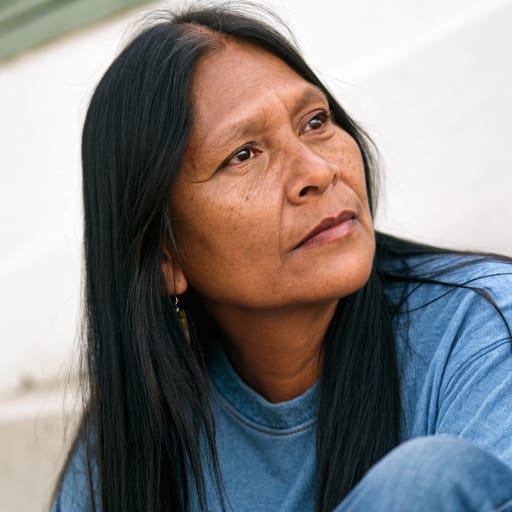
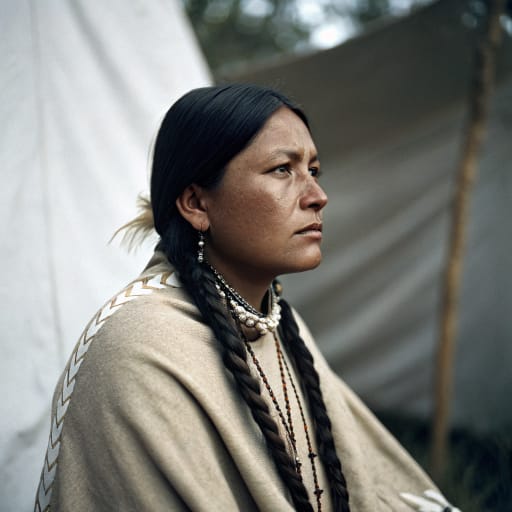
Typical Mescalero Phenotypes
Reference for AI generation: hair, eyes, skin, facial structure, build
Mescalero Body & Anatomy Reference
Indigenous Northern American / Algonquian-Iroquoian phenotype: anatomy reference for AI nude generation
Mescalero Boobs & Breasts
Bust reference for Mescalero women: medium cup, moderate projection, which is typical of Indigenous Northern American / Algonquian-Iroquoian ancestry. Areolas measure about 30-44mm across, with medium-brown pigmentation. Body type (mesomorph, broader frame in northern Indigenous populations) shapes the bust as well, so Mescalero tits are usually full and moderate projection. In AI imagery, keep the forward-set shape rather than drifting toward the smaller East Asian bust.
Mescalero Ass & Hips
The Mescalero ass is typically medium, moderate-to-full projection, which sets it apart from the slim East Asian narrow-hip profile. Underneath, the pelvis shows medium iliac crests, part of the Indigenous Northern American / Algonquian-Iroquoian skeletal pattern. For Mescalero butt pics and AI renders, match that silhouette and the overall build (mesomorph, broader frame in northern Indigenous populations).
Mescalero Vagina & Pussy
Mescalero pussy and vulvar anatomy presents medium-brown labial pigmentation, consistent with the Indigenous Northern American / Algonquian-Iroquoian phenotype's pigmentation pattern. Mescalero pubic hair is typically straight medium-coarse texture, in the inverted-triangle pattern. For anatomically accurate Mescalero pussy renders the labial coloration should match the surrounding copper to medium-brown skin tone with a continuous gradient, and the hair should keep its straight medium-coarse texture.
Mescalero Dicks & Penis
Mescalero dicks follow the Indigenous Northern American / Algonquian-Iroquoian reference data: regional mean ~13cm erect; moderate girth; medium-brown shaft pigmentation. Shaft color should track the copper to medium-brown skin tone with a smooth change toward the glans, and Mescalero pubic hair keeps its straight medium-coarse texture.
Mescalero Body, Curves & Build
Mescalero body type and overall build presents as mesomorph, broader frame in northern Indigenous populations, with mean adult female BMI 25-28: the characteristic Indigenous Northern American / Algonquian-Iroquoian habitus. Mescalero curves and proportions should keep the regional skeletal frame (height, shoulder-to-hip ratio, limb proportions) rather than a generic mesomorph default.
Mescalero Skin Tone & Hair Texture
Mescalero skin sits in the copper to medium-brown (Fitzpatrick III-V) band. Hair is typically straight 1A, dark-brown to black, often thick and dense, in keeping with the Indigenous Northern American / Algonquian-Iroquoian phenotype. In nude renders the skin should stay one even tone from face to body, and body, pubic and head hair should match.
Explore phenotype categories
Structured taxonomy with peer-reviewed scales · 22 anatomical categories
Erotic Poses & Sex Positions
From the pose catalog: 219 named positions with reference skeletons
Frequently asked questions about Mescalero people
Where is the Mescalero homeland?
The Mescalero homeland is The Sacramento and Guadalupe mountains of south-central New Mexico, historically reaching into west Texas and northern Chihuahua; today the Mescalero Apache Reservation in Otero County, New Mexico, United States in North America.
What language do Mescalero people speak?
Mescalero people primarily speak Mescalero-Chiricahua Apache (Southern Athabaskan, Na-Dene family), alongside English.
What religion do Mescalero people practice?
The predominant religion among Mescalero people is Traditional Apache practice centered on Ussen and the Gahe mountain spirits, together with Catholic and Protestant Christianity and the Native American Church.






Make your own Mescalero images
Five a day, free, no credits to buy. The studio starts from this group's phenotype data, so you can set body type, pose and style and keep the traits accurate.
Start with Mescalero