Help us get this right
Does this portrait look right for Masalit?
One tap. It takes a second and it is recorded.
2 say it looks right, 0 say it looks off.
Masalit Erotic
Islam / Sunni Islam
About Masalit People
The Masalit are a sedentary farming people of the Dar Masalit — "home of the Masalit" — a stretch of savanna straddling the Sudan–Chad border in what is now West Darfur and the Ouaddaï region. Until 1922 they ran their own sultanate, founded in the late nineteenth century by Sultan Abuker Ismail and held together against successive Mahdist, French, and British encroachments before being absorbed into Anglo-Egyptian Sudan. That memory of late, hard-won sovereignty still shapes how Masalit talk about themselves: not as a tribe scattered into someone else's map, but as a polity that was annexed within living family memory.
Their language, Masalit, belongs to the Maba branch of the Nilo-Saharan family — a small cluster shared with the Maba of Ouaddaï and a handful of smaller Chadian groups, and quite distinct from the Arabic spoken by their pastoralist neighbors. Most Masalit are bilingual in Arabic out of necessity; the home language stays Masalit. Islam arrived gradually through the central Sudanic trade routes and was consolidated under the sultanate, so Sunni practice here is old and matter-of-fact rather than recently imposed. Sufi orders, especially the Tijaniyya, run through ordinary religious life, and Friday observance coexists with older agricultural rites tied to the millet and sorghum cycle.
Masalit society is organized around the village and its fursha, a hereditary local notable who handles land allocation and disputes — a system that survived the end of the sultanate because the colonial and post-colonial state found it useful. Land, not livestock, is the currency of belonging: a Masalit identity is bound up in farming a specific patch of inherited ground, which is part of why the conflicts of the past two decades have been so devastating. The Darfur war that began in 2003 and the renewed violence from 2023 onward have driven hundreds of thousands of Masalit into Chad, particularly around Adré and Farchana, and the community now has a substantial diaspora that did not exist a generation ago.
Day-to-day Masalit life still leans on what it always has: the cleared field, the thatched tukul, marriage alliances negotiated between extended kin, and a strong oral tradition of poetry and proverbs in a language that, despite everything, continues to be passed to children. The people are smaller in number on their own land than they were twenty years ago, but they are not, in any meaningful sense, gone.
Related ethnic groups
Groups that share Masalit's homeland, region, language, or religious tradition. These are likely candidates for comparative phenotype reference.
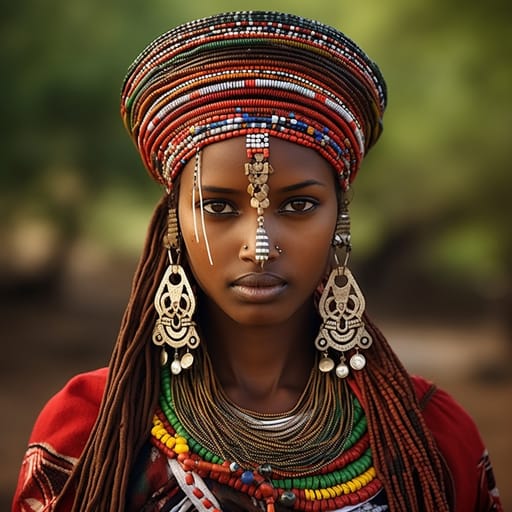
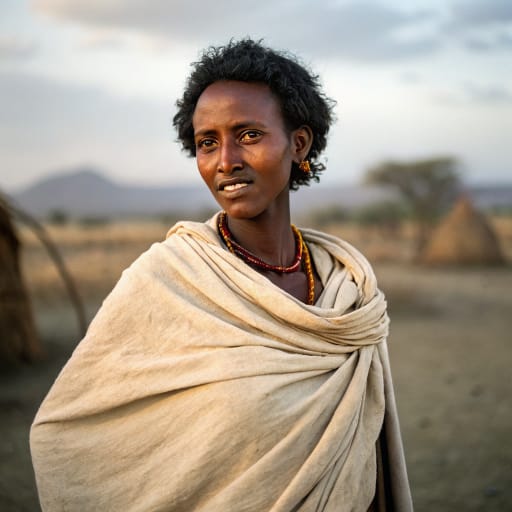
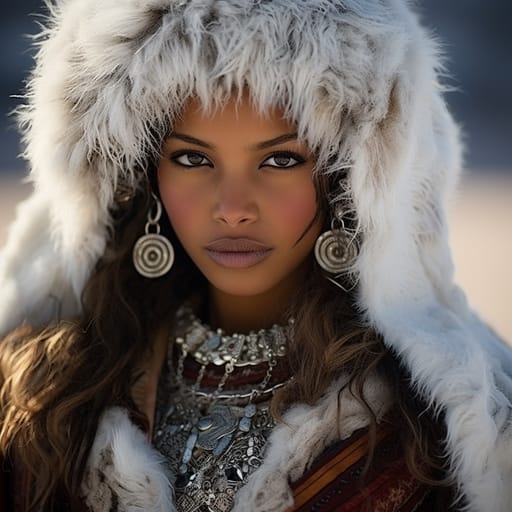
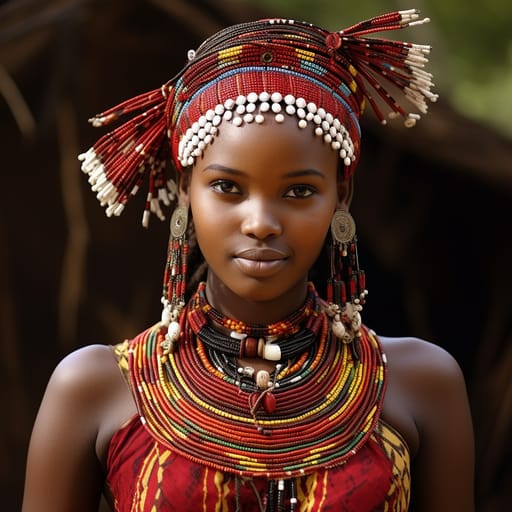
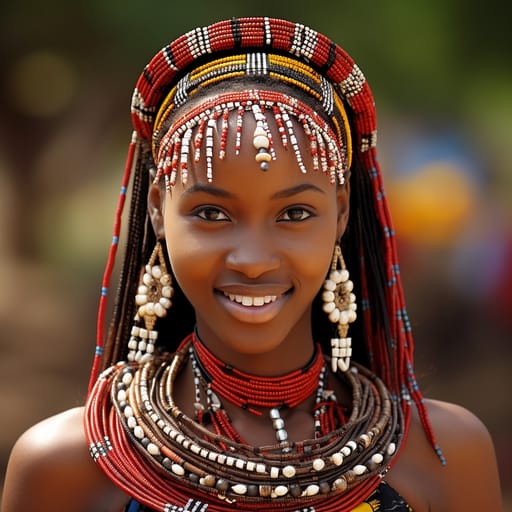
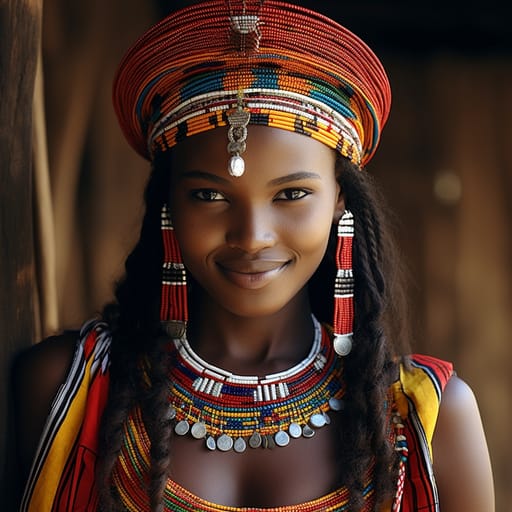
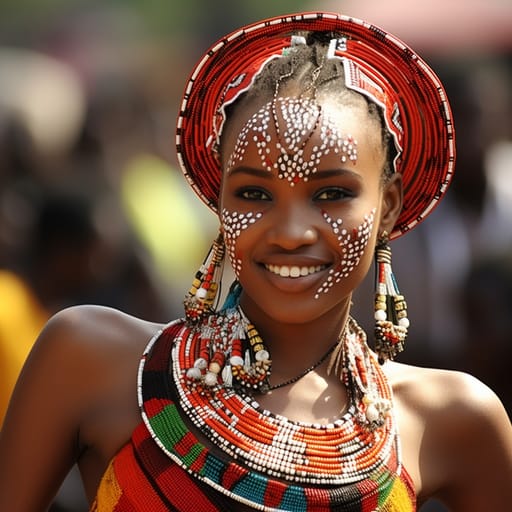
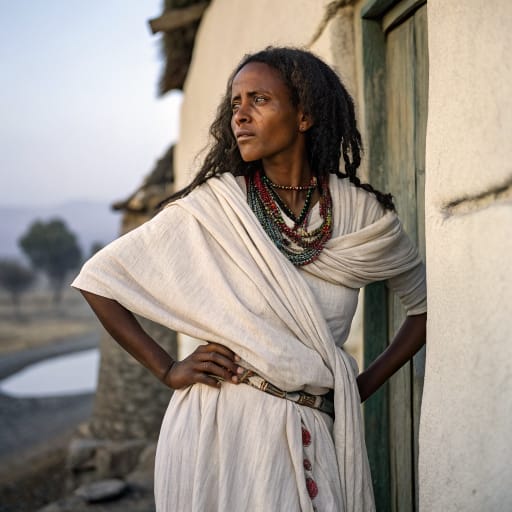
Geographic Distribution: Masalit populations across 1 country
Each row is ranked by the group's share of that country's population, with the source citation drawn from published census and demographic surveys. Click through for the full per-country phenotype profile.
| Country | Share | Source |
|---|---|---|
| Sudan | 1.2% | Estimates; Masalit (~1.2%, ~520,000+); concentrated in West Darfur (Sudan-Chad border region). Maba / Nilo-Saharan language family. Subject to documented violence during the 2003-2005 Darfur conflict and continuing 2023-present civil war (the 2023 mass killings in El Geneina specifically targeted Masalit) |
Typical Masalit Phenotypes
Reference for AI generation: hair, eyes, skin, facial structure, build
The Masalit phenotype sits in the Sahelian band of central Africa, where Nilo-Saharan populations meet the southern edge of the Sahara. The dominant impression is a tall, lean, deep-skinned profile typical of the Darfur–Wadai borderlands, distinct from both the rounder Bantu features further south and the more Arab-influenced Sudanese to the east.
Hair is almost uniformly black and tightly coiled, falling into Type 4B–4C textures, worn close-cropped on men and frequently braided, twisted, or wrapped on women. Greying tends to come late and arrives at the temples first. Facial and body hair is sparse to moderate.
Eyes are dark brown to near-black, with no epicanthic fold and generally almond-shaped, set under a smooth, unbroken brow ridge. Whites of the eyes often carry a faint warm cast against the surrounding skin. Eye shape tends to be long and slightly upturned at the outer corner.
Skin is deeply pigmented — Fitzpatrick V to VI, with a strong cool-brown to near-black register and warm red-brown undertones in sun-exposed populations. Sahelian sun exposure produces an evenness of tone across the body rather than the contrast patterns seen in lower-UV regions.
Facial structure leans long and narrow rather than broad: a relatively high, straight nasal bridge with moderate alar width, prominent cheekbones, a defined jawline, and full but well-defined lips — fuller on the lower lip than the upper. The forehead is typically high and the chin slightly recessed.
Build is the most regionally distinctive trait. Masalit men and women tend toward the tall, narrow-framed Sahelian body type — long limbs, low body fat, narrow hips and shoulders, and a high lower-limb-to-torso ratio. Adult male stature commonly reaches 175–185 cm; women run proportionally tall and slender. Activist Usumain Baraka reflects this lanky, fine-boned build well. Older or rural adults carry visible wiriness from agro-pastoral labor rather than gym-shaped musculature.
Masalit Body & Anatomy Reference
Cushitic / Nilo-Cushitic East African phenotype: anatomy reference for AI nude generation
Masalit Boobs & Breasts
Bust reference for Masalit women: small-to-medium-cup, high-set, conical, which is typical of Cushitic / Nilo-Cushitic East African ancestry. Areolas measure about 28-38mm across, with moderate-to-high pigmentation. Body type (lean ectomorph-to-mesomorph) shapes the bust as well, so Masalit tits are usually firmer and less projecting than the African-American or West African norm. In AI imagery, keep the forward-set shape rather than drifting toward the lateral spread of the West African phenotype.
Masalit Ass & Hips
The Masalit ass is typically small-to-medium, high-set, rounded, which sets it apart from the wide-set heavy-projection West African or African-American norm. Underneath, the pelvis shows narrow-to-medium iliac crests, longer torso-to-leg ratio, part of the Cushitic / Nilo-Cushitic East African skeletal pattern. For Masalit butt pics and AI renders, match that silhouette and the overall build (lean ectomorph-to-mesomorph).
Masalit Vagina & Pussy
Masalit pussy and vulvar anatomy presents brown-to-deep-brown labial pigmentation, narrow-to-medium labia minora projection, consistent with the Cushitic / Nilo-Cushitic East African phenotype's pigmentation pattern. Masalit pubic hair is typically tightly-coiled coarse texture, densely distributed, in the inverted-triangle pattern. For anatomically accurate Masalit pussy renders the labial coloration should match the surrounding brown to deep brown skin tone with a continuous gradient, and the hair should keep its tightly-coiled coarse texture.
Masalit Dicks & Penis
Masalit dicks follow the Cushitic / Nilo-Cushitic East African reference data: regional mean ~13.5cm erect; moderate girth, ~12cm circumference; deeper-pigmented than the West African norm. Shaft color should track the brown to deep brown skin tone with a smooth change toward the glans, and Masalit pubic hair keeps its tightly-coiled coarse texture.
Masalit Body, Curves & Build
Masalit body type and overall build presents as lean ectomorph-to-mesomorph, with mean adult female BMI 19-22: the characteristic Cushitic / Nilo-Cushitic East African habitus. Masalit curves and proportions should keep the regional skeletal frame (height, shoulder-to-hip ratio, limb proportions) rather than a generic mesomorph default.
Masalit Skin Tone & Hair Texture
Masalit skin sits in the brown to deep brown (Fitzpatrick V-VI) band. Hair is typically tight 4A-4C coil, often worn natural or in braided/twisted protective styles, in keeping with the Cushitic / Nilo-Cushitic East African phenotype. In nude renders the skin should stay one even tone from face to body, and body, pubic and head hair should match.
Data depth
0/100Coverage of image-grounded phenotype observations · drives AI generation diversity
- Sample size
- 0/40· 0 images
- Image quality
- 0/30· 0% high
- Confidence
- 0/20
- Source diversity
- 0/10
- ·No image observations yet
Explore phenotype categories
Structured taxonomy with peer-reviewed scales · 22 anatomical categories
Notable Masalit People
1 reference figure, sourced from Wikipedia
- Usumain Baraka, born 1994), activist
Erotic Poses & Sex Positions
From the pose catalog: 219 named positions with reference skeletons
Frequently asked questions about Masalit people
Where is the Masalit homeland?
The Masalit homeland is Sudan, Chad in Eastern Africa.
What countries do Masalit people live in?
Masalit populations are documented across 1 country: Sudan.
What language do Masalit people speak?
Masalit people primarily speak Nilo-Saharan / Masalit.
What religion do Masalit people practice?
The predominant religion among Masalit people is Islam / Sunni Islam.






Make your own Masalit images
Five a day, free, no credits to buy. The studio starts from this group's phenotype data, so you can set body type, pose and style and keep the traits accurate.
Start with Masalit