Help us get this right
Does this portrait look right for Fur?
Nobody has judged this one yet. You would be the first.
Fur Erotic
Darfur (Sudan)
Islam / Sunni Islam
About Fur People
The Fur are the people who gave Darfur its name — dar Fur, the home of the Fur — and they remain the demographic anchor of that western Sudanese region despite decades of displacement and war. Their heartland is the Jebel Marra, a volcanic massif rising green and cool out of the surrounding savanna, with crater lakes near its summit and terraced fields stepping down its slopes. Sorghum and millet on the flats, onions and citrus and mangoes higher up where the rain catches: the Fur are settled cultivators, and that fact has shaped almost everything about how they live and how outsiders have treated them.
The Fur language sits by itself inside the Nilo-Saharan family — its closest relative is Amdang, spoken by a small group across the border in Chad, and beyond that the connections grow distant and contested. This is unusual in a region where Arabic now dominates trade and government, and most Fur today are bilingual, switching between Fur at home and Sudanese Arabic outside it. The language has held on better in the Jebel Marra villages than in the towns; in El Fasher and Nyala, Arabic does most of the work.
Islam arrived gradually and became total. The Fur are Sunni Muslims, and have been since the Keira Sultanate consolidated power in the seventeenth century and made Islam the state religion of an independent kingdom that lasted, with one interruption, until 1916, when the British finally absorbed it into Anglo-Egyptian Sudan. That sultanate matters: it is why the Fur think of themselves as a people with a state-history rather than a tribal one, and why the loss of Darfur's autonomy still registers. Sufi orders, particularly the Tijaniyya, run alongside ordinary mosque practice; pre-Islamic ideas about the Jebel Marra as a sacred landscape have not entirely disappeared either.
The conflict that began in 2003 has reshaped Fur life more than any other event in living memory. Villages were burned, populations driven into camps around the regional capitals or across into Chad, and an older agricultural rhythm — the careful coordination of farming with the seasonal movements of Arab pastoralists — broke down into something much uglier. A great many Fur are now displaced people inside their own homeland, holding onto language, kin networks, and the idea of return.
Related ethnic groups
Groups that share Fur's homeland, region, language, or religious tradition. These are likely candidates for comparative phenotype reference.
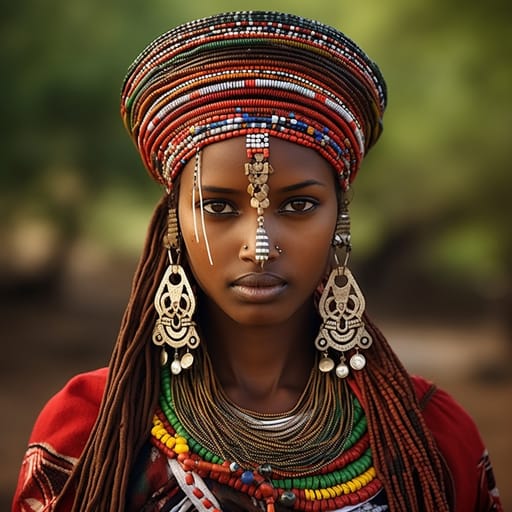
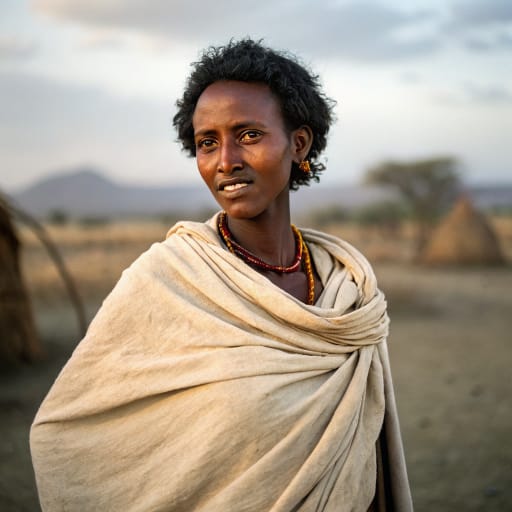
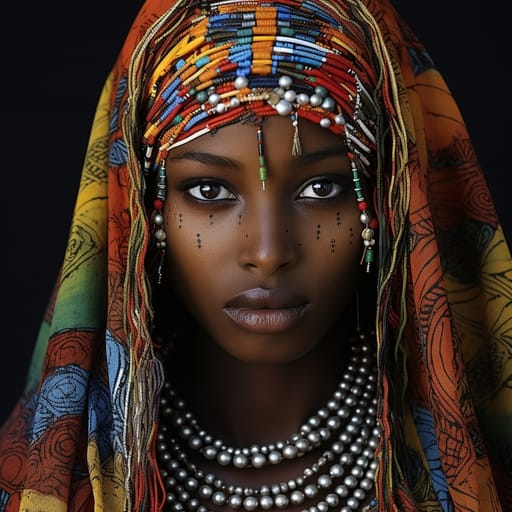
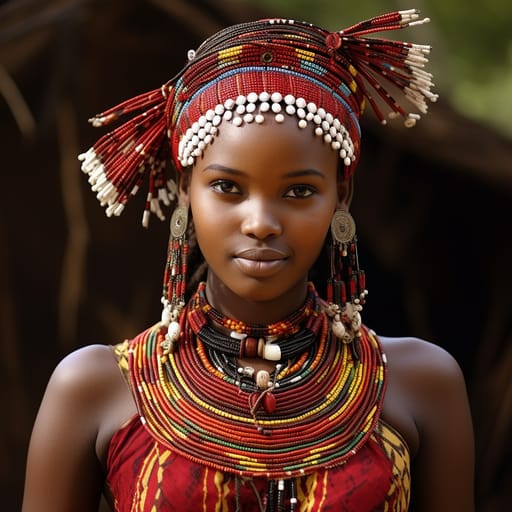
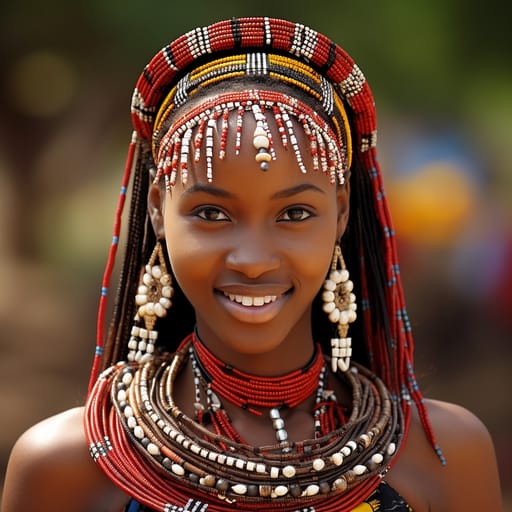
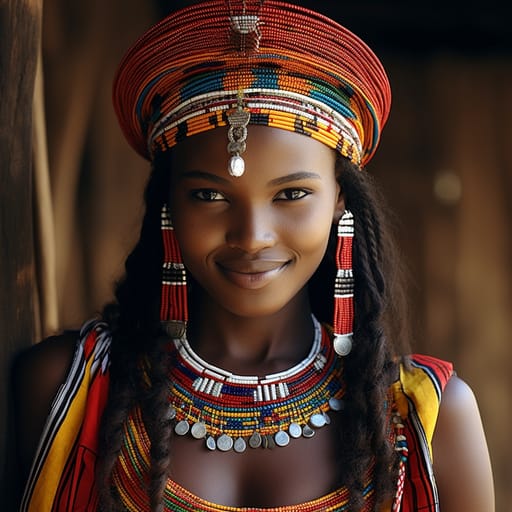
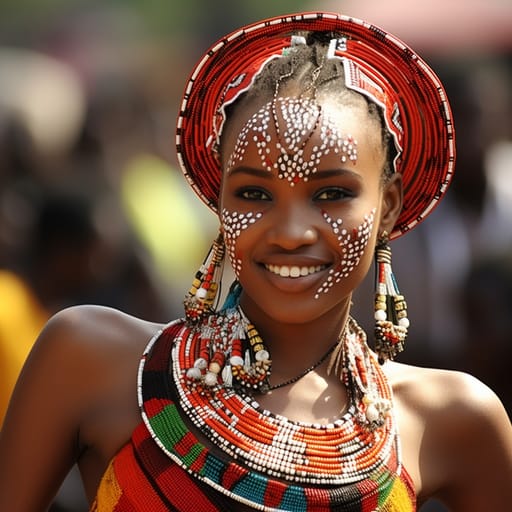
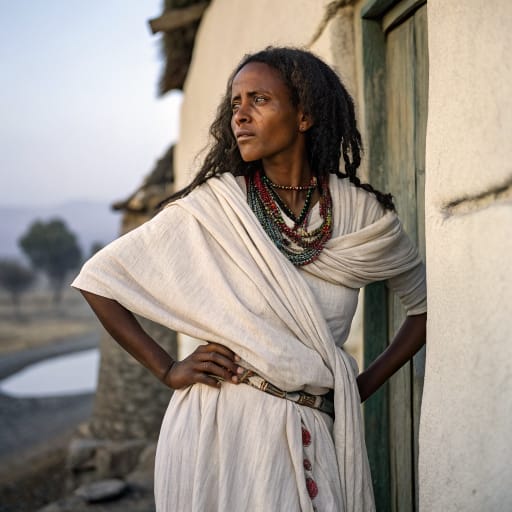
Typical Fur Phenotypes
Reference for AI generation: hair, eyes, skin, facial structure, build
The Fur present a phenotype shaped by their position at the Sahel-Saharan boundary in western Sudan — a population with long Nilo-Saharan continuity overlaid by selective Arab admixture during the Darfur Sultanate period. The dominant impression is dark-skinned Sahelian rather than Nilotic-tall or North African-aquiline, with their own consistent facial signature.
Hair is uniformly Type 4 — tightly coiled to kinky, with the dense Z-pattern coil typical of Sahelian and sub-Saharan populations. Color sits at deep black-brown; reddish sun-bleaching at the tips is common in rural cultivators who work uncovered fields. Beards on men tend toward sparse-to-moderate density rather than the heavier growth seen in their Baggara Arab neighbors.
Eyes are dark brown to near-black, almond-shaped, set under moderately heavy brow ridges. The epicanthic fold is absent. Lashes are dense and dark.
Skin tone ranges from medium-dark brown to deep brown-black — Fitzpatrick V to VI, with warm red-brown rather than blue-black undertones. The Sahelian sun produces a matte, even pigmentation; vitiligo and tonal variegation are uncommon.
Facial structure is where the Fur read as distinct from both their Nilotic east and Arab north. Noses are moderate-bridged with broader alar bases — wider than Nubian, narrower than equatorial Central African. Lips are full but not everted. Cheekbones sit high and forward; the jaw is squared in men and softer-rounded in women, with a relatively short midface. Foreheads are high and often slightly sloped.
Build is medium-statured and lean — men typically 170–178 cm, women 158–165 cm — with the wiry, low-body-fat composition common to subsistence cultivators and pastoralists in semi-arid zones. Shoulders are moderate, hips narrow, limbs proportionally long relative to torso. Postpartum and middle-aged women carry weight centrally rather than gluteally. Visible muscularity is functional rather than developed; the overall silhouette is angular rather than rounded.
Fur Body & Anatomy Reference
Anatomy by feature, Cushitic / Nilo-Cushitic East African phenotype
Fur Boobs & Breasts
The typical Fur bust is small-to-medium-cup, high-set, conical, in line with the wider Cushitic / Nilo-Cushitic East African pattern. Areolas usually fall in the 28-38mm range, with moderate-to-high areolar pigmentation against the brown-to-deep-brown skin tone. Compared with the lateral spread of the West African phenotype, Fur breasts sit forward and are generally firmer and less projecting than the African-American or West African norm. A faithful AI render of Fur tits keeps that shape and areola size.
Fur Ass & Hips
Butt shape among Fur women: small-to-medium, high-set, rounded, over narrow-to-medium iliac crests, longer torso-to-leg ratio. This follows Cushitic / Nilo-Cushitic East African ancestry and looks quite unlike the wide-set heavy-projection West African or African-American norm. An accurate Fur ass in adult AI imagery keeps both the silhouette and the overall build (lean ectomorph-to-mesomorph) instead of a generic average.
Fur Vagina & Pussy
Vulvar anatomy among Fur women: brown-to-deep-brown labial pigmentation, narrow-to-medium labia minora projection. Pubic hair tends to be tightly-coiled coarse texture, densely distributed, in the usual inverted-triangle pattern. Both follow Cushitic / Nilo-Cushitic East African pigmentation, which is why Fur pussy renders should not fall back on a pale, sparse Western template.
Fur Dicks & Penis
The Fur cock profile, from Cushitic / Nilo-Cushitic East African anthropometric data: regional mean ~13.5cm erect; moderate girth, ~12cm circumference; deeper-pigmented than the West African norm. Pubic hair has a tightly-coiled coarse texture and forms the usual inverted-V pattern. Whether Fur men are circumcised follows religious and cultural practice rather than phenotype.
Fur Body, Curves & Build
Build and curves among Fur women follow the Cushitic / Nilo-Cushitic East African pattern: lean ectomorph-to-mesomorph, mean adult female BMI 19-22. Proportions matter as much as skin tone, so Fur figures should keep their regional height and limb ratios.
Fur Skin Tone & Hair Texture
The Fur skin range is brown to deep brown (Fitzpatrick V-VI), and hair tends to be tight 4A-4C coil, often worn natural or in braided/twisted protective styles. That combination marks the Cushitic / Nilo-Cushitic East African phenotype, and skin tone is the trait AI generators most often get wrong for Fur women.
Data depth
0/100Coverage of image-grounded phenotype observations · drives AI generation diversity
- Sample size
- 0/40· 0 images
- Image quality
- 0/30· 0% high
- Confidence
- 0/20
- Source diversity
- 0/10
- ·No image observations yet
Explore phenotype categories
Structured taxonomy with peer-reviewed scales · 22 anatomical categories
Erotic Poses & Sex Positions
From the pose catalog: 219 named positions with reference skeletons
Frequently asked questions about Fur people
Where is the Fur homeland?
The Fur homeland is Darfur (Sudan) in Eastern Africa.
What language do Fur people speak?
Fur people primarily speak Nilo-Saharan / Fur.
What religion do Fur people practice?
The predominant religion among Fur people is Islam / Sunni Islam.






Make your own Fur images
Five a day, free, no credits to buy. The studio starts from this group's phenotype data, so you can set body type, pose and style and keep the traits accurate.
Start with Fur