Help us get this right
Does this portrait look right for Harari?
One tap. It takes a second and it is recorded.
2 say it looks right, 0 say it looks off.
Harari Erotic
Hararia (Ethiopia)
Islam / Sunni Islam
About Harari People
The Harari are a city people in the strict sense — their identity is bound up with a single walled town, Harar Jugol, in the eastern highlands of Ethiopia. For centuries the city was a sovereign emirate and a node in the trade routes connecting the Ethiopian interior to the Red Sea and the Indian Ocean, and the Harari themselves built much of their distinct character behind those walls: an urban Muslim population in a region whose hinterland is mostly Oromo and whose imperial overlord, eventually, was Christian. They call themselves Gey Usu', "the people of the city," and the phrase is meant literally. Rural life is for neighbors; the Harari are townsmen.
Their language, Harari, is Ethiosemitic — a cousin of Amharic and Tigrinya, and more distantly of Arabic — but it has spent so long surrounded by Cushitic Oromo and Somali speakers that it has absorbed a great deal from them, and it is mutually unintelligible with its closer Semitic relatives. It is spoken almost entirely inside the old city and by Harari communities in the diaspora; outside that circle it has no public life. Sunni Islam arrived early, and Harar became one of the major centers of Islamic scholarship in the Horn of Africa, with a reputation as a city of saints and shrines. The mosques and tombs scattered through the alleys are not heritage in the past-tense sense; they are still in use, and the calendar of saint-day visitations still organizes a great deal of social time.
Domestic life has its own grammar. The traditional Harari house — narrow doorway, raised platforms along the walls, a tiered niche of carved wood and basketry on the main wall — is built around the reception of guests, and the elaborate basketry made by Harari women, hung in tight constellations on the walls, functions as both decoration and a record of female craft lineage. Coffee is taken seriously, qat-chewing sessions structure afternoons, and the famous practice of feeding wild hyenas by hand at the edge of the city walls is genuinely old, not a tourist invention, though tourists now watch. The community is small — tens of thousands inside Ethiopia, with significant emigration to the Gulf, Europe, and North America — and that smallness, combined with strong endogamy and a dense network of guild-like associations called afocha, is what has kept a city-sized identity intact for so long.
Related ethnic groups
Groups that share Harari's homeland, region, language, or religious tradition. These are likely candidates for comparative phenotype reference.
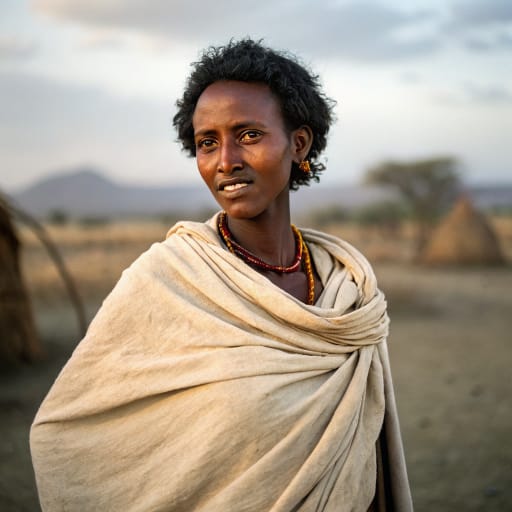
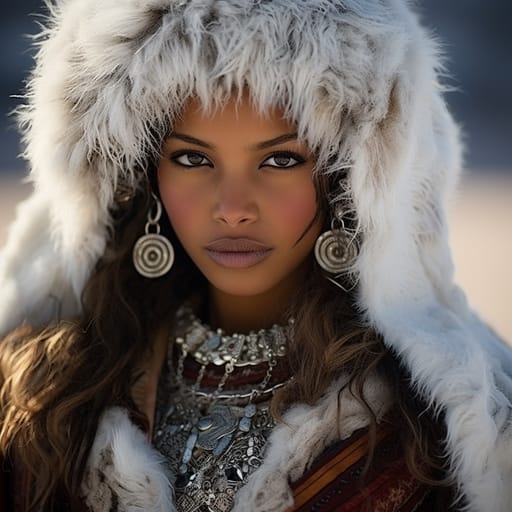
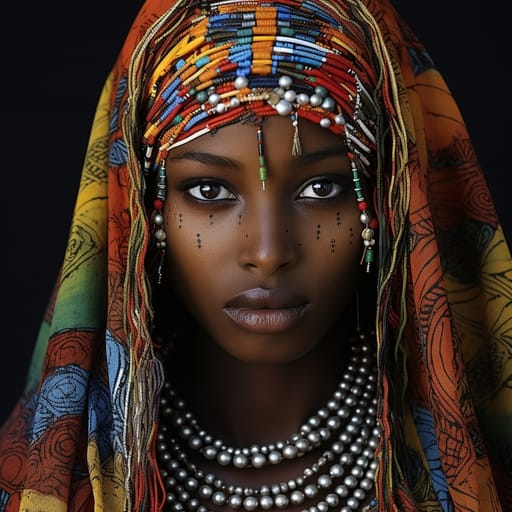
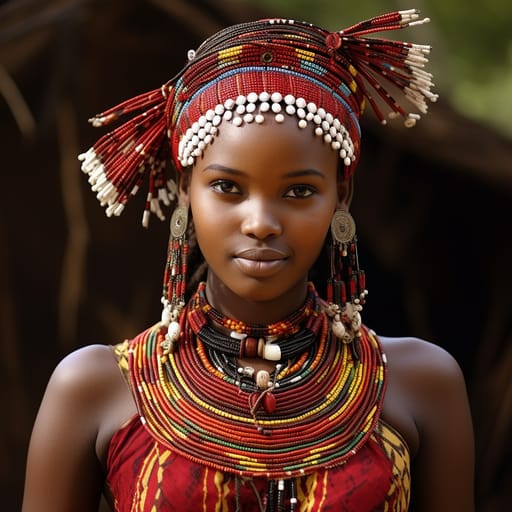
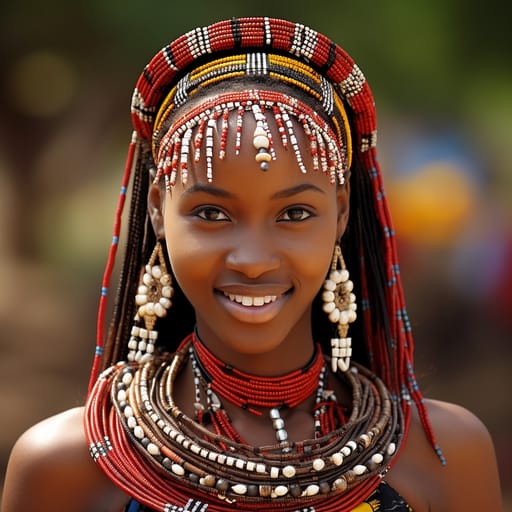
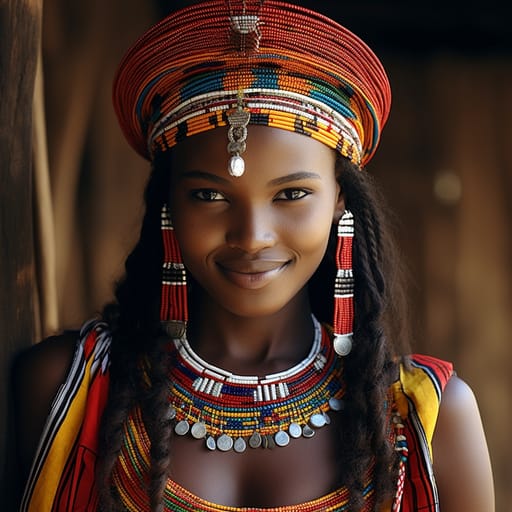
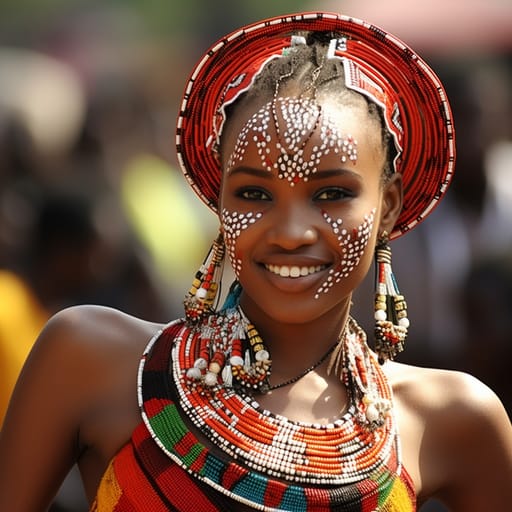
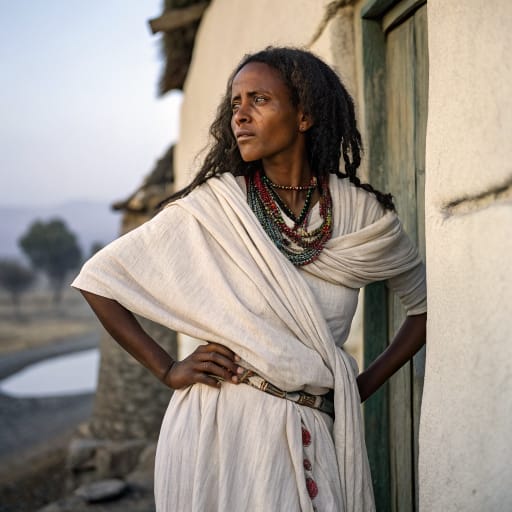
Typical Harari Phenotypes
Reference for AI generation: hair, eyes, skin, facial structure, build
The Harari are a small, historically urban Semitic-speaking population concentrated inside the walled city of Harar and its immediate surroundings in eastern Ethiopia. Their phenotype reflects centuries of contact between highland Cushitic and Semitic Ethiopian stock and Arab, Somali, and Argobba neighbors arriving through the Red Sea trade — producing a look that is distinctly Horn African rather than either Sub-Saharan or Arab, but visibly tilted toward the lighter, finer-featured end of that Horn spectrum.
Hair is typically very dark brown to black, with a curl pattern most often falling in the Type 3 range — defined ringlets and loose coils rather than the tighter Type 4 coil common further south and west. Wavy Type 2 textures appear with some frequency, especially among women, and outright straight hair is uncommon but not unheard of. Eye color is overwhelmingly dark brown, occasionally a lighter honey or hazel; the eye shape is almond, large, and almost always lacks an epicanthic fold. Brows are full and arched.
Skin tone clusters in Fitzpatrick IV–V — a warm, reddish-brown to medium-brown range with golden or coppery undertones rather than the deeper olive of Arabs or the very dark browns of southern Ethiopian and Sudanic groups. Lighter Type III complexions occur, particularly among older urban families with documented Arab ancestry.
Facial structure leans toward narrow, high-bridged noses with modest alar width, delicate jaws, and high cheekbones. Lips are medium-full — more defined than typically Arab, less full than typically West African. Chins are often pointed.
Build is generally slight and gracile. Men average roughly 168–172 cm, women around 158–162 cm; both sexes tend toward lean, narrow-shouldered, long-limbed proportions with low body fat — a body composition shared broadly with highland Ethiopian populations. Women carry a softer, pear-leaning fat distribution within that overall slim frame. Visible obesity is uncommon in the home population.
Harari Body & Anatomy Reference
Anatomy by feature, Cushitic / Nilo-Cushitic East African phenotype
Harari Boobs & Breasts
The typical Harari bust is small-to-medium-cup, high-set, conical, in line with the wider Cushitic / Nilo-Cushitic East African pattern. Areolas usually fall in the 28-38mm range, with moderate-to-high areolar pigmentation against the brown-to-deep-brown skin tone. Compared with the lateral spread of the West African phenotype, Harari breasts sit forward and are generally firmer and less projecting than the African-American or West African norm. A faithful AI render of Harari tits keeps that shape and areola size.
Harari Ass & Hips
Butt shape among Harari women: small-to-medium, high-set, rounded, over narrow-to-medium iliac crests, longer torso-to-leg ratio. This follows Cushitic / Nilo-Cushitic East African ancestry and looks quite unlike the wide-set heavy-projection West African or African-American norm. An accurate Harari ass in adult AI imagery keeps both the silhouette and the overall build (lean ectomorph-to-mesomorph) instead of a generic average.
Harari Vagina & Pussy
Vulvar anatomy among Harari women: brown-to-deep-brown labial pigmentation, narrow-to-medium labia minora projection. Pubic hair tends to be tightly-coiled coarse texture, densely distributed, in the usual inverted-triangle pattern. Both follow Cushitic / Nilo-Cushitic East African pigmentation, which is why Harari pussy renders should not fall back on a pale, sparse Western template.
Harari Dicks & Penis
The Harari cock profile, from Cushitic / Nilo-Cushitic East African anthropometric data: regional mean ~13.5cm erect; moderate girth, ~12cm circumference; deeper-pigmented than the West African norm. Pubic hair has a tightly-coiled coarse texture and forms the usual inverted-V pattern. Whether Harari men are circumcised follows religious and cultural practice rather than phenotype.
Harari Body, Curves & Build
Build and curves among Harari women follow the Cushitic / Nilo-Cushitic East African pattern: lean ectomorph-to-mesomorph, mean adult female BMI 19-22. Proportions matter as much as skin tone, so Harari figures should keep their regional height and limb ratios.
Harari Skin Tone & Hair Texture
The Harari skin range is brown to deep brown (Fitzpatrick V-VI), and hair tends to be tight 4A-4C coil, often worn natural or in braided/twisted protective styles. That combination marks the Cushitic / Nilo-Cushitic East African phenotype, and skin tone is the trait AI generators most often get wrong for Harari women.
Data depth
27/100Coverage of image-grounded phenotype observations · drives AI generation diversity
- Sample size
- 14/40· 6 images
- Image quality
- 8/30· 17% high
- Confidence
- 5/20· mean 0.51
- Source diversity
- 0/10· wikipedia
- ·Small sample (n<10)
- ·Low overall confidence
- ·Mostly low-quality source images
- ·Wikipedia-only source, not population-representative
Observed Distribution: Image Sample
Empirical observations from analyzed photographs · supplementary signal, not population truth
Sample: 6 images analyzed (6 wikipedia). Quality: 1 high, 2 medium, 3 low, 0 very_low. Avg analyzer confidence: 0.51.
Skin tone (Fitzpatrick): IV (17%), V (50%), unclear (33%)
Hair color: black (50%), unclear (50%)
Hair texture: curly (17%), coily (17%), covered (67%)
Eye color: dark brown (67%), unclear (33%)
Epicanthic fold: 0% present, 67% absent, 33% unclear
Caveats: Sample size 6 is small, so the observed distribution should be treated as suggestive, not definitive. Quality skews toward older or low-resolution photos; phenotype detail may be lossy. Low average analyzer confidence: many photos partially obscured or historical. Sample is 100% Wikipedia notable people, which skews toward male, public-life, and modern figures, not population-representative.
Last aggregated: May 7, 2026
Explore phenotype categories
Structured taxonomy with peer-reviewed scales · 22 anatomical categories
Notable Harari People
22 reference figures, sourced from Wikipedia
- 'Abd Allah II ibn 'Ali 'Abd ash-Shakur, last Emir of Harar
- `Ali ibn Da`ud, founder of the Emirate of Harar
- Abu Bakr ibn Muhammad, Sultan of the Adal Sultanate
- Mahfuz, Imam and General of the Adal Sultanate
- Bati del Wambara, Queen of the Adal Sultanate
- Ahmad ibn Ibrahim al-Ghazi, Imam and General of the Adal Sultanate
- Nur ibn Mujahid, founder of Sultanate of Harar
- Shaykh Abdullah al-Harari, Mujtahid, Muhaddith, and Mujaddid of the 20th Century
- Abdullahi Sadiq, businessman and Governor of Ogaden
- Abogn ibn Adish, Garad and Emir of the Adal Sultanate
- Duri Mohammed, former President of Addis Ababa University
- Kabir Khalil, 19th century Muslim scholar in the Emirate of Harar
- Samia Gutu, Ethiopian diplomat
- Maria Yusuf, Activist, Judge
- Nebila Abdulmelik, Activist
- Mohammed Ahmed, former CEO of Ethiopian Airlines
- Huda Mukbil, Activist
- Fariyal Abdullahi, American Chef
- Garad, an old Harari title
- Malassay, Harari corps
- Kabir, title for scholar in the Emirate of Harar
- Aw, title for father
Erotic Poses & Sex Positions
From the pose catalog: 219 named positions with reference skeletons
Frequently asked questions about Harari people
Where is the Harari homeland?
The Harari homeland is Hararia (Ethiopia) in Eastern Africa.
What language do Harari people speak?
Harari people primarily speak Afroasiatic / Semitic / Ethiopic / Harari.
What religion do Harari people practice?
The predominant religion among Harari people is Islam / Sunni Islam.






Make your own Harari images
Five a day, free, no credits to buy. The studio starts from this group's phenotype data, so you can set body type, pose and style and keep the traits accurate.
Start with Harari