Help us get this right
Does this portrait look right for Balkars?
Nobody has judged this one yet. You would be the first.
Balkars Erotic
Kabardino-Balkaria (Russia)
Islam / Sunni Islam
About Balkars People
The Balkars are a Turkic-speaking mountain people of the central Caucasus, settled in the high gorges that cut north from Mount Elbrus into what is now the Russian republic of Kabardino-Balkaria. They share that republic with the Kabardians, a Circassian people whose language belongs to an entirely different family — a pairing arranged by Soviet administrators that has shaped local politics ever since. Balkar villages cluster along five river valleys: Baksan, Chegem, Cherek, Khulam-Bezengi, and Bashkhi. The traditional named societies — Malkar, Bezengi, Khulam, Chegem, Baksan — correspond to those gorges and still carry weight in how Balkars place each other.
Linguistically the Balkars sit with the Karachays as speakers of nearly the same Kipchak Turkic tongue; the two are usually treated as one people split across two republics by an administrative line. The closest relatives further afield are Kumyk and the Crimean Tatar dialects, not the Oghuz Turkish most Westerners associate with the word "Turkic." Centuries of life among Iranian-speaking Ossetians and Northwest Caucasian Circassians have left the vocabulary studded with loans, and the older pre-Islamic religious layer — sky-cult terminology, mountain spirits, the figure of Teyri — survives in idiom and folk poetry well after Sunni Islam, which arrived seriously only in the eighteenth and nineteenth centuries, became the standard public religion.
The defining historical wound is the deportation of 8 March 1944, when Stalin's NKVD loaded the entire Balkar population onto trains for Central Asia on charges of collaboration with the Wehrmacht. Roughly a quarter died in transit or in the first years of exile. They were permitted to return in 1957, and the date of the deportation remains a public day of mourning. Older Balkars who grew up in Kazakhstan or Kyrgyzstan and came back as children to half-emptied villages are still alive; this is recent memory, not folklore.
Day-to-day culture carries the marks of high-altitude pastoralism: sheep and the sturdy local horse breed, hard cheeses, the felt cloak and tall papakha, and a strong code of guest-hospitality (namys) shared with neighboring Caucasian peoples. Stone tower-houses still stand in the upper Cherek and Chegem gorges, some clan-built, some defensive. Weddings, funerals, and the naming of a child remain occasions where the older village structure — elders, in-laws, the obligations of a son-in-law — visibly outranks anything the state has tried to impose on top of it.
Related ethnic groups
Groups that share Balkars's homeland, region, language, or religious tradition. These are likely candidates for comparative phenotype reference.
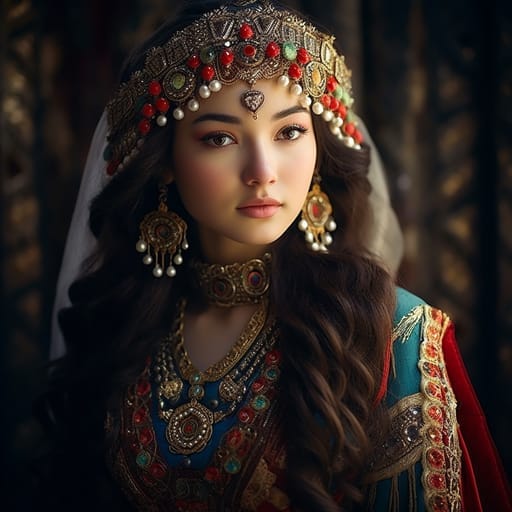
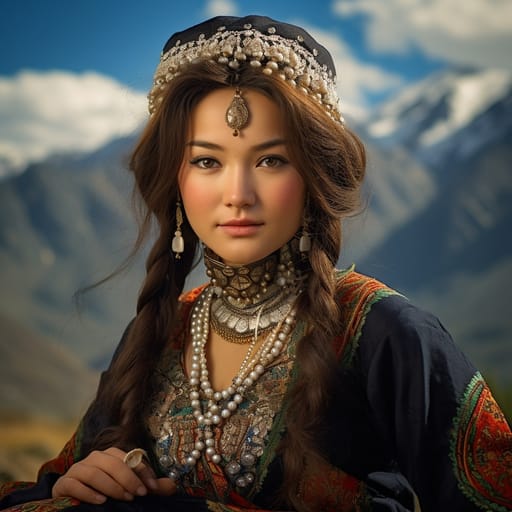
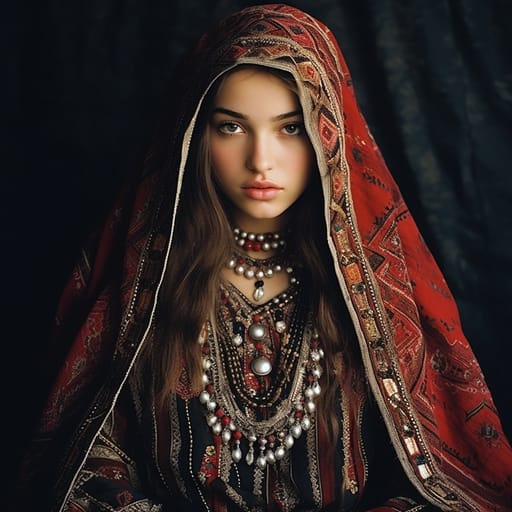
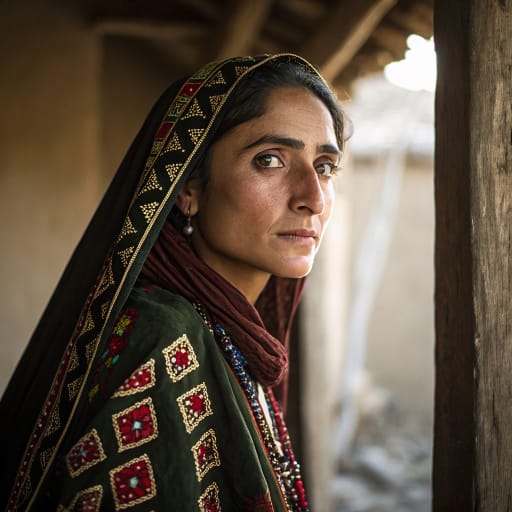
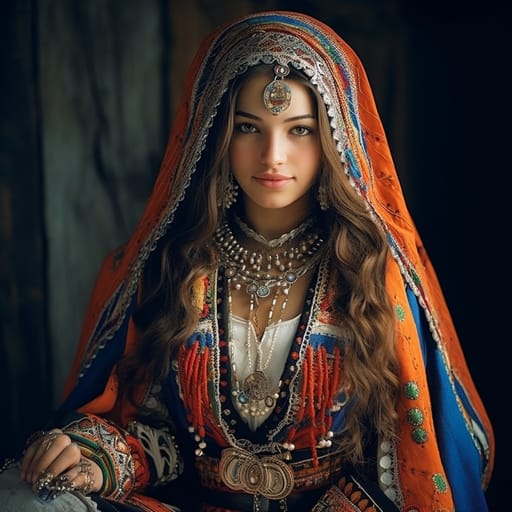
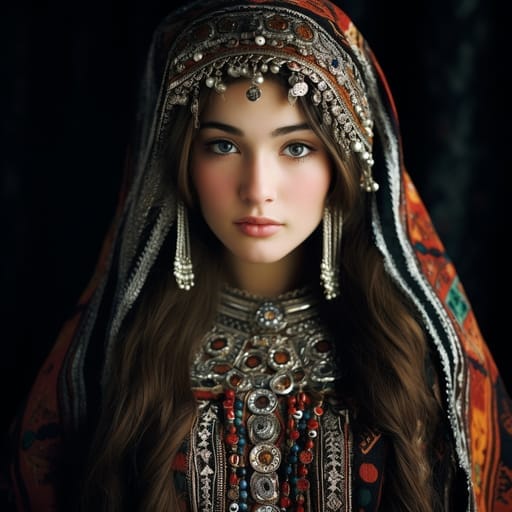
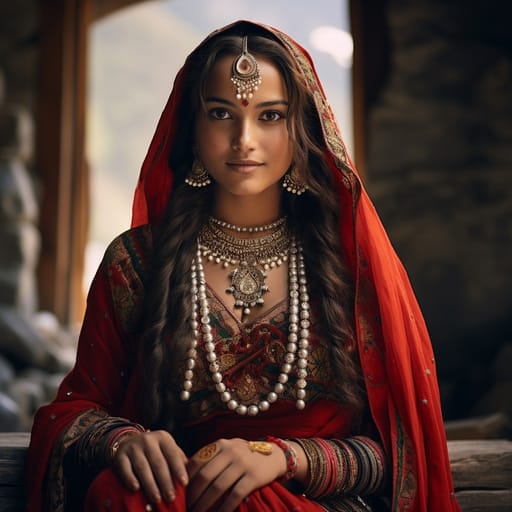
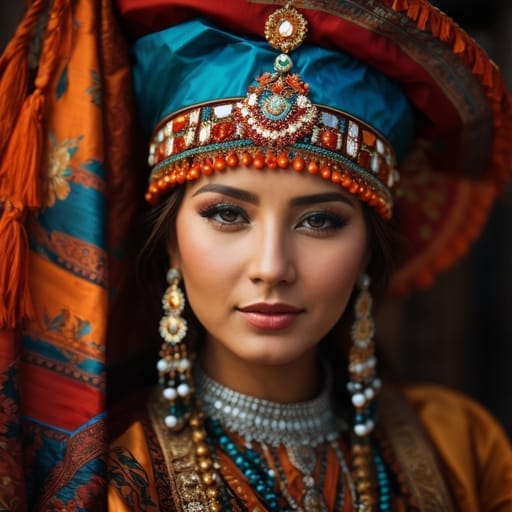
Typical Balkars Phenotypes
Reference for AI generation: hair, eyes, skin, facial structure, build
The Balkars are a small Turkic-speaking population of the central Caucasus, concentrated in the high valleys of the Cherek, Chegem, Baksan, and Malka rivers. Centuries of mountain isolation have produced a phenotype that reads as Caucasian highlander first and Turkic second — closer in appearance to neighboring Karachays, Ossetians, and Kabardians than to the Kipchak-Turkic groups of the steppe.
Hair is typically dark brown to black, often with a cool ash or near-black cast rather than the warm chestnut tones common further west in the Caucasus. Texture runs straight to loosely wavy; tight curl is rare. Beard growth in men tends to be heavy and uniform, with strong jaw and cheek coverage. Eye color is predominantly brown — mid to dark — with a meaningful minority of hazel, green, and grey-blue eyes inherited from the broader Caucasian gene pool; epicanthic folds are essentially absent despite the Turkic linguistic heritage.
Skin sits mostly in Fitzpatrick II–III, with neutral-to-olive undertones; high-altitude sun exposure produces a weathered, warm tan in working populations rather than a deep base pigmentation. Facial structure is the group's most distinctive register: a tall, often narrow nasal bridge with a straight or slightly convex profile, moderate alar width, defined supraorbital ridges, and a strong squared jaw. Lips are typically medium in fullness; cheekbones are present but less laterally projected than in steppe Turkic populations.
Build skews compact and powerfully constructed. Men tend toward 170–178 cm with broad shoulders, thick wrists, and dense musculature through the chest and posterior chain — a body composition reflected in the group's outsized presence in weightlifting, wrestling, and combat sports, with athletes like Khadzhimurat Akkaev exemplifying the type. Women trend slightly shorter than the regional Caucasian average, with hourglass proportions and a tendency toward fuller hips relative to a defined waist. Sub-regional variation across the five historical Balkar societies is minor and largely a matter of slightly lighter pigmentation in the higher Chegem and Bezengi valleys.
Data depth
47/100Coverage of image-grounded phenotype observations · drives AI generation diversity
- Sample size
- 12/40· 5 images
- Image quality
- 20/30· 40% high
- Confidence
- 15/20· mean 0.77
- Source diversity
- 0/10· wikipedia
- ·Small sample (n<10)
- ·Wikipedia-only source, not population-representative
Observed Distribution: Image Sample
Empirical observations from analyzed photographs · supplementary signal, not population truth
Sample: 5 images analyzed (5 wikipedia). Quality: 2 high, 3 medium, 0 low, 0 very_low. Avg analyzer confidence: 0.77.
Skin tone (Fitzpatrick): II (60%), III (40%)
Hair color: light/medium brown (40%), black (40%), dark brown (20%)
Hair texture: straight (60%), wavy (40%)
Eye color: dark brown (40%), brown (40%), unclear (20%)
Epicanthic fold: 0% present, 80% absent, 20% unclear
Caveats: Sample size 5 is small, so the observed distribution should be treated as suggestive, not definitive. Sample is 100% Wikipedia notable people, which skews toward male, public-life, and modern figures, not population-representative.
Last aggregated: May 7, 2026
Explore phenotype categories
Structured taxonomy with peer-reviewed scales · 22 anatomical categories
Notable Balkars People
8 reference figures, sourced from Wikipedia
- Khadzhimurat Akkaev, weightlifter
- Asker Dzhappuyev, jihadist leader
- Muslim Atayev, jihadist leader
- Alim Kouliev, actor, theatre director
- Alikhan Shavayev, football player
- Ismail Musukaev, wrestler
- Albert Tumenov, professional mixed martial artist
- Khyzyr Appayev, [citation needed] football player
Erotic Poses & Sex Positions
From the pose catalog: 219 named positions with reference skeletons
Frequently asked questions about Balkars people
Where is the Balkars homeland?
The Balkars homeland is Kabardino-Balkaria (Russia) in Southern Asia.
What language do Balkars people speak?
Balkars people primarily speak Turkic / Kipchak / Balkar.
What religion do Balkars people practice?
The predominant religion among Balkars people is Islam / Sunni Islam.






Make your own Balkars images
Five a day, free, no credits to buy. The studio starts from this group's phenotype data, so you can set body type, pose and style and keep the traits accurate.
Start with Balkars