Help us get this right
Does this portrait look right for Manjak?
One tap. It takes a second and it is recorded.
0 say it looks right, 1 says it looks off.
Manjak Erotic
Traditional African religions
About Manjak People
The Manjak are a rice-farming people whose homeland straddles the lower Casamance in southern Senegal and the northern coastal provinces of Guinea-Bissau, particularly Cacheu. They are one of the smaller Atlantic-speaking peoples of the Upper Guinea coast, numbering perhaps a few hundred thousand, but their footprint is wider than that count suggests: Manjak labor migration to Dakar, to The Gambia, and onward to France — especially the Paris suburbs and the port cities of the south — has been steady for the better part of a century, and a Manjak diaspora abroad now sustains villages back home through remittances and seasonal returns.
Their language, also called Manjak (Mandyak, Manjaco), belongs to the Bak branch of the Atlantic family, alongside Mankanya and Pepel — neighbors close enough that a Manjak speaker can usually follow a Mankanya conversation with effort. It sits in a region thick with unrelated tongues: Mandinka to the east, Wolof to the north, Portuguese-based Kriol as the everyday lingua franca in Bissau. Most Manjak today move between three or four languages without thinking about it.
Religious life is where the group is most distinct from its Muslim and Christian neighbors. The majority still practice the inherited Manjak religion, organized around lineage shrines, ancestral spirits, and a tier of local deities tied to specific groves, water sources, and stretches of farmland. The most recognized institution is the pcaay — funerary masquerades, sometimes glossed as the "bull masks," which appear at the second burial ceremonies that mark a person's full passage to the ancestors. These are not performances for outsiders; they are work, and the obligation to return home for a parent's funeral is one of the strongest pulls on the diaspora. Catholicism, brought through the Portuguese, has made inroads in some villages, and Islam at the edges, but conversion has not displaced the older system so much as layered onto it.
Manjak society is matrilineal in inheritance and cosmology, though residence is patrilocal — a tension that gives the kinship system its particular shape, with a man's heirs being his sister's sons rather than his own. They are also famous within the region for weaving: narrow-strip cotton cloth in dense indigo and red geometric patterns, woven by men on horizontal looms, traded across West Africa and increasingly recognized as one of the distinctive textile traditions of the coast.
Related ethnic groups
Groups that share Manjak's homeland, region, language, or religious tradition. These are likely candidates for comparative phenotype reference.
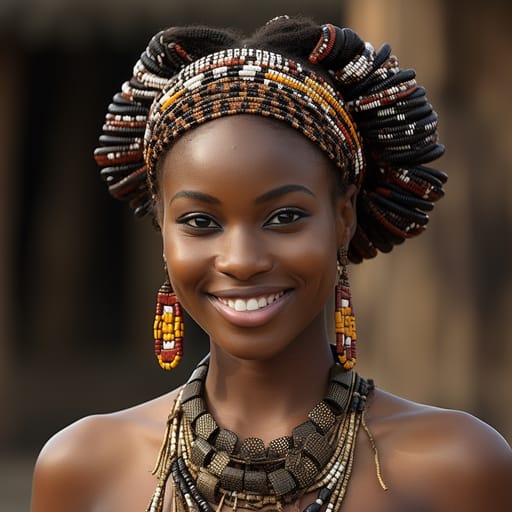
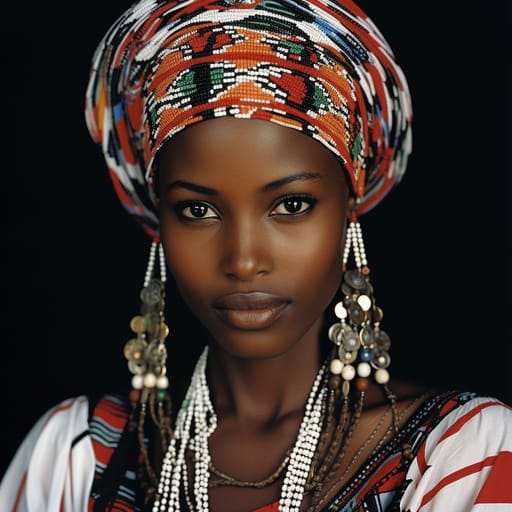
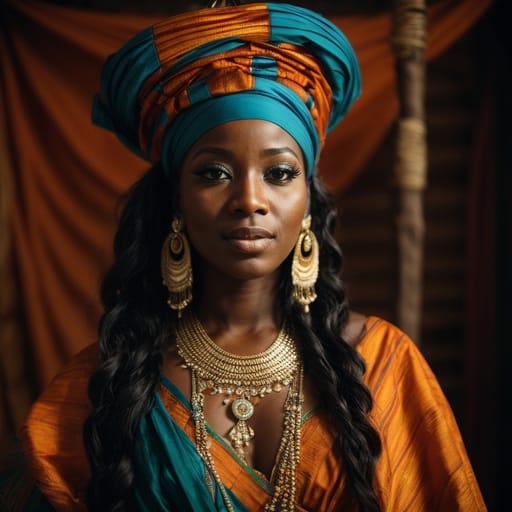
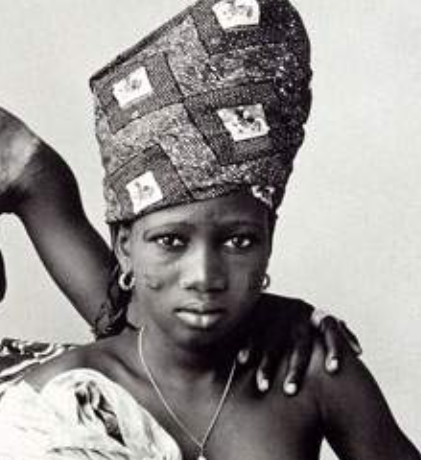
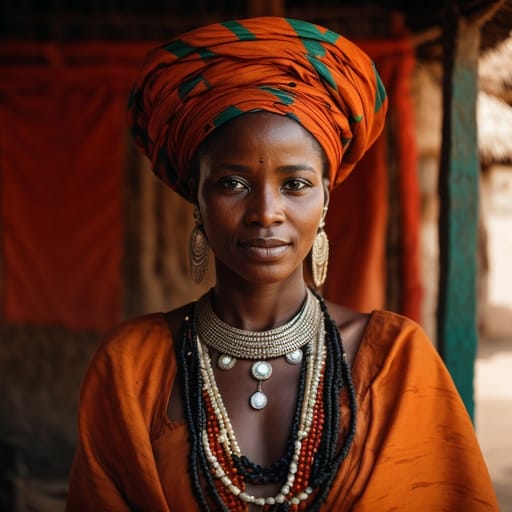
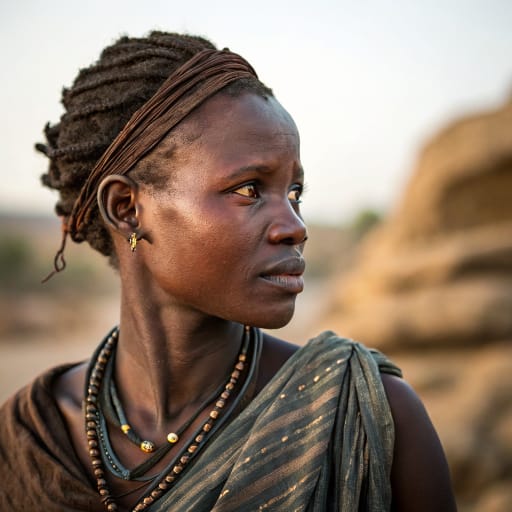
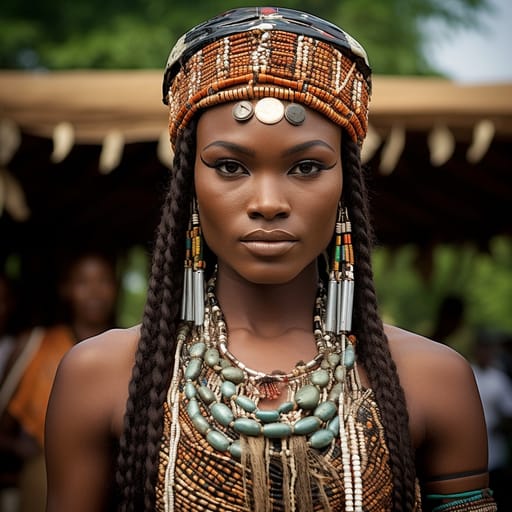
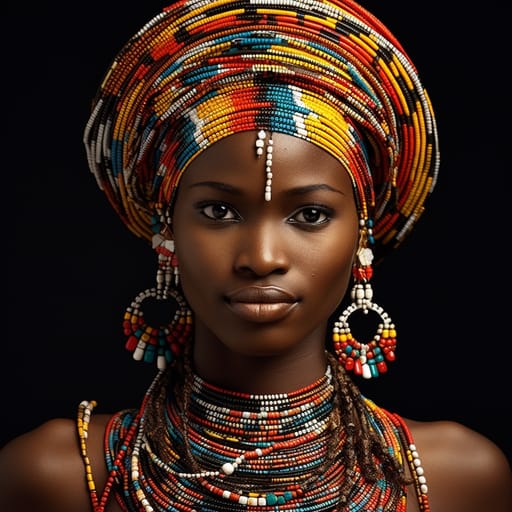
Typical Manjak Phenotypes
Reference for AI generation: hair, eyes, skin, facial structure, build
The Manjak phenotype sits firmly within the dark-skinned West African coastal cluster of the Senegambian belt, with skin tones running from deep umber to true blue-black — Fitzpatrick VI dominates, with smaller numbers of Fitzpatrick V in mixed-heritage individuals from the Bissau and Casamance river deltas. Undertones lean cool and neutral rather than the warmer red-brown registers seen further inland. Scalp hair is almost uniformly Type 4 — tight coils ranging from springy 4A through dense 4C — and naturally jet black, with greying that arrives late and tends to come in patchy rather than even.
Eyes are predominantly dark brown to near-black, set under a low, gently sloped brow without an epicanthic fold; the eye opening is typically wide and almond-shaped, and sclera contrast against the surrounding skin is high. Noses run broad at the alar base with low-to-medium bridges — narrower nasal forms turn up but are not the norm — and lips are full on both upper and lower, with a clearly defined vermillion border. Jaws are square and well-defined, and cheekbones sit prominently but not high; the overall face is balanced and somewhat heart-shaped rather than long.
Build is where the Manjak read becomes most distinctive. The community produces a strikingly high concentration of elite athletes — the Mendy and Gomis surnames recur through European football and track for a reason — and the typical adult male phenotype trends tall (often 180–190 cm), long-limbed, with naturally low body fat and dense, ropey musculature rather than bulk. Women are similarly tall by West African averages, with narrow waists, long legs, and gluteal development that is full but not exaggerated. Shoulders are broad relative to hips in both sexes.
Sub-regional variation is modest: coastal Bissau-Guinean Manjak skew slightly darker and rounder-featured, while Senegalese Casamance Manjak show occasional Wolof and Diola admixture — slightly lighter skin, finer noses, and a marginally less dense hair pattern.
Manjak Body & Anatomy Reference
Per-feature anatomical profile for AI nude generation: West African Niger-Congo phenotype
Manjak Boobs & Breasts
Manjak tits and boobs run medium-to-large cup, full, projecting, the classic West African Niger-Congo bust profile. Manjak nipples and areolas show deep-brown to near-black areolar pigmentation against the medium-to-deep-brown skin tone, with areolar diameter typically in the 35-50mm range and forward-set positioning rather than the smaller conical Cushitic East African profile. Manjak breasts trend fuller and more projecting than the East African norm, a function of the mesomorph with strong gluteal-femoral fat distribution body habitus and the mean adult female BMI 24-27. For anatomically accurate AI-generated Manjak nudes the render preserves the medium-to-large cup, full, projecting shape, 35-50mm areolas with deep-brown to near-black pigmentation, and the torso proportions of the West African Niger-Congo phenotype.
Manjak Ass & Hips
Manjak hips and butt usually read as wide-set, full, heavily projected glutes. The skeletal base is wide iliac crests, broad gynoid pelvic pattern, high glute-to-waist ratio, the West African Niger-Congo pattern. Set against the slim narrow-hip Cushitic East African profile, the difference is easy to see, and the hip-to-waist ratio is often what identifies Manjak women in photos.
Manjak Vagina & Pussy
Expect deep-brown to near-black labial pigmentation, fuller labia minora on Manjak women, in keeping with West African Niger-Congo ancestry. The pubic hair is tightly-coiled coarse texture, densely distributed. Coloring should run evenly from the medium-brown to deep-brown skin of the thighs to the labia, and Manjak nude imagery should keep the hair's tightly-coiled coarse texture.
Manjak Dicks & Penis
Manjak dick and penile anatomy in adult AI generation should anchor on the regional reference data: regional mean ~14-15cm erect, above-average girth, ~13cm circumference, and deep-brown-to-near-black shaft pigmentation. The Manjak cock profile reflects the West African Niger-Congo population's anthropometric measurements. The shaft pigmentation should track the surrounding medium-brown to deep-brown skin tone, and the pubic hair should keep its tightly-coiled coarse texture in the typical inverted-V escutcheon.
Manjak Body, Curves & Build
Manjak body type: mesomorph with strong gluteal-femoral fat distribution, with mean adult female BMI 24-27. This is the typical West African Niger-Congo build. Height range, shoulder-to-hip ratio and fat distribution all follow from it, which is what an accurate Manjak nude body should show.
Manjak Skin Tone & Hair Texture
Manjak skin tone falls in the medium-brown to deep-brown (Fitzpatrick V-VI) band, the surface signal most often miscalibrated by generic AI nude generators. Manjak hair texture is typically tight 4A-4C coil, often worn natural, braided, or relaxed, characteristic of the West African Niger-Congo phenotype. In Manjak nude renders the skin should hold that band consistently across the body.
Data depth
0/100Coverage of image-grounded phenotype observations · drives AI generation diversity
- Sample size
- 0/40· 0 images
- Image quality
- 0/30· 0% high
- Confidence
- 0/20
- Source diversity
- 0/10
- ·No image observations yet
Explore phenotype categories
Structured taxonomy with peer-reviewed scales · 22 anatomical categories
Notable Manjak People
19 reference figures, sourced from Wikipedia
- Ansu Fati, Spanish footballer
- Ansumane Faty, Bissau-Guinean footballer
- António Baticã Ferreira, Bissau-Guinean poet
- Alfred Gomis, Senegalese footballer
- Bafétimbi Gomis, French footballer
- Kafétien Gomis, French long jumper
- Alexandre Mendy, Bissau-Guinean footballer
- Arnaud Mendy, Bissau-Guinean footballer
- Benjamin Mendy, French footballer
- Bernard Mendy, French footballer
- Edouard Mendy, Senegalese footballer
- Emmanuel Mendy, Bissau-Guinean footballer
- Ferland Mendy, French footballer
- Frédéric Mendy, Bissau-Guinean footballer
- Jacob Mendy, Gambian footballer
- Nampalys Mendy, Senegalese footballer
- Carlos Mendes Gomes, Spanish footballer
- Américo Gomes, Guinean singer
- DIP Doundou Guiss, born Dominique Preira, Senegalese rapper ()
Erotic Poses & Sex Positions
From the pose catalog: 219 named positions with reference skeletons
Frequently asked questions about Manjak people
Where is the Manjak homeland?
The Manjak homeland is Guinea-Bissau, Senegal in Western Africa.
What language do Manjak people speak?
Manjak people primarily speak Niger-Congo / Atlantic / Senegambian / Manjak.
What religion do Manjak people practice?
The predominant religion among Manjak people is Traditional African religions.






Make your own Manjak images
Five a day, free, no credits to buy. The studio starts from this group's phenotype data, so you can set body type, pose and style and keep the traits accurate.
Start with Manjak