Cowgirl (woman on top)
M/F · Vaginal penetration · Receiving partner on top
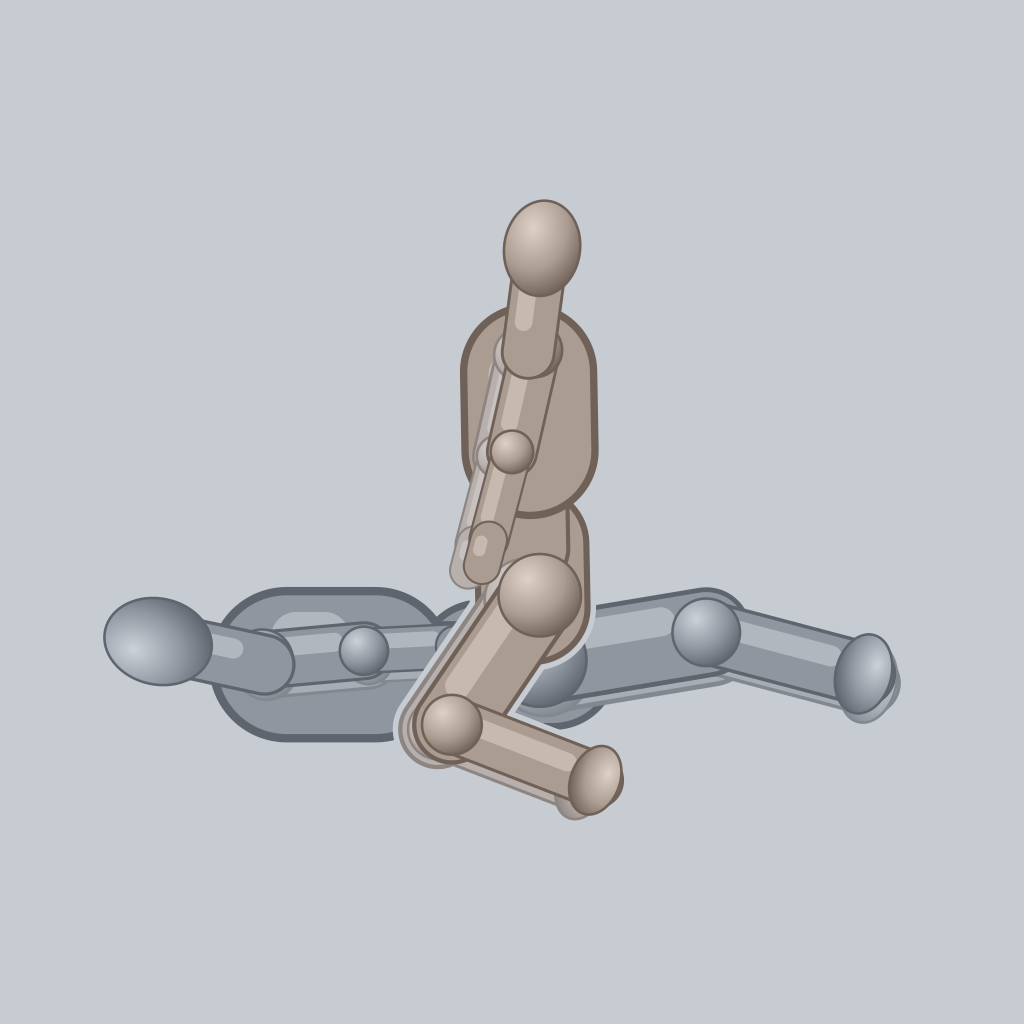
Posed figure
Help us fix this
Does this figure match the position?
One tap. Flagged drawings get fixed.
4 say it looks right, 4 say it looks off.
Something wrong with the write-up?
Keypoint template
Attributes
- Position family
- One-on-one
- Primary act
- Vaginal penetration
- Partner arrangement
- Receiving partner on top
- Penetration type
- Vaginal
- Facing
- Face to face
- Dynamics
- Riding
- Support / surface
- Flat surface / bed
- Participant count
- Two
- Composition code
- M/F
- Source medium
- Both
- Physical difficulty
- Low
- Prevalence in adult media
- Very common
- Intensity tier (compliance)
- Explicit
Common camera framing
Description: The penetrating partner lies supine; the receiving partner sits astride facing them and controls the motion. The defining member of the receiving-partner-on-top family.
Variations: Leaning forward onto the hands (prone-cowgirl), leaning back, squatting on the feet rather than kneeling, and the reverse-facing variant (reverse cowgirl).
On camera: Favoured for penetrating-partner POV and low-angle framing; the upright receiving partner is fully presented to camera.
AI design considerations: An upright astride figure over a supine figure; the two pelvises must register while the upper bodies separate vertically.
Historical provenance
Where this position appears in historical sex manuals, erotic art & literature · full timeline →
- Purushayita; Bhramara (the bee)Indian (Gupta era) →
Kama Sutra · Vatsyayana · c. 3rd century CE
Role-reversal congress; the bee names the spinning ride.
- Fluttering ButterfliesChinese (Tang dynasty) →
Dongxuanzi (Master of the Cavern Mystery) · attributed to Li Dongxuan · c. 7th century CE
- The horse of HectorRoman →
Ars Amatoria · Ovid · 2 CE
Ovid's advice to ride astride as Andromache did.
- Keles (the racehorse)Greek (Archaic–Classical) →
Greek symposium pottery · Attic and Corinthian vase painters · 6th–4th century BCE
The comedians' premium ride, pictured on symposium cups.
- Mulier equitansRoman →
Pompeian erotic frescoes · Campanian wall painters · 1st century CE
The woman-riding motif that dominates Roman erotic wall painting.
- The astride postureItalian (Renaissance) →
I Modi (The Sixteen Postures) · Giulio Romano, engraved by Raimondi; sonnets by Pietro Aretino · 1524–1527 CE
Recurs across the surviving fragments and copies of the sixteen.
Depicted in the historical record
Museum-attested works showing this arrangement · full timeline →
- Erotic fresco cycle, Suburban Baths apodyteriumPompeii, Herculaneum & the Silver-and-Ceramic Repertoire →
c. 62–79 CE, discovered 1986 · Pompeii, in situ
- Lupanar wall paintingsPompeii, Herculaneum & the Silver-and-Ceramic Repertoire →
Before 79 CE (one dating: 72 CE, via a coin impression) · Pompeii, in situ brothel
- Erotic fresco, House of the Centenary, Room 43Pompeii, Herculaneum & the Silver-and-Ceramic Repertoire →
1st c. CE · Pompeii, likely still in situ
- I Modi ("The Ways"/"The Positions"), original engravingsI Modi & Renaissance Erotic Engraving, 1524–1600 →
1524, destroyed; 2nd ed. with Aretino's sonnets, 1527, destroyed · Fragments at the British Museum, Albertina Vienna, Biblioteca Nacional de España
- "Woman Sitting on a Man to Engage in Coitus," anonymous19th–20th Century Erotic Art & Early Erotic Photography →
1895–98 · Kinsey Institute, Bloomington
Generating this position
A starting prompt composed from the catalog vocabulary. Every tag is verified to exist and not be deprecated. Compose across wardrobe, scene and expression in the prompt builder.
Booru-tag checkpoints
1boy, 1girl, hetero, cowgirl_position, girl_on_top, on_back, vaginal, on_bed
negative: bad_anatomy, bad_hands, censored, monochrome, 2girls, 3girls, 2boys, 3boys
Image to video (Ride (bounce))
upper figure rises and drops vertically, thighs driving, torso upright, camera is locked on a tripod and does not move.
Motion only. The still you condition on must already carry the position, wardrobe and scene: restating them causes drift.
Identifiers in other vocabularies
How this position is denoted elsewhere, and what each mapping discards. Full table in the crosswalk.
- Q875006exact
cowgirl_position denotes the whole facing-forward rider family: the wiki fixes only that the penetrating partner is lying down and the receiver straddles them face-on, saying nothing about the rider's torso angle. It therefore does not separate this upright kneeling-astride default from the catalog's own prone-cowgirl, cowgirl-leaning-forward and leaning-back-cowgirl entries, all of which fall inside it. Torso angle is the discarded feature and the permitted vocabulary cannot restore it: upright_straddle is the only candidate and its wiki requires the straddled person to be "sitting upright", not lying down, so no pool tag pins an upright rider over a supine partner. Containment is also imperfect in the other direction: riding while squatting on planted feet is routed out of the tag to squatting_cowgirl_position, so that listed variation of the entry sits outside the tag rather than beneath it.
Purushayita; Bhramara (the bee)closeKama SutraAttested source name. Role-reversal congress; the bee names the spinning ride.
Fluttering ButterfliescloseDongxuanzi (Master of the Cavern Mystery)Attested historical name for this position in the named source; the source wording may describe a variant of the general form.
The horse of HectorcloseArs AmatoriaAttested source name. Ovid's advice to ride astride as Andromache did.
Keles (the racehorse)closeGreek symposium potteryAttested source name. The comedians' premium ride, pictured on symposium cups.
Mulier equitansclosePompeian erotic frescoesAttested source name. The woman-riding motif that dominates Roman erotic wall painting.
The astride posturecloseI Modi (The Sixteen Postures)Attested source name. Recurs across the surviving fragments and copies of the sixteen.
Actions this position admits
The position fixes who is where. These are the beats that are physically possible in it, from the action catalog. Contact through the characteristic beat is intermittent.
Camera moves that suit the geometry: POV (head-mounted), Push in, Arc (partial), Crane up.
Related positions
Part of the Erotic Pose Catalog open dataset · CC BY 4.0 · keypoints are idealised COCO-17 templates.