Help us get this right
Does this portrait look right for Mandinka?
Nobody has judged this one yet. You would be the first.
Mandinka Erotic
Islam
Bolon
About Mandinka People
The Mandinka trace their identity to the Mali Empire, the medieval West African state that grew from a small Manding chiefdom on the upper Niger into one of the largest polities of its time. That ancestry is not abstract for modern Mandinka — the praise songs, lineage names, and the conventions of who can speak in council still carry the imprint of empire. They are spread today across Mali, Guinea, Senegal, and The Gambia, with smaller clusters in Guinea-Bissau and Sierra Leone, and despite this dispersal across colonial-drawn borders they remain mutually intelligible, mutually recognizable, and connected by a dense web of kinship and trade.
Their language belongs to the Manding cluster within the Mande branch of Niger–Congo, close enough to Bambara and Dyula that a speaker of one can usually follow the others after a few minutes of adjustment. Mande languages are tonal but the tones do less semantic work than in many West African systems, and the literary tradition is overwhelmingly oral. That oral inheritance is held by the jeli — often translated as griot, though the word flattens what is really a hereditary professional class of historians, genealogists, musicians, and political mediators. A jeli's authority over the past is taken seriously; the recitation of the Sunjata epic, the founding story of the empire, is a genre in itself, performed differently in different villages but recognized everywhere.
Mandinka society is patrilineal and organized through named lineages — Keita, Traoré, Camara, Konaté, Diabaté and others — each carrying associations with old occupational categories: rulers, warriors, blacksmiths, leatherworkers, jeliw. Joking relationships, the sanankuya, run between certain lineage pairs and license a kind of ritualized teasing that is genuinely defusing in conflict. Islam arrived gradually from the eleventh century onward through Saharan trade routes and was embraced more deeply after the jihads of the nineteenth century; today nearly all Mandinka are Muslim, though older practices around masking, initiation, and the spiritual authority of certain forests sit alongside the mosque rather than being displaced by it. The Bolon, sometimes counted as a Mandinka sub-group and sometimes as a related Mande-speaking people of southwestern Mali, illustrate how porous these categories can be at the edges. Rural life is built around millet, sorghum, rice along the river valleys, and groundnut as the cash crop the colonial economy fixed in place — a fixture that has shaped Gambian and Senegalese economic life ever since.
Related ethnic groups
Groups that share Mandinka's homeland, region, language, or religious tradition. These are likely candidates for comparative phenotype reference.
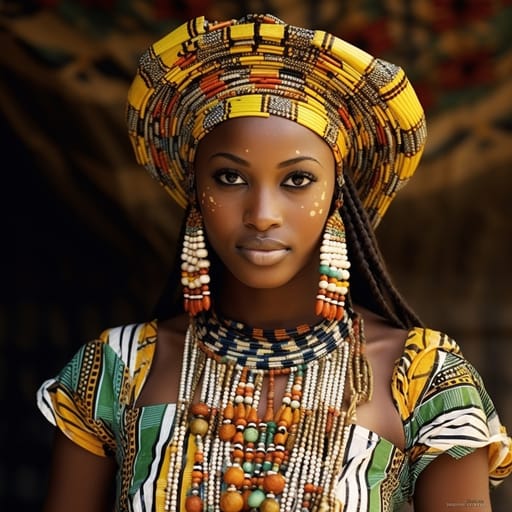
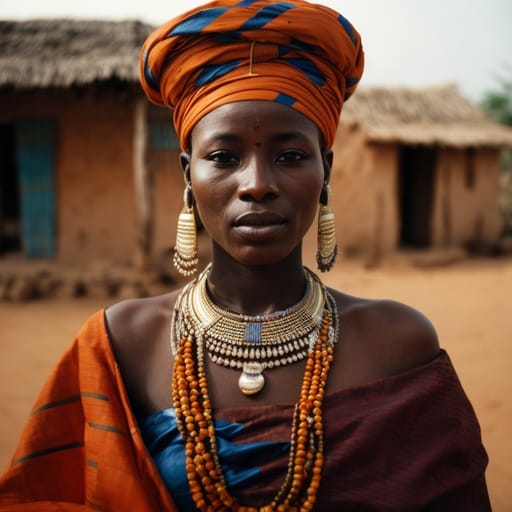
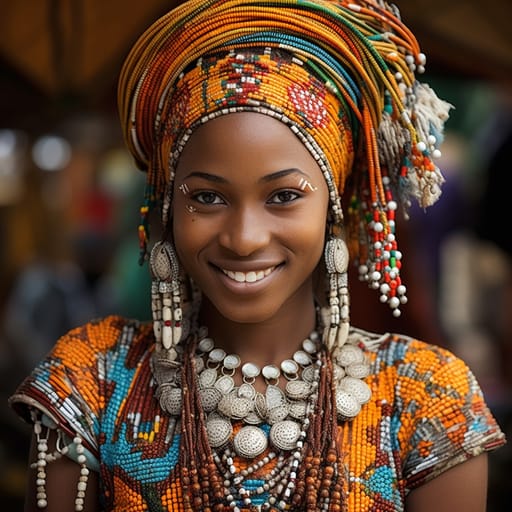
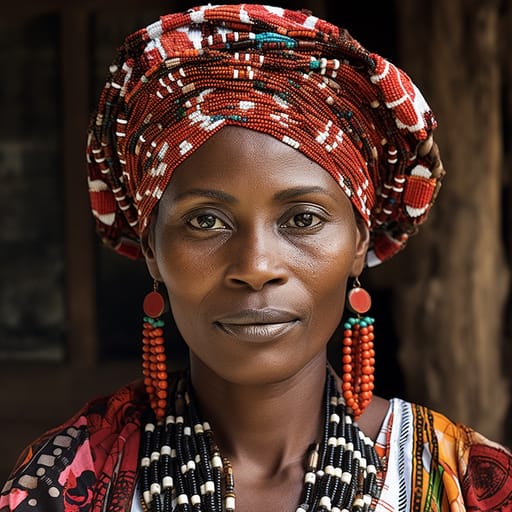
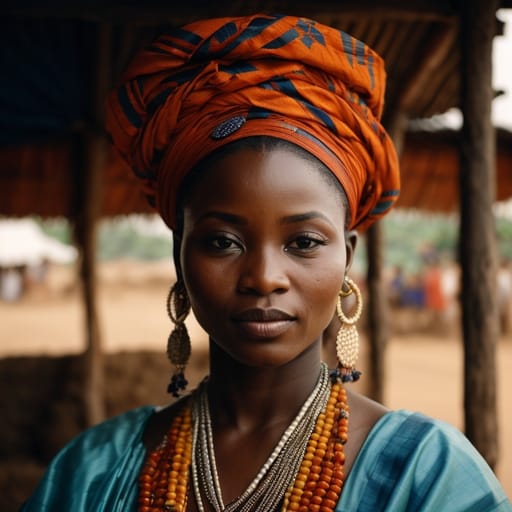
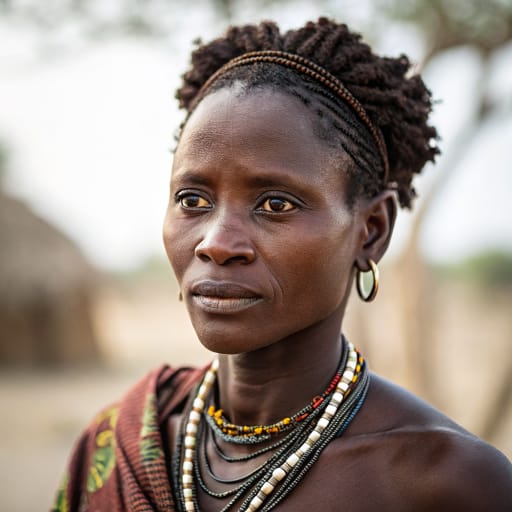
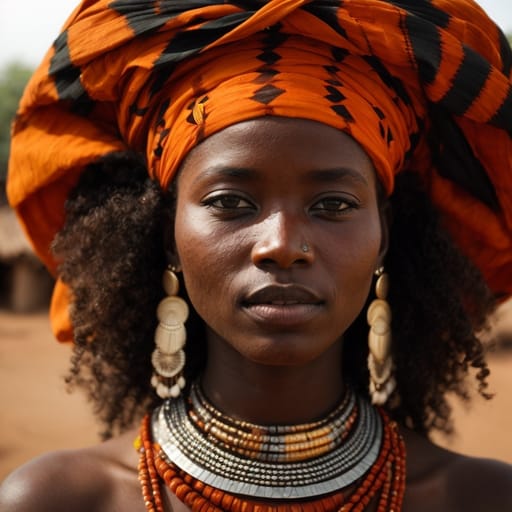
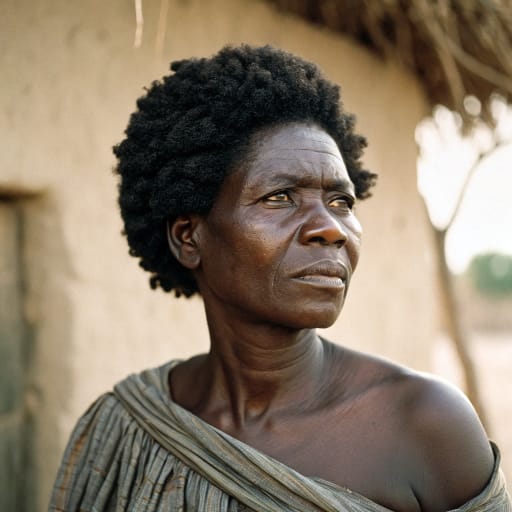
Typical Mandinka Phenotypes
Reference for AI generation: hair, eyes, skin, facial structure, build
The Mandinka phenotype reflects their core West African Mande origins — descendants of the Mali Empire spread across the savanna belt from the upper Niger to the Atlantic. Skin tone runs deep, almost uniformly within Fitzpatrick V–VI, with rich dark-brown to near-black tones and warm undertones that read coppery in strong sun. There is less of the reddish-brown range common to coastal Akan or Yoruba populations; Mandinka skin tends toward cooler, deeper register, sometimes with a slightly ashier matte quality.
Hair is Type 4 throughout — tightly coiled, dense, with high shrinkage. Natural color is uniformly black-brown; reddish or auburn casts are rare and usually nutritional rather than genetic. Traditional grooming favors close cuts on men and braided or wrapped styles on women, which has shaped how the hairline reads on most adults.
Eyes are dark brown to black, no epicanthic fold, with relatively wide-set placement and full upper lids. The brow ridge is moderate — less pronounced than in Nilotic populations, more defined than in coastal Wolof neighbors. Facial structure is the most distinctive marker: a broad mid-face with strong, rounded cheekbones, a wide nasal base with low-to-moderate bridge height, and notably full lips with a clear vermilion border. The jaw tends toward squared and substantial rather than tapered.
Build is where Mandinka show real anthropometric distinctiveness — they are among the taller West African groups, with average male stature around 175–180 cm and famously long limbs relative to torso. Body composition runs lean-muscular with narrow hips and broad shoulders on men; women carry a more pronounced hourglass with fuller gluteofemoral fat distribution typical of the region. The combined long-limbed leanness and broad cheekbone-to-jaw architecture is what makes the Mandinka look identifiable across the diaspora, visible in figures from Adama Barrow to Cheick Kongo.
The Bolon sub-group, concentrated in eastern Guinea and southern Mali, shows no consistent visible divergence — minor variation in stature and slightly broader noses, but within the same overall phenotype envelope.
Mandinka Body & Anatomy Reference
Anatomy by feature, West African Niger-Congo phenotype
Mandinka Boobs & Breasts
The typical Mandinka bust is medium-to-large cup, full, projecting, in line with the wider West African Niger-Congo pattern. Areolas usually fall in the 35-50mm range, with deep-brown to near-black areolar pigmentation against the medium-to-deep-brown skin tone. Compared with the smaller conical Cushitic East African profile, Mandinka breasts sit forward and are generally fuller and more projecting than the East African norm. A faithful AI render of Mandinka tits keeps that shape and areola size.
Mandinka Ass & Hips
Butt shape among Mandinka women: wide-set, full, heavily projected glutes, over wide iliac crests, broad gynoid pelvic pattern, high glute-to-waist ratio. This follows West African Niger-Congo ancestry and looks quite unlike the slim narrow-hip Cushitic East African profile. An accurate Mandinka ass in adult AI imagery keeps both the silhouette and the overall build (mesomorph with strong gluteal-femoral fat distribution) instead of a generic average.
Mandinka Vagina & Pussy
Vulvar anatomy among Mandinka women: deep-brown to near-black labial pigmentation, fuller labia minora. Pubic hair tends to be tightly-coiled coarse texture, densely distributed, in the usual inverted-triangle pattern. Both follow West African Niger-Congo pigmentation, which is why Mandinka pussy renders should not fall back on a pale, sparse Western template.
Mandinka Dicks & Penis
The Mandinka cock profile, from West African Niger-Congo anthropometric data: regional mean ~14-15cm erect; above-average girth, ~13cm circumference; deep-brown-to-near-black shaft pigmentation. Pubic hair has a tightly-coiled coarse texture and forms the usual inverted-V pattern. Whether Mandinka men are circumcised follows religious and cultural practice rather than phenotype.
Mandinka Body, Curves & Build
Build and curves among Mandinka women follow the West African Niger-Congo pattern: mesomorph with strong gluteal-femoral fat distribution, mean adult female BMI 24-27. Proportions matter as much as skin tone, so Mandinka figures should keep their regional height and limb ratios.
Mandinka Skin Tone & Hair Texture
The Mandinka skin range is medium-brown to deep-brown (Fitzpatrick V-VI), and hair tends to be tight 4A-4C coil, often worn natural, braided, or relaxed. That combination marks the West African Niger-Congo phenotype, and skin tone is the trait AI generators most often get wrong for Mandinka women.
Data depth
79/100Coverage of image-grounded phenotype observations · drives AI generation diversity
- Sample size
- 40/40· 54 images
- Image quality
- 24/30· 48% high
- Confidence
- 15/20· mean 0.81
- Source diversity
- 0/10· wikipedia
- ·Wikipedia-only source, not population-representative
Observed Distribution: Image Sample
Empirical observations from analyzed photographs · supplementary signal, not population truth
Sample: 54 images analyzed (54 wikipedia). Quality: 26 high, 22 medium, 6 low, 0 very_low. Avg analyzer confidence: 0.81.
Skin tone (Fitzpatrick): II (2%), IV (2%), V (6%), VI (91%)
Hair color: black (59%), gray/white (35%), light/medium brown (2%), unclear (4%)
Hair texture: coily (70%), bald (4%), shaved (7%), covered (19%)
Eye color: dark brown (98%), unclear (2%)
Epicanthic fold: 0% present, 96% absent, 4% unclear
Caveats: Sample is 100% Wikipedia notable people, which skews toward male, public-life, and modern figures, not population-representative.
Last aggregated: May 7, 2026
Explore phenotype categories
Structured taxonomy with peer-reviewed scales · 22 anatomical categories
- SkinFitzpatrick I to VI, undertone, pigmentation
- EyesColor, shape, eyelid, epicanthic fold
- Head hairColor, Andre Walker texture, hairline
- Body shapeHeath-Carter somatotype, WHR, frame
- NoseBridge, tip, nostril, alar width
- Lips & mouthVolume, Cupid’s bow, philtrum
Measured in Mandinka portraits
Notable Mandinka People
100 reference figures, sourced from Wikipedia
- Mohamed Touré, Australian footballer
- Joffrey Bazié, Burkinabé footballer
- Amadou Coulibaly, Burkinabé footballer
- Joseph Ki-Zerbo, political leader and historian
- Bakary Koné, Burkinabé footballer
- Cheick Kongo, Burkinabé mixed martial artist
- Lassina Zerbo, scientist and former prime minister
- Adama Barrow, politician; third president of The Gambia since 2017[update][needs update]
- Jatto Ceesay, footballer
- Ousainou Darboe, Foreign Minister of The Gambia
- Sheriff Mustapha Dibba, veteran politician and the First vice President of The Gambia
- Abdoulie Janneh, former UN under-secretary general
- Sidia Jatta, opposition politician
- Alhajj Sir Dawda Kairaba Jawara, first president of The Gambia
- Sona Jobarteh, first female kora artist (musician)
- Jaliba Kuyateh, kora artist and celebrated musician in the Mandinka language
- Foday Musa Suso, international musician.
- Sekouba Bambino, Guinean musician
- Alpha Condé, former Guinean President
- Mamady Condé, Guinean foreign minister from 2004 to 2007
- Sékou Condé, Guinean footballer
- Sona Tata Condé, Guinean musician
- Vincent Coulibaly, Guinean archbishop of Conakry
- Djeli Moussa Diawara, Guinean musician (also known as Jali Musa Jawara - 32-stringed Kora player)
- Kaba Diawara, Guinean footballer
- Mamady Doumbouya, Guinean military officer
- Daouda Jabi, Guinean footballer
- Mamadi Kaba, Guinean footballer
- Sory Kaba, Guinean footballer
- Mory Kanté, Guinean kora musician
- Alhassane Keita, Guinean footballer
- Mamady Keïta, Guinean musician
- Naby Keita, Guinean footballer
- Kabiné Komara, former prime minister of Guinea
- Famoudou Konaté, Guinean musician
- General Sékouba Konaté, former Head of State of Guinea
- Lansana Kouyaté, former prime minister of Guinea
- N'Faly Kouyate, Guinean musician
- Fodé Mansaré, Guinean footballer
- Petit Sory, Guinean footballer
- Sekou Touré, President of Guinea from 1958 to 1984; grandson of Samory Touré
- Diarra Traoré, former prime minister of Guinea
- Samori Ture, founder of the Wassoulou Empire, an Islamic military state that resisted Fren…
- Yalany Baio, Bissau-Guinean footballer
- Mimito Biai, Bissau-Guinean footballer
- Sana Canté, Bissau-Guinean activist
- Rui Dabó, Bissau-Guinean footballer
- Tomás Dabó, Bissau-Guinean footballer
- João Jaquité, Bissau-Guinean footballer
- Madi Queta, Bissau-Guinean footballer
- Neemias Queta, Bissau-Guinean basketball player
- Panutche Camará, Bissau-Guinean footballer
- Sidiki Bakaba, Ivorian actor and filmmaker
- Jonathan Bamba, footballer
- Alpha Blondy, Ivorian (reggae) musician
- Ibrahim Cissé, Ivorian footballer
- Sekou Cissé, Ivorian footballer
- Fousseny Coulibaly, footballer
- Kafoumba Coulibaly, footballer
- Siriki Dembélé, Ivorian footballer
- Henriette Diabaté, former Ivorian politician
- Sinaly Diomande, footballer
- Emmanuel Eboué, footballer
- Tiken Jah Fakoly, Ivorian (reggae) musician
- Hassane Kamara, Ivorian Footballer
- Abdul Kader Keïta, Ivorian footballer
- Karim Konaté, footballer
- Arouna Koné, Ivorian footballer
- Bakari Koné, Ivorian footballer
- Tiassé Koné, Ivorian footballer
- Ahmadou Kourouma, Ivorian writer
- Alassane Ouattara, Côte d'Ivoire president since 2010[update][needs update]; Prime Minister of C…
- Guillaume Soro, Ivorian politician
- Kolo Touré, Ivorian footballer
- Sékou Touré, Ivorian politician, environmental engineer, former UN Executive
- Yaya Touré, Ivorian footballer
- Marco Zoro, footballer
- Momolu Dukuly, former Liberian foreign minister
- Amara Mohamed Konneh, Minister of Finance
- G. V. Kromah, member of the defunct Liberian Council of State
- Soumaila Coulibaly, Malian footballer
- Bako Dagnon, Malian female griot singer
- Cheick Diabaté, Malian footballer
- Massa Makan Diabaté, Malian historian, writer and playwright
- Mamadou Diabate, Malian musician
- Toumani Diabaté, Malian musician
- Yoro Diakité, former Malian prime minister
- Fatoumata Diawara, Malian musician
- Fousseni Diawara, Malian footballer
- Daba Diawara, Malian politician
- Aoua Kéita, Malian politician and activist
- Ibrahim Boubacar Keïta, President of Mali, September 2013 to August 2020
- Modibo Keïta, President of Mali from 1960 to 1968
- Salif Keita, Malian musician
- Seydou Keita, Malian footballer
- Sundiata Keita, founder of the Mali Empire
- Amy Koita, Malian musician
- Moussa Kouyate, Malian musician
- Mansa Musa, c. 1280 to c. 1337), the ninth, especially renowned, Mansa (emperor) of the M…
- Oumou Sangaré, Malian musician
Erotic Poses & Sex Positions
From the pose catalog: 219 named positions with reference skeletons
Frequently asked questions about Mandinka people
Where is the Mandinka homeland?
The Mandinka homeland is Mali, The Gambia, Guinea, Senegal in Western Africa.
What language do Mandinka people speak?
Mandinka people primarily speak Niger-Congo / Mande / Manding.
What religion do Mandinka people practice?
The predominant religion among Mandinka people is Islam.






Make your own Mandinka images
Five a day, free, no credits to buy. The studio starts from this group's phenotype data, so you can set body type, pose and style and keep the traits accurate.
Start with Mandinka