Help us get this right
Does this portrait look right for Mossi?
Nobody has judged this one yet. You would be the first.
Mossi Erotic
Mossiland (Burkina Faso)
Islam
About Mossi People
The Mossi built and kept something rare in West Africa: a set of centralized kingdoms that survived nearly a thousand years and never fell to the great Islamic empires that surrounded them. From roughly the 11th century onward, the Mossi states — Ouagadougou, Yatenga, Tenkodogo, and Fada N'Gourma chief among them — held the upper Volta basin against Mali to the west, Songhai to the north, and the Hausa city-states to the east. They raided Timbuktu more than once. They refused, for centuries, to convert. That refusal is the through-line of Mossi identity, and it shapes the present in ways a religion-line on a metadata page can flatten.
Today most Mossi are Muslim, but the conversion is recent — largely 20th-century — and it sits on top of an older religious architecture rather than replacing it. The traditional system centers on the Mogho Naba, the paramount ruler in Ouagadougou, whose authority is sacral as much as political. The Friday-morning Nabayius Gou ceremony at his palace, in which the Mogho Naba ritually decides not to ride out to war, has been performed for centuries and is still performed now, in the capital of a modern republic. Ancestor veneration, earth-priests (tengsoba) tied to specific patches of land, and a careful distinction between political chiefs (nakomse, descendants of the conquering horsemen) and the older farming peoples they ruled (tengbiise) all persist underneath the mosque attendance.
The language, Mooré, belongs to the Gur branch of Niger–Congo and is spoken by something like seven or eight million people, which makes it one of the dominant languages of the Sahel even though it is rarely taught outside the region. It is tonal, written in a Latin-based orthography for the schools and in Ajami in older Muslim scholarly contexts. Mossi society is patrilineal and historically organized around horse-borne nobility, a fact still legible in the iconography and the prestige of cavalry imagery — the Mogho Naba's court symbols include the horse and the calabash.
Mossiland sits on the savanna plateau of central Burkina Faso, dry and increasingly pressed by the Sahel's southward creep. Subsistence is millet, sorghum, and groundnuts, with seasonal labor migration south to the Ivorian coast a long-established part of the household economy. Burkinabè national identity leans heavily on Mossi cultural forms, but the Mossi are emphatic that the two are not the same thing.
Related ethnic groups
Groups that share Mossi's homeland, region, language, or religious tradition. These are likely candidates for comparative phenotype reference.
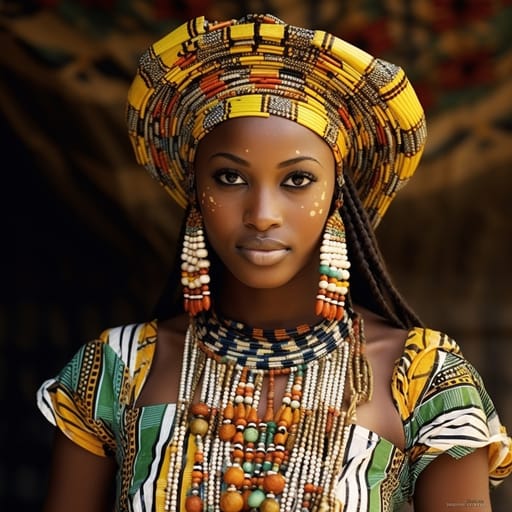
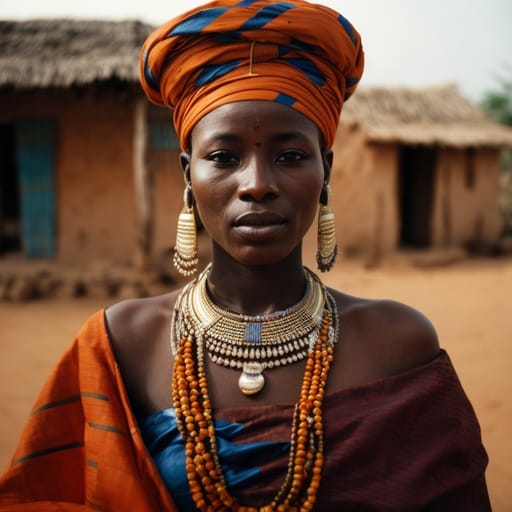
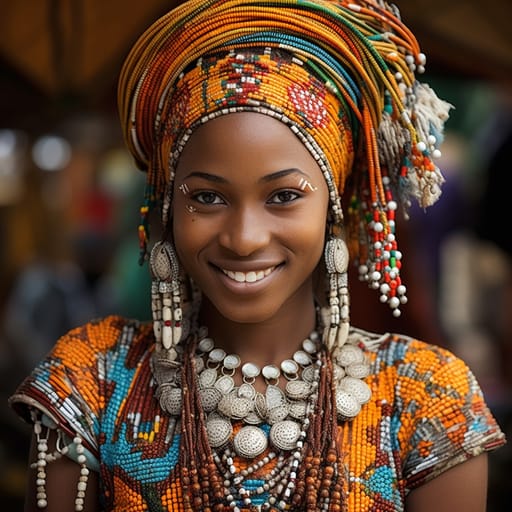
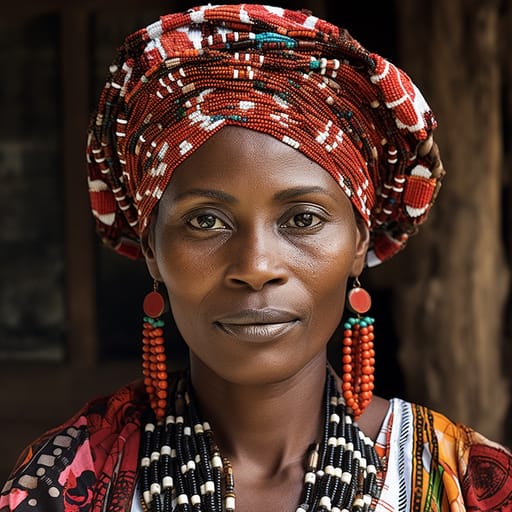
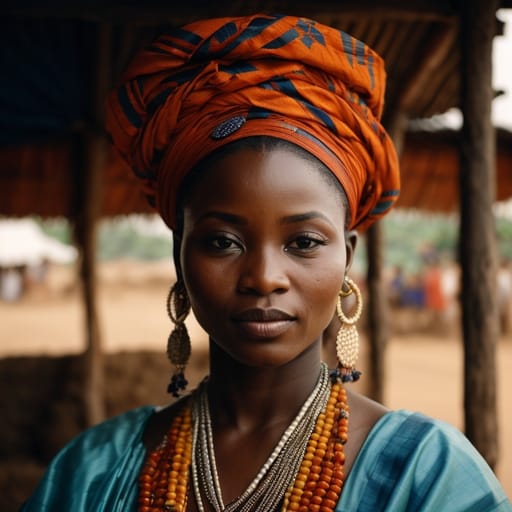
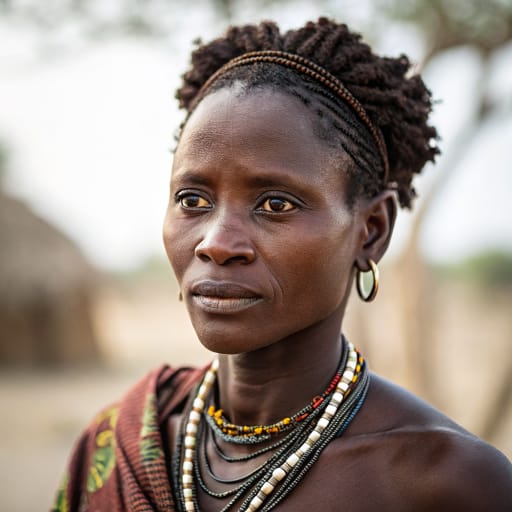
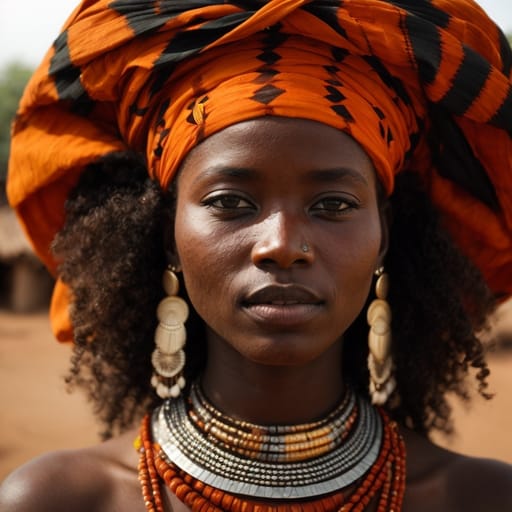
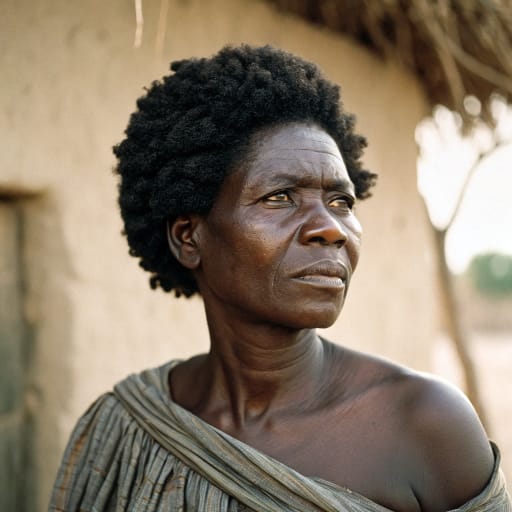
Geographic Distribution: Mossi populations across 1 country
Each row is ranked by the group's share of that country's population, with the source citation drawn from published census and demographic surveys. Click through for the full per-country phenotype profile.
| Country | Share | Source |
|---|---|---|
| Burkina Faso | 52.0% | INSD Burkina Faso 2019 Census; Mossi (~52%, ~11M+ of ~21M+ total). Niger-Congo / Voltaic / Mooré language. Concentrated in central Burkina Faso plus Ouagadougou. Founders of the historic Mossi kingdoms (~12th-19th c. CE) |
Typical Mossi Phenotypes
Reference for AI generation: hair, eyes, skin, facial structure, build
The Mossi present one of West Africa's more uniform phenotypes, a consequence of long settlement on the Burkinabé plateau with limited inflow from neighboring Sahelian or forest populations. Skin tone clusters tightly in the Fitzpatrick V–VI range, running from a deep cool brown through near-black with cool, slightly blue-undertoned darkness rather than the warmer red-brown register seen in some Akan or Yoruba populations to the south. Sun exposure on the open savanna plateau reinforces this depth; lighter complexions are uncommon and usually trace to mixed parentage.
Hair is uniformly Type 4 — tightly coiled, fine to medium in strand diameter, with the dense Z-pattern coiling typical of Sudanic populations. Natural color is black through black-brown; reddish sun-bleaching at the tips is common in rural contexts. Eyes are dark brown to near-black, almond-shaped to slightly rounded, set under a moderate brow ridge. Epicanthic folds are absent. Sclerae often carry a faint warm tint against the surrounding skin.
Facial structure is the most distinctive register. Mossi faces tend toward a broad mid-face with high, forward-set cheekbones and a relatively short, wide nose — the alar base is broad and the bridge low to medium, without the high narrow bridge of Fulani or Tuareg neighbors. Lips are full, with a well-defined vermilion border; the lower lip is typically the fuller of the two. The jawline is square to slightly tapered, and the chin sits modestly receded.
Build leans lean and long-limbed, with the elongated tibia-to-femur ratio characteristic of Sudanic-belt populations — visible in the runners and footballers the country produces, like sprinter Innocent Bologo. Average male stature sits around 170 cm, women around 160 cm, with narrow hips, low body fat in working-age adults, and shoulders that read narrow relative to height. Sub-group variation is modest: the core Mossi, Yarse (Mande-influenced traders), and southern Nakomsé show only slight gradients in nose width and stature, with Yarse occasionally lighter and finer-featured from historic Mande admixture.
Mossi Body & Anatomy Reference
Anatomy by feature, West African Niger-Congo phenotype
Mossi Boobs & Breasts
The typical Mossi bust is medium-to-large cup, full, projecting, in line with the wider West African Niger-Congo pattern. Areolas usually fall in the 35-50mm range, with deep-brown to near-black areolar pigmentation against the medium-to-deep-brown skin tone. Compared with the smaller conical Cushitic East African profile, Mossi breasts sit forward and are generally fuller and more projecting than the East African norm. A faithful AI render of Mossi tits keeps that shape and areola size.
Mossi Ass & Hips
Butt shape among Mossi women: wide-set, full, heavily projected glutes, over wide iliac crests, broad gynoid pelvic pattern, high glute-to-waist ratio. This follows West African Niger-Congo ancestry and looks quite unlike the slim narrow-hip Cushitic East African profile. An accurate Mossi ass in adult AI imagery keeps both the silhouette and the overall build (mesomorph with strong gluteal-femoral fat distribution) instead of a generic average.
Mossi Vagina & Pussy
Vulvar anatomy among Mossi women: deep-brown to near-black labial pigmentation, fuller labia minora. Pubic hair tends to be tightly-coiled coarse texture, densely distributed, in the usual inverted-triangle pattern. Both follow West African Niger-Congo pigmentation, which is why Mossi pussy renders should not fall back on a pale, sparse Western template.
Mossi Dicks & Penis
The Mossi cock profile, from West African Niger-Congo anthropometric data: regional mean ~14-15cm erect; above-average girth, ~13cm circumference; deep-brown-to-near-black shaft pigmentation. Pubic hair has a tightly-coiled coarse texture and forms the usual inverted-V pattern. Whether Mossi men are circumcised follows religious and cultural practice rather than phenotype.
Mossi Body, Curves & Build
Build and curves among Mossi women follow the West African Niger-Congo pattern: mesomorph with strong gluteal-femoral fat distribution, mean adult female BMI 24-27. Proportions matter as much as skin tone, so Mossi figures should keep their regional height and limb ratios.
Mossi Skin Tone & Hair Texture
The Mossi skin range is medium-brown to deep-brown (Fitzpatrick V-VI), and hair tends to be tight 4A-4C coil, often worn natural, braided, or relaxed. That combination marks the West African Niger-Congo phenotype, and skin tone is the trait AI generators most often get wrong for Mossi women.
Data depth
67/100Coverage of image-grounded phenotype observations · drives AI generation diversity
- Sample size
- 22/40· 14 images
- Image quality
- 30/30· 64% high
- Confidence
- 15/20· mean 0.78
- Source diversity
- 0/10· wikipedia
- ·Modest sample (n<25)
- ·Wikipedia-only source, not population-representative
Observed Distribution: Image Sample
Empirical observations from analyzed photographs · supplementary signal, not population truth
Sample: 14 images analyzed (14 wikipedia). Quality: 9 high, 4 medium, 1 low, 0 very_low. Avg analyzer confidence: 0.78.
Skin tone (Fitzpatrick): VI (93%), unclear (7%)
Hair color: black (57%), gray/white (36%), unclear (7%)
Hair texture: coily (86%), shaved (7%), unclear (7%)
Eye color: dark brown (86%), unclear (14%)
Epicanthic fold: 0% present, 86% absent, 14% unclear
Caveats: Sample size 14 is modest, so secondary patterns may not be reliable. Sample is 100% Wikipedia notable people, which skews toward male, public-life, and modern figures, not population-representative.
Last aggregated: May 7, 2026
Explore phenotype categories
Structured taxonomy with peer-reviewed scales · 22 anatomical categories
Notable Mossi People
100 reference figures, sourced from Wikipedia
- Dez Altino, Burkinabé musicia
- Habib Bamogo, Burkinabé footballer
- Jean Claude Bamogo, Burkinabé m
- Blaise Bassoleth, Burkinabe politician
- Pingdwinde Beleme, Burkinabé footballer
- Sana Bob, Burkinabé musician
- Innocent Bologo, Burkinabé sprinter
- Juliette Bonkoungou, Burkinabé ambassador
- Bassirou Compaoré, Burkinabé footballer
- Blaise Compaoré, former President of Burkina Faso from 1987 to 2014
- Raïssa Compaore, Burkinabé journalist
- Simon Compaoré, Burkinabé politician
- Simporé Simone Compaoré, Burkinabé playwright
- Aminata Sana Congo, Burkinabé politician
- Ernest Aboubacar Congo, Burkinabé footballer
- Noellie Marie béatri Damiba, Burkinabé journalist
- Issoufou Dayo, Burkinabé footballer
- Moumouni Fabré, Burkinabé politician
- Floby, Burkinabé musician
- Pierre Claver Ilboudo, Burkinabé writer
- Aline Koala Kaboré, Burkinabé diplomat
- Charles Kaboré, Burkinabé footballer
- Gaston Kaboré, Burkinabé film director
- Idrissa Kabore, Burkinabé boxer
- Issa Kaboré, Burkinabé footballer
- Mohamed Kaboré, Burkinabé footballer
- Omar Kaboré, Burkinabé footballer
- Pierre Landry Kaboré, Burkinabé footballer
- Rahiza Kaboré, Bukinabé designer
- Roch Marc Christian Kaboré, former President of Burkina Faso
- Zinda Kaboré, Burkinabé politician
- Michel Kafando, former President of Burkina Faso
- Bébè Kambou, Burkinabé footballer
- Ismaël Karambiri, Burkinabé footballer
- Kayawoto, Burkinabé musician
- Marthe Koala, Burkinabé athlete
- Eddie Komboïgo, Burkinabé politician
- Nathanio Kompaoré, Burkinabé footballer
- Cheick Kongo, French mixed martial artist
- Brahima Korbeogo, Burkinabé footballer
- Jean-Baptiste Kiéthéga, Burkinabé archeologist
- Ismaël Koudou, Burkinabé footballer
- Imilo Lechanceux, Ivorian-Burkinabé musician
- Hubert Maga, former President of Benin
- Frére Malkhom, Burkinabé musician
- Kamou Malo, Burkinabé football coach
- Patrick Malo, Burkinabé footballer
- Alif Naaba, Burkinabé musician
- Mogho Naaba, Paramount chief of the Mossi people
- Supreme Nabiga, Burkinabé musician
- Préjuce Nakoulma, Burkinabé footballer
- Elisabeth Nikiema, Burkinabé swimmer
- Jacqueline Marie Zaba Nikiéma, Burkinabé diplomat
- Mamounata Nikiéma, Burkinabé producer
- Suzy Henrique Nikiéma, Burkinabé writer
- Boubacar Nimi, Burkinabé footballer
- Xavier Niodogo, Burkinabé diplomat
- Kollin Noaga, Burkinabé novelist
- Salif Nogo, Burkinabé footballer
- Ablassé Ouedraogo, Burkinabé economist
- Adama Ouedraogo, Burkinabé swimmer
- Adama Ouédraogo, Burkinabé actor
- Alassane Ouédraogo, Burkinabé footballer
- Alice Ouédraogo, Burkinabé lawyer
- Ambroise Ouédraogo, Burkinabé Roman Catholic Archbishop of Maradi
- Angéle Bassolé-Ouédraogo, Canadian poet
- Angelika Ouedraogo, Burkinabé swimmer
- Antoinette Ouédraogo, Burkinabé lawyer
- Assita Ouédraogo, Burkinabé actress
- Bachir Ismaël Ouédraogo, Burkinabé politician
- Claire Ouedraogo, Burkinabé nun and activist
- Dim-Dolobsom Ouédraogo, Burkinabé intellectual
- Élodie Ouédraogo, Belgian sprinter
- Fulgence Ouedraogo, French rugby union player
- Gérard Kango Ouédraogo, Burkinabé statesman
- Gilbert Noël Ouédraogo, Burkinabé politician
- Hamado Ouedraogo, Burkinabé footballer
- Idrissa Ouédraogo, Burkinabé filmmaker
- Ismahila Ouédraogo, Burkinabé footballer
- Issa Ouédraogo, Burkinabé javelin thrower
- Issiaka Ouédraogo, Burkinabé footballer
- Jean-Baptiste Ouédraogo, former president of Burkina Faso
- Jean-Bernard Ouédraogo, Burkinabe sociologist
- Joseph Ouédraogo, Burkinabé politician
- Joséphine Ouédraogo, Burkinabé sociologist
- Kadré Désiré Ouédraogo, former Prime Minister of Burkina Faso
- Kassoum Ouédraogo, former Burkinabé footballer
- Louckmane Ouédraogo, Burkinabé footballer
- Mahamadou Lamine Ouédraogo, Burkinabé author
- Mamadou Ouedraogo, Burkinabé swimmer
- Mamadou Ouédraogo, Burkinabé politician
- Marie Françoise Ouedraogo, Burkinabé mathematician
- Noufou Ouédraogo, Burkinabé actor
- Ouamdégré Ouedraogo, Burkinabé playwright
- Paul Yemboaro Ouédraogo, Burkinabé archbishop
- Philippe Ouédraogo, Burkinabé politician
- Rabaki Jérémie Ouédraogo, Burkinabé cyclist
- Ram Ouédraogo, Burkinabé politician
- Rasmané Ouédraogo, Burkinabé cyclist
- Robert Ouédraogo, Burkinabé priest and musician
Erotic Poses & Sex Positions
From the pose catalog: 219 named positions with reference skeletons
Frequently asked questions about Mossi people
Where is the Mossi homeland?
The Mossi homeland is Mossiland (Burkina Faso) in Western Africa.
What countries do Mossi people live in?
Mossi populations are documented across 1 country: Burkina Faso.
What language do Mossi people speak?
Mossi people primarily speak Niger-Congo / Gur / Mossi.
What religion do Mossi people practice?
The predominant religion among Mossi people is Islam.






Make your own Mossi images
Five a day, free, no credits to buy. The studio starts from this group's phenotype data, so you can set body type, pose and style and keep the traits accurate.
Start with Mossi