Help us get this right
Does this portrait look right for Kanuri?
One tap. It takes a second and it is recorded.
1 says it looks right, 1 says it looks off.
Kanuri Erotic
Islam
Kanembu, Yerwa Kanuri
About Kanuri People
The Kanuri are the people of the old Lake Chad basin — the heirs, more directly than any other living group, of one of Africa's longest-running political traditions. The Kanem-Bornu Empire ran in some form from roughly the 9th century into the 19th, which is to say it outlasted most European dynasties anyone can name. That continuity matters: when Kanuri speak about themselves, they tend to do so with the unhurried confidence of a people who were ruling, taxing, and conducting trans-Saharan trade while much of the surrounding region was organized differently. Today they sit across four national borders — northeastern Nigeria, southeastern Niger, western Chad, far-northern Cameroon — but the cultural center of gravity remains Borno, around Maiduguri, with the Kanembu branch holding to the Kanem side north and east of the lake.
Their language belongs to the Saharan branch of Nilo-Saharan, which makes it a structural outlier in a region dominated by Chadic and Niger-Congo neighbors. A Kanuri speaker and a Hausa speaker, despite living as close commercial partners for centuries, are not working from related grammars; the heavy lexical borrowing between the two reflects proximity, not kinship. Within Kanuri itself the major split is between the Yerwa Kanuri of Borno — the prestige variety, shaped by the move of the political capital westward in the 19th century — and the Kanembu of the older Kanem heartland, who preserve features the Yerwa form has shed.
Islam is not a recent veneer. The Kanem court converted in the 11th century, which puts the Kanuri among the earliest sub-Saharan Muslim populations and gives their religious life a settled, scholarly cast rather than the frontier intensity of more recent conversions. Quranic education is woven into childhood; the mallam — the local Islamic teacher — is a fixture of social life, not just religious life. Distinctively, Kanuri Islam coexists with a strong sense of dynastic and ethnic identity centered on the Shehu of Borno, whose office is a continuation of the old imperial line and still commands real moral authority alongside the Nigerian state.
Two practical markers worth knowing: facial scarification, once near-universal as a clan and identity signal, has receded sharply among younger generations but is still legible on older faces. And the recent decade has been brutal — Borno was the epicenter of the Boko Haram insurgency, and a great deal of contemporary Kanuri life, including significant displacement into Niger and Cameroon, has been shaped by that disruption rather than by the older rhythms.
Related ethnic groups
Groups that share Kanuri's homeland, region, language, or religious tradition. These are likely candidates for comparative phenotype reference.
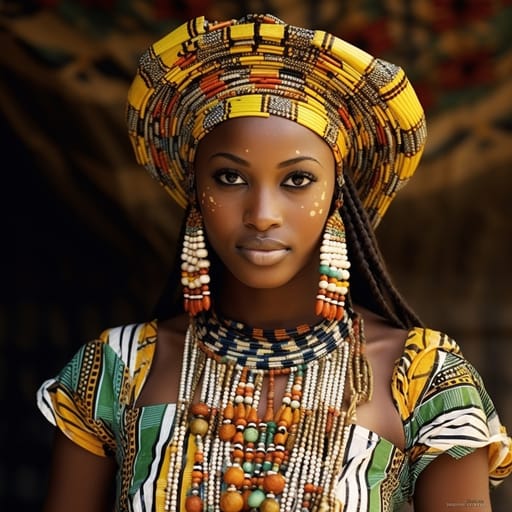
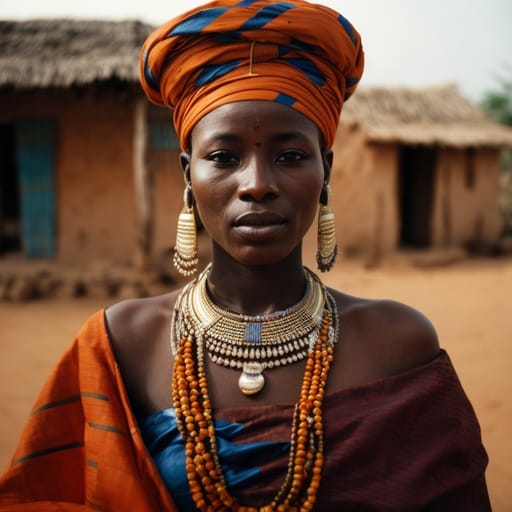
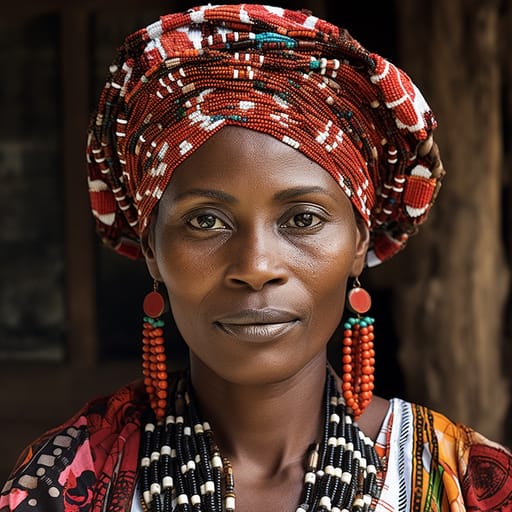
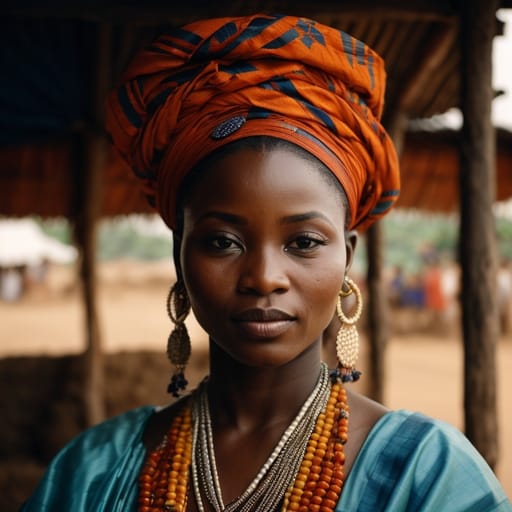
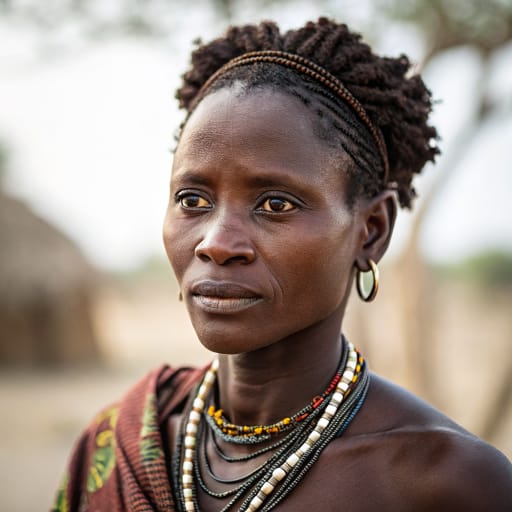
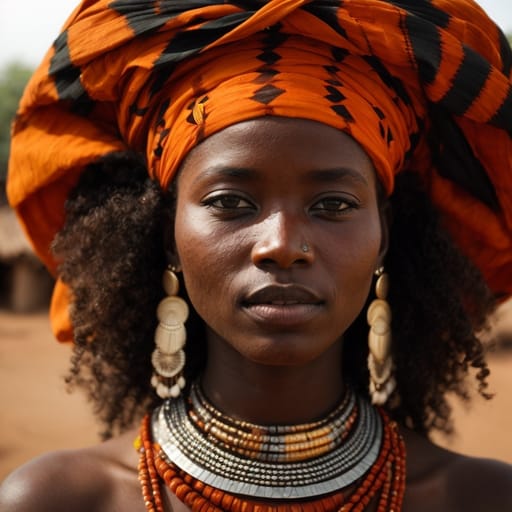
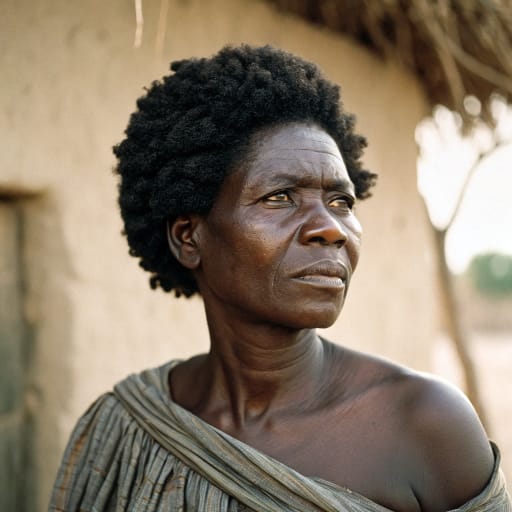
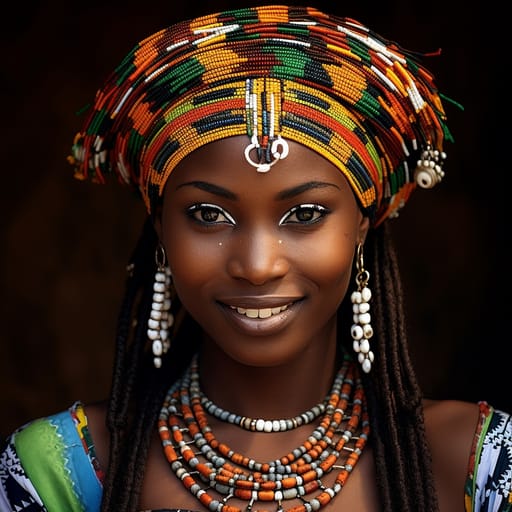
Typical Kanuri Phenotypes
Reference for AI generation: hair, eyes, skin, facial structure, build
The Kanuri phenotype sits at a Sahelian crossroads — structurally West African with clear Saharan and North-East African layering, the legacy of the Kanem-Borno Empire's long reach across the Lake Chad basin. The result is a population that reads as recognizably Sub-Saharan African but consistently leaner-featured and narrower-built than neighbouring Hausa or southern Nigerian groups.
Hair is almost uniformly black and tightly coiled — Type 4, with 4B and 4C textures dominant. Many men keep it close-cropped under a cap; women's hair is typically braided or covered, so observed texture variation is narrower than in unveiled populations. Eyes are dark brown to near-black, almond-shaped, with a flat upper lid and no epicanthic fold. Brows tend to be straight and well-defined rather than arched.
Skin tones cluster in the deep-brown to dark-brown range — Fitzpatrick V to VI — with warm reddish or coppery undertones more common than the cooler bluish-black undertones seen further south on the Nigerian coast. Sun-saturated rural complexions read noticeably darker than urban Maiduguri ones. Facial structure is the giveaway: noses are typically narrow to medium-width with a defined bridge, less broad-rooted than in Yoruba or Igbo phenotypes; lips are full but not the heaviest in the region; cheekbones sit high and the jawline is often long and tapered, producing the elongated oval face seen on figures like Kashim Shettima and Babagana Zulum.
Build runs tall and slender. Adult male stature commonly lands in the 175–183 cm range, with narrow shoulders, long limbs and low body fat — a Sahelian-pastoralist body composition closer to Tuareg or Toubou neighbours than to the stockier builds of forest-zone West Africans.
Between the two main branches, Kanembu populations north and east of Lake Chad tend to show slightly more pronounced Saharan layering — narrower noses, marginally lighter coppery skin — while the Yerwa Kanuri of Borno trend a touch darker and broader-featured from longer admixture with surrounding Nigerian groups.
Kanuri Body & Anatomy Reference
West African Niger-Congo phenotype: anatomy reference for AI nude generation
Kanuri Boobs & Breasts
Kanuri boobs follow the West African Niger-Congo profile: medium-to-large cup, full, projecting. Areolar diameter is usually 35-50mm, and the coloring is deep-brown to near-black areolar pigmentation against the medium-to-deep-brown skin tone. Breast shape tracks body composition (mesomorph with strong gluteal-femoral fat distribution, mean adult female BMI 24-27), so Kanuri breasts tend to be fuller and more projecting than the East African norm. Expect a forward-set shape, not the smaller conical Cushitic East African profile.
Kanuri Ass & Hips
Kanuri ass and hip morphology presents as wide-set, full, heavily projected glutes, distinctly different from the slim narrow-hip Cushitic East African profile. The Kanuri pelvic profile shows wide iliac crests, broad gynoid pelvic pattern, high glute-to-waist ratio, anchored in the West African Niger-Congo skeletal pattern. Kanuri butt shots in adult AI imagery should render the wide-set, full, heavily projected glutes silhouette with the overall build (mesomorph with strong gluteal-femoral fat distribution) and the fat distribution typical of the West African Niger-Congo phenotype.
Kanuri Vagina & Pussy
Kanuri pussy anatomy typically shows deep-brown to near-black labial pigmentation, fuller labia minora. Pubic hair is usually tightly-coiled coarse texture, densely distributed. In AI-generated Kanuri nudes, labial color should blend into the medium-brown to deep-brown skin with a gradual transition, and the hair should keep its tightly-coiled coarse texture.
Kanuri Dicks & Penis
Penis reference for Kanuri men: regional mean ~14-15cm erect, above-average girth, ~13cm circumference. Coloring: deep-brown-to-near-black shaft pigmentation. An accurate Kanuri cock in AI imagery matches the surrounding medium-brown to deep-brown skin rather than a generic porn default. Circumcision depends on religion and custom, not ancestry.
Kanuri Body, Curves & Build
The Kanuri figure is generally mesomorph with strong gluteal-femoral fat distribution, with mean adult female BMI 24-27, characteristic of West African Niger-Congo ancestry. AI image tools tend to flatten regional body types into a few stock shapes; here the Kanuri build is kept as its own reference.
Kanuri Skin Tone & Hair Texture
Skin: medium-brown to deep-brown (Fitzpatrick V-VI). Hair: tight 4A-4C coil, often worn natural, braided, or relaxed. Both are typical of West African Niger-Congo ancestry. The most common mistake in AI nudes of Kanuri women is a body rendered lighter than the face.
Data depth
51/100Coverage of image-grounded phenotype observations · drives AI generation diversity
- Sample size
- 23/40· 15 images
- Image quality
- 13/30· 27% high
- Confidence
- 15/20· mean 0.73
- Source diversity
- 0/10· wikipedia
- ·Modest sample (n<25)
- ·Mostly low-quality source images
- ·Wikipedia-only source, not population-representative
Observed Distribution: Image Sample
Empirical observations from analyzed photographs · supplementary signal, not population truth
Sample: 15 images analyzed (15 wikipedia). Quality: 4 high, 6 medium, 5 low, 0 very_low. Avg analyzer confidence: 0.73.
Skin tone (Fitzpatrick): V (47%), VI (53%)
Hair color: black (53%), gray/white (33%), unclear (13%)
Hair texture: coily (47%), covered (53%)
Eye color: dark brown (93%), unclear (7%)
Epicanthic fold: 0% present, 93% absent, 7% unclear
Caveats: Sample size 15 is modest, so secondary patterns may not be reliable. Quality skews toward older or low-resolution photos; phenotype detail may be lossy. Sample is 100% Wikipedia notable people, which skews toward male, public-life, and modern figures, not population-representative.
Last aggregated: May 7, 2026
Explore phenotype categories
Structured taxonomy with peer-reviewed scales · 22 anatomical categories
Notable Kanuri People
19 reference figures, sourced from Wikipedia
- Sani Abacha, former Nigerian Head of State
- Zanna Bukar Dipcharima, Nigerian First Republic politician
- Ibrahim Gaidam, former Governor of Yobe State
- Abubakar Garbai, 9th Shehu of Borno
- Abubakar Shekau, Former Nigerian militant and 2nd leader of Boko Haram
- Mohammed Laminu Mele, Current Vice-Chancellor of University of Maiduguri
- Kashim Ibrahim, former Governor of Northern Nigeria
- Waziri Ibrahim, Northern People's Congress politician and founder of Great Nigeria People's P…
- Ibrahim Imam, founder of Borno Youth Movement and former opposition leader in the Northern …
- Baba Gana Kingibe, prominent diplomat and former SGF under President Umaru Yar'Adua
- Sanda Kura, 10th Shehu of Borno
- Aliyu Mai-Bornu, 1st indigenous Governor of the Central Bank of Nigeria
- Ali Modu Sheriff, former Governor of Borno State
- Kashim Shettima, Vice-president of Nigeria and former Governor of Borno State
- Umaru Shehu, physician and academic
- Bashir Tofa, businessman and politician
- Babagana Zulum, Governor of Borno State
- Mai Mala Buni, Governor of Yobe State
- Nicholas Said, 19th-century traveller, translator, Union Army soldier and author
Erotic Poses & Sex Positions
From the pose catalog: 219 named positions with reference skeletons
Frequently asked questions about Kanuri people
Where is the Kanuri homeland?
The Kanuri homeland is Kanuriland (Nigeria, Niger, Chad, Cameroon) in Western Africa.
What language do Kanuri people speak?
Kanuri people primarily speak Nilo-Saharan / Saharan / Kanuri.
What religion do Kanuri people practice?
The predominant religion among Kanuri people is Islam.






Make your own Kanuri images
Five a day, free, no credits to buy. The studio starts from this group's phenotype data, so you can set body type, pose and style and keep the traits accurate.
Start with Kanuri