Help us get this right
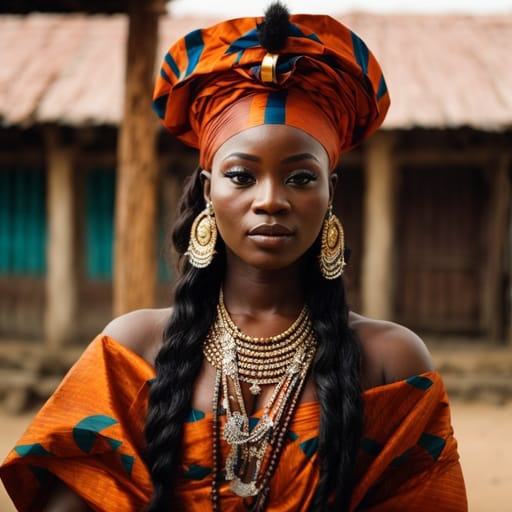
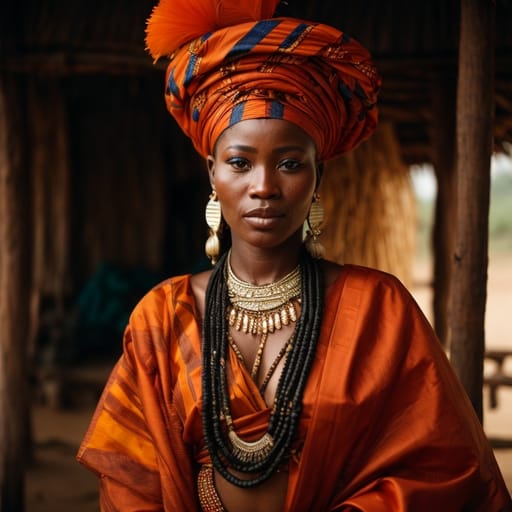
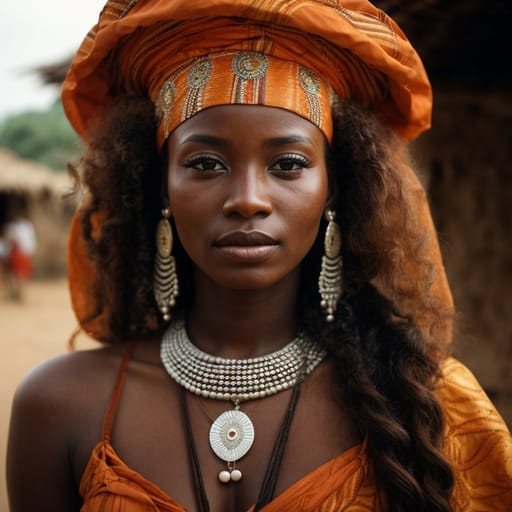
Does this portrait look right for Akan?
One tap. It takes a second and it is recorded.
2 say it looks right, 0 say it looks off.
Akan Erotic
Gold Coast (Ghana)
Christianity
Twi (including Ashanti and Akuapem), Fante, Abbé, Abidji, Ahafo, Ahanta, Akwamu, Akyem, Anyi, Aowin, Assin, Attie, Avatime, Avikam, Baoulé, Brong, Chakosi, Evalue, M'Bato, Nzema, Sefwi, Tchaman, Wassa, Abure, Alladian
About Akan People
The Akan are the people of the forest belt that runs from southeastern Côte d'Ivoire across the southern half of Ghana — gold country, cocoa country, and historically the seat of one of West Africa's most consequential pre-colonial states. What binds them across the dozens of named branches — Ashanti, Fante, Akuapem, Akyem, Brong, Nzema, Baoulé, and many more — is a shared Kwa language continuum (the varieties of Akan are largely mutually intelligible at the core, diverging at the edges), a common matrilineal kinship system, and a set of political and ritual conventions that survived colonization and still organize daily life.
The matrilineal piece is the one outsiders most often miss. Among the Akan, descent, inheritance of stools and certain property, and clan identity pass through the mother. A man's heir is traditionally his sister's son, not his own. This is not a folkloric remnant; it shapes how families are built, how chieftaincies are succeeded, and how disputes get adjudicated in the customary courts that operate in parallel with the state. Every Akan belongs to one of the eight abusua — exogamous matriclans whose membership cuts across the sub-group divisions.
The Asante (Ashanti) Confederacy, founded around 1701 under Osei Tutu and the priest-statesman Okomfo Anokye, fought the British to a standstill more than once before its incorporation in 1902, and the Golden Stool — said to have descended from the sky and to embody the soul of the nation — remains a real political object, never sat upon, never traded, the focus of a long war when a colonial governor demanded to sit on it in 1900. The Asantehene still occupies that throne in Kumasi today, and his court protocols are intact.
Most Akan are Christian — Methodist and Presbyterian along the Fante coast where European missions landed first, Catholic and Pentecostal further inland — but the older cosmology is not gone. Libations are still poured at openings of public events, day-names (Kofi, Ama, Kwame, Akosua) are still given according to the day of the week one was born, and the funeral remains the central social occasion of Akan life, often elaborate and expensive in ways that strike outsiders as disproportionate until one understands that the dead are still kin. Kente cloth, woven on narrow strip looms in towns like Bonwire, was originally restricted to royal use; the patterns carry names and proverbs, and weaving one is closer to writing than to decoration.
Related ethnic groups
Groups that share Akan's homeland, region, language, or religious tradition. These are likely candidates for comparative phenotype reference.
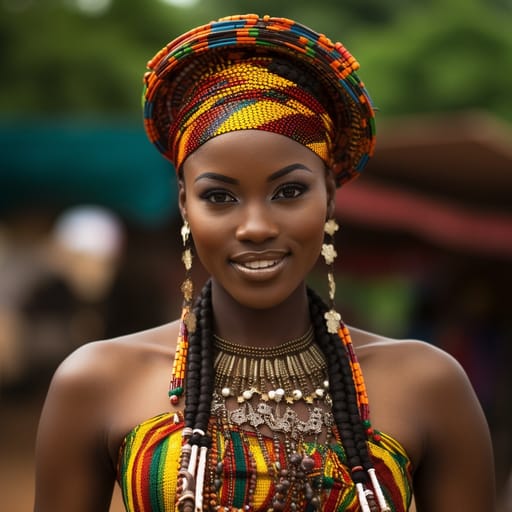
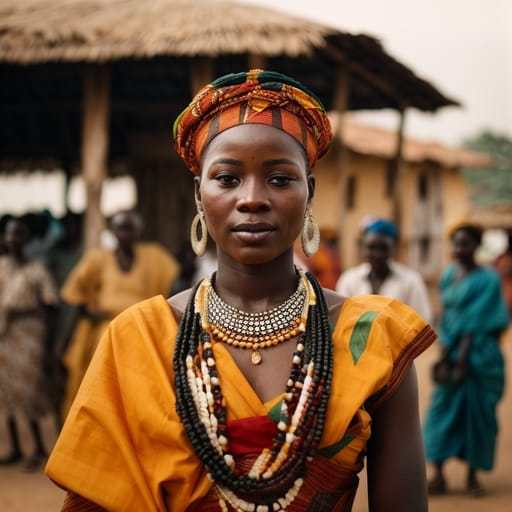
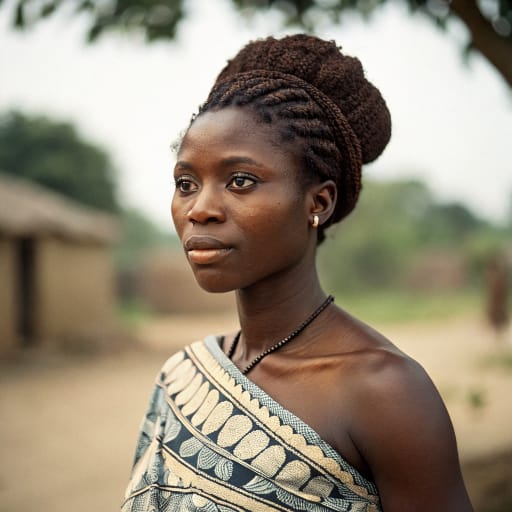
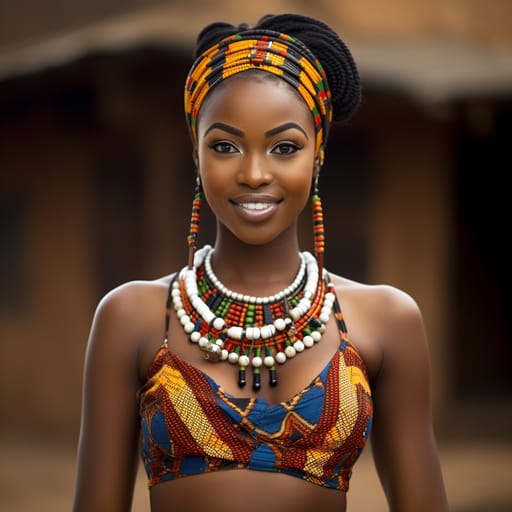
Geographic Distribution: Akan populations across 1 country
Each row is ranked by the group's share of that country's population, with the source citation drawn from published census and demographic surveys. Click through for the full per-country phenotype profile.
| Country | Share | Source |
|---|---|---|
| Ghana | 47.9% | Ghana Statistical Service 2021 Census; Akan (~47.9%, ~15M+ of ~31M+ total). Niger-Congo / Kwa source population. Sub-groups include Ashanti, Fante, Akwapim, Brong-Ahafo, plus other groups. The Akan ethnogenesis traces to the historic Akan kingdoms (Ashanti Empire ~17th-19th c. CE) |
Typical Akan Phenotypes
Reference for AI generation: hair, eyes, skin, facial structure, build
The Akan phenotype sits firmly within the West African coastal range, with the deep brown-to-very-dark skin tones, broad mid-facial structure, and tightly coiled hair characteristic of populations native to the Gulf of Guinea forest belt. Skin runs from a warm medium-brown roughly at Fitzpatrick V through to a deep near-black VI, with reddish-bronze undertones common among Ashanti and Fante communities and cooler, more neutral browns appearing in the Nzema and Ahanta zones nearer the coast. Sun exposure is constant year-round but rarely produces dramatic gradient — pigmentation is uniform across the body rather than concentrated on exposed areas.
Hair is almost universally Type 4, predominantly 4B and 4C — densely coiled, fine to medium in strand thickness, with high shrinkage. Natural color is a uniform black-brown; reddish casts under sunlight are common but true non-black hair is essentially absent. Eyes are brown to very dark brown, with no epicanthic fold; the eye opening tends toward almond with a slightly downward outer canthus, set under a moderately prominent supraorbital ridge.
Facial structure is the most identifiable feature: a wide, low-bridged nose with broad alae and forward-flared nostrils, full and well-defined lips with pronounced vermilion borders, and a strong horizontal jawline. Cheekbones sit relatively low and broad rather than high and angular — the overall face reads rounder and fuller than the more elongated faces of Sahelian groups to the north. Foreheads are typically high and smooth.
Build runs medium-tall by West African averages — men commonly 5'8" to 6'0", women 5'4" to 5'8" — with naturally muscular shoulders, strong gluteal and thigh development, and a tendency toward an hourglass or pear silhouette in women. Coastal Fante and Nzema populations skew slightly shorter and stockier than the inland Ashanti and Brong, who tend toward longer limbs and leaner frames. Blessing Afrifah's lean sprinter's build reflects the inland Akan tendency toward long-limbed athleticism rather than the broader coastal norm.
Akan Body & Anatomy Reference
West African Niger-Congo phenotype: anatomy reference for AI nude generation
Akan Boobs & Breasts
The typical Akan bust is medium-to-large cup, full, projecting, in line with the wider West African Niger-Congo pattern. Areolas usually fall in the 35-50mm range, with deep-brown to near-black areolar pigmentation against the medium-to-deep-brown skin tone. Compared with the smaller conical Cushitic East African profile, Akan breasts sit forward and are generally fuller and more projecting than the East African norm. A faithful AI render of Akan tits keeps that shape and areola size.
Akan Ass & Hips
Butt shape among Akan women: wide-set, full, heavily projected glutes, over wide iliac crests, broad gynoid pelvic pattern, high glute-to-waist ratio. This follows West African Niger-Congo ancestry and looks quite unlike the slim narrow-hip Cushitic East African profile. An accurate Akan ass in adult AI imagery keeps both the silhouette and the overall build (mesomorph with strong gluteal-femoral fat distribution) instead of a generic average.
Akan Vagina & Pussy
Vulvar anatomy among Akan women: deep-brown to near-black labial pigmentation, fuller labia minora. Pubic hair tends to be tightly-coiled coarse texture, densely distributed, in the usual inverted-triangle pattern. Both follow West African Niger-Congo pigmentation, which is why Akan pussy renders should not fall back on a pale, sparse Western template.
Akan Dicks & Penis
The Akan cock profile, from West African Niger-Congo anthropometric data: regional mean ~14-15cm erect; above-average girth, ~13cm circumference; deep-brown-to-near-black shaft pigmentation. Pubic hair has a tightly-coiled coarse texture and forms the usual inverted-V pattern. Whether Akan men are circumcised follows religious and cultural practice rather than phenotype.
Akan Body, Curves & Build
Build and curves among Akan women follow the West African Niger-Congo pattern: mesomorph with strong gluteal-femoral fat distribution, mean adult female BMI 24-27. Proportions matter as much as skin tone, so Akan figures should keep their regional height and limb ratios.
Akan Skin Tone & Hair Texture
The Akan skin range is medium-brown to deep-brown (Fitzpatrick V-VI), and hair tends to be tight 4A-4C coil, often worn natural, braided, or relaxed. That combination marks the West African Niger-Congo phenotype, and skin tone is the trait AI generators most often get wrong for Akan women.
Data depth
0/100Coverage of image-grounded phenotype observations · drives AI generation diversity
- Sample size
- 0/40· 0 images
- Image quality
- 0/30· 0% high
- Confidence
- 0/20
- Source diversity
- 0/10
- ·No image observations yet
Explore phenotype categories
Structured taxonomy with peer-reviewed scales · 22 anatomical categories
Notable Akan People
1 reference figure, sourced from Wikipedia
- Blessing Afrifah, born 2003), Israeli Olympic sprinter
Erotic Poses & Sex Positions
From the pose catalog: 219 named positions with reference skeletons
Frequently asked questions about Akan people
Where is the Akan homeland?
The Akan homeland is Gold Coast (Ghana) in Western Africa.
What countries do Akan people live in?
Akan populations are documented across 1 country: Ghana.
What language do Akan people speak?
Akan people primarily speak Niger-Congo / Kwa / Akan.
What religion do Akan people practice?
The predominant religion among Akan people is Christianity.






Make your own Akan images
Five a day, free, no credits to buy. The studio starts from this group's phenotype data, so you can set body type, pose and style and keep the traits accurate.
Start with Akan