Help us get this right
Does this portrait look right for Ga-Adangbe?
One tap. It takes a second and it is recorded.
2 say it looks right, 2 say it looks off.
Ga-Adangbe Erotic
Greater Accra (Ghana)
Christianity
Ga, Adangbe
About Ga-Adangbe People
The Ga-Adangbe are the people of Ghana's southeastern coast — the population whose villages and clan houses became the city of Accra. They are two related peoples rather than one: the Ga, concentrated around the coastal capital and the lagoons west of the Volta; and the Adangbe (also written Dangme), whose towns spread eastward through Ada, Krobo, Shai, and Osudoku toward the river. Oral tradition holds that both branches arrived from the east in successive migrations and settled the plain in clan-based townships, an organizing logic that still shapes inheritance, land tenure, and chieftaincy disputes today.
Their language, Ga-Dangme, sits inside the Kwa branch of Niger–Congo, alongside Akan and Ewe, but it is not mutually intelligible with either; Ga and Dangme themselves are close cousins rather than dialects of one tongue. Ga in particular has absorbed centuries of contact — Portuguese, Danish, Dutch, and English traders all worked the forts along this coastline — and the city dialect carries loanwords from each. Most Ga-Adangbe today are Christian, with a strong Presbyterian and Methodist presence rooted in the nineteenth-century Basel and Wesleyan missions, though indigenous practice persists alongside the church rather than under it. The annual Homowo festival of the Ga, marking the end of a remembered famine with a ritual meal of kpokpoi, is observed widely by Christian families; it is treated as cultural inheritance rather than rival religion.
The Adangbe have their own distinctive institutions, the most discussed being the Krobo dipo rite — a coming-of-age ceremony for young women that has been continually revised under missionary, colonial, and modern public-health pressure but has not disappeared. Politically, the Ga-Adangbe occupy an unusual position in Ghana: their homeland is the seat of national government and the country's commercial center, yet they are a numerical minority within it, surrounded by Akan and Ewe migration into Accra. This produces a recurring public conversation about indigenous land rights, traditional authority, and the chieftaincy of the Ga Mantse, whose stool sits at the symbolic center of the capital. The character of the group is shaped by that paradox — coastal traders and fishermen who became, almost incidentally, the hosts of a national capital, and who now hold their identity in a city that long ago outgrew them.
Related ethnic groups
Groups that share Ga-Adangbe's homeland, region, language, or religious tradition. These are likely candidates for comparative phenotype reference.
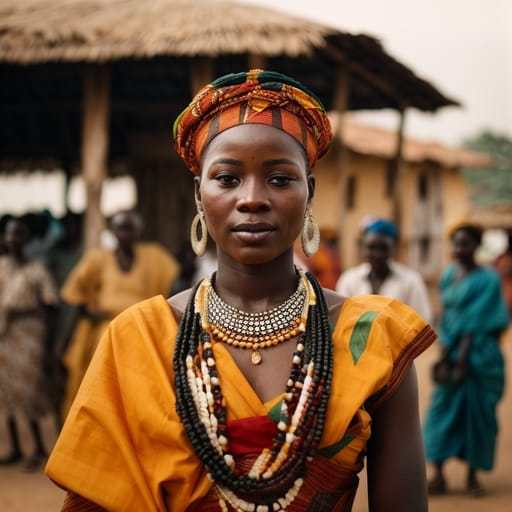
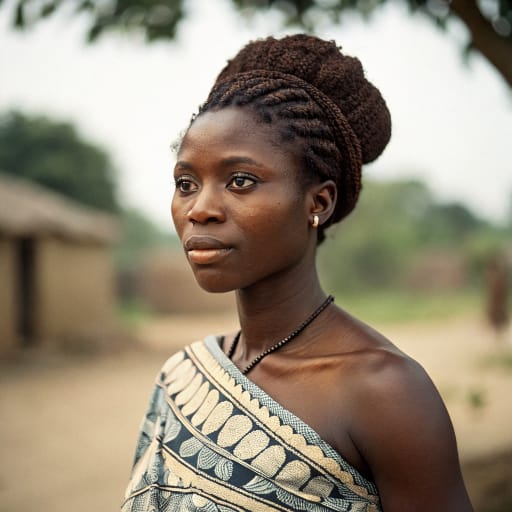
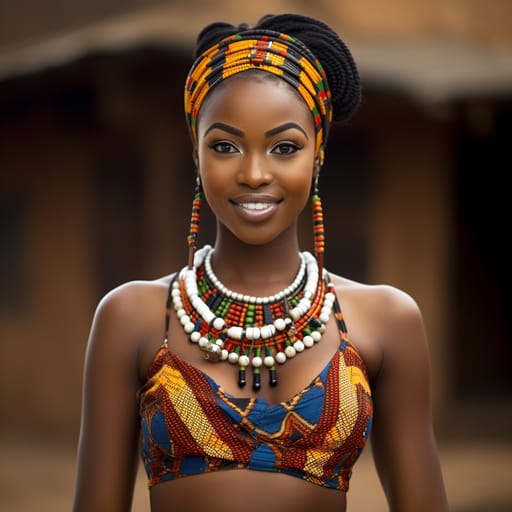
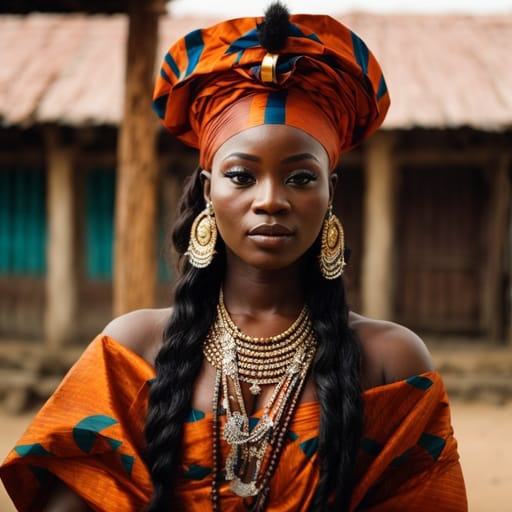
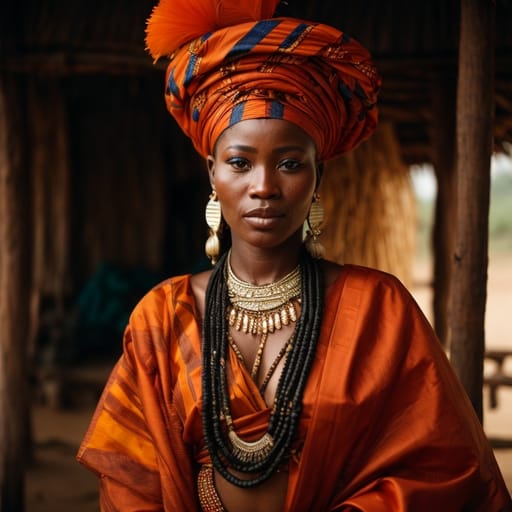
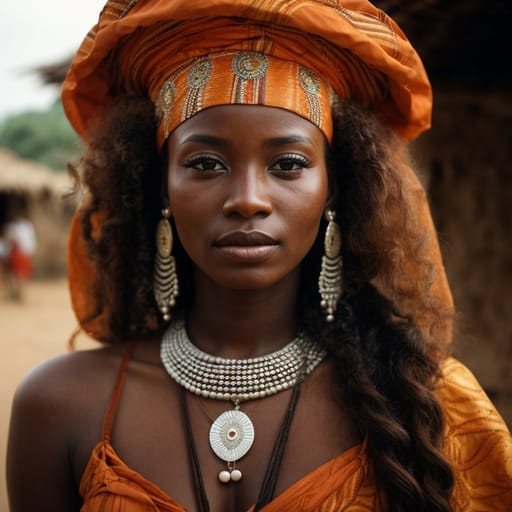
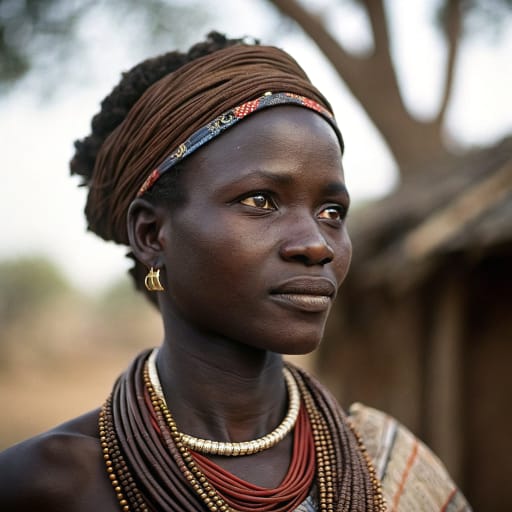
Typical Ga-Adangbe Phenotypes
Reference for AI generation: hair, eyes, skin, facial structure, build
The Ga-Adangbe phenotype belongs squarely to the West African coastal cluster, but with features that distinguish them from their inland Akan neighbors and from the Ewe to the east. Skin tones run deep — predominantly Fitzpatrick V to VI, with warm reddish-brown to near-black undertones. The very dark, blue-black register seen in figures like Azumah Nelson is common among coastal fishing-community lineages, while merchant and mixed-heritage families along the Accra littoral sometimes carry lighter sienna and copper tones, a legacy of centuries of Euro-African contact reflected in historical figures like Carl Christian Reindorf.
Hair is uniformly Type 4 — tightly coiled, often 4B to 4C, with high shrinkage and dense follicular packing. Natural color is jet black; graying tends to come late. Eyes are almost always deep brown to near-black, set under a flat or only mildly developed brow ridge, with no epicanthic fold and rounded almond shapes. Lashes are typically thick and curled.
Facial structure is the most identifiable signature. Ga-Adangbe faces tend toward a broader, more rounded cranial profile than the longer Akan oval, with prominent malar bones, a relatively short midface, and a strong, square jaw — visible across performers like Shatta Wale and boxers like Ike Quartey and Joshua Clottey. Noses are broad-based with low-to-medium bridges and full alar wings; lips are full to very full, with a well-defined vermilion border and often a pronounced lower lip.
Build trends compact and densely muscled rather than tall and slender. Average male stature sits around 170–175 cm — shorter than the Sahelian average — but with thick limb girth, broad shoulders, and powerful posterior chains, a build pattern that has translated into Ga-Adangbe overrepresentation in Ghanaian boxing. Women carry curvier, hourglass distributions with fuller hips and thighs.
Phenotype differences between the Ga (Accra-centered, more coastal-trader admixture) and the Adangbe (Ada, Krobo, Shai — slightly inland) are subtle: Adangbe lineages skew marginally taller and longer-faced, Ga lineages rounder-featured and more compact.
Ga-Adangbe Body & Anatomy Reference
Anatomy by feature, West African Niger-Congo phenotype
Ga-Adangbe Boobs & Breasts
The typical Ga-Adangbe bust is medium-to-large cup, full, projecting, in line with the wider West African Niger-Congo pattern. Areolas usually fall in the 35-50mm range, with deep-brown to near-black areolar pigmentation against the medium-to-deep-brown skin tone. Compared with the smaller conical Cushitic East African profile, Ga-Adangbe breasts sit forward and are generally fuller and more projecting than the East African norm. A faithful AI render of Ga-Adangbe tits keeps that shape and areola size.
Ga-Adangbe Ass & Hips
Butt shape among Ga-Adangbe women: wide-set, full, heavily projected glutes, over wide iliac crests, broad gynoid pelvic pattern, high glute-to-waist ratio. This follows West African Niger-Congo ancestry and looks quite unlike the slim narrow-hip Cushitic East African profile. An accurate Ga-Adangbe ass in adult AI imagery keeps both the silhouette and the overall build (mesomorph with strong gluteal-femoral fat distribution) instead of a generic average.
Ga-Adangbe Vagina & Pussy
Vulvar anatomy among Ga-Adangbe women: deep-brown to near-black labial pigmentation, fuller labia minora. Pubic hair tends to be tightly-coiled coarse texture, densely distributed, in the usual inverted-triangle pattern. Both follow West African Niger-Congo pigmentation, which is why Ga-Adangbe pussy renders should not fall back on a pale, sparse Western template.
Ga-Adangbe Dicks & Penis
The Ga-Adangbe cock profile, from West African Niger-Congo anthropometric data: regional mean ~14-15cm erect; above-average girth, ~13cm circumference; deep-brown-to-near-black shaft pigmentation. Pubic hair has a tightly-coiled coarse texture and forms the usual inverted-V pattern. Whether Ga-Adangbe men are circumcised follows religious and cultural practice rather than phenotype.
Ga-Adangbe Body, Curves & Build
Build and curves among Ga-Adangbe women follow the West African Niger-Congo pattern: mesomorph with strong gluteal-femoral fat distribution, mean adult female BMI 24-27. Proportions matter as much as skin tone, so Ga-Adangbe figures should keep their regional height and limb ratios.
Ga-Adangbe Skin Tone & Hair Texture
The Ga-Adangbe skin range is medium-brown to deep-brown (Fitzpatrick V-VI), and hair tends to be tight 4A-4C coil, often worn natural, braided, or relaxed. That combination marks the West African Niger-Congo phenotype, and skin tone is the trait AI generators most often get wrong for Ga-Adangbe women.
Data depth
79/100Coverage of image-grounded phenotype observations · drives AI generation diversity
- Sample size
- 34/40· 35 images
- Image quality
- 30/30· 69% high
- Confidence
- 15/20· mean 0.75
- Source diversity
- 0/10· wikipedia
- ·Wikipedia-only source, not population-representative
Observed Distribution: Image Sample
Empirical observations from analyzed photographs · supplementary signal, not population truth
Sample: 35 images analyzed (35 wikipedia). Quality: 24 high, 6 medium, 3 low, 1 very_low. Avg analyzer confidence: 0.75.
Skin tone (Fitzpatrick): IV (6%), V (29%), VI (54%), unclear (11%)
Hair color: black (51%), gray/white (31%), dark brown (3%), unclear (14%)
Hair texture: straight (9%), wavy (9%), coily (63%), bald (3%), covered (6%), unclear (11%)
Eye color: dark brown (83%), unclear (17%)
Epicanthic fold: 0% present, 83% absent, 17% unclear
Caveats: Sample is 100% Wikipedia notable people, which skews toward male, public-life, and modern figures, not population-representative.
Last aggregated: May 7, 2026
Explore phenotype categories
Structured taxonomy with peer-reviewed scales · 22 anatomical categories
Notable Ga-Adangbe People
54 reference figures, sourced from Wikipedia
- Ebenezer Ako-Adjei, was a lawyer and politician, who served as foreign minister and in other lead…
- Tetteh Quarshie, was a pre-independence agriculturalist and the person directly responsible fo…
- Carl Christian Reindorf, was a Euro-African-born pioneer historian, teacher, farmer, trader, physician…
- Nii Tackie Tawiah III, was the monarch of the Ga State from 2006 to 2012.
- John William Hansen, popularly known as Jerry Hansen, was a highlife musician. He was a singer, co…
- Queen Asabia Cropper, is regarded as a pioneering figure in Ghanaian highlife, recognised for her w…
- Mustapha Tettey Addy, traditional drummer & composer (b. 1942)
- Nii Quaynor, born 1945) is a scientist and engineer who has played an important role in th…
- Ashitey Trebi-Ollennu, is a Ghanaian robotics engineer at NASA, serving as the chief engineer and te…
- Victor B. Lawrence, is a renowned electrical engineer recognized for his groundbreaking work in s…
- Shirley Ayorkor Botchwey, Honourable Shirley Ayorkor Botchwey (born 8 February 1963) is a Ghanaian dipl…
- Raphael Nii Amaa Ollennu, JSC, FGA (21 May 1906 to 22 December 1986) was a jurist and judge who became …
- Obo Addy, traditional and contemporary drummer, composer and educator; NEA National Her…
- Yacub Addy, traditional drummer, composer, choreographer and educator: NEA National Herit…
- Christian Tsui Hesse, popularly known as Chris Hesse (born 29 August 1932) is a cinematographer, fi…
- Atukwei John Okai, was a poet, cultural activist, and an academic. He was Secretary-General of t…
- Ernestina Naadu Mills, is an educator and a former First Lady of Ghana. She was the wife of Presiden…
- Rebecca Akufo-Addo, is a public figure and a First Lady of Ghana. She is the wife of President Na…
- Ayi Kwei Armah, writer (b. 1939)
- Alice Annum, aka the original "Baby Jet" (b. 1948) was also the first woman to represent G…
- Nii Ayikwei Parkes, is a performance poet, writer, publisher, and sociocultural commentator. He i…
- Emmanuel Tettey Mensah, aka E. T. Mensah, musician (1919-1996) who was regarded as the "King of Highl…
- King Bruce, 3 June 1922 to 12 September 1997), a composer, band leader, musician, arrange…
- Shatta Wale, Born Charles Nii Armah Mensah Jr., a Ghanaian musician, songwriter, and produ…
- Saka Acquaye, a musician, playwright, sculptor and textile designer. He founded the African…
- Grace Nortey, is an actress who played multi-character lead roles on Ghanaian television in…
- Mac Jordan Amartey, was a popular actor.
- Emmanuel Armah, is a retired football defender. He played for Hearts of Oak in Ghana, except …
- Augustine Abbey, also known as Idikoko, is an actor and movie maker known for comedy. He is al…
- Theresa Amerley Tagoe, Minister of Parliament (1943-2010)
- Azumah "The Professor" Nelson, boxer (b. 1958)
- Neville Alexander Odartey-Wellington, army commander
- Nii Amaa Ollennu, former Interim President of Ghana (1906-1986)
- Ike "Bazooka" Quartey, boxer (b. 1969)
- Ben Tackie, boxer (b. 1973)
- George Commey Mills-Odoi, first Ghanaian Attorney General of Ghana; Justice of Supreme Court of Ghana (…
- Ebenezer Akuete, former diplomat
- Joshua Clottey, boxer, Former IBF Welterweight Champion.
- Richard Commey, boxer, International Boxing Federation (IBF) Lightweight World Champion
- Daniel McKorley, the founder and chief executive officer of McDan Group of Companies
- Lesley Naa Norle Lokko, is a Ghanaian-Scottish architect, academic, and novelist.
- Adjetey Anang, actor, popularly known as "Pusher", which was his screen name in the televisi…
- Nii Addo Quaynor, a rapper better known by his stage name Tinny.
- Boris Frederic Cecil Tay-Natey Ofuatey-Kodjoe, better known as Boris Kodjoe, is an Austrian-born actor of German and Ghanaia…
- Abraham Nii Attah, . He made his feature film debut in Beasts of No Nation (2015). For his leadi…
- Joselyn Dumas, television show host and actress
- Naa Ashorkor Mensah-Doku, actress, radio/TV broadcaster and public relations professional
- Yvonne Nelson, actress, model, film producer and entrepreneur
- Chris Attoh, is an actor, on-air personality, television presenter and producer. He is bes…
- Theophilus Tagoe, popularly known as Castro or Castro Under Fire is a hiplife recording artist …
- Nii Kwate Owoo, born 1944) is an academic and filmmaker, described by Variety as "one of the …
- Eddie Nartey, born 6 November 1984) is an actor, director, and film producer. His supportin…
- Nii Okai, is a contemporary gospel singer and choir leader.
- Danny Nettey, was a musician and songwriter. He was best described as one of the pioneers o…
Erotic Poses & Sex Positions
From the pose catalog: 219 named positions with reference skeletons
Frequently asked questions about Ga-Adangbe people
Where is the Ga-Adangbe homeland?
The Ga-Adangbe homeland is Greater Accra (Ghana) in Western Africa.
What language do Ga-Adangbe people speak?
Ga-Adangbe people primarily speak Niger-Congo / Kwa / Ga-Dangme.
What religion do Ga-Adangbe people practice?
The predominant religion among Ga-Adangbe people is Christianity.






Make your own Ga-Adangbe images
Five a day, free, no credits to buy. The studio starts from this group's phenotype data, so you can set body type, pose and style and keep the traits accurate.
Start with Ga-Adangbe