Help us get this right
Does this portrait look right for Baoulé?
One tap. It takes a second and it is recorded.
1 says it looks right, 0 say it looks off.
Baoulé Erotic
Central Côte d'Ivoire (Bouaké region, between the Comoé and Bandama rivers)
Akan traditional religion and Christianity, with some Islam
Akan (related to Ashanti and Agni)
About Baoulé People
Baoulé (also spelled Baule) are one of the largest ethnic groups in Côte d'Ivoire, numbering several million and living mainly in the center of the country between the Comoé and Bandama rivers, around the city of Bouaké. They belong to the wider Akan family and speak Baoulé, a Kwa language of the Niger-Congo phylum. Oral tradition traces their origin to a westward migration from the Asante lands of present-day Ghana in the eighteenth century, led by the queen Abla Pokou, whose sacrifice at a swollen river gives the people their name.
Society and subsistence
Baoulé society is organized around matrilineal descent, with inheritance and succession passing through the mother's line. Villages are led by chiefs advised by elders, and gold long served as a marker of wealth and authority. The economy rests on farming: yams and cassava for subsistence, and cocoa and coffee as cash crops that have made the region agriculturally important. Craft traditions are highly developed, including gold casting by the lost-wax method, weaving, and woodcarving. As one of the most numerous peoples of Côte d'Ivoire, the Baoulé have also held a prominent place in the country's political and economic life.
Art and belief
The Baoulé are internationally known for their sculpture. Carvers produce refined portrait masks, seated ancestor and spirit figures, and the blolo bian and blolo bla, carved spirit spouse figures believed to represent a partner in the other world. Religious life blends veneration of ancestors and nature spirits with widespread Christianity and, in places, Islam.
Appearance and adornment
In daily life most Baoulé wear printed wax cloth and modern clothing, while festivals bring out woven and wax-print wrappers worn over one shoulder together with gold ornaments. Cast-gold pendants, rings, and beads signal status, and women wear gold earrings and strings of beads. Older generations sometimes bear discreet facial scarification. The combination of goldwork, patterned cloth, and refined carving gives Baoulé visual culture its distinctive character.
Related ethnic groups
Groups that share Baoulé's homeland, region, language, or religious tradition. These are likely candidates for comparative phenotype reference.
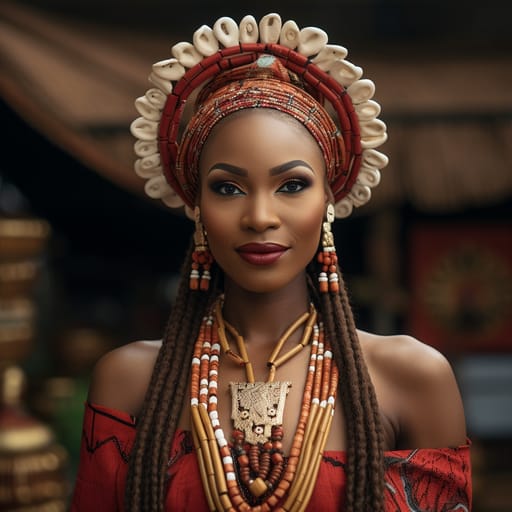
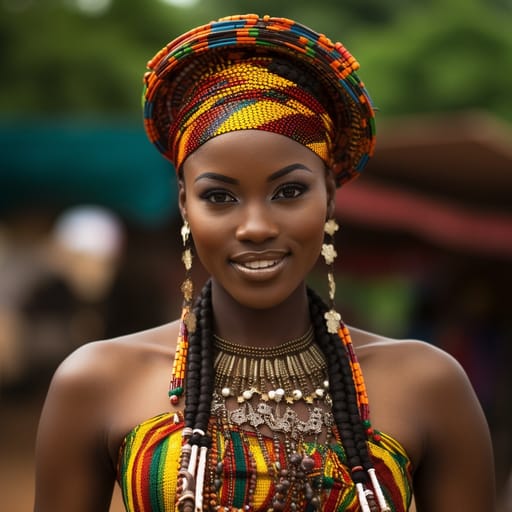
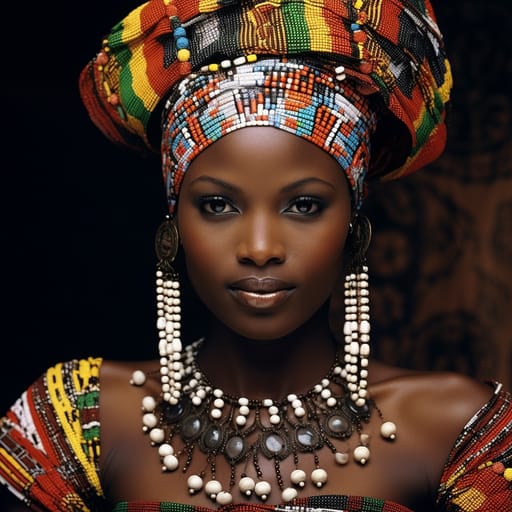
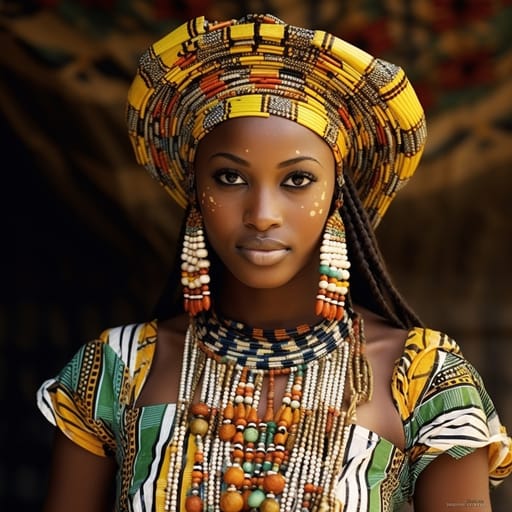
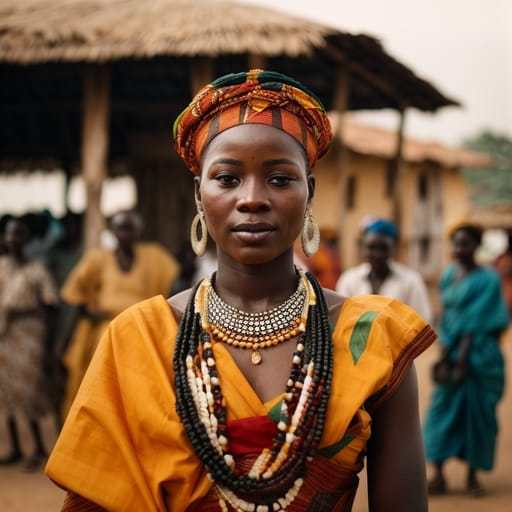
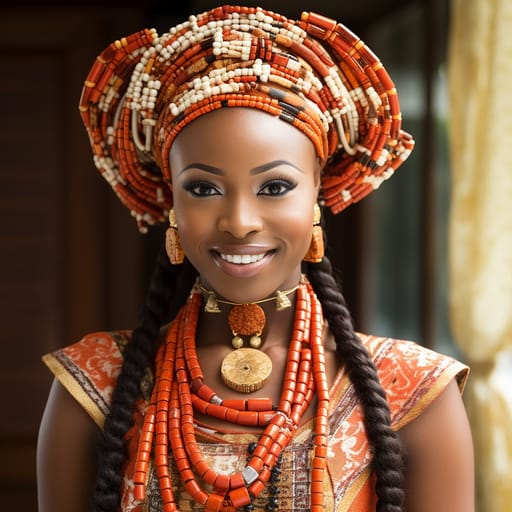
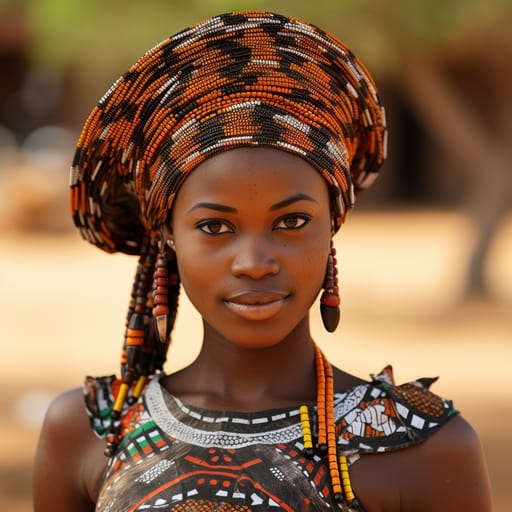
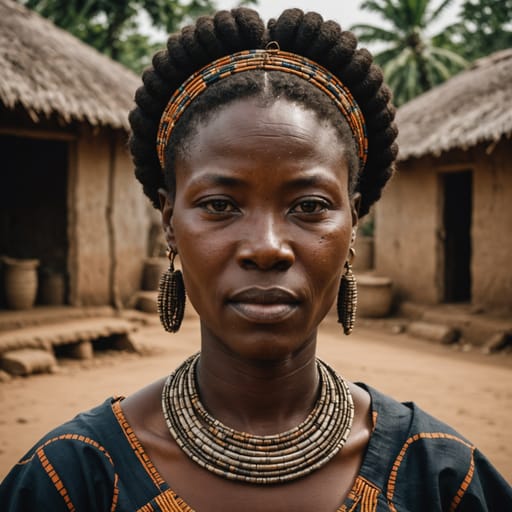
Typical Baoulé Phenotypes
Reference for AI generation: hair, eyes, skin, facial structure, build
Baoulé Body & Anatomy Reference
Anatomy by feature, West African Niger-Congo phenotype
Baoulé Boobs & Breasts
Baoulé tits and boobs run medium-to-large cup, full, projecting, the classic West African Niger-Congo bust profile. Baoulé nipples and areolas show deep-brown to near-black areolar pigmentation against the medium-to-deep-brown skin tone, with areolar diameter typically in the 35-50mm range and forward-set positioning rather than the smaller conical Cushitic East African profile. Baoulé breasts trend fuller and more projecting than the East African norm, a function of the mesomorph with strong gluteal-femoral fat distribution body habitus and the mean adult female BMI 24-27. For anatomically accurate AI-generated Baoulé nudes the render preserves the medium-to-large cup, full, projecting shape, 35-50mm areolas with deep-brown to near-black pigmentation, and the torso proportions of the West African Niger-Congo phenotype.
Baoulé Ass & Hips
Baoulé hips and butt usually read as wide-set, full, heavily projected glutes. The skeletal base is wide iliac crests, broad gynoid pelvic pattern, high glute-to-waist ratio, the West African Niger-Congo pattern. Set against the slim narrow-hip Cushitic East African profile, the difference is easy to see, and the hip-to-waist ratio is often what identifies Baoulé women in photos.
Baoulé Vagina & Pussy
Expect deep-brown to near-black labial pigmentation, fuller labia minora on Baoulé women, in keeping with West African Niger-Congo ancestry. The pubic hair is tightly-coiled coarse texture, densely distributed. Coloring should run evenly from the medium-brown to deep-brown skin of the thighs to the labia, and Baoulé nude imagery should keep the hair's tightly-coiled coarse texture.
Baoulé Dicks & Penis
Baoulé dick and penile anatomy in adult AI generation should anchor on the regional reference data: regional mean ~14-15cm erect, above-average girth, ~13cm circumference, and deep-brown-to-near-black shaft pigmentation. The Baoulé cock profile reflects the West African Niger-Congo population's anthropometric measurements. The shaft pigmentation should track the surrounding medium-brown to deep-brown skin tone, and the pubic hair should keep its tightly-coiled coarse texture in the typical inverted-V escutcheon.
Baoulé Body, Curves & Build
Baoulé body type: mesomorph with strong gluteal-femoral fat distribution, with mean adult female BMI 24-27. This is the typical West African Niger-Congo build. Height range, shoulder-to-hip ratio and fat distribution all follow from it, which is what an accurate Baoulé nude body should show.
Baoulé Skin Tone & Hair Texture
Baoulé skin tone falls in the medium-brown to deep-brown (Fitzpatrick V-VI) band, the surface signal most often miscalibrated by generic AI nude generators. Baoulé hair texture is typically tight 4A-4C coil, often worn natural, braided, or relaxed, characteristic of the West African Niger-Congo phenotype. In Baoulé nude renders the skin should hold that band consistently across the body.
Explore phenotype categories
Structured taxonomy with peer-reviewed scales · 22 anatomical categories
Notable Baoulé People
1 reference figure, sourced from Wikipedia
- Blessing Afrifah, Israeli Olympic sprinter
Erotic Poses & Sex Positions
From the pose catalog: 219 named positions with reference skeletons
Frequently asked questions about Baoulé people
Where is the Baoulé homeland?
The Baoulé homeland is Central Côte d'Ivoire (Bouaké region, between the Comoé and Bandama rivers) in Western Africa.
What language do Baoulé people speak?
Baoulé people primarily speak Baoulé (Niger-Congo, Kwa, Akan).
What religion do Baoulé people practice?
The predominant religion among Baoulé people is Akan traditional religion and Christianity, with some Islam.






Make your own Baoulé images
Five a day, free, no credits to buy. The studio starts from this group's phenotype data, so you can set body type, pose and style and keep the traits accurate.
Start with Baoulé