Help us get this right
Does this portrait look right for Louisiana Creoles?
One tap. It takes a second and it is recorded.
1 says it looks right, 0 say it looks off.
Louisiana Creoles Erotic
Southern Louisiana, United States, centered on New Orleans, the river parishes, the Cane River area near Natchitoches, and the southwest prairies, with large communities in Texas, California and Illinois.
Louisiana Creole or Kouri-Vini (French-lexifier creole), Louisiana French (Indo-European, Romance), English
Predominantly Roman Catholic, with folk devotional practice alongside it
Creoles of color and the historic gens de couleur libres, white Creole families of French and Spanish descent, Cane River Creoles of Isle Brevelle, prairie Creoles of southwest Louisiana
About Louisiana Creoles People
Creole began as a word about birthplace rather than ancestry: born in the colony, not shipped to it. In Louisiana it hardened into an identity, carried by families descended from the colony's French, Spanish, West African and Native ancestors in nearly every combination the eighteenth century produced. Spanish rule mattered enormously here, because Spanish law allowed enslaved people to purchase their own freedom, and the free population of color that grew under it became propertied, literate, Catholic and organized. In 1809 that community absorbed thousands of refugees from the Haitian Revolution arriving by way of Cuba, which roughly doubled the size of New Orleans and deepened its French and Creole-speaking side. The United States bought Louisiana in 1803 and then spent a century dismantling the three-tier social order it found there. Creoles of color fought back in court: the Comité des Citoyens, a group of downtown New Orleans Creoles, recruited Homer Plessy and financed the case that became Plessy v. Ferguson in 1896, and lost. What followed was the one-drop rule, Jim Crow, and a long migration out to Houston, Los Angeles and Chicago that scattered Creole families and made the word portable. Ask ten Creoles today what it means and you will get ten genealogies, not a definition.
Home ground is the lower Mississippi and the country around it: the downtown wards of New Orleans, the river parishes, Pointe Coupee, the Cane River settlement at Isle Brevelle below Natchitoches, and the southwest prairies. Two French-derived languages live here and get confused constantly. Louisiana French is French. Kouri-Vini, the Louisiana Creole language, is its own creole, French in vocabulary and not in grammar, closer in kind to Haitian Creole than to anything spoken in France. English-only schooling after 1921 nearly finished both, though Kouri-Vini has had a serious revival since the 2000s, with dictionaries, classes and a young cohort of learners working largely online. Catholicism is the default, and it shows up on the calendar more than in doctrine: saints' names, godparent ties that function as real kinship, and Toussaint on the first of November, when families clean and whitewash the tombs and stand around them into the evening. Music is the other public marker. Zydeco is Creole, not Cajun, built on accordion and rubboard by prairie players like Clifton Chenier out of the older house dances people called la-la.
Related ethnic groups
Groups that share Louisiana Creoles's homeland, region, language, or religious tradition. These are likely candidates for comparative phenotype reference.

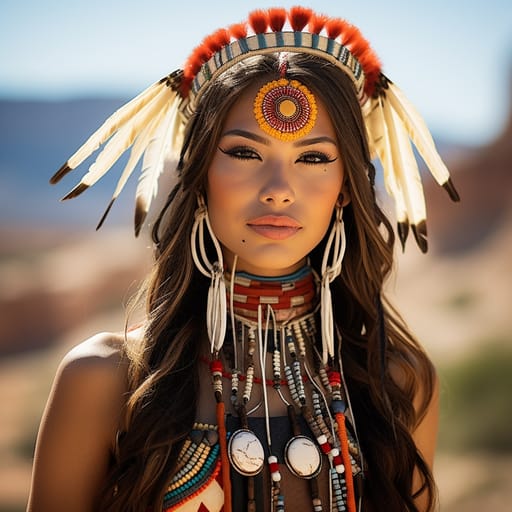
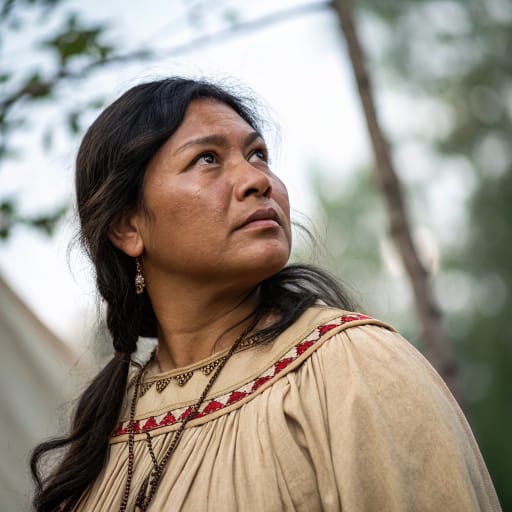
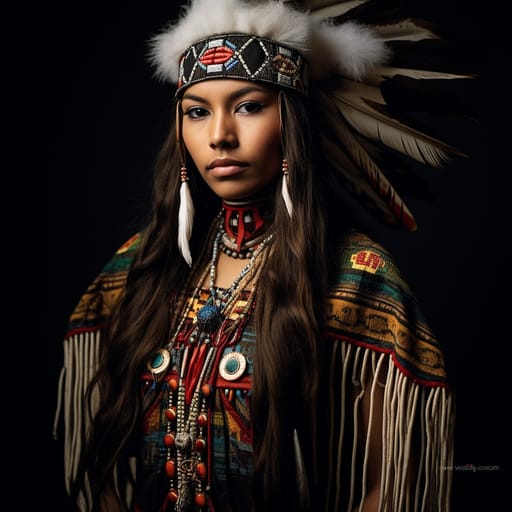

Typical Louisiana Creoles Phenotypes
Reference for AI generation: hair, eyes, skin, facial structure, build
Louisiana Creoles Body & Anatomy Reference
Per-feature anatomical profile for AI nude generation: Indigenous Northern American / Algonquian-Iroquoian phenotype
Louisiana Creoles Boobs & Breasts
Louisiana Creoles tits and boobs run medium cup, moderate projection, the classic Indigenous Northern American / Algonquian-Iroquoian bust profile. Louisiana Creoles nipples and areolas show medium-brown areolar pigmentation against the copper-to-medium-brown skin tone, with areolar diameter typically in the 30-44mm range and forward-set positioning rather than the smaller East Asian bust. Louisiana Creoles breasts trend full and moderate projection, a function of the mesomorph, broader frame in northern Indigenous populations body habitus and the mean adult female BMI 25-28. For anatomically accurate AI-generated Louisiana Creoles nudes the render preserves the medium cup, moderate projection shape, 30-44mm areolas with medium-brown pigmentation, and the torso proportions of the Indigenous Northern American / Algonquian-Iroquoian phenotype.
Louisiana Creoles Ass & Hips
Louisiana Creoles hips and butt usually read as medium, moderate-to-full projection. The skeletal base is medium iliac crests, the Indigenous Northern American / Algonquian-Iroquoian pattern. Set against the slim East Asian narrow-hip profile, the difference is easy to see, and the hip-to-waist ratio is often what identifies Louisiana Creoles women in photos.
Louisiana Creoles Vagina & Pussy
Expect medium-brown labial pigmentation on Louisiana Creoles women, in keeping with Indigenous Northern American / Algonquian-Iroquoian ancestry. The pubic hair is straight medium-coarse texture. Coloring should run evenly from the copper to medium-brown skin of the thighs to the labia, and Louisiana Creoles nude imagery should keep the hair's straight medium-coarse texture.
Louisiana Creoles Dicks & Penis
Louisiana Creoles dick and penile anatomy in adult AI generation should anchor on the regional reference data: regional mean ~13cm erect, moderate girth, and medium-brown shaft pigmentation. The Louisiana Creoles cock profile reflects the Indigenous Northern American / Algonquian-Iroquoian population's anthropometric measurements. The shaft pigmentation should track the surrounding copper to medium-brown skin tone, and the pubic hair should keep its straight medium-coarse texture in the typical inverted-V escutcheon.
Louisiana Creoles Body, Curves & Build
Louisiana Creoles body type: mesomorph, broader frame in northern Indigenous populations, with mean adult female BMI 25-28. This is the typical Indigenous Northern American / Algonquian-Iroquoian build. Height range, shoulder-to-hip ratio and fat distribution all follow from it, which is what an accurate Louisiana Creoles nude body should show.
Louisiana Creoles Skin Tone & Hair Texture
Louisiana Creoles skin tone falls in the copper to medium-brown (Fitzpatrick III-V) band, the surface signal most often miscalibrated by generic AI nude generators. Louisiana Creoles hair texture is typically straight 1A, dark-brown to black, often thick and dense, characteristic of the Indigenous Northern American / Algonquian-Iroquoian phenotype. In Louisiana Creoles nude renders the skin should hold that band consistently across the body.
Explore phenotype categories
Structured taxonomy with peer-reviewed scales · 22 anatomical categories
Erotic Poses & Sex Positions
From the pose catalog: 219 named positions with reference skeletons
Frequently asked questions about Louisiana Creoles people
Where is the Louisiana Creoles homeland?
The Louisiana Creoles homeland is Southern Louisiana, United States, centered on New Orleans, the river parishes, the Cane River area near Natchitoches, and the southwest prairies, with large communities in Texas, California and Illinois. in North America.
What language do Louisiana Creoles people speak?
Louisiana Creoles people primarily speak Louisiana Creole or Kouri-Vini (French-lexifier creole), Louisiana French (Indo-European, Romance), English.
What religion do Louisiana Creoles people practice?
The predominant religion among Louisiana Creoles people is Predominantly Roman Catholic, with folk devotional practice alongside it.






Make your own Louisiana Creoles images
Five a day, free, no credits to buy. The studio starts from this group's phenotype data, so you can set body type, pose and style and keep the traits accurate.
Start with Louisiana Creoles